


More news on this day
A newly updated United States travel advisory for the United Arab Emirates is casting a shadow over Etihad Airways’ just-launched Calgary–Abu Dhabi service, raising fresh questions for Western Canadian travelers weighing long-haul itineraries that cross a tense regional landscape.
Get the latest news straight to your inbox!
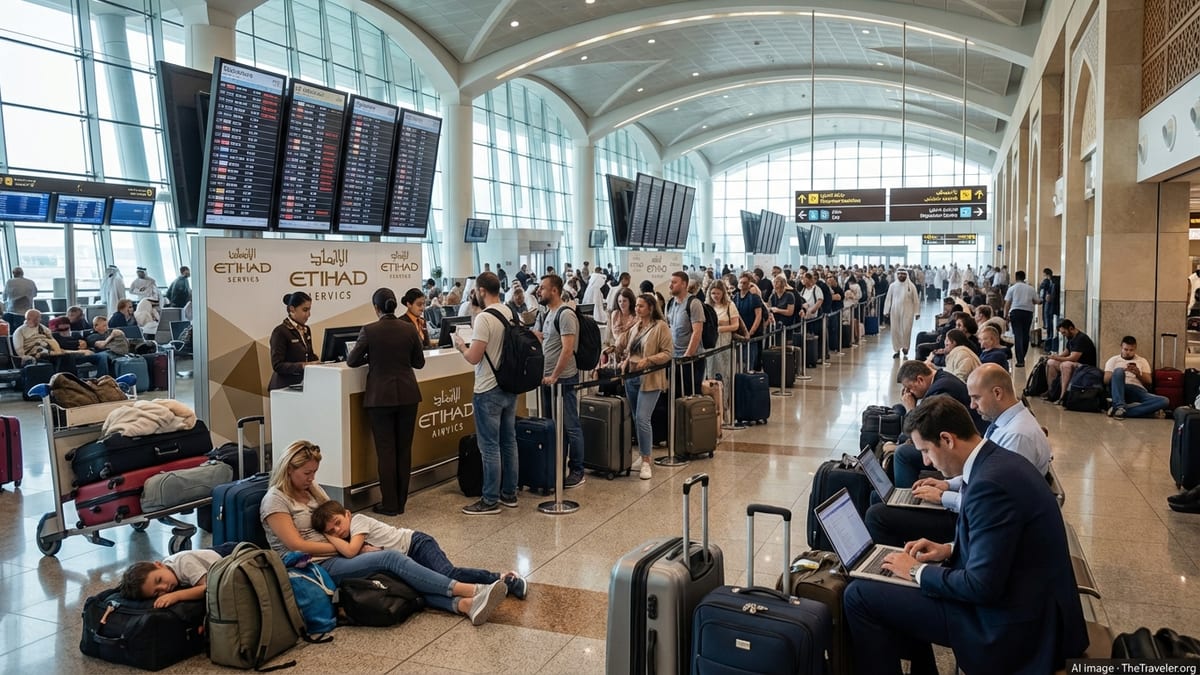
Long-awaited Calgary link debuts amid regional tension
Etihad’s new nonstop between Calgary International Airport and Abu Dhabi marks the carrier’s second Canadian destination and its westernmost gateway in North America. The airline’s own launch material highlights the route as a key plank in its growth strategy, positioning Abu Dhabi’s Zayed International Airport as a one-stop hub from Western Canada to South Asia, Africa and the wider Middle East.
Industry data cited in recent coverage indicates that the Abu Dhabi flight is now among the longest nonstop services from Calgary, joining an expanding roster of transatlantic and transpacific links that has steadily elevated the airport’s profile as a mid-continent connecting hub. For travelers in Alberta, Saskatchewan and parts of British Columbia, the new routing offers the possibility of shaving several hours off journeys that previously required backtracking via Toronto or a European gateway.
The timing, however, places the route launch squarely against a backdrop of regional instability. Middle East tensions have repeatedly disrupted air corridors in recent months, with airspace closures and precautionary suspensions periodically affecting flights into and out of Gulf hubs. Publicly available notices from regulators and airlines have underscored that routings may change at short notice in response to shifting risk assessments.
Despite these headwinds, Abu Dhabi’s main airport remains operational, and Etihad continues to promote the Calgary service as part of a wider network serving about 80 global destinations. The message from the carrier’s public communications stresses network resilience and connectivity even as governments update their security guidance for the region.
US advisory highlights security risks in UAE and regional airspace
The latest United States travel advisory for the United Arab Emirates reiterates a range of security concerns tied to wider Gulf and Arabian Peninsula dynamics. Publicly available information from the advisory notes the risk of terrorist activity targeting Western interests in the region and references prior attacks on civilian aviation infrastructure in neighboring states.
The same advisory points to long-running disputes involving nearby airspace and notes that armed groups have previously targeted airports and critical infrastructure. While the guidance does not single out Etihad’s Calgary route, the broad language around aviation safety and regional hostilities is likely to factor into how risk-averse travelers perceive new services connecting North America to the Gulf.
In parallel, US regulatory records show that Etihad has come under scrutiny in the past for operating flights through airspace that US authorities had restricted for American operators. A 2024 enforcement order from the US Department of Transportation outlined how the airline, while carrying a US partner’s code on certain flights, entered airspace covered by a Federal Aviation Administration prohibition linked to security fears. The case has since been closed with a settlement, but it remains part of the public record shaping perceptions of compliance culture and route planning.
Current US guidance does not ban Americans from transiting Abu Dhabi, and there is no public indication of a specific prohibition on using the new Calgary service. Even so, the combination of an elevated advisory level and documented sensitivity around certain flight information regions underscores how quickly policy can shift if regional conditions deteriorate.
Canada’s updated UAE guidance adds another layer of caution
For Canadian travelers, federal travel advice adds a second filter to any decision to book the Calgary–Abu Dhabi route. Canada’s official advisory for the United Arab Emirates continues to urge travelers to exercise a high degree of caution, and a mid-October 2026 update introduced a targeted warning to avoid non-essential travel in the vicinity of Al Minhad Air Base near Dubai due to security concerns and broader Middle East tensions.
The advisory language makes clear that the UAE overall is not subject to an “avoid all travel” designation, but it frames the risk environment as more volatile than in recent years. Explanation notes on the same site describe higher warning tiers as signals of materially elevated safety risks compared with destinations where the government simply advises normal precautions.
At the same time, Canada’s material emphasizes that day-to-day crime rates in major Emirati cities remain relatively low by global standards, distinguishing between conventional public safety issues and the more complex, externally driven security picture. That nuance may be important for Calgary-origin passengers planning a short airport transit versus an extended city stay, even though both scenarios sit under the same country-level advisory.
The practical effect is that Canadian residents looking at the new Etihad service must now read two layers of foreign affairs guidance: their own government’s country page for the UAE and, in many cases, the United States advisory, especially if their onward travel involves US-bound segments or American partners.
Booking decisions shaped by risk tolerance and flexibility
The intersecting US and Canadian warnings are already being reflected in online discussions among would-be passengers and travel planners. Public forums and industry digests surveyed in recent days show a mix of reactions, from travelers who say they remain comfortable transiting Abu Dhabi to others who are actively rerouting through Europe or East Asia to avoid the Gulf entirely.
For Western Canadians, the calculus often comes down to balancing convenience against uncertainty. The Calgary–Abu Dhabi nonstop can, in theory, consolidate connections to cities in India, Pakistan, Southeast Asia and parts of Africa into a single change of planes. Yet the same one-stop logic also means that any airspace disruption or escalation in regional tensions has the potential to reverberate through return itineraries and connection windows.
Corporate travel managers and university mobility offices are beginning to factor the updated advisories into their internal guidance, according to publicly accessible policy summaries and memos shared in industry channels. Some organizations now recommend routing sensitive or non-essential trips away from Gulf hubs when reasonable alternatives exist, while stopping short of imposing outright bans on Etihad or other regional carriers.
Travelers considering the Calgary service are also being encouraged, in publicly available consumer advice, to scrutinize fare rules and waiver policies. Flexible tickets, longer layovers, and comprehensive travel insurance that explicitly addresses security-related disruptions are emerging as key tools for mitigating perceived risk without abandoning the route altogether.
Route still seen as strategically important despite headwinds
Even with the cloud of heightened US and Canadian advisories, analysts continue to view the Calgary–Abu Dhabi link as strategically significant. Aviation data and commentary suggest that the service deepens air connectivity between Canada and the Gulf at a time when both countries are seeking closer economic and investment ties, including in energy, aviation services and tourism.
For Calgary International Airport, attracting a Gulf network carrier is broadly interpreted in trade and local business reporting as a vote of confidence in the region’s long-term demand, complementing existing services by European, US and Mexican airlines. The extended reach into South and Southeast Asia via Abu Dhabi also dovetails with demographic trends in Western Canada, where communities with ties to those regions have grown steadily.
Whether the route fulfills its potential will depend in part on how long elevated security advisories remain in place and whether regional tensions ease or harden in the months ahead. Publicly accessible route planning references show the Calgary service listed as a long-term addition rather than a seasonal experiment, suggesting that both airport and airline are preparing to ride out periods of softer demand.
For now, Etihad’s Calgary–Abu Dhabi flight epitomizes the new reality for long-haul travelers and carriers alike: a world in which connectivity gains are often accompanied by fine-print warnings, and where government advisories have become as central to trip planning as schedules and fares.