


Mexico remains a pivotal destination for global investors and mobile professionals, combining North American market access with lower operating costs. At the same time, its political and security dynamics are shifting rapidly, with a new administration, contentious judicial reforms, and a complex security environment. Understanding these political risk signals is essential for expats and investors evaluating medium to long-term exposure in the country.
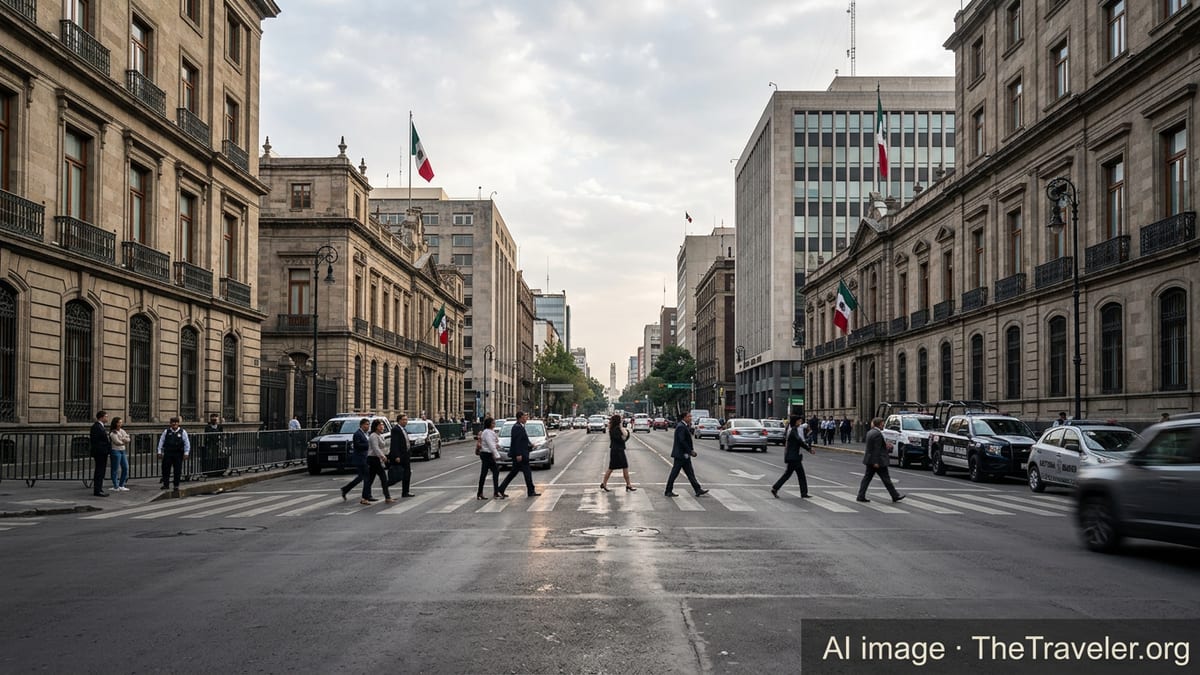
Overview of Mexico’s Current Political Trajectory
Mexico is in a transition phase following the election of President Claudia Sheinbaum in 2024, who took office in October of that year after a landslide victory by the governing Morena coalition. This marked continuity with the previous administration in terms of political orientation, but it also coincides with a period of institutional restructuring and intensified debate about the balance of powers. For expats and investors, the key signal is a strong governing mandate paired with a willingness to undertake far-reaching constitutional change.
Mexico’s system remains a federal presidential republic with regular, competitive elections and a constitutional ban on presidential reelection. However, the ruling coalition currently holds significant influence at the federal and many state levels, which has enabled it to move quickly on reforms affecting the judiciary, energy sector, and regulatory institutions. This concentration of political power reduces short-term policy gridlock but increases uncertainty about checks and balances over time.
From a macro-political risk perspective, Mexico does not face imminent regime instability, and there is no widespread expectation of systemic breakdown. The dominant risk signals instead relate to the quality of institutions that underpin rule of law, contract enforcement, and personal security. These factors directly affect how secure expats feel and how predictable the operating environment is for businesses planning long-term investments.
Judicial Reform and Rule of Law Concerns
The most important recent development for political risk is the 2024 constitutional reform of the judiciary, often referred to domestically as part of “Plan C.” The reform package, approved by Congress and a majority of state legislatures and published in the official gazette in September 2024, restructures how judges are selected and overseen. Federal and many state judges, including Supreme Court justices, are now chosen by popular election from candidate lists preselected by Congress and other institutions, for renewable nine-year terms.
Supporters argue this model will reduce entrenched corruption by making judges accountable to voters. Critics in Mexico and abroad warn it could undermine judicial independence, expose judicial races to political party dominance and money, and give the ruling coalition long-term influence over the courts. Analytical commentary has highlighted risks of “executive aggrandizement,” where elected leaders progressively weaken institutional constraints, as well as potential challenges for foreign investors seeking neutral venues for dispute resolution.
For investors and expats, the main risk signal is heightened uncertainty around contract enforcement and regulatory disputes. Strategic sectors such as energy, infrastructure, and telecommunications depend heavily on credible, timely judicial decisions. Concerns have been raised that a judiciary more closely aligned with the governing party might be less likely to rule against major state-backed projects or policy shifts, increasing exposure to de facto expropriation, arbitrary permit cancellations, or selective enforcement. The potential for politically influenced or delayed court rulings is particularly relevant for relocation-linked investments such as industrial parks, logistics platforms, and regional headquarters.
The first elections under the new system, held in 2025, also introduced operational uncertainty, including campaign dynamics around judicial races and questions about how organized crime or local power brokers might seek to influence outcomes. While the long-term impact is still unfolding, risk-sensitive investors are already incorporating scenarios where legal predictability could deteriorate in certain jurisdictions, leading to higher compliance and due diligence costs.
Security Environment and Political Violence
Mexico’s security situation is central to political risk assessments for both expats and investors. Official data and independent research indicate that national homicide rates have declined from peaks reached in the late 2010s. Preliminary figures for 2025 suggest a rate around the high teens per 100,000 inhabitants, down from roughly 29 per 100,000 in 2018, and the government has highlighted a reduction of around 30 to 40 percent in homicides over the first full year of the new administration. Nonetheless, Mexico still ranks among the countries with the highest homicide rates globally, and organized crime remains embedded in many regions.
Analysts point out that improvements in national averages coexist with stark geographic disparities. States such as Guanajuato, parts of Michoacán, Chihuahua, Baja California, and Guerrero continue to record some of the highest homicide totals, with frequent clashes between rival criminal groups and targeted massacres. At the same time, large metropolitan areas with significant foreign investment, such as parts of Mexico City and several northern industrial corridors, have seen relative stabilization or slower growth in violent crime, supported by heavier security deployment and coordinated policing.
Political violence is a distinct and growing concern. The 2024 election cycle was widely described as the most violent on record for political figures, with dozens of candidates and local officeholders assassinated and hundreds of nonlethal attacks documented. Research on Mexico’s electoral violence shows that organized crime targets candidates and officials in areas where illicit markets, such as fuel theft or trafficking routes, are at stake. Although such attacks typically focus on political actors rather than voters or bystanders, they signal the ability of criminal organizations to influence local governance outcomes.
For expats, political violence usually remains localized and targeted, but it can disrupt municipal services, create sudden power vacuums, and lead to rapid shifts in local authority alignment. For corporate investors, especially in energy, logistics, and agribusiness, the combination of organized crime and local political capture can affect access to permits, security costs, extortion risk, and the reliability of local partners. Relocation planners therefore need to evaluate risk not only at the national level but down to specific states and municipalities.
Organized Crime, Internal Displacement, and Social Stability
Organized crime continues to shape Mexico’s security and political risk landscape despite recent improvements in headline homicide metrics. Over the past decade, the national homicide rate has risen significantly from mid-teens per 100,000 residents to the low 20s, even after recent declines, with more than 300,000 people killed in that period. Independent assessments highlight that an estimated two-thirds of homicides are linked to organized crime, underscoring how deeply criminal networks intersect with local politics, business, and law enforcement.
One signaling metric for social stability is internal displacement due to violence. Monitoring organizations reported that conflict and criminal violence forced about 26,000 people from their homes in 2024, more than double the figure for 2023. These displacements are typically concentrated in rural areas and small towns contested by rival groups, often in states already known for security problems. While expat communities are rarely the direct targets of such displacement, the phenomenon reflects high levels of localized insecurity and weak state control in certain regions.
Another indicator relevant to social and political risk is gender-based violence, including femicide. Some states such as Colima report more than four femicides per 100,000 women, among the highest rates nationally. Persistent gender violence has prompted protests, legal reforms, and scrutiny of policing and judicial responses, revealing systemic weaknesses in institutions tasked with protecting citizens. For international employers and relocating professionals, these issues translate into heightened attention to duty-of-care obligations, workforce safety policies, and the reputational implications of operating in areas associated with severe human rights concerns.
Although most expatriate enclaves and major business corridors are physically distant from the most acute conflict zones, the broader pattern of organized crime and displacement contributes to an overall perception of risk. It can influence future policy priorities, budget allocations under security pressure, and social trust in institutions, which in turn shape the long-term attractiveness of Mexico as a destination for foreign professionals and capital.
Economic Policy Direction, USMCA Review, and Investor Confidence
Mexico’s political risk profile is also influenced by its economic policy direction and relations with key partners, particularly the United States and Canada. The United States-Mexico-Canada Agreement (USMCA) is due for a joint review process beginning in 2026. This review will assess the agreement’s performance and could open debates on labor provisions, energy policy, digital trade, and dispute settlement mechanisms. Mexico has attracted significant nearshoring interest, with foreign direct investment inflows in the tens of billions of dollars annually, but the extent to which this trend continues will depend on perceptions of regulatory stability and respect for USMCA commitments.
Under the previous administration, Mexico faced formal disputes and consultations under USMCA related to energy policies and state dominance in the electricity and hydrocarbons sectors. Some of these cases remained unresolved or in early stages, reflecting political calculations that sometimes outweighed investor certainty. The current government must balance domestic priorities, including a strong role for state-owned enterprises, with the need to avoid escalations that could lead to retaliatory measures or reduced investor protections under the trade agreement.
Analytical commentary notes that judicial reforms and perceived erosion of checks and balances may influence credit rating agencies and currency markets if they are interpreted as weakening rule of law or raising expropriation risk. Scenarios under discussion include the possibility of higher risk premiums on Mexican assets, increased volatility of the peso, or slower progress on energy and infrastructure projects if investors adopt a wait-and-see approach. For expats tied to corporate deployments, such macro-level risks can affect expansion plans, hiring, and the long-term viability of specific locations, even if daily life conditions remain stable.
On the other hand, Mexico’s geographic proximity to the United States, integrated supply chains, and large domestic market continue to offer structural advantages. Many firms are proceeding with nearshoring strategies but are spreading risk across multiple Mexican states, diversifying suppliers, and negotiating more robust contractual protections. Political risk signals are therefore less about imminent systemic crisis and more about a gradual recalibration of how investors price and manage long-term exposure.
State-by-State Variations in Political and Security Risk
Mexico’s federal structure and regional disparities mean that political risk is highly variable across states and municipalities. Some states are governed by opposition parties, others by the ruling coalition, and local institutional capacity ranges from relatively strong to severely compromised. For expats and investors, this means that the national political narrative often tells only part of the story; localized governance dynamics frequently determine everyday security and regulatory predictability.
States with high levels of organized crime activity, such as Guanajuato, Michoacán, Guerrero, and parts of Baja California and Chihuahua, tend to exhibit elevated rates of homicides, extortion, and attacks on local officials. Businesses operating in these areas often face higher security expenditures, more complex relations with local authorities, and potential exposure to supply chain disruptions. Internal displacement data and incident mapping consistently flag specific municipalities within these states as hotspots for conflict over territory and illicit markets.
In contrast, other regions, including key parts of Mexico City, Queretaro, Nuevo Leon, and certain border industrial zones, have made modest but measurable improvements in peace indicators, benefiting from stronger local institutions, coordinated security operations, or economic diversification. Even in these relatively better-performing areas, however, organized crime retains influence in certain sectors, and local politics can be affected by national-level reforms and party dynamics.
Relocation decisions therefore increasingly rely on granular risk assessments rather than broad national averages. Corporate security teams and relocation advisors commonly differentiate between “green,” “amber,” and “red” zones within the same state, adjusting travel policies and residential recommendations accordingly. Political developments, such as upcoming gubernatorial elections or high-profile corruption investigations, can shift a location’s risk profile within months, underlining the importance of continuous monitoring.
The Takeaway
Mexico’s political risk environment in 2026 is characterized by institutional flux rather than imminent instability. The governing coalition’s strong mandate has enabled ambitious reforms, especially in the judiciary, that may reshape how power is balanced across branches of government for years to come. For expats and investors, the key question is not whether Mexico will remain a major economic partner, but how predictable its legal and regulatory frameworks will be, and how effectively authorities can contain organized crime and political violence.
Headline crime indicators show gradual improvement from peak levels, yet Mexico still faces high rates of homicide and pervasive criminal influence in many regions. Political violence, particularly around elections, and internal displacement due to conflict signal persistent governance challenges at the local level. At the same time, the upcoming USMCA review and ongoing debates over energy and regulatory policy introduce additional layers of uncertainty for long-term investments linked to relocation.
Decision-grade analysis suggests that Mexico remains a viable destination for many corporate deployments and internationally mobile professionals, provided risks are managed proactively. This typically entails focusing on states and municipalities with relatively stronger institutions, reinforcing corporate governance and compliance, and building flexible scenarios around potential shifts in judicial behavior and trade relations. Continuous monitoring of political developments, security trends, and subnational variations is essential to maintain an accurate picture of Mexico’s evolving risk landscape.
FAQ
Q1. How stable is Mexico’s political system for long-term expat relocation?
Mexico’s political system is institutionally stable, with regular elections and no expectation of regime collapse, but current reforms are reshaping checks and balances, so long-term relocations should factor in potential changes in judicial independence and regulatory predictability.
Q2. What is the main political risk signal for investors in Mexico today?
The leading signal is uncertainty around rule of law due to judicial reforms that increase political influence over the courts, which may affect contract enforcement, regulatory disputes, and perceptions of investment protection in strategic sectors.
Q3. How serious is political violence for everyday expats?
Most political violence targets candidates and officials in specific high-risk municipalities, so it rarely affects day-to-day life for expats in major business centers, but it does indicate underlying governance weaknesses that can indirectly impact local services and security.
Q4. Are homicide rates improving enough to change the risk picture?
National homicide rates have declined from peak levels and recent data show noticeable reductions, yet Mexico still ranks among the higher-violence countries globally, and improvements are uneven, so risk remains significant in several states despite positive trends.
Q5. How do organized crime groups influence political risk for investors?
Organized crime affects political risk by infiltrating local governments, influencing elections in contested areas, and driving extortion and corruption that can raise operating costs, disrupt projects, and complicate relationships with local authorities.
Q6. What does the USMCA review mean for relocation-linked investments?
The 2026 USMCA review introduces uncertainty around trade rules, energy policy, and dispute settlement, which could alter incentives for nearshoring, supply chain investments, and cross-border operations that underpin many corporate relocation decisions.
Q7. Do political risks differ significantly between Mexican states?
Yes, risk levels vary widely; some states have persistently high violence and weaker institutions, while others show improving security and more predictable governance, making state-level and even municipal-level analysis critical for relocation planning.
Q8. How likely are sudden policy shifts that could affect foreign businesses?
The current government has shown willingness to pursue rapid constitutional and regulatory changes, particularly in sectors it views as strategic, so while outright expropriation is unlikely, policy shifts and tougher regulatory environments remain a realistic scenario.
Q9. What signals should expats and investors monitor over the next two to three years?
Key signals include the implementation of judicial elections, outcomes of USMCA-related disputes and the 2026 review, trends in homicide and political violence by state, and any moves to expand state control in energy or infrastructure sectors.
Q10. Is Mexico still considered a viable destination despite these political risks?
Yes, Mexico remains a major destination due to its market size and integration with North America, but successful relocation now depends on rigorous, location-specific risk assessment and active management of political, security, and regulatory exposure.