


Mexico and Portugal are two of the most discussed destinations among prospective expats, particularly for those leaving North America and Europe. Both offer relatively attractive living conditions compared with many origin countries, but they differ sharply in safety, governance, infrastructure, and social environment. This briefing compares Mexico and Portugal as expat destinations to assess which country is generally more practical to move to, depending on an individual’s risk tolerance, expectations, and long-term plans.
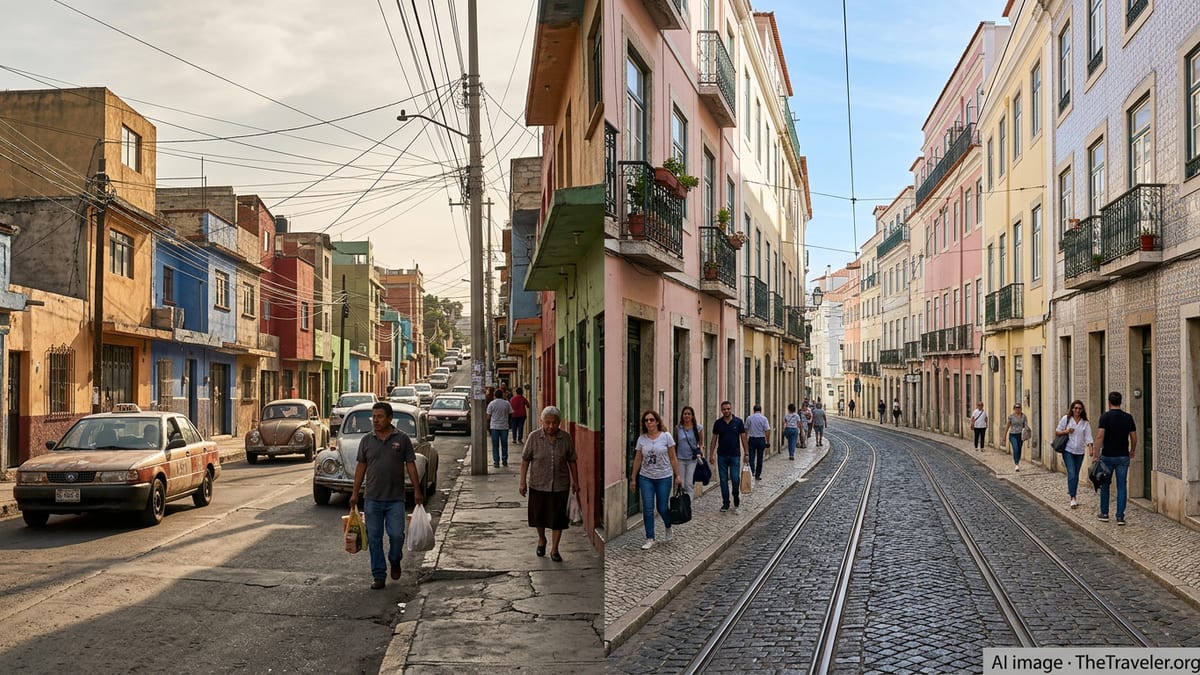
Overall Attractiveness for Expats
International expat surveys consistently place both Mexico and Portugal in the upper tier of destinations, though for different reasons. In the 2025 Expat Insider ranking, Mexico placed in the global top three overall, while Portugal ranked in the mid‑teens, confirming that both countries remain highly visible and attractive in the expat market. Mexico tends to score strongly on personal happiness and ease of settling in, whereas Portugal performs best in quality of life and safety indices.
Independent quality of life comparisons suggest that Portugal offers a stronger structural environment for day‑to‑day living. In the 2024 Numbeo Quality of Life Index, Portugal scored around the mid‑160s, compared with the low‑120s for Mexico, indicating better outcomes on factors such as safety, healthcare perception, pollution, and purchasing power. These aggregate indicators suggest that Portugal is better aligned with European standards of public services and security, while Mexico’s appeal is more lifestyle‑ and community‑driven.
Both countries have sizeable and growing expat communities. Mexico attracts a large North American population across coastal and urban centers, while in Portugal, foreign residents now make up roughly 14 percent of the population. The scale and maturity of these communities increase the likelihood of established support networks, English‑speaking professionals, and international schools, which strengthens overall relocation practicality in both destinations.
From a purely structural perspective, Portugal offers higher institutional quality, safety, and life expectancy, while Mexico offers a more flexible and socially open environment that many expats find personally rewarding despite higher systemic risks. The choice between the two is therefore largely about trade‑offs between hard quality‑of‑life indicators and soft lifestyle advantages.
Safety, Stability, and Personal Security
Safety is one of the most important differentiators between Mexico and Portugal from a relocation risk perspective. Mexico continues to face elevated levels of violent crime linked to organized crime and regional disparities in law enforcement capacity. National peace indices show that Mexico’s overall peace score has deteriorated over the past decade, and cartel‑related violence remains a systemic challenge in several states. Even in relatively safer regions, expats must adapt to higher situational awareness and more conservative mobility routines.
Portugal, by contrast, is consistently ranked among the safer countries globally. It typically appears in the upper tier of international peace and safety rankings, reflecting low levels of violent crime, stable political institutions, and predictable policing. Petty theft and opportunistic crime do exist in urban and tourist areas, but the baseline risk profile is closer to other Western European countries than to emerging markets.
For expats, this differential in safety translates directly into lifestyle constraints and psychological load. In Mexico, many long‑term residents report that daily life can feel normal and comfortable in specific neighborhoods, yet they accept constraints such as avoiding certain highways at night, being cautious with displays of wealth, and monitoring local security developments. In Portugal, such considerations are significantly reduced; most expats can move freely within urban areas and smaller towns with low perceived risk.
When comparing the two countries purely on the criterion of personal security and stability, Portugal clearly offers the lower‑risk environment. Mexico can still be a viable choice for expats who are experienced with higher‑risk environments, willing to research local conditions in detail, and prepared to adapt their routines accordingly, but for risk‑averse individuals and families, Portugal is generally the safer relocation decision.
Quality of Life and Everyday Living Conditions
Quality of life for expats is shaped by a combination of public infrastructure, environmental conditions, and social functioning. On a range of international indices, Portugal outranks Mexico on composite quality‑of‑life measures. Numbeo’s 2024 country ranking places Portugal significantly higher, based on indicators such as safety, healthcare perception, climate satisfaction, traffic, and pollution. Portugal also records higher life expectancy, around the low‑80s in recent data, compared with mid‑70s in Mexico.
In practical terms, Portugal provides more predictable public infrastructure. Urban centers generally offer reliable water supply, electricity, and public transport networks. In contrast, parts of Mexico still experience infrastructure stress, such as intermittent water shortages in large metros and more pronounced disparities between central districts and peripheral areas. These issues do not make relocation impossible, but they introduce an additional layer of complexity that expats must manage, particularly in larger cities.
Environmental conditions differ as well. Both countries provide generally favorable climates for outdoor lifestyles, but Portugal has an advantage in air quality and pollution metrics. Large Mexican urban areas typically report higher air pollution, traffic congestion, and noise levels. For expats sensitive to air quality or seeking a quieter urban environment, medium‑sized Portuguese cities and regional centers often provide a calmer, more stable quality of life baseline.
Overall, for expats prioritizing system‑level quality indicators such as public infrastructure reliability, environmental quality, and life expectancy, Portugal is comparatively stronger. Mexico can still offer an excellent subjective quality of life for those who value social vibrancy and informality more than infrastructure predictability, but it requires greater tolerance for variability and occasional service disruptions.
Integration, Language, and Social Environment
Social integration and language are decisive for long‑term expat outcomes. Portugal’s integration environment benefits from widespread English proficiency in urban areas and within younger age groups. International surveys indicate that a large share of the Portuguese population, especially in major cities, can communicate in English at a functional level, which reduces initial friction for new arrivals. This does not eliminate the need to learn Portuguese for deeper integration, but it creates a smoother early‑stage adjustment.
Mexico presents a different profile. English is widely used in specific sectors such as tourism and among highly educated urban residents, but outside these contexts, Spanish is dominant. This creates a steeper language requirement for expats who want to operate independently in public services, bureaucracy, and local community life. On the other hand, expats frequently report that Mexican social culture is open and welcoming, making it relatively easy to build personal networks once language barriers are reduced.
Both countries have well‑established expat communities, but their structure differs. In Mexico, expats are often concentrated in specific coastal towns, central highland cities, and defined neighborhoods within large metros. These hubs can provide strong peer networks but may also limit integration if newcomers remain within foreigner‑heavy circles. In Portugal, expats are widely present in Lisbon, Porto, and parts of the Algarve, but there is also growing dispersion to smaller cities and inland areas, which can facilitate deeper engagement with local society.
For expats who prioritize a gradual, English‑supported integration path within a European cultural framework, Portugal generally offers the smoother entry. For those who are prepared to invest more heavily in language acquisition and are attracted to a more informal, highly social environment, Mexico can deliver a rewarding integration experience, though with more dependence on individual initiative.
Economic Context and Long-Term Prospects
While this article does not focus on detailed labor markets or tax regimes, the broader economic context influences how sustainable a move might be over time. Both Mexico and Portugal have relatively modest average income levels compared with major origin countries like the United States, Canada, or northern Europe. Expats who rely on local salaries rather than foreign income should therefore expect tighter budgets and more limited consumption power in both locations.
Portugal’s economy is integrated into the European Union and Eurozone, offering regulatory stability and predictable institutions. However, growth has been modest and local wages comparatively low, which can create a perception of economic stagnation for younger professionals and highly skilled expats. This environment may still be attractive for remote workers or retirees whose income originates abroad, as they can leverage European infrastructure with externally sourced income streams.
Mexico, as an upper middle‑income economy with strong ties to North American supply chains, offers a different set of dynamics. Economic growth in recent years has been moderate but supported by manufacturing and nearshoring trends. For expats who operate as entrepreneurs, consultants, or remote workers paid in stronger currencies, Mexico can offer substantial day‑to‑day financial comfort, even if public services lag behind European standards. The trade‑off lies in higher systemic risk and variable enforcement of regulations.
From a long‑term practicality standpoint, both countries can work well for internationally mobile individuals with portable income. Portugal’s advantage is macro‑stability, strong institutions, and alignment with European standards, while Mexico’s advantage is flexibility, entrepreneurial space, and the potential for a higher subjective standard of living relative to foreign income, albeit with a higher risk profile.
The Takeaway
Evaluated strictly as destinations for relocation, Mexico and Portugal each offer compelling but distinct value propositions. Portugal scores better on measurable indicators: higher quality of life indices, stronger safety profile, longer life expectancy, and more reliable public infrastructure. For expats prioritizing security, predictability, and alignment with European norms, Portugal is generally the lower‑risk and more structurally robust choice.
Mexico’s strengths lie in social environment and lifestyle flexibility. It ranks highly in expat satisfaction surveys for personal happiness and ease of settling in, particularly for those who value community, informality, and lower day‑to‑day costs relative to foreign income. However, these benefits come with meaningful trade‑offs in safety and infrastructure consistency, which not all expats will find acceptable, especially families or risk‑averse individuals.
In decision‑grade terms, Portugal is typically the better option for expats seeking a stable, secure, and institutionally solid base for the long term, with moderate but predictable living standards. Mexico can be the better fit for those with higher risk tolerance, strong motivation to learn Spanish and engage locally, and a clear plan for navigating regional safety differences and infrastructure variability.
Ultimately, the choice between Mexico and Portugal is less about which country is universally better and more about alignment between each destination’s structural profile and an individual expat’s risk appetite, income model, and expectations for long‑term daily life.
FAQ
Q1. Which country is safer overall for expats, Mexico or Portugal?
Portugal is significantly safer overall, with low violent crime and stable institutions, while Mexico has persistently higher crime rates and regional security risks.
Q2. Where is day-to-day quality of life higher on average?
On composite indices, Portugal scores higher for quality of life, reflecting better safety, infrastructure, and environmental indicators, although individual experiences vary.
Q3. Which destination is more suitable for risk-averse families?
Risk-averse families generally find Portugal more suitable due to its strong safety profile, predictable public services, and lower exposure to serious crime.
Q4. Is it easier to integrate socially in Mexico or Portugal?
Both offer welcoming environments, but Portugal benefits from wider English use, while Mexico may require more intensive Spanish learning for full integration.
Q5. How do infrastructure and public services compare between the two?
Portugal usually provides more reliable water, transport, and urban services, whereas Mexico shows greater regional variability and occasional infrastructure stress.
Q6. Which country offers better long-term stability for relocation?
Portugal offers higher institutional and political stability, making it a more predictable base for long-term planning than Mexico in most cases.
Q7. For remote workers with foreign income, which is more attractive?
Both can work well; Portugal offers stability and EU standards, while Mexico can provide greater lifestyle flexibility but with higher security and infrastructure risks.
Q8. How important is language choice in deciding between Mexico and Portugal?
Language is critical; Portugal allows more initial reliance on English, whereas in Mexico, Spanish proficiency quickly becomes essential for independent daily life.
Q9. Which country is better if healthcare quality is a key concern?
Without detailing systems, aggregate indices and life expectancy suggest that Portugal offers stronger overall health-related outcomes than Mexico.
Q10. Overall, which country is better to move to for most expats?
For most risk-averse expats seeking structural quality and safety, Portugal is generally the better choice, while Mexico suits those prioritizing flexibility and social vibrancy.