


More news on this day
Escalating tensions and airspace closures across the Middle East are rippling through global tourism, cooling demand for hub-dependent destinations such as the Maldives and Gulf states while redirecting holidaymakers toward Europe’s heavyweight markets in Germany, the United Kingdom, France, Switzerland and Italy.
Get the latest news straight to your inbox!
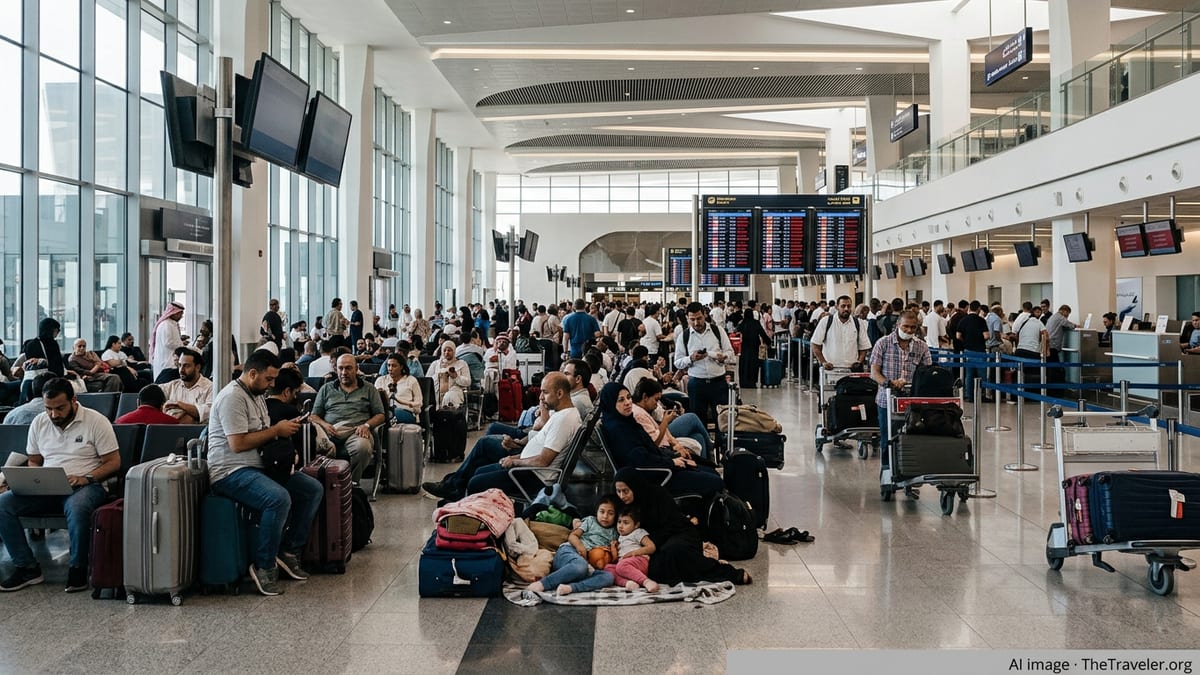
Airspace Blockages Disrupt Asia–Middle East–Europe Corridors
The latest conflict in West Asia has triggered one of the most severe aviation disruptions since the pandemic, with large sections of airspace over Iran, Iraq and neighboring states either closed outright or subject to tight restrictions. Publicly available aviation data shows that several major airports in the region, including Dubai International, briefly halted most operations as authorities responded to missile strikes and security alerts, before gradually reopening on a limited basis.
Industry briefings describe the February and March 2026 closure sequence as a cascading event that forced airlines to abandon their preferred Europe–Middle East–Asia corridors and instead route aircraft along more northerly paths over the Caucasus or much further south over the Arabian Sea. The detours add two to five hours to many long-haul itineraries, increase fuel burn and crew costs, and compress the number of viable daily frequencies on key routes.
Travel advisories from Western governments have also risen in severity for parts of the region, citing elevated security risks and uncertainty around further airspace restrictions. Airlines serving the Gulf, Levant and broader Middle East have responded with temporary suspensions, reduced schedules or aircraft swaps on some routes, weakening the role of regional hubs as seamless connecting points between Europe, Asia and the Indian Ocean.
Analysts point out that the disruption hits a part of the global network that had become structurally important for tourism flows. Before the current crisis, Gulf hubs such as Dubai, Doha and Abu Dhabi handled tens of millions of passengers per year and functioned as key waypoints for travelers from Europe and North America en route to destinations like the Maldives, Sri Lanka, Vietnam and the wider Indian Ocean region.
Maldives and Hub-Dependent Destinations Feel the Strain
The Maldives offers one of the clearest examples of how airspace closures can undermine tourism without a dramatic collapse in headline arrival numbers. Official statistics tracked by local media indicate that total foreign arrivals in early 2026 inched up slightly compared with the previous year, but the country’s tourism ministry has warned that as many as 35 percent of already-booked tourists may ultimately cancel or be unable to travel if the Middle East conflict continues to snarl flight paths.
The challenge stems from the way many of the country’s core markets reach the archipelago. Visitors from Europe and North America frequently rely on one-stop itineraries via Dubai or Doha, as well as other Gulf and regional hubs. When these airports face closures or significant disruption, the knock-on effect can be immediate for resort islands that depend on smooth, time-sensitive arrivals and tight onward transfers by seaplane or domestic flights.
Similar patterns are emerging in other long-haul leisure markets that are tightly woven into Middle Eastern aviation networks. Routes to popular destinations in Sri Lanka, Vietnam, Jordan and Qatar have been subject to schedule changes or higher fares as airlines absorb the extra costs of detours or, in some cases, suspend certain services. Reports indicate that some prospective visitors are postponing or rebooking trips rather than commit to itineraries that may involve extended or uncertain connections through conflict-adjacent skies.
Tourism consultants note that even where aggregate annual arrivals have not yet fallen dramatically, booking lead times are shortening and cancellation rates are rising for trips that depend on Middle Eastern transit. This creates volatility for hotels and tour operators that built their business models on predictable flows via Gulf super-connectors and regional carriers.
Europe Emerges as a Geographic and Psychological Safe Haven
While parts of the Middle East and connected Indian Ocean markets grapple with weakened demand, Europe’s main tourism economies are recording continued growth. Recent assessments by European air traffic agencies show that flight volumes across the continent in 2025 and early 2026 have surpassed 2024 levels, with particularly strong activity along the south-east axis linking Germany, Italy, Switzerland and the Balkans to long-haul routes.
Global tourism statistics compiled by international organizations indicate that Europe welcomed more than 740 million international visitors in 2024, a mid-single-digit increase on the previous year and close to record pre-pandemic levels. Countries such as Italy remain among the world’s most visited destinations by arrival numbers, joined by France and Spain at the top of global rankings, with Germany, the United Kingdom and Switzerland also drawing steady growth.
Travel-focused economic research highlights that spending on experiences, culture and food has become a key driver of trips to Europe. Recent studies from private-sector analysts show robust demand for “bucket list” travel, wellness escapes and nature-based holidays across the continent, with cities such as Munich, Interlaken, Barcelona and coastal Italian and French regions emerging as top trending choices for long-haul visitors.
Industry commentary suggests that the Middle East crisis is acting as an accelerant for this trend. For many holidaymakers in North America and Asia, rebooking from an Indian Ocean resort that requires a Gulf connection to a European destination served by nonstop or northerly routes can feel like the less risky choice. The relative perception of stability in European airspace, alongside well-established tourism infrastructure, reinforces this pivot.
Shifting Flight Patterns Reshape Competition Among Destinations
Operational data from European network managers and global airline groups shows that the airspace disruption is not merely a temporary inconvenience but is starting to reshape capacity planning. Airlines are redeploying aircraft toward routes that avoid conflict-affected skies, opening or expanding services that link major European gateways directly with North America, Africa and parts of Asia via alternative corridors.
For airports in Germany, the United Kingdom, France, Switzerland and Italy, this reallocation often translates into increased long-haul frequencies and higher passenger throughput, particularly during peak leisure seasons. Carriers have boosted seats on transatlantic services and on selective Asia–Europe links that can be operated without overflying the most volatile sections of Middle Eastern airspace, capturing demand from travelers who might previously have routed via Gulf hubs.
By contrast, destinations whose appeal depends on seamless one-stop links through the Middle East are facing tougher competition. Tourism boards in the Maldives, Sri Lanka, Jordan and Gulf states are ramping up marketing in key origin markets and exploring incentives for airlines to maintain or restore capacity, yet they are operating against a backdrop of elevated insurance premiums, longer flight times and traveler caution.
Analysts caution that if airspace restrictions persist into the 2026–2027 peak seasons, the shift in flight patterns could harden into a more structural advantage for European destinations. Once carriers and passengers become accustomed to new routings and airport preferences, some of the traffic that has returned to Europe’s traditional hubs may be slow to revert even if Middle Eastern skies fully reopen.
Outlook: A Fragmented Recovery and New Tourism Map
Forecasts from tourism and aviation research firms suggest a more fragmented global recovery over the next few years than many had anticipated before the latest Middle East escalation. Projections now point to a potential double-digit decline in international arrivals across parts of the Middle East in 2026, while Europe is expected to continue expanding, albeit at a more moderate pace than during the immediate post-pandemic rebound.
The divergence underscores how sensitive tourism is to changes in perceived safety and connectivity. Countries that lean heavily on a single air corridor or a small cluster of transit hubs are more exposed when geopolitical tensions flare, whereas diversified access and strong domestic or intra-regional markets can cushion the blow.
For policy makers in affected destinations, the current crisis is prompting renewed focus on route diversification, alternative source markets and resilience planning. Public communication campaigns are emphasizing that many resorts and cities remain far from conflict zones, while investment discussions increasingly center on direct air links that bypass vulnerable chokepoints.
For travelers, the upshot is a reconfigured world tourism map in which classic European destinations enjoy a new surge of demand, even as places like the Maldives, the United Arab Emirates, Turkey, Sri Lanka, Vietnam, Jordan and Qatar work to reassure visitors and adapt to a future in which Middle Eastern airspace can no longer be taken for granted.