

More news on this day
Thousands of travellers have been left stranded across the Middle East as a fast-moving airspace crisis linked to the ongoing conflict with Iran triggers at least 558 flight cancellations and widespread delays, disrupting major routes through Bahrain, Saudi Arabia, the United Arab Emirates, Egypt, Qatar and beyond.
Get the latest news straight to your inbox!
Airspace Closures Ripple Across Gulf Hubs
Publicly available aviation updates show that a series of airspace restrictions and intermittent closures across the Gulf have severely disrupted normal traffic flows since early March 2026. Multiple Gulf states, including the United Arab Emirates, Qatar, Bahrain and Kuwait, have at various points restricted or shut their skies to civilian overflights as a precaution in response to regional missile activity.
Operational notices and airline travel advisories indicate that the closures have hit the region’s major hubs hardest, particularly Dubai International, Abu Dhabi, Doha and key Saudi airports. With traditional east–west corridors through the Gulf constrained, airlines have been forced either to cancel services outright or reroute aircraft along longer southern paths, adding time, cost and additional pressure to already congested alternative corridors.
Industry analyses describe Saudi airspace as one of the only consistently open east–west corridors, funnelling significant volumes of traffic over the kingdom. This has created bottlenecks and air traffic control challenges, further complicating efforts by carriers to run reliable schedules and contributing to mounting knock-on delays across the wider network.
According to travel-management bulletins, many short- and medium-haul links within the Gulf, as well as long-haul connections between Europe, Asia and Africa that typically transit the region, have experienced disruption. The cumulative effect has been the cancellation or delay of hundreds of flights over a matter of days, stranding passengers across airports from Manama and Jeddah to Dubai and Doha.
Gulf Carriers Slash Schedules as IndiGo, EgyptAir and Others Pull Back
Operational summaries and media coverage indicate that major Gulf-based airlines, including Emirates, FlyDubai, Saudia and Gulf Air, have sharply reduced their schedules as the crisis has unfolded. Emirates and FlyDubai have moved from near-normal operations to heavily curtailed, selectively operating limited services while many departures and arrivals remain suspended or subject to last-minute changes.
Gulf Air has adjusted its Bahrain-centric network in response to restricted overflight options and safety considerations along traditional corridors. Saudia, while continuing to use Saudi airports as staging points, has also scaled back services to several neighbouring Gulf destinations. Travel forums and airline advisories describe a patchwork of operating routes that can change from day to day, leaving travellers uncertain about whether their flights will depart as planned.
The disruption extends beyond Gulf-based carriers. Public reports note that Indian low-cost giant IndiGo has suspended or reduced multiple services into the Gulf, especially to the UAE, Qatar and Saudi Arabia, following the escalation in regional tensions. EgyptAir and other regional and international airlines have likewise trimmed operations to affected hubs, citing safety assessments and the inability to secure stable routings through closed or contested airspace.
Collectively, cancellations attributed to the current phase of the crisis are estimated at 558 flights across a rolling period, with many more services heavily delayed or rerouted. Aviation analysts suggest that the true impact on travellers is far larger when missed connections, diversions and equipment changes are taken into account.
Travellers Stranded From Bahrain to Dubai and Doha
Reports from regional newspapers and traveller accounts describe thousands of passengers stranded in airports across Bahrain, Saudi Arabia, the UAE, Egypt and Qatar as the disruption continues. In Manama, Bahrain’s role as a Gulf Air hub has meant that cancelled and delayed services have left transfer passengers searching for scarce seats on remaining flights or waiting for specially arranged onward options.
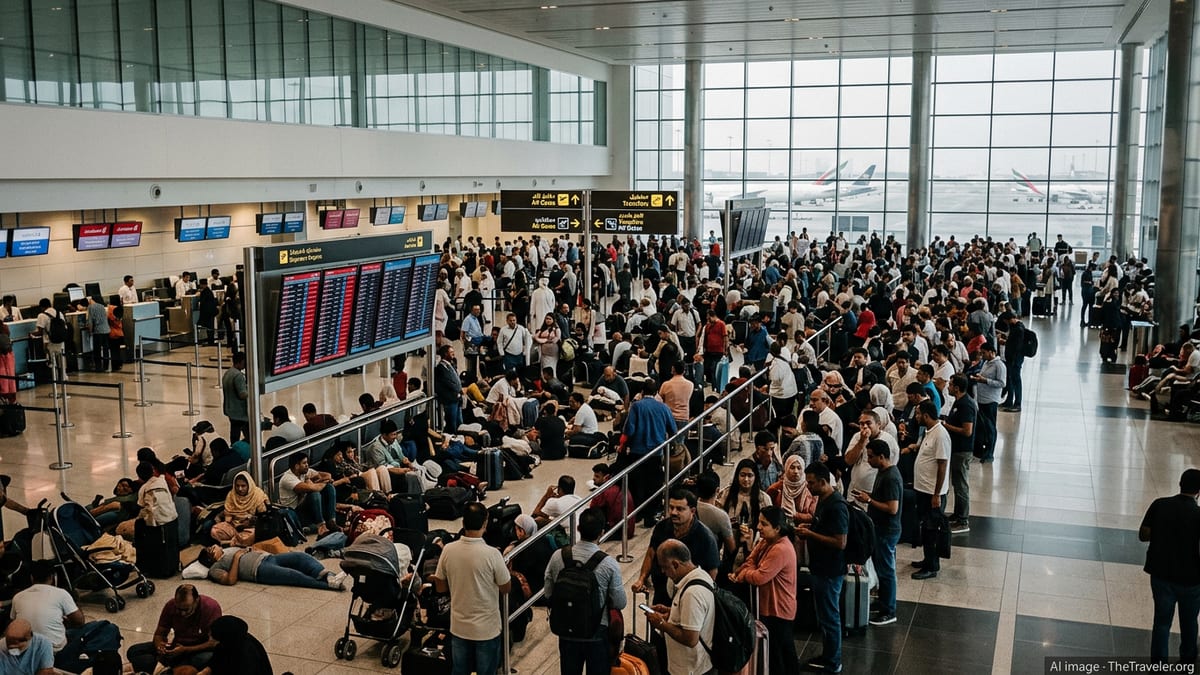
In the UAE, Dubai International and Abu Dhabi airports have experienced waves of stranded travellers after large portions of scheduled operations were suspended with limited notice. Social media posts and travel community forums reference crowded terminals, rapidly changing departure boards and long queues at airline transfer and customer service desks as passengers seek rerouting, refunds or emergency accommodation.
Doha’s Hamad International Airport in Qatar has likewise faced congestion after missile threats and interception activity in early March temporarily interrupted normal operations. While some services have resumed on a limited basis, ongoing airspace and routing constraints continue to affect connectivity, particularly to Europe and South Asia, compounding the strain on travellers trying to leave the region or transit through it.
Further west, EgyptAir’s network adjustments and general caution over eastern Mediterranean air routes have impacted Cairo’s role as a connecting hub between Africa, the Middle East and Europe. Passengers bound for North African and sub-Saharan destinations have reported extended layovers and, in some cases, the need to reroute via alternative gateways in Europe or Turkey when direct services through the Gulf are unavailable.
Knock-on Effects on Europe–Asia Corridors and Global Travel
Aviation data and corporate travel advisories highlight the broader implications of the Middle East disruptions for global connectivity. With some of the busiest east–west air corridors either partially closed or heavily constrained, airlines are rerouting long-haul services between Europe and Asia via more southerly tracks over the Arabian Sea, the Red Sea and parts of Africa.
These detours add flight time and fuel burn, squeezing already tight aircraft and crew schedules. The result has been a rise in secondary delays and cancellations even for flights that do not touch Middle Eastern airports directly. Travellers originating in North America or Europe and connecting to South or Southeast Asia through Gulf hubs have been particularly vulnerable, as a single cancelled segment can unravel an entire multi-leg itinerary.
Travel-management firms report that corporate travel programs are rapidly revising routing policies, steering employees away from heavily affected hubs where possible. Some organisations are temporarily preferring itineraries via Istanbul, European hubs or southern routes that use airports in Oman or parts of North and East Africa, though capacity on these alternatives is limited.
Leisure travellers and migrant workers, who make up a significant portion of passenger flows between South Asia and the Gulf, are also facing disrupted plans and higher costs. With fewer flights operating and uncertainty over when full schedules will resume, rebooking can be challenging, and some passengers are turning to overland options or secondary airports to find a way home.
Passenger Options, Refunds and What to Expect Next
Airline policy notices and public advisories indicate that many affected carriers, including Emirates, Saudia, FlyDubai and Gulf Air, are offering flexible rebooking and, in some cases, full refunds for flights cancelled as a direct result of the airspace crisis. IndiGo, EgyptAir and other impacted airlines have introduced similar measures, allowing passengers to change their travel dates or routes without the usual penalties within specified windows.
Travel insurers are warning, through publicly shared guidance, that coverage may be limited in situations linked to armed conflict or government-mandated airspace closures, which are often excluded under standard policies. Passengers are being urged in public advisories to review policy wording carefully and to rely first on airline waivers, rather than assuming that insurance will cover additional accommodation or alternative transport costs.
Industry observers caution that recovery is likely to be uneven. Even if some airspace restrictions are relaxed in the coming days, the process of restoring full schedules could take considerably longer. Airlines will need to reposition aircraft and crews, clear backlogs of displaced passengers and re-establish predictable routings before service reliability returns to pre-crisis levels.
For now, publicly available guidance from aviation and travel organisations consistently stresses the importance of checking flight status frequently, using airline apps and airport information channels, and maintaining flexible plans. With at least 558 flights already cancelled and the situation still evolving, travellers with upcoming journeys through Bahrain, Saudi Arabia, the UAE, Egypt or Qatar are being advised to prepare for potential last-minute changes and prolonged disruptions to one of the world’s most important aviation crossroads.