


More news on this day
Escalating airline disruption across key Middle East hubs is turning routine international trips into high-stakes logistical gambles for South African companies, with stranded executives, spiralling costs and fragile supply chains highlighting structural weaknesses in corporate travel risk management.
Get the latest news straight to your inbox!
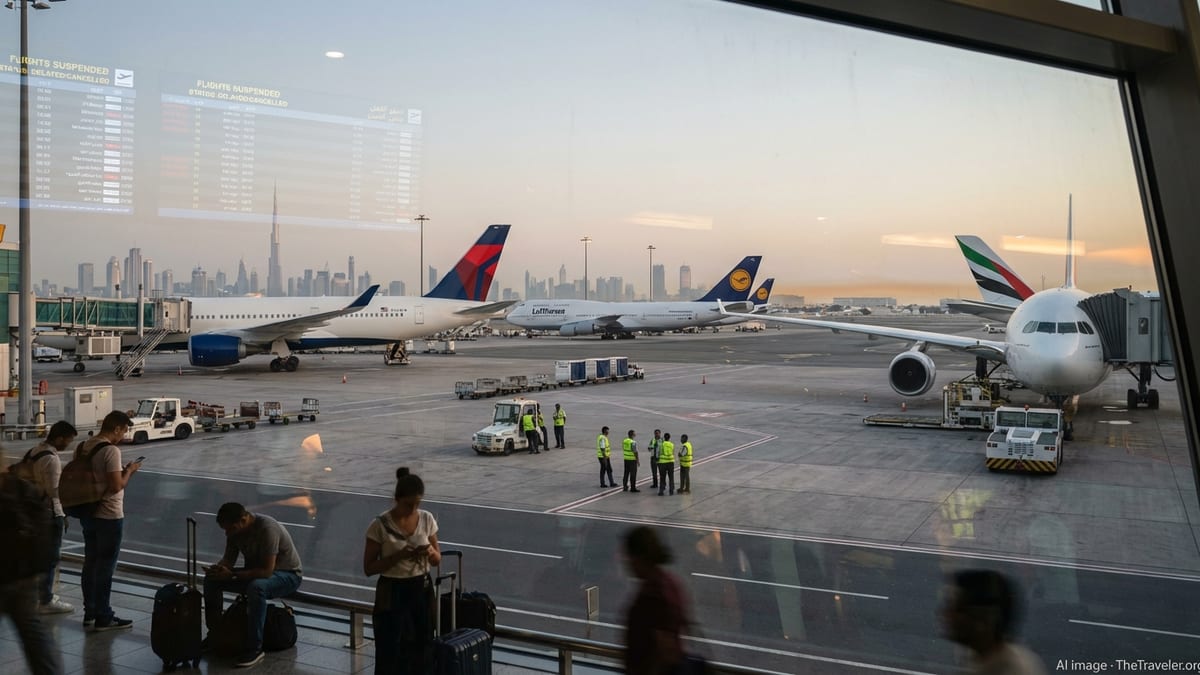
Regional conflict turns vital hubs into chokepoints
The latest geopolitical flare-up in the Middle East, which intensified after late February 2026, has triggered rolling airspace closures and operational restrictions at major transit hubs. Public reporting shows that thousands of flights have been cancelled or rerouted as carriers navigate high-risk corridors around Iran, the Gulf and parts of the Levant. Key airports in Dubai, Abu Dhabi, Kuwait and other cities have at times faced reduced operations or temporary suspensions as airlines rework schedules and crew routings.
Travel-industry coverage indicates that more than 10 000 flights across the region have been cancelled since late February, with airlines extending suspensions on select routes well into May and June. Schedules to Dubai, Riyadh, Dammam, Tel Aviv and other high-exposure destinations remain particularly volatile, with several European and Asian carriers pushing back restart dates as they reassess security and insurance conditions.
The knock-on effect is acutely felt in Africa, where Middle Eastern hubs function as indispensable bridges between Johannesburg or Cape Town and commercial centres in Europe, North America and Asia. South African business travellers who previously relied on Gulf and Levantine stopovers for efficient one-stop connectivity are now facing prolonged disruptions, last-minute rebookings and unplanned detours via secondary European or African gateways.
For corporates that had concentrated long-haul travel on a narrow set of Middle East-based partners, the regional turmoil has exposed a classic single-point-of-failure risk. When a hub closes or an airline suspends a route, there is often no immediate like-for-like replacement, leaving executives grounded and meetings postponed or cancelled outright.
South African companies count the cost of disrupted mobility
South African media coverage of the crisis describes a growing list of travellers stuck on both sides of the Indian Ocean and Mediterranean, including corporate passengers unable to depart on Gulf carriers from Johannesburg and Cape Town. Airport operators in South Africa have reported that operations by some Middle East airlines were directly affected following successive strikes and counterstrikes in the region, contributing to backlogs of passengers seeking alternative routings.
For businesses, the financial impact extends far beyond refunded tickets. Missed tenders, delayed project site visits and postponed board-level negotiations translate into tangible revenue risk. Travel specialists note that premium cabin fares on alternative routings have surged, as demand shifts from disrupted Gulf hubs to European and African carriers with available capacity. Short-notice rebookings often occur in higher fare buckets, compounding budget overruns.
At the same time, aviation analysts highlight the rapid increase in jet fuel prices since the conflict began, a trend that feeds directly into higher long-haul fares. Industry commentary suggests that fuel now represents an even larger slice of airline operating costs, with average ticket prices on some intercontinental corridors rising by around 10 percent in March and April. For South African firms that manage pan-African and intercontinental travel programs, these cost pressures are hitting in parallel with currency volatility and domestic inflation.
Human capital considerations are equally significant. Stranded staff can face extended layovers in unfamiliar cities, visa complications and personal safety concerns. Corporate travel managers report that some employees are declining routings via particular hubs, forcing companies to adjust policies on permissible airlines and transit points. The reputational risk of perceived negligence in duty-of-care obligations is now central to board-level discussions on travel approval and routing.
Connectivity gaps expose structural overreliance on Gulf hubs
South Africa’s long-haul connectivity has, over the past decade, become closely tied to Middle Eastern and other offshore hubs as local carriers scaled back intercontinental networks. While a handful of South African and African airlines link Johannesburg to select destinations in Europe, South America and within the continent, the most extensive one-stop access to Asia, the Middle East and parts of Europe has typically relied on Gulf and Levantine transit points.
Industry research on the current crisis underscores that Middle Eastern hubs handle a disproportionate share of global connecting traffic between Africa, Europe and Asia. When these nodes experience sustained disruption, entire corporate travel programs can be thrown off balance. For companies headquartered in Johannesburg or Cape Town but managing assets in India, China, the Gulf energy sector or European financial centres, the lack of non-stop alternatives amplifies the impact of every cancelled or delayed flight.
The present turmoil has also highlighted the vulnerability of time-sensitive sectors. Mining houses, engineering consultancies, financial services groups and fast-moving consumer goods companies frequently fly teams to project sites, client meetings and regional headquarters on tight schedules. With routings via Dubai, Doha, Abu Dhabi, Jeddah or Amman now subject to rapid change, travel planners are being forced to stitch together less direct itineraries, sometimes involving two connections instead of one.
Logistics-focused analysis from South African freight and forwarding firms shows similar patterns in air cargo flows. Exporters of high-value goods that previously relied on Middle East hubs for fast uplift to Europe and Asia have been exploring alternative routings via East Africa or direct freighter charters. Although passenger and cargo networks are distinct, both feed into the same corporate risk matrix, especially for companies that move specialist personnel and critical components on the same flights.
Corporate travel policies come under pressure to adapt
The latest round of disruptions has accelerated a reassessment of travel risk frameworks inside South African corporations. Publicly available advisory notes from travel-management and logistics providers in the region urge clients to treat Middle East routings as structurally volatile for the remainder of 2026, recommending longer connection windows, flexible tickets and diversified carrier portfolios.
Companies with mature travel programs are revisiting their preferred-supplier lists to avoid concentrating volume with any single hub or alliance. This includes adding European, East African or Indian Ocean carriers as alternates where schedules permit, even if base fares are slightly higher. Some risk consultants are also encouraging South African firms to run scenario planning exercises that model the impact of longer-term closures of specific hubs, rather than assuming a rapid return to pre-crisis patterns.
Travel insurers have begun updating policy wording to reflect the evolving security and disruption landscape, with analysts noting a greater emphasis on explicit coverage for missed connections, forced stopovers and rerouting driven by airspace closures. For corporate buyers, the fine print on trip-cancellation and disruption benefits is becoming as important as headline premiums, particularly for senior executives and technical specialists whose travel is mission-critical.
The experience of March to May 2026 has also brought corporate communication gaps into focus. Reports from affected travellers describe confusion over who bears responsibility for rebooking, accommodation and expense approvals when itineraries collapse mid-journey. In response, South African employers are increasingly codifying escalation procedures, 24-hour contact details and spending thresholds for disrupted trips, so that staff are not left negotiating alone at airport counters.
From crisis response to long-term resilience planning
While some airlines have begun cautiously restoring limited services and adjusting routings to skirt the highest-risk corridors, industry forecasts suggest that volatility across Middle Eastern airspace could persist for months. Strategic commentary from aviation and economic analysts emphasises that the region’s central position in global air networks makes even partial disruptions disproportionately damaging for connected markets such as South Africa.
Business associations and risk consultancies are therefore urging South African companies to shift from ad hoc crisis response to structured resilience planning. This includes mapping critical travel corridors, identifying essential versus discretionary trips and exploring virtual alternatives for internal meetings where feasible. In-person visits to key clients, regulators and project sites are likely to remain indispensable, but less critical travel may need to be rationalised to preserve budget flexibility.
More broadly, the Middle East airline disruption has exposed the extent to which South African corporate mobility is shaped by factors far beyond the country’s borders. Decisions taken in foreign aviation authorities, insurance markets and airline boardrooms reverberate through South African boardrooms in the form of delayed deals, higher costs and new layers of risk. For many firms, the events of early 2026 are prompting a fundamental rethink of how travel fits into enterprise risk management, and how much exposure they are willing to carry on routes that depend on a suddenly fragile set of global hubs.