


More news on this day
Operations at New York’s LaGuardia Airport were disrupted on Wednesday after a sinkhole discovered near a main runway forced its closure, with videos circulating online showing repair crews working beside grounded aircraft.
Get the latest news straight to your inbox!
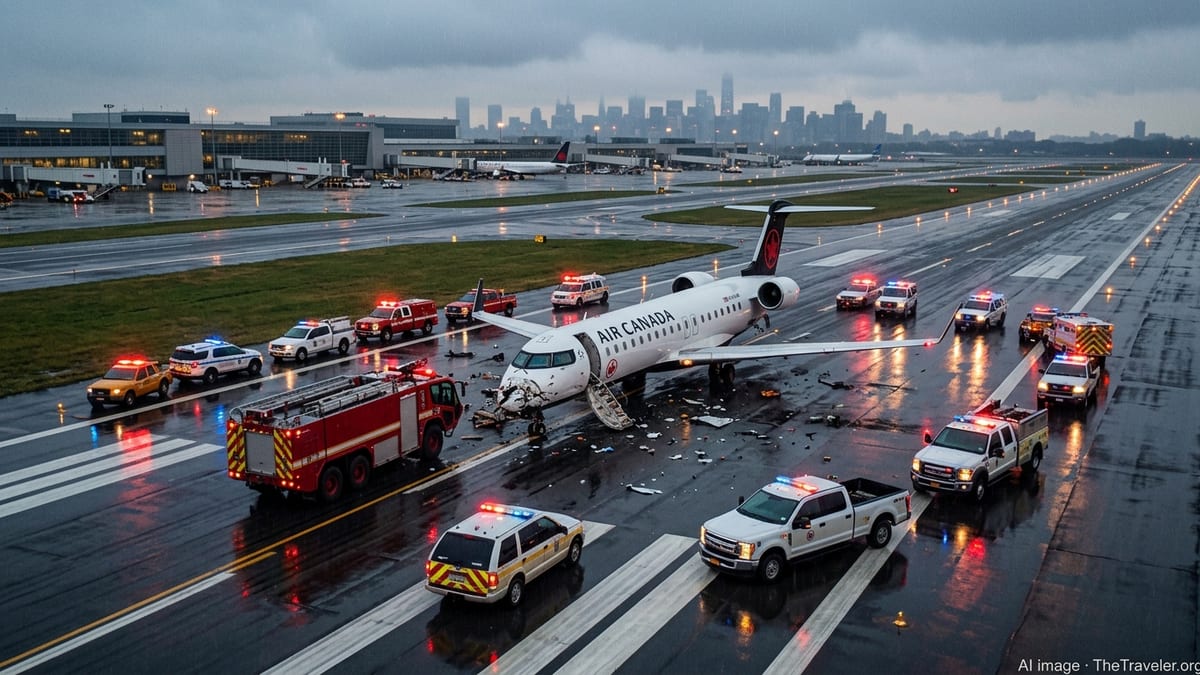
Runway 4/22 Shut After Early-Morning Inspection
Publicly available information indicates that the sinkhole was detected near Runway 4/22 during a routine airfield inspection on the morning of May 20, prompting an immediate shutdown of the strip at the busy Queens hub. The affected area lies along the eastern side of the airfield, where portions of the airport are built on landfill along Flushing Bay.
Coverage by multiple outlets describes the ground failure as a localized depression that appeared in the pavement near the runway surface, close enough to require suspending operations while engineers assess the underlying soil and drainage conditions. Initial assessments suggest the problem is confined to a limited section of pavement, but its proximity to aircraft movements has made a conservative safety response unavoidable.
The closure affects one of LaGuardia’s most heavily used runways for both arrivals and departures, particularly during peak bank periods. With the strip offline, controllers have been shifting traffic to the remaining runway configuration, reducing capacity at an airport already operating near its limits on a typical weekday.
Reports indicate that ground crews and contractors moved in quickly after the discovery, cordoning off the area and deploying heavy equipment to dig out and stabilize the compromised section of pavement. Visuals shared by local television and social media users show excavators, dump trucks, and fresh asphalt as teams work to rebuild the affected section from the base layers up.
Flight Delays and Cancellations Ripple Across Networks
Published coverage from airline tracking services and local news outlets shows that the runway shutdown has triggered a wave of delays and cancellations across LaGuardia’s schedule. With fewer arrival and departure slots available, carriers have been forced to consolidate flights, re-time departures, and in some cases cancel rotations entirely.
Data from flight-tracking platforms on Wednesday afternoon pointed to delays of an hour or more on some routes, particularly short-haul services that rely on tight turnarounds in New York. Travelers connecting through LaGuardia on popular business corridors to Boston, Washington, Chicago, and Toronto appear to be experiencing the heaviest disruption, with scattered knock-on effects at those destination airports.
Several airlines have issued public advisories encouraging passengers to check their flight status before leaving for the airport and to allow additional time for security and boarding. Some carriers are also offering limited change-fee waivers for customers booked to or from LaGuardia on the day of the incident, reflecting expectations that schedule irregularities could continue as the runway repair timeline becomes clearer.
Terminal crowds, according to local broadcast footage and social media posts, have grown through the day as passengers wait out rolling delays. Long lines at customer service desks and rebooking counters underscore how a single infrastructure issue at a slot-constrained airport can quickly cascade into a broader operational challenge.
Viral Aerial Footage Highlights Runway Vulnerabilities
Helicopter footage and telephoto images broadcast by New York television stations have given travelers an unusually close look at the affected runway. Viewed from above, the sinkhole appears as a darker patch of excavated pavement bordered by bright construction vehicles and work lights, creating a stark contrast with the orderly geometry of surrounding taxiways and markings.
Clips shared across social platforms show arriving aircraft taxiing past the work zone on adjacent pavement, underscoring the tight footprint of LaGuardia’s airfield and the limited options available when one of its primary runways is taken out of service. Aviation enthusiasts have pointed out that portions of the airport sit atop decades-old fill and reclaimed shoreline, making subsurface stability and drainage ongoing concerns for infrastructure planners.
The incident at LaGuardia also comes at a time when regulators and airport operators across the United States are paying closer attention to extreme weather, sea-level rise, and aging infrastructure. Heavy rains, freeze-thaw cycles, and shifting groundwater can accelerate pavement degradation, increasing the risk of sudden surface failures such as localized sinkholes and voids.
While the specific trigger for the LaGuardia sinkhole has not yet been identified in public reporting, specialists note that runway and taxiway pavements are subject to repeated heavy loads from aircraft, as well as constant exposure to jet blast, de-icing fluids, and fuel residues. Any weakness in drainage systems or underlying soil can grow over time until the surface suddenly caves in, as appears to have happened near Runway 4/22.
Safety Measures and Inspection Protocols Under Spotlight
Reports on the incident highlight that the sinkhole was discovered during a planned morning inspection, a standard practice at major US airports intended to identify foreign objects, wildlife hazards, and pavement anomalies before daily traffic peaks. The discovery and rapid closure have been cited by aviation analysts as evidence that layered safety protocols are functioning as intended, even if the resulting disruption is frustrating for travelers.
LaGuardia, like other high-traffic airports, uses a combination of visual checks, periodic pavement condition surveys, and longer-term engineering studies to monitor runway health. These processes can include ground-penetrating radar, core sampling, and drainage inspections aimed at identifying voids or soft spots beneath the surface. The appearance of a visible sinkhole suggests that an underlying issue had progressed to the point where the asphalt could no longer span the gap below.
In the wake of the incident, attention is likely to turn to how often deeper structural checks are carried out on runways built over fill or near tidal waters. Industry observers note that airports constructed on reclaimed land may require more frequent monitoring and reinforcement, particularly as climate impacts and changing weather patterns place added stress on aging infrastructure.
Past federal reports on airport construction and maintenance at LaGuardia have already documented a pattern of scheduled overnight closures for pavement work and infrastructure upgrades, reflecting the constant effort required to keep the compact airfield in operational condition. The sinkhole may prompt a reassessment of those maintenance plans and timelines, especially around high-load areas near runway thresholds and intersections.
What Travelers Can Expect in the Coming Days
As of Thursday, repair crews are continuing to excavate and rebuild the affected section of pavement, and publicly available updates from airlines and airport trackers suggest that reduced runway capacity could persist until engineers are satisfied with the stability of the repaired area. The exact reopening time for Runway 4/22 has not been formally detailed in coverage, but reporting indicates that the work is being treated as a priority project.
Passengers with near-term travel plans through LaGuardia are being advised in public statements and travel alerts to monitor their airline apps or text notifications closely. Same-day rebooking options may be limited on popular routes, and some carriers may shift passengers to flights from nearby airports such as JFK or Newark where feasible.
Industry analysts note that once the structural repair is complete, additional time may still be needed for pavement curing, repainting of runway markings, and final inspections before aircraft are cleared to use the strip again. During that period, airlines and air traffic managers will continue to balance LaGuardia’s constrained capacity with regional demand, potentially leading to longer-than-usual taxi times and holding patterns during peak hours.
For now, the sinkhole has become the latest reminder of how quickly a localized infrastructure issue at one of the nation’s key urban airports can send shockwaves through airline networks and travel plans. Travelers passing through New York in the coming days are likely to feel those effects first-hand, even as crews race to restore full operations on the busy LaGuardia runway.