


More news on this day
Widespread flight cancellations and rolling delays across the Middle East are continuing to upend travel plans and strain the global aviation network, as conflict-driven airspace closures and damage at key hubs force airlines to slash schedules and reroute long-haul traffic.
Get the latest news straight to your inbox!
Conflict, Airspace Closures and a Strained Hub Network
Publicly available information shows that months of regional conflict have pushed the Middle East’s role as a global transit hub into an acute crisis, with airspace closures over Iran and several neighboring states triggering cascading operational problems. Aviation analyses indicate that within days of the first large-scale attacks in late February 2026, a substantial majority of scheduled capacity to and from the region was withdrawn as carriers halted services or diverted around closed skies.
Industry data compiled in recent economic briefings indicates that at the height of the disruption in early March, roughly three quarters of available seat capacity on Middle East routes had been removed compared with planned schedules. Corridors linking Asia-Pacific with Europe, Africa and the Americas, which rely heavily on Gulf hubs for one-stop connections, were among the hardest hit as flights were cancelled at short notice and aircraft were repositioned away from the region.
The resulting pattern has been a sharp contraction in connectivity through major hubs such as Dubai, Abu Dhabi, Doha and Kuwait City, with knock-on effects for airports across Europe, Asia and North America. Reports from airlines and airport operators describe a fluid situation in which partial resumptions of service are frequently interrupted by renewed security concerns, additional military activity or new temporary airspace restrictions.
Although some airports have reopened with limited operations after initial strikes and closures, capacity remains far below pre-conflict levels. Forecasts from aviation consultancies suggest that even under relatively optimistic scenarios, schedules through the main Gulf hubs are likely to remain constrained through the peak northern summer travel period.
Thousands of Flights Cancelled and Delayed Across Key Gateways
Travel tracking services and regulatory filings show that the wave of cancellations has numbered in the thousands, particularly during the first weeks of the crisis when airspace closures spread rapidly across the region. Regional hubs that collectively handled a significant share of global long-haul traffic before the conflict have faced repeated suspensions, with airlines pulling down large portions of their networks as operating and insurance risks spiked.
Dubai International and Abu Dhabi, two of the world’s busiest long-haul gateways, saw operations slashed after sustaining damage and facing repeated closure of surrounding airspace. Similar patterns have been reported at Kuwait International and several smaller regional fields, where strikes and drone activity have forced carriers to ground aircraft, divert arrivals and abandon turnaround schedules.
Beyond complete cancellations, delay statistics indicate that hundreds of flights on any given day have been running late as airlines attempt to operate limited services around restricted corridors and congested alternative routings. Longer flight times on detours through the Caucasus, Central Asia, Egypt or the eastern Mediterranean have complicated crew scheduling, aircraft rotations and airport slot management, amplifying disruption well beyond the immediate conflict zone.
Publicly available monitoring data for July 2026 points to a continued pattern of elevated disruption, with hundreds of services cancelled or heavily delayed on peak days at major airports including Dubai, Doha, Riyadh and Kuwait City. Travelers have reported uneven experiences, with some routes operating close to schedule while others are repeatedly rescheduled or withdrawn with little lead time.
Ripple Effects on Global Routes, Fares and Capacity
The Middle East’s position as a connective hub between continents means these cancellations are not confined to regional itineraries. Economic assessments from aviation bodies emphasize that corridors linking Asia-Pacific to Europe, Africa and the Americas are particularly exposed, as many one-stop itineraries depend on Gulf hubs for efficient connections.
With those hubs operating at sharply reduced capacity, airlines based in Europe and Asia have added some capacity on alternative routings but generally have not been able to fully replace lost Middle Eastern lift. This has contributed to higher load factors on many long-haul routes, tighter availability in premium cabins and rising fares for travelers seeking last-minute alternatives, particularly on Europe–Asia and Asia–Africa sectors.
Longer routings around closed airspace have also pushed up fuel burn and operating costs, putting additional pressure on airlines already grappling with elevated fuel prices linked to wider economic fallout from the conflict. Analysts note that some carriers with significant exposure to Middle Eastern transfer traffic are facing intensified financial strain, especially where their business models depend on high aircraft utilization and dense connecting banks.
For travelers, these network adjustments are often most visible in suddenly elongated journey times, extended layovers at substitute hubs, or unexpected rebookings through secondary airports. Travel agents and online booking platforms report a marked increase in demand for itineraries that avoid the Gulf entirely, even when such routes are longer or more expensive.
Passenger Experience: Stranded Travelers and Shifting Itineraries
Accounts shared through travel forums and social media over recent months describe thousands of passengers stranded or forced into complex rerouting as flights via the Middle East are cancelled. Many travelers with summer itineraries routed through Dubai, Doha or Abu Dhabi have reported receiving short-notice cancellations or significant schedule changes, sometimes without immediate guidance on rebooking options.
In numerous cases, passengers holding tickets issued by partner or codeshare airlines have had to work through the original ticketing carrier to secure refunds or alternative routes, lengthening resolution times. Some have turned to European or Asian carriers that offer one-stop connections avoiding the Middle East, while others have opted to postpone trips altogether rather than risk further disruption.
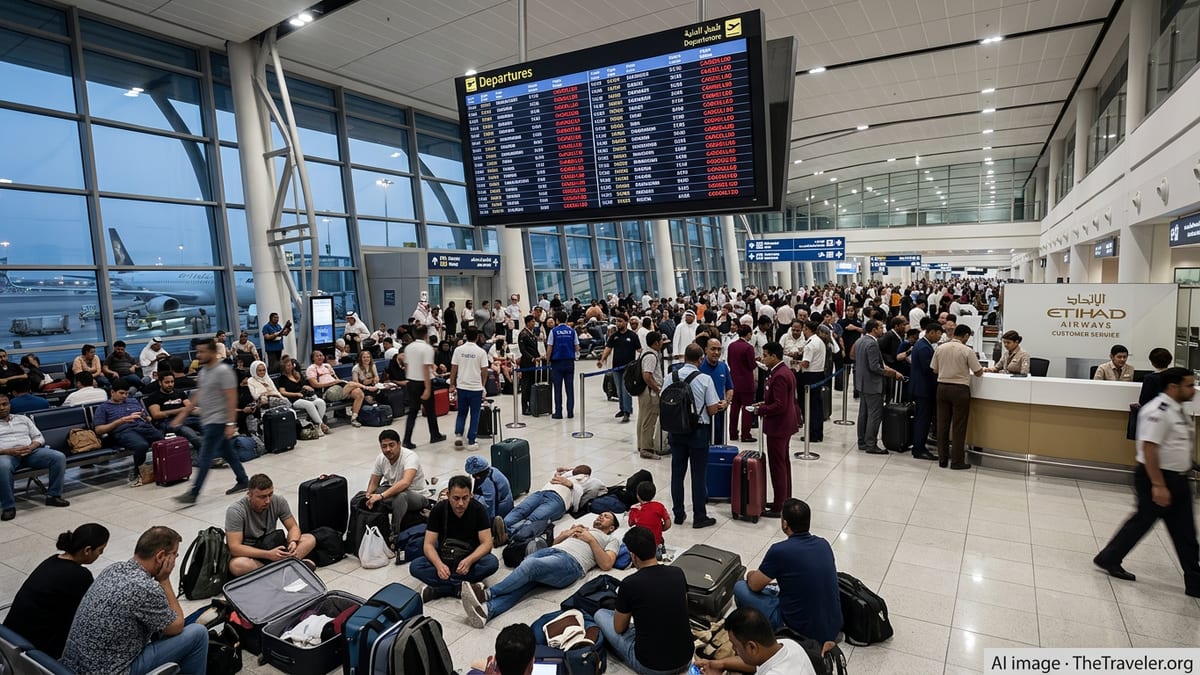
Reports from regional airports during peak periods of the crisis describe crowded terminal halls, long queues at transfer and ticket desks, and limited accommodation options as travelers wait for replacement flights. In several instances, evacuations and special relief flights organized by governments and carriers have added to the operational complexity, compressing airport resources already stretched by rolling delays.
Travel advisors increasingly recommend that passengers with itineraries touching the region build in additional buffer time, avoid tight connections and closely monitor airline apps and flight-status tools in the days leading up to departure. Flexible tickets and comprehensive travel insurance are also being highlighted as important safeguards in light of the rapidly changing conditions.
Outlook: Prolonged Disruption and a Re-shaped Transit Landscape
Analysts following the aviation sector caution that the Middle East’s flight disruption is likely to remain a defining feature of global travel for months, given the combination of security concerns, infrastructure damage and the time needed to rebuild airline schedules. Industry briefings suggest that some airspace restrictions could be eased gradually if security conditions improve, but warn that confidence among airlines, insurers and passengers may take longer to return.
Forward schedules indicate that a portion of capacity originally planned for the summer 2026 season through Gulf hubs has already been removed, with some carriers redeploying aircraft to intra-European, transatlantic or Asia–Pacific routes that do not require overflight of the most sensitive areas. This gradual reallocation of capacity hints at a broader rebalancing of the global hub-and-spoke system, at least in the short to medium term.
Emerging alternative routings through secondary hubs in Europe, Central Asia and parts of Africa may gain prominence as airlines and travelers look to diversify away from traditional Gulf connectors. However, constraints on airport slots, ground infrastructure and available widebody fleets limit how quickly these alternatives can scale to absorb displaced demand.
For now, prospective travelers with plans involving the Middle East are being advised by many travel providers to remain flexible, stay informed about evolving schedules and consider backup routing options where feasible. As the conflict’s trajectory remains uncertain, the region’s once-seamless transit network is likely to stay under significant strain, with widespread cancellations and delays continuing to reverberate through global air travel.