


Landing at Cusco’s Alejandro Velasco Astete International Airport is exciting and a little disorienting. You step out at 3,300 meters, feel the altitude, and within seconds a dozen drivers are calling out “Taxi, amigo?” Knowing what a ride should cost, which taxis are legitimate and how to avoid the small but real risk of scams can make your first 30 minutes in Cusco smooth instead of stressful. This guide walks you through exactly how airport taxis work today, what you should expect to pay, and the warning signs that something is not right.
Get the latest updates straight to your inbox!
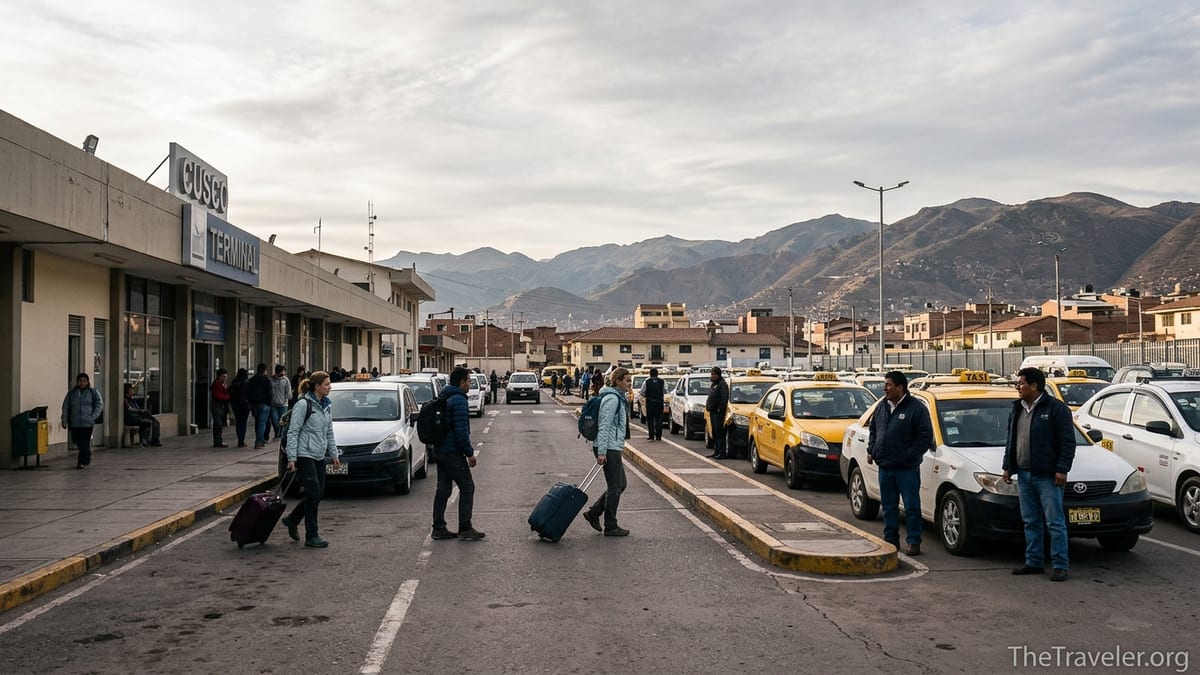
How Airport Taxis Work at Alejandro Velasco Astete Today
Alejandro Velasco Astete International Airport sits only about 4 to 5 kilometers from Cusco’s historic center, which is why rides are short and, by international standards, fairly cheap. The flip side is that taxi pricing is almost entirely informal. There are no meters and no posted, government regulated fare table, so every ride is based on agreement between you and the driver. Authorized taxi companies have service counters in the arrivals area of the terminal where you can arrange a ride at a fixed price, while independent drivers wait outside the terminal doors and around the airport access road.
Inside arrivals you will see small desks or kiosks marked as taxi or transfer services, often branded with names that include words like “Airport,” “Cusco,” or “Shuttle.” Staff will usually approach passengers as soon as they exit customs, offering a ride into town or directly to hotels in San Blas, Plaza de Armas or the San Pedro market area. These counters sell you a ride at a pre-agreed fare and then walk you to the driver outside. You pay either at the counter or directly to the driver, depending on the company’s policy.
Once you step outside the sliding doors, the atmosphere changes. A line of clearly marked taxis waits at the curb, but you will also encounter individual drivers, some holding handwritten signs, others simply calling out destinations. Many are legitimate independent drivers, but there is more pressure to accept an offer immediately and more room for misunderstanding about the fare. Knowing the going rate before you leave the building is the single most useful piece of preparation you can do.
Shared vans and hotel transfers add another layer. A number of hotels in Cusco will send their own trusted drivers to pick you up if you arrange it by email or messaging ahead of time. Separately, pre-booked transfer companies operate private cars and vans that meet you with a sign in arrivals. These usually cost more than a street taxi but are comparable to or slightly below airport counter prices, with the benefit of knowing the price before you fly.
What You Should Expect to Pay: Realistic Fares
Because there are no meters, fares fluctuate, but a few real-world numbers help anchor expectations. As of mid 2026, many travelers report paying in the range of 15 to 25 soles for a standard taxi from the airport to hotels near Plaza de Armas or San Blas when they negotiate directly with a driver outside. That is roughly the price local residents expect to pay during daytime for a straightforward trip without heavy traffic, and it reflects the short distance from the airport to the historic center.
Official counters inside the terminal often quote more. Depending on the company and season, quotes of around 30 to 40 soles for the same airport to center trip are common, and during peak dates such as Inti Raymi in June or Christmas and New Year you may hear prices in the 40 to 50 soles range. In practice, this means you can easily pay double the street rate for the convenience and perceived safety of arranging a ride inside arrivals, though you are still paying far less than airport taxis in many other countries.
Longer rides from Cusco airport are where prices start to vary dramatically. A private car from the airport to Pisac or Urubamba in the Sacred Valley often runs in the 120 to 200 soles range depending on the hour and vehicle size, while direct airport to Ollantaytambo quotes can range from about 150 soles with a local driver to 65 to 80 US dollars when negotiated in a hurry with an airport taxi during late evening arrivals. In other words, two families arriving on the same flight can easily pay very different amounts for the same route simply based on how much they negotiate and whether they booked ahead.
Pre-booked online transfer services commonly quote in US dollars for simplicity. For example, a private car from Cusco airport to a central hotel might be priced around 8 to 15 dollars, with vans for four to six passengers priced around 15 to 25 dollars, depending on the provider and time of day. These rates sit between the cheapest local taxis and the most expensive last-minute airport quotes and can offer good value if you prefer to lock everything in advance.
Official Counters vs Informal Drivers: Which Should You Choose?
The main advantage of using an official taxi counter inside the terminal is predictability. The price is fixed at the desk, the company is registered with the airport authority, and if you forget luggage or have a dispute, there is a clear place to come back to. For solo travelers arriving late at night, first-time visitors to Peru or anyone nervous about their Spanish, that extra structure is often worth the premium of 10 to 20 soles over what you might negotiate outside.
Informal or independent drivers outside the terminal appeal mainly on price. Walking past the first line of eager drivers and negotiating calmly at the edge of the airport property, many experienced travelers report easily securing 15 to 20 soles into the historic center, especially midday or in the early afternoon when traffic is lighter and there is steady competition for fares. Local residents do this as a matter of routine. The tradeoff is that there is rarely paperwork or a receipt, and if there is a problem later it may be difficult to track the driver down.
A middle ground is to use a well-reviewed local taxi or transfer company that you contact directly before your trip. They will assign a specific driver, share the vehicle plate number in advance and meet you in arrivals or just outside with a sign bearing your name. Prices are typically closer to airport counter rates than to street prices, but the communication is more personal and you know who is picking you up. Solo female travelers in particular often report feeling more comfortable with this approach than haggling curbside after a long flight.
Ride-hailing apps operate in Cusco in a somewhat patchy way. Apps like Uber or inDriver may show drivers around the airport, but airport authorities and traditional taxi companies have historically been hostile to them. Some visitors successfully use the app to get an estimate of a fair fare and then either complete the ride if a car appears, or use the quoted amount as a basis for negotiating with a regular taxi. This can be a useful reality check: if your app shows a 15 soles estimate and a driver insists that 50 soles is the “official” price for a central hotel at noon, you know you are being overcharged.
Negotiating Fares Without Drama
Since taxis in Cusco do not use meters, agreeing the price before the car moves is non-negotiable. A simple approach is to ask “Cuánto hasta [hotel name or area]?” and have a number in mind that is realistic. For a daytime trip from the airport to Plaza de Armas or San Blas, 15 to 20 soles is a fair counteroffer if a driver starts high. If you arrive at night, are carrying several large bags or need multiple stops, accepting 20 to 25 soles from a driver who seems professional and unhurried is reasonable.
Always confirm three details before you close the door: the total price, whether it is for the whole car or per person, and whether any extra charge will be added for luggage. A common misunderstanding is “per head” pricing. For example, a driver might say “20 soles” while pointing at your group of three; if you do not clarify, you may be presented with a 60 soles bill at the end. One quick question, “Veinte en total por todos, sí?” reduces the risk of surprise. If you do not speak Spanish, you can type the total amount in the calculator on your phone and show it to the driver with a questioning look.
It also helps to have small bills ready. Many drivers will claim not to have change for a 100 soles note, especially after dark when shops are closed. Paying 20 soles with an exact 20 avoids this issue. If you only have large bills, consider changing some money at an ATM or currency exchange in the airport before heading out. While airport exchange rates are not the best in Peru, having 40 to 60 soles in small notes can save you far more than the small spread on the exchange.
If at any point during the negotiation you feel rushed, pressured or uncomfortable, simply step back towards the terminal doors and decline with a polite “No, gracias.” One advantage of Cusco’s small size is that there will always be another taxi within sight in a matter of seconds. You are under no obligation to accept the first or loudest offer, and calm, polite firmness typically brings prices down to the normal range.
Luggage, Groups and Special Situations
Most airport taxis in Cusco are small sedans or compact hatchbacks. For two travelers with one suitcase and a small backpack each, this is perfectly adequate. Problems start when three or four adults arrive with large trekking packs and rolling suitcases. In that case you will need either a larger car or two vehicles. Some drivers will try to squeeze four passengers plus gear into a small car, but you are entitled to say no if it looks unsafe or uncomfortably cramped.
Expect modest surcharges for larger vehicles or out-of-the-way drop offs. A common pattern is an extra 5 to 10 soles for a van instead of a car, or a small bump in price if your accommodation is up a steep, narrow street in San Blas that requires extra maneuvering. It is better to agree that surcharge upfront. For example, a driver might say 20 soles to Plaza de Armas but 25 to reach a guesthouse on a hillside lane above San Blas. For a group of four, that difference is minor and often reflects real extra time and fuel.
Very early morning flights and late-night arrivals complicate matters slightly. Between about 10 p.m. and 6 a.m. demand drops, and some drivers will quote higher fares to compensate for empty return trips or to reflect perceived safety risks. Paying 25 to 30 soles to or from the airport during these hours is not unusual, and travelers going directly to the Sacred Valley at night will often be asked for significantly more. At these times, having a pre-arranged transfer from a hotel or a reputable operator is often worth it simply for peace of mind.
Families traveling with young children should be aware that child seats are rarely available in standard taxis. If you need a proper car seat, you will almost certainly need to arrange it with a private transfer company or bring a portable travel seat of your own. While local standards are more relaxed, insisting that children sit in the back seat and that everyone uses seat belts is a basic safety measure you should not compromise on.
Common Taxi Scams and How to Avoid Them
Most taxi rides in Cusco are uneventful, but a handful of recurring problems appear in traveler reports. The most common issue is aggressive overcharging: a driver agrees to a price, then demands more on arrival, claiming the fare was “per person,” that the distance was longer than expected or that there is an extra fee for luggage. This typically happens to visitors who did not clearly agree the total ahead of time or who feel rushed to get to a tour or train. Avoid it by stating the total fare up front, clarifying it covers all passengers and bags, and having the exact amount ready at drop off.
A second pattern involves drivers who insist midway through the journey that the hotel you requested is closed, dangerous or overbooked, and propose taking you to a “better” or “cheaper” option where they earn a commission. This is more common in other Peruvian cities but has been reported occasionally in Cusco. If you are told your hotel is closed, ask the driver to stop so you can call the property yourself, or simply insist they take you to the address anyway. Reputable drivers will respect your choice without argument.
There are also reports of drivers attempting to switch notes during payment, claiming that a 50 soles bill you handed over was actually a 10, or that your 100 was a 20. This scam relies on distraction and poor lighting. To protect yourself, state the amount as you hand it over, make eye contact and avoid handing over multiple bills at once in a dark car. If a dispute arises, calmly point out that you know what you gave and are willing to call the tourist police to clarify. The mere mention of tourist police usually ends the argument.
Finally, be cautious about surrendering passports or valuables to any driver for “registration,” “security” or any other reason. Your driver does not need to hold your passport or boarding pass at any time. If someone tries to take them, firmly refuse and, if necessary, step out of the vehicle with your belongings and walk back towards the well-lit, busier area of the airport. In Cusco, uniformed police and security staff patrol the curb and are generally responsive if a situation looks tense or confrontational.
Why Prices Vary So Much in Such a Short Ride
It can be baffling that one traveler pays 15 soles from the airport to the center while another pays 50 for the same distance. Several factors explain this disparity. First is simple market segmentation: drivers and counters adjust prices based on their read of your budget and urgency. A backpacker with no checked luggage who arrives midday and walks past the first row of taxis will often be quoted local-level rates. A family rolling out of baggage claim at night with multiple suitcases and children visibly exhausted is more likely to hear higher initial numbers and less flexible offers.
Time of day and traffic also matter. During the early morning rush and late afternoon, traffic between the airport and central Cusco can snarl quickly, turning a 15-minute ride into 30 minutes or more. Many drivers factor this into their quotes, especially if they risk missing a more lucrative longer trip while stuck in congestion. In contrast, at 2 p.m. on a weekday, when roads are clearer, drivers are more willing to accept lower fares and turn over shorter rides faster.
Supply and demand spikes around big events. During major festivals like Inti Raymi, regional holidays, large conferences or sudden flight disruptions, the number of arriving passengers can far exceed the number of taxis immediately available. On those days you may find that even informal drivers feel comfortable charging near counter rates or higher, simply because travelers are lining up and there is little incentive to bargain. Booking ahead or arranging a hotel pick up becomes more attractive in those circumstances.
Lastly, personal negotiation style plays a role. Visitors who ask locals at the airport café or information desk what a normal price is, and then approach taxis with that benchmark in mind, almost always fare better. By contrast, travelers who see the first quote as a fixed, official tariff often pay more than they need to. The good news is that even at the high end, airport taxis in Cusco remain relatively affordable compared with many international airports, so an occasional overpayment is more a matter of annoyance than financial damage.
The Takeaway
Taxi logistics at Alejandro Velasco Astete International Airport are straightforward once you know the local rules: no meters, always agree the fare before moving, and be prepared to pay a little more for extra safety or convenience if that suits your comfort level. Official counters inside arrivals offer fixed prices and clearer accountability at a premium; informal drivers outside provide lower fares but require more active negotiation. Pre-booked transfers and hotel pickups sit in between, trading a bit of extra cost for peace of mind.
For most travelers, aiming for a fare of 15 to 25 soles from the airport to central Cusco during the day, and 20 to 30 soles at night, is realistic. Longer journeys into the Sacred Valley will naturally cost more, and obtaining at least a rough quote before you arrive is wise. Keep small bills handy, clarify that the price quoted is the total for everyone and all bags, and avoid handing over passports or valuables to anyone who is not an immigration or security officer.
If you find yourself facing an unusually high quote, pressured to change hotels or confused by last-minute changes to the agreed fare, remember that you can always walk back towards the terminal, seek out a different driver or ask airport staff or tourist police for help. With a bit of preparation and a willingness to say no when something feels off, your first ride in Cusco can be just another pleasant step towards Machu Picchu, the Sacred Valley and the rest of your Andean adventure.
FAQ
Q1. How much should a taxi from Cusco airport to the historic center cost?
For most travelers arriving during the day, a fair price is usually between 15 and 25 soles for a standard taxi to areas around Plaza de Armas, San Blas or San Pedro market.
Q2. Is it safer to use the official taxi counters inside the airport?
Official counters generally offer more structure and accountability, which many travelers find reassuring, especially at night, though you will often pay 10 to 20 soles more than the street rate.
Q3. Can I negotiate the taxi fare at Cusco airport?
Yes. Because taxis do not use meters, prices are negotiable. Always agree the total fare before the car moves and confirm it covers all passengers and luggage.
Q4. Are ride-hailing apps like Uber reliable at Cusco airport?
Ride-hailing apps operate inconsistently around the airport. Some travelers successfully use them, while others find few cars available, so treat in-app prices as a guideline rather than a guarantee.
Q5. Do I need to pay extra for luggage in Cusco airport taxis?
Most taxis include normal luggage in the fare, but some drivers try to add a small surcharge. To avoid disputes, ask if the quoted price includes all bags before you accept the ride.
Q6. What should I do if a driver demands more money at the end of the ride?
Calmly remind the driver of the agreed total, pay that amount, and, if necessary, mention that you are willing to involve tourist police. Having the exact fare in small bills helps reduce conflict.
Q7. Is it normal to be asked for payment per person instead of per car?
Some drivers try to switch to per-person pricing, especially for groups. Make sure to confirm that the price is for the whole car by asking clearly before you get in.
Q8. Are taxis from Cusco airport safe for solo female travelers?
Many solo female travelers use airport taxis without issues, but using an official counter, a reputable pre-booked transfer or a hotel-arranged pickup offers an extra layer of safety.
Q9. How far in advance should I arrange a private transfer from the airport?
Booking a private transfer at least a few days before arrival is usually sufficient, but during peak holiday periods or major festivals, reserving one to two weeks ahead is wise.
Q10. Can I pay for a Cusco airport taxi with a credit card?
Most taxis are cash only. A few official counters might accept cards, but you should not rely on it, so withdraw or exchange enough soles at the airport to cover your first rides.