


More news on this day
Hundreds of flights across the Middle East have been scrapped this week as Saudia, Emirates and Etihad collectively cancel 249 services, highlighting how regional conflict, volatile airspace restrictions and rising fuel costs continue to disrupt aviation in one of the world’s busiest travel corridors.
Get the latest news straight to your inbox!
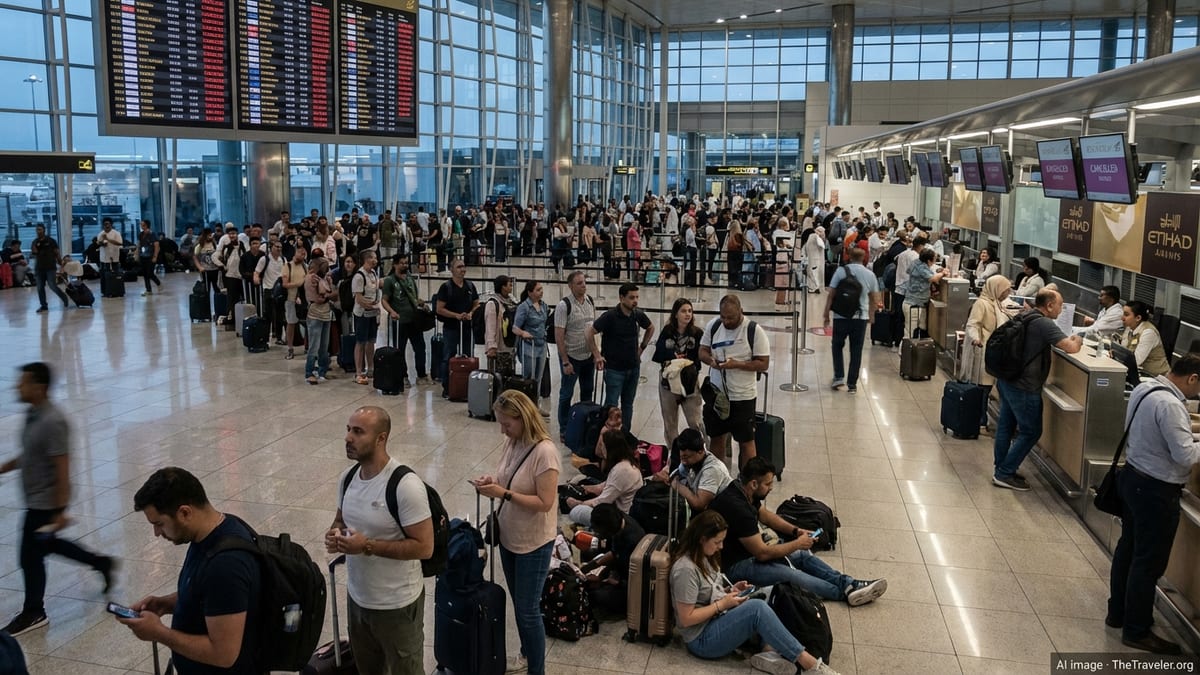
Concentrated Cancellations Across Key Hubs
Publicly available schedules and news coverage show the latest round of cancellations clustered around major Gulf and Saudi hubs, with services touching Dubai, Abu Dhabi, Jeddah and Riyadh bearing the brunt. While individual airlines have not always published full route-by-route breakdowns, aggregated data on disrupted operations indicates that some 249 flights scheduled by Saudia, Emirates and Etihad have been withdrawn over several consecutive days.
Reports on regional operations point to a mix of domestic and international services being affected. Saudia has trimmed frequencies on certain high-density regional routes, particularly to Gulf neighbours, while also adjusting selected medium haul services. Emirates and Etihad, which rely heavily on transit traffic through Dubai and Abu Dhabi, have concentrated cuts on rotations where conflict-related diversions and longer routings make operations less economical or more exposed to airspace uncertainty.
Industry analyses suggest that the cancellations come on top of a broader capacity reset in the region during 2026. Traffic out of key Middle Eastern hubs remains well below 2025 levels, with major carriers still operating a reduced schedule relative to their pre-crisis networks even as they gradually restore long haul links to Europe, North America and Asia.
Airspace Closures and Conflict Pressure Operations
The latest disruption is closely tied to the evolving security situation across the Middle East. Coverage by international outlets has documented how the conflict involving Iran and the United States and Israel has repeatedly forced countries to close or restrict sections of their airspace, particularly over the Gulf and parts of the Levant. These closures have triggered cascading knock on effects for airlines that rely on dense east–west traffic flows through the region.
At various points in 2026, carriers have been compelled to suspend departures entirely from key hubs, as occurred in Abu Dhabi when Etihad halted all commercial flights for a limited period because of regional airspace constraints. Even after some states eased restrictions, corridors over Iraq, Iran and Syria have remained tightly controlled or avoided altogether, pushing flights onto longer, more fuel intensive paths and complicating fleet and crew planning.
Slot coordinators and airport operators in the Gulf and Saudi Arabia have reported elevated cancellation rates since March, with some airports seeing more than a third of planned movements withdrawn in the most severely affected weeks. While those percentages have eased from their peak, the cumulative impact remains significant, and the 249 flights pulled by Saudia, Emirates and Etihad form part of this wider pattern of irregular operations.
Financial and Operational Strain on Carriers
The withdrawal of such a large block of flights within a compressed period underscores the financial and operational pressures facing the region’s airlines. Analyses by aviation consultancies indicate that Gulf carriers have been operating at a fraction of their previous traffic volumes since the start of the year, with Emirates, Etihad and Saudia all carrying far fewer passengers than in 2025.
Higher fuel prices linked to the conflict, combined with circuitous routings and sporadic airspace access, have eroded margins on many routes. In response, airlines have adopted a mix of capacity cuts, load consolidation and schedule thinning to protect yields. Long haul flights deemed strategically essential have often been preserved, while shorter regional links and secondary destinations have borne a disproportionate share of cancellations.
Fleet deployment has also become more complex. Widebody aircraft that once cycled predictably between European, Asian and African destinations now face irregular duty patterns as airlines adjust in real time to temporary corridor openings or new advisories. This volatility raises crew rostering and maintenance planning challenges, contributing to the need for preemptive cuts such as those that produced the latest 249 lost flights.
Passenger Impact and Changing Travel Patterns
For passengers, the latest wave of cancellations translates into missed connections, extended layovers and, in some cases, outright trip cancellations. Public guidance from airlines and regulators has repeatedly urged travellers to monitor flight status up to departure and to allow extra time for rebooking, particularly on itineraries connecting through Dubai, Abu Dhabi, Jeddah and Riyadh.
Several carriers in the region, including Emirates and Etihad, have temporarily relaxed some change and refund rules during earlier phases of the crisis, offering rebooking windows or refunds on affected tickets. However, consumer advocates note that policies vary by fare type and route, and that high seasonal demand on surviving services can limit the availability of alternative seats, especially on popular Europe–Asia and transatlantic connections.
Travel search data and industry commentary indicate a measurable shift in booking patterns. Some passengers are routing via alternative hubs beyond the immediate conflict zone, even when this involves additional stops. Others are postponing discretionary travel to or through the Middle East, waiting for more stable schedules and clearer guidance on airspace risks before committing to long haul itineraries.
Outlook for Recovery and Network Rebuilding
Despite the immediate disruption, recent airline updates suggest that major Gulf and Saudi carriers still aim to rebuild their networks progressively through the second half of 2026, provided that the security environment does not deteriorate further. Emirates has highlighted the restoration of a large share of its global destinations, while Etihad and Saudia have focused on maintaining core regional and long haul links even as they trim frequencies on others.
Airport coordination data indicates that cancellation rates across Middle Eastern airports have eased from the extreme highs recorded in March and April, when more than half of scheduled slots were pulled at some hubs. Current levels remain elevated by historical standards but point to a gradual normalization as carriers recalibrate schedules to reflect persistent airspace constraints.
Aviation analysts caution that any additional flare up in regional tensions, new missile or drone activity, or unexpected airspace closures could rapidly reverse that progress and trigger another wave of large scale cancellations. For now, the 249 flights removed by Saudia, Emirates and Etihad serve as a tangible measure of how fragile the recovery remains, and how closely the region’s role as a global aviation nexus is tied to developments far beyond the terminal and runway.