


More news on this day
Rail traffic has resumed between Gothenburg and Borås in western Sweden, three weeks after a freight train derailed near Bollebygd and forced the closure of one of the country’s busiest diversion routes during the summer rail works.
Get the latest news straight to your inbox!
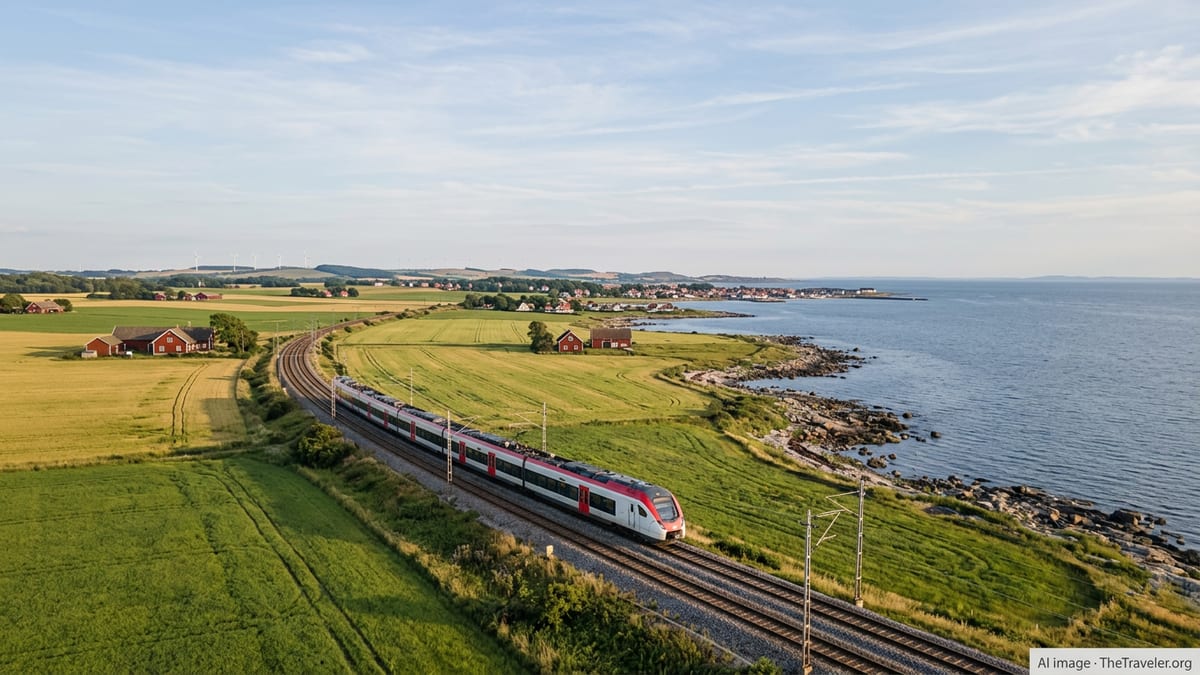
Passenger trains return after weeks of disruption
Passenger services on the Gothenburg–Borås line restarted on July 16, following the completion of intensive track repairs and safety checks along the affected section east of Bollebygd. The reopening restores an important regional link across Västra Götaland and eases pressure on Sweden’s strained summer rail network.
According to publicly available information from the Swedish Transport Administration, the derailment occurred on June 25 when a freight train left the tracks outside Bollebygd, damaging rails, sleepers and ballast over a significant stretch. No injuries were reported, but all traffic on the line was halted while investigators and engineering teams secured the area and began reconstruction of the track structure.
During the closure, regional operators redirected many trains and relied on extensive rail replacement buses. Services between Gothenburg and Borås, as well as longer-distance routes onward toward Kalmar and Stockholm that were temporarily funneled via Borås due to other maintenance projects, had to be adjusted or rerouted, leading to longer journey times and crowded services.
The line’s reopening is expected to restore a more predictable timetable for commuters, leisure travelers and international visitors using Gothenburg as a gateway to western and southern Sweden during the peak holiday period.
Rebuilding the line near Bollebygd
Reports from the infrastructure manager describe a complex restoration effort along the damaged section near Bollebygd. Crews removed the derailed wagons, cleared debris and then set about replacing destroyed sleepers, twisted rail and contaminated ballast. Heavy machinery was brought in to lift out old track panels and install new ones under tight time pressure.
In the week leading up to the reopening, the new rail was welded into continuous lengths and additional ballast was packed under and around the sleepers to stabilize the formation. Once the physical reconstruction was complete, the line underwent a series of inspections, including geometry measurements and checks of signalling equipment, before test runs could take place.
Publicly available information indicates that the infrastructure manager aimed to reopen the line as soon as it could be certified for safe operation, while still coordinating with ongoing planned works elsewhere in the region. The result is that trains are returning to normal operation roughly three weeks after the initial derailment, a relatively rapid turnaround for an incident involving substantial track damage.
For passengers, most of the work has been invisible beyond the disruption to their journeys, but the completed repairs now underpin the reliability of services over the coming months as traffic levels remain high.
Key diversion route during major summer works
The Gothenburg–Borås corridor has taken on outsized importance this summer as a strategic diversion route during extensive renewal works on the Western Main Line between Gothenburg and Alingsås. According to published coverage and planning documents, many long-distance trains between Gothenburg and Stockholm have been diverted via Borås and Herrljunga, adding both travel time and traffic density to the regional line.
When the freight derailment shut the Gothenburg–Borås line, these diversions were abruptly cut, forcing operators to rely on alternative routings via other corridors or to substitute trains with coaches. Passengers on routes connecting Gothenburg with Borås, Kalmar and Stockholm encountered replacement buses, extra transfers and crowded services on remaining open lines.
The reopening therefore restores not only local commuter links but also an important relief valve for Sweden’s intercity network during a period of exceptional maintenance activity. With the line back in use, diverted long-distance services can again share the corridor with regional trains, distributing traffic more evenly and reducing the risk of cascading delays.
For travelers planning rail journeys in southern Sweden over the rest of the summer, the restored connectivity between Gothenburg, Borås and onward junctions should translate into more options, fewer forced bus segments and better on-time performance, although operators still advise checking timetables close to departure because planned works continue elsewhere on the network.
Impact on commuters and regional mobility
The three-week closure of the Gothenburg–Borås line has highlighted how dependent western Sweden has become on a small number of rail corridors for both daily commuting and longer-distance travel. The affected line links Gothenburg, Sweden’s second-largest city, with Borås, a growing regional center with significant textile, logistics and service industries.
During the disruption, commuters between the two cities and surrounding communities faced longer journey times and less predictable connections. Bus replacements navigated peak-hour road congestion around Gothenburg, while some passengers opted to drive rather than risk missed transfers, adding traffic to already busy highways.
With trains now back on the tracks, regional planners expect a gradual return to normal patronage as commuters regain confidence in the rail link. The corridor serves not only point-to-point travel between the two cities but also smaller stations in between, providing access to jobs, education and services for residents in more rural parts of Västra Götaland.
Tourism has also been affected. The Gothenburg region is a major summer destination, and Borås positions itself as a base for exploring surrounding nature areas and towns. The resumption of direct trains simplifies planning for visitors who prefer to rely on public transport rather than renting a car.
Safety focus and future upgrades
The Bollebygd derailment has renewed attention on the resilience and capacity of the Gothenburg–Borås line at a time when long-term plans call for significant upgrades. Publicly available policy documents note that the corridor is earmarked for future double-track construction as part of broader efforts to expand high-capacity rail in southern Sweden.
While the precise cause of the June 25 freight derailment remains subject to ongoing technical analysis, industry observers point to the incident as a reminder of how a single failure on a busy single-track route can disrupt traffic over a wide area. When the line closed, both regional and long-distance services lost a key link, demonstrating the vulnerability of critical nodes in the network.
Current national investment plans foresee increased spending on maintenance and upgrades across Sweden’s rail system over the coming decade, including measures aimed at reducing backlogs and improving safety. Strengthening diversion routes such as Gothenburg–Borås is seen as important for keeping traffic moving when primary main lines are undergoing renewal or affected by incidents.
For travelers, the immediate message is that rail services between Gothenburg and Borås are running again after three challenging weeks. In the longer term, the episode may add urgency to discussions about accelerating capacity and safety improvements so that future derailments or infrastructure failures have a less severe impact on both local passengers and long-distance journeys across the country.