


More news on this day
Thousands of passengers are facing cancellations, diversions and extended travel times as airlines around the world scale back or suspend services across the Middle East amid the intensifying US–Iran conflict.
Get the latest news straight to your inbox!
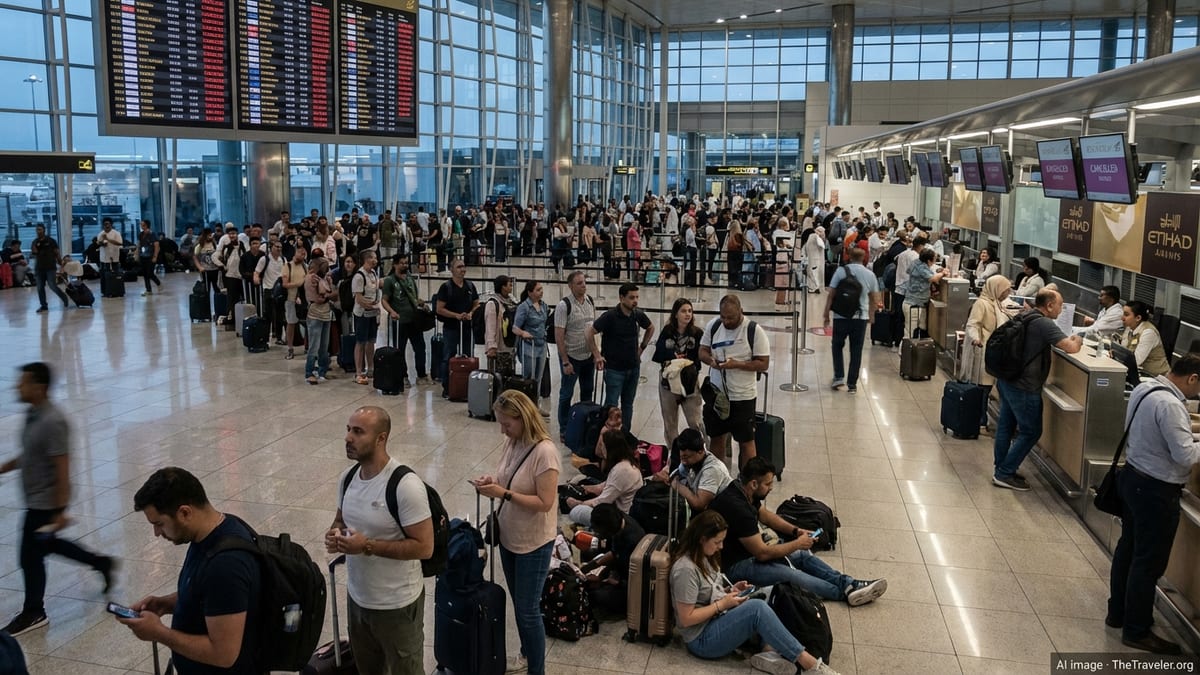
Widespread airspace closures choke regional hubs
Rapidly shifting security conditions since late February 2026 have led to rolling airspace closures across Iran, Iraq, Israel, Kuwait, Qatar, Bahrain, Syria and parts of the United Arab Emirates, according to publicly available aviation notices and industry briefings. Several major airports that collectively handle a significant share of global traffic have seen normal operations suspended or severely curtailed, affecting both point-to-point and connecting journeys.
Analysts tracking the disruption indicate that more than 50,000 flights have been cancelled or materially impacted since the conflict flared, with cancellations spiking following major strikes and retaliatory attacks. Dubai, Abu Dhabi and Kuwait City, usually among the busiest transfer hubs worldwide, have endured periods where most scheduled departures were grounded, forcing airlines to park aircraft or reposition them to secondary gateways.
In Iran itself, international connectivity has largely collapsed. Flight information for Tehran’s Imam Khomeini International Airport shows that all scheduled commercial services remain suspended, cutting off one of the region’s primary long-haul gateways. With Iranian skies effectively off limits and corridors over neighbouring states periodically closed, carriers have been forced into longer reroutes that skirt the Middle East entirely, adding hours to journeys between Europe and Asia and pushing up fuel and crew costs.
Industry outlook reports suggest these conditions will persist in the short term, with planners modelling continued volatility in regional airspace availability. While limited corridors open on some days, the pattern of short-notice closures is making it difficult for airlines to publish reliable schedules far in advance.
European and Asian airlines extend suspensions
European flag carriers were among the first to suspend services into the conflict zone, and many have kept restrictions in place into the peak northern summer season. Publicly available timetables and corporate updates indicate that Air France, Lufthansa, British Airways, ITA Airways and other European operators have either halted flights to cities such as Tehran, Tel Aviv, Beirut, Baghdad and Dubai or sharply reduced frequencies.
Coverage from regional and international media shows that multiple European airlines have also adopted strict overflight bans, avoiding the airspace of Iran, Iraq, Israel, Lebanon, Jordan and Syria. Some have suspended flights to Gulf hubs entirely for defined periods, while others are operating a skeleton schedule that can be adjusted at short notice. Budget affiliates and leisure-focused brands have cancelled a number of seasonal services to resort destinations accessed via Middle East connections.
Asian carriers have taken similar action. Reports on network changes indicate that Air India, IndiGo, Biman Bangladesh Airlines, Cathay Pacific, Korean Air and several Southeast Asian airlines have suspended or reduced services to major Gulf hubs and Israeli airports since the start of the conflict. Some have pushed back planned launches of new routes to Dubai and Abu Dhabi, while others have shifted capacity to alternative transit points in Central Asia or Europe.
Across both Europe and Asia, airline statements and schedule data point to a cautious approach: even where limited operations to the region continue, most long-haul carriers are avoiding routings that require transiting Middle Eastern airspace, preferring longer but more predictable polar or southern tracks.
Gulf and regional carriers cut frequencies and routes
Gulf-based airlines, which rely heavily on their hub-and-spoke networks linking Europe, Africa, Asia and Oceania, have been hit particularly hard. According to industry digests, Emirates, Etihad Airways, Qatar Airways and Air Arabia have all cancelled or suspended flights to certain neighbouring states during periods of heightened tension, including Kuwait and Bahrain, where airspace and airport operations have been intermittently restricted.
With their home hubs close to potential conflict zones, these carriers have faced days where the majority of flights could not depart as planned. Aviation community reports from late February described scenarios in which more than 90 percent of movements at Dubai International Airport were grounded after regional airspace closures, affecting transit passengers from as far away as North America and Australia.
Beyond the Gulf, national airlines in Lebanon, Iraq and Jordan have also significantly reduced operations. Passenger accounts and local media coverage from Beirut’s Rafic Hariri International Airport in early March described departure boards dominated by cancellations, including services by Lufthansa, Air France, Transavia, Qatar Airways and Pegasus. Route maps for several Middle Eastern carriers show temporary suspensions on links to Tel Aviv, Beirut, Erbil and other cities close to active fronts.
Some regional airlines have indicated in public updates that they are focusing on essential repatriation and limited regional services when airspace is available, while deferring the full reinstatement of commercial schedules until security conditions and insurance requirements stabilise.
US carriers scale back connections into the region
Although US airlines have relatively limited direct exposure to the Middle East compared with their European and Gulf counterparts, the conflict has still led to notable changes. According to corporate schedules and sector analyses, American Airlines has suspended its New York to Tel Aviv route through at least early 2027, removing one of the few nonstop US links to Israel.
Other US carriers have largely relied on codeshare agreements with European and Gulf partners to provide access to Middle Eastern destinations. With many of those partners suspending flights or closing specific routes, practical connectivity from North America into the region has dropped sharply even where US-branded flights remain technically available for sale.
Analysts note that some North American airlines have rebalanced capacity toward transatlantic and Latin American markets, where demand remains strong and operational risk is lower. At the same time, higher fuel costs and longer flight times on Europe–Asia routes, driven by detours around the Middle East, are indirectly affecting US carriers’ global networks through aircraft and crew rotations.
For travellers in the United States, the most immediate impact is reduced choice and higher reliance on multi-stop itineraries via secondary hubs, often with longer layovers and less predictable connections.
Extended disruption reshapes global travel patterns
The longer the conflict persists, the more structurally significant its impact on global aviation appears to become. Economic assessments of the war highlight that airlines are not only facing lost revenue from cancelled flights but also enduring sustained increases in operating costs from detours, war-risk insurance premiums and schedule disruption.
Some carriers have begun to permanently reconfigure networks, favouring routes that avoid the Middle East entirely and diverting connecting traffic to alternative hubs in Europe, Central Asia and East Africa. Industry forecasts suggest that even if a durable ceasefire allows airspace to reopen, it may take months for full schedules at major Middle Eastern hubs to return, given the need to reposition aircraft, retrain crews on revised routings and rebuild passenger confidence.
For passengers, the patchwork of suspensions, resumptions and reroutes means that checking flight status and route details has become essential when planning trips involving the region. Travel advisers widely recommend building in additional time for connections, being prepared for last-minute changes and considering flexible tickets, as airlines continue to adjust operations in response to evolving security conditions.
With the US–Iran conflict still unresolved and regional tensions periodically flaring, aviation observers expect Middle East flight disruptions to remain a defining feature of the global travel landscape through at least the near term, influencing fares, schedules and route maps far beyond the immediate conflict zone.