


More news on this day
Commercial aviation across the Middle East and surrounding corridors is holding relatively steady despite renewed Iranian attacks on regional targets, with most airlines maintaining services through rerouted flight paths and temporary schedule adjustments rather than widespread cancellations.
Get the latest news straight to your inbox!
Fresh attacks test a fragile regional aviation network
The latest wave of Iranian missile and drone launches toward United States and allied facilities in Bahrain, Kuwait, Jordan and other Gulf states has again put the region’s aviation system under scrutiny. Publicly available information from regional monitoring groups and media coverage indicates that alerts were issued around several key hubs following the strikes, prompting short-lived airspace restrictions and changes in flight activity rather than wholesale shutdowns.
Reports describe how radar tracks briefly thinned around Bahrain, Kuwait and parts of the United Arab Emirates as airlines steered clear of potential risk zones and air traffic controllers paused some movements. However, major passenger airports that had faced outright closures earlier in the conflict, such as Dubai International and Abu Dhabi, have largely remained operational during the most recent escalation, handling arrivals and departures with tighter spacing and occasional holding patterns.
Aviation analysts cited in recent coverage emphasize that the Gulf’s dense web of hubs and air corridors leaves limited room for error when hostilities flare. Even so, the pattern emerging in July suggests that militaries and civil aviation authorities are increasingly calibrating responses to preserve commercial flows where possible, relying on time-bound restrictions and corridor-specific closures instead of regionwide bans.
Airlines favor rerouting over mass cancellations
Industry tracking shows that, unlike the widespread cancellations seen in late February and early March when the Iran war erupted and multiple states closed their airspace entirely, the current phase has been marked more by reroutings and modest schedule trims. According to recent factbox-style reporting from international financial media, several European and Asian carriers have restored services to select Middle Eastern destinations after earlier suspensions, while keeping some routes halted or reduced in frequency.
Flag carriers based in the Gulf appear to be prioritizing core trunk routes and high-demand connections. Coverage focused on Dubai and Doha indicates that airlines are operating with thinner schedules than before the conflict, but they are avoiding large new waves of cancellations in response to the latest strikes. Instead, flights are being rescheduled, consolidated onto larger aircraft, or rerouted along northerly or southerly corridors that bypass temporarily sensitive airspace.
Credit and risk assessments issued in recent months suggested that, barring a complete closure of multiple Gulf airspaces, the global financial impact of the conflict on aviation would likely remain contained. The current pattern of limited, localized disruption following Iran’s renewed attacks broadly aligns with those earlier expectations, with airlines demonstrating an ability to flex capacity and adjust routings at short notice.
Regional hubs stay open but operate under strain
Dubai International, Abu Dhabi, Doha and other major hubs that sit astride Europe–Asia traffic flows continue to shoulder the burden of keeping passengers and cargo moving while coexisting with a live conflict environment. Earlier in the war, these airports suffered outright suspensions of movements following strikes and airspace closures, with images and flight-tracking data showing near-empty skies over the Gulf at the peak of the initial shock.
More recent reporting, however, points to a shift toward rapid recovery. After temporary halts triggered by security alerts or interception activity, traffic has generally resumed within hours at the main hubs, albeit with backlog-related delays. Observers tracking radar data describe arriving aircraft entering holding patterns over safer offshore or desert stacks while air defenses respond to suspected threats, after which airports work through accumulated queues.
This pattern suggests that contingency procedures developed earlier in the conflict are now being applied in a more calibrated fashion. Airport operators are publishing operational bulletins, while airlines lean on automated rebooking tools and flexible crew rostering to smooth irregular operations. The net effect is that passengers are more likely to face extended travel times and last-minute gate or routing changes than outright trip cancellations.
Global routes adjust to narrower corridors
One of the most significant ongoing impacts for travelers is the compression of long-haul flight paths into a smaller number of viable corridors. Industry analyses over recent months have highlighted how wars in both Ukraine and the Middle East have carved out large swaths of airspace that airlines prefer to avoid. The conflict involving Iran has further constrained options, pushing many carriers to favor tracks over the Caucasus, Central Asia or the eastern Mediterranean.
These detours add flight time and fuel burn, raising operating costs and occasionally necessitating technical refueling stops. For passengers, this translates into slightly longer scheduled block times and a higher risk of missed connections at busy hubs. Yet despite these pressures, most long-haul links between Europe, Asia, Africa and the Americas remain intact, relying on careful planning around military activity advisories and notices to air missions.
Publicly available assessments indicate that while insurers and lessors are closely monitoring exposures, there has not been a broad withdrawal of war-risk coverage or a systemic grounding of fleets linked specifically to the latest Iranian actions. Instead, the industry appears to be absorbing the additional complexity as part of a wider shift toward more resilient network planning in an era of recurring geopolitical shocks.
What travelers are experiencing on the ground
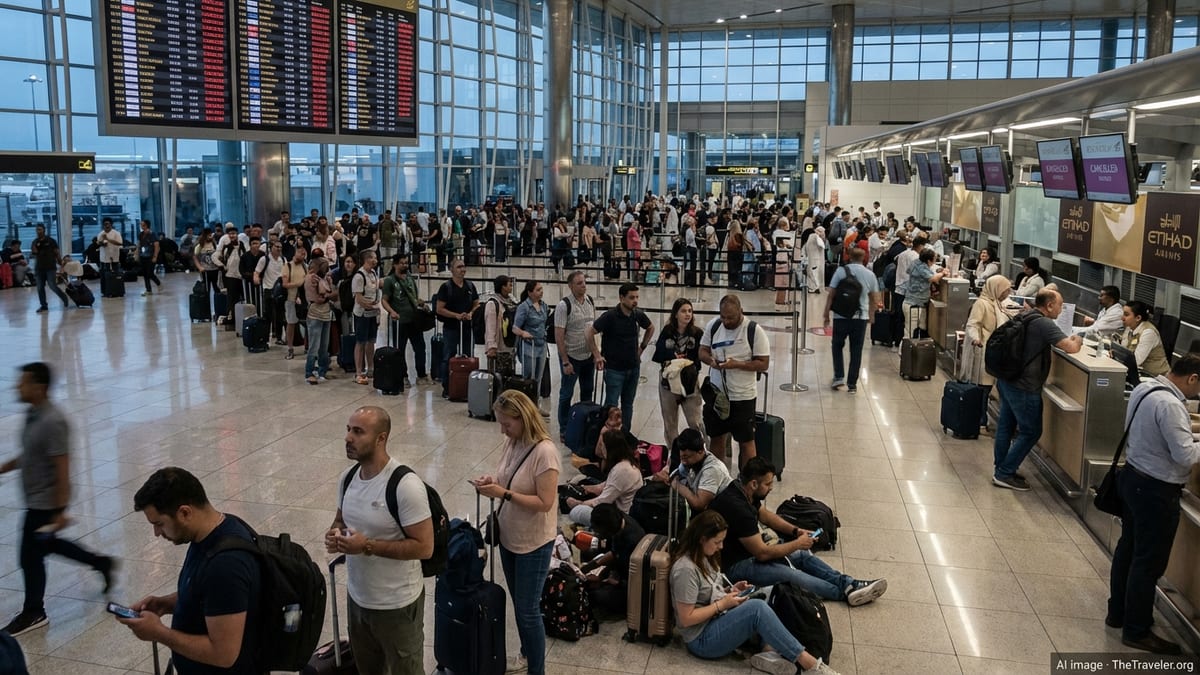
For passengers, the lived reality of “minimal disruption” is still far from seamless. Social media accounts and travel forums from the region describe a familiar pattern of rolling delays, last-minute gate changes and uncertainty about departure times when new attacks or alerts surface. However, they also point to a clear difference from the situation in late February and early March, when hundreds of thousands of travelers were stranded as airports abruptly closed and thousands of flights were cancelled over a matter of days.
In the current phase, many travelers are reaching their destinations the same day, even if journeys take several hours longer than planned. Airlines are generally offering rebooking options on alternative dates or routings when flights are consolidated or retimed, with some carriers relaxing change fees for itineraries touching affected hubs. Hotel lobby crowds and makeshift terminal camps that characterized the early days of the war appear less prevalent in recent imagery and passenger accounts.
Travel specialists recommend that anyone transiting the region in the coming days monitor their booking apps frequently, allow for longer connection windows, and remain prepared for routing changes that may add time but keep flights operating. Publicly available information from aviation data providers and regional media indicates that, for now, the system is bending rather than breaking, as airlines and airports adapt their playbooks to a conflict that shows little sign of immediate resolution.