


More news on this day
Tourism across the Middle East is entering a new period of uncertainty as the United Arab Emirates joins Iran, Qatar, Kuwait, Bahrain, Jordan, Saudi Arabia and other states in confronting heightened security tensions, evolving visa policies and persistent airspace disruptions that are reshaping how and whether travelers move through the region.
Get the latest news straight to your inbox!
Security Labels Fuel Perception Of A “Hostile” Region
Recent security classifications and travel warnings by Western governments are reinforcing a perception of parts of the Middle East as a high-risk or even “hostile” environment, placing pressure on destinations that only a year ago were promoting record visitor numbers. Publicly available advisories from the United States, Europe and several Asian governments now point to elevated risks linked to the 2026 Iran war, missile and drone strikes, and the related Strait of Hormuz crisis. In practice, this has meant more stringent screening for travelers with recent stays in Iran and neighboring states, as well as strong recommendations to reconsider nonessential travel to multiple Middle Eastern countries.
While terminology varies between governments, analysts note that the cumulative effect is a clustering of Iran and a number of Gulf and Levant states into a single perceived risk zone in the minds of travelers and insurers. Reports indicate that this is already influencing how airlines, tour operators and corporations assess itineraries that transit regional hubs such as Dubai, Doha and Riyadh. Even destinations not directly affected by strikes or closures are finding themselves drawn into a broader narrative of instability.
Industry monitoring suggests that this framing is beginning to interact with political rhetoric around “hostile” or high-risk bases in the region, including long-standing military facilities in Bahrain, Qatar and Kuwait. As security debates intensify, observers say there is a growing risk that travelers will conflate military designations and foreign policy disputes with the safety of commercial tourism, amplifying anxiety far beyond the areas actually affected by attacks.
Visa Processing Grows Uneven As Consulates Recalibrate
Alongside security language, visa and immigration processing across the Middle East has entered a more volatile phase. Legal and mobility specialists tracking the region report that consular posts in and around the Gulf are regularly adjusting appointment availability, documentation requirements and processing priorities in response to the conflict and to shifting demand. Some missions have temporarily reduced staff or relocated operations, while others are channeling capacity toward citizens and emergency cases, leaving business and leisure applicants facing longer waits and less predictability.
Available guidance from global immigration firms notes that exit permits remain unnecessary for most short-term visitors in key destinations such as the UAE, Qatar, Bahrain and Jordan, yet employers and travelers are being urged to build in more time for any new work or residency applications. In Saudi Arabia, where exit permissions are still required for many foreign workers, companies are being advised to review their mobility policies in light of potential short-notice travel needs and changing risk thresholds.
Paradoxically, these frictions are unfolding just as several Gulf countries seek to expand access through e-visa schemes and reciprocal facilitation for select nationalities. Recent coverage of Saudi Arabia’s growing e-visa network and regional discussions of more integrated Gulf visitor policies underline the tension between long-term diversification strategies built on tourism and the short-term constraints imposed by conflict and consular caution.
Flight Cancellations And Rerouting Hit Regional Hubs
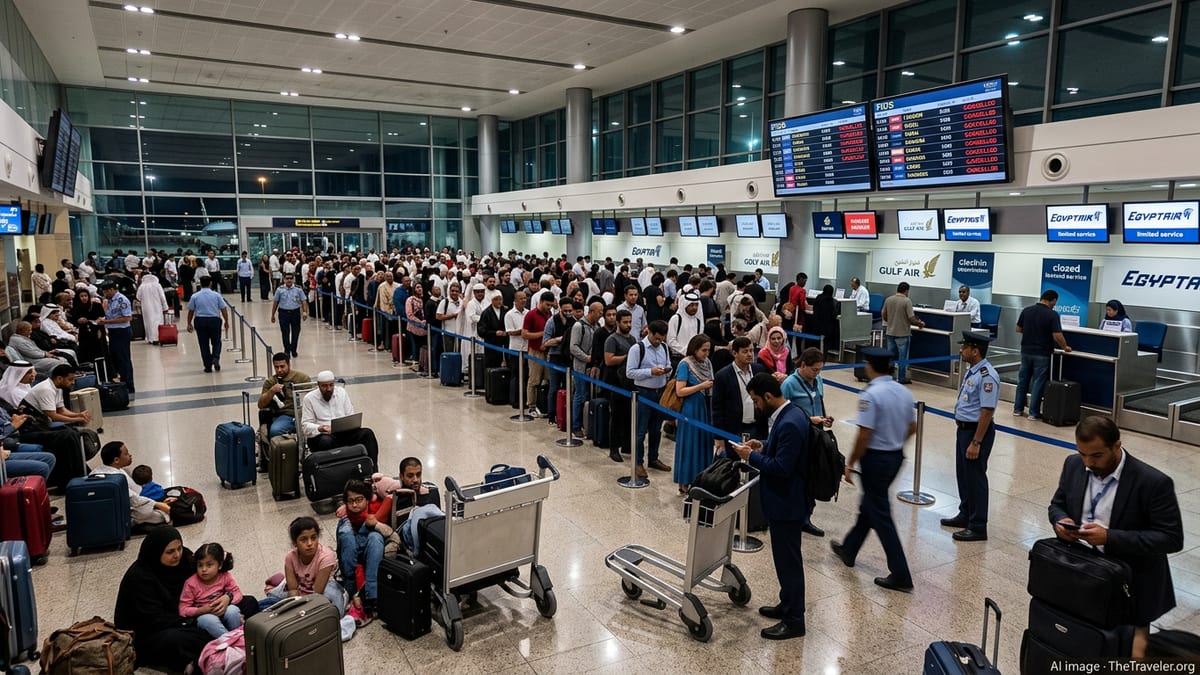
Aviation data and travel-industry reporting show that airlines have become a visible front line of the crisis. Over the past several months, global and regional carriers have repeatedly suspended, reduced or rerouted services to and over parts of the Middle East in response to missile strikes, airspace advisories and updated insurance rules. Routes touching Iran, Iraq and Israel have seen some of the most severe adjustments, but secondary effects are being felt across hubs in the UAE, Qatar, Kuwait, Bahrain, Jordan and Saudi Arabia.
Recent analyses of the 2026 airspace disruption describe a patchwork of openings and closures, with Jordan, Saudi Arabia, Kuwait, Bahrain, Qatar and Oman mostly open yet operating against a backdrop of elevated caution. European and North American carriers have in many cases opted to avoid regional overflights altogether, accepting longer routings and higher fuel costs instead of transiting contested corridors. These changes have forced last-minute schedule overhauls, longer journey times for passengers and more complex connections through alternative gateways in Europe, Africa and South Asia.
Travel advisories compiled by risk consultancies and insurers emphasize that even when airports are technically open, operational conditions can shift quickly. Passengers are being urged to wait for confirmed departure times before traveling to the airport, as airlines juggle crew duty limits, rerouting constraints and sudden regulatory updates. For tourism-dependent cities like Dubai, Doha and Abu Dhabi, this volatility translates into softer forward bookings, compressed lead times and a noticeable rise in traveler reluctance to commit to nonrefundable fares and packages.
Tourism Slowdown And Demand Shifts Across The Gulf
Economic briefings and sector analyses released in recent weeks point to a measurable drag on tourism performance across the wider Middle East. Initial estimates suggest that destinations viewed as closest to the front line of the Iran conflict and the Strait of Hormuz crisis, including the UAE, Oman, Bahrain, Qatar and Kuwait, may face the sharpest near-term risk to arrival numbers. At the same time, Saudi Arabia’s flagship megaprojects and inland cultural destinations are seen by some analysts as relatively insulated, although coastal resorts along exposed waterways could still see cancellations if tensions rise further.
Published assessments of booking trends note that travelers are increasingly favoring itineraries that either bypass the Gulf altogether or concentrate stays in a single country to minimize intra-regional movements. Cruise calls and multi-country tours that once linked the UAE, Qatar, Bahrain and Jordan are being pared back or reprogrammed, while demand is shifting toward perceived fallback options such as Turkey or Mediterranean alternatives. Domestic and intra-Gulf leisure travel remains more resilient, but is unlikely to fully offset declines from long-haul source markets if conflict fears persist.
For regional governments that have spent the past decade positioning tourism as a central pillar of economic diversification, the timing is especially sensitive. Investment cycles for new resorts, attractions and aviation capacity are colliding with an external shock that was not built into pre-2026 projections. Analysts caution that prolonged uncertainty could slow the pace of private investment or raise financing costs, even as public authorities continue to signal long-term commitment to tourism-led growth.
Travelers Weigh Risk, Insurance And Alternative Routes
For individual travelers, the current environment translates into a more complex set of decisions. Guidance from travel associations and insurance providers stresses the importance of checking policy language around war, terrorism and civil unrest, as some low-cost products exclude coverage for disruptions linked to conflict. Where coverage is still available, premiums for trips passing through certain Middle Eastern airports have risen, and underwriters are scrutinizing itineraries that rely on tight connections across multiple risk-rated hubs.
Advisory services are also encouraging travelers to think differently about routing. Rather than defaulting to established Gulf mega-hubs, some long-haul passengers are exploring connections through secondary points in Europe, Central Asia or East Africa that avoid contested skies. For those already in the region, there is growing emphasis on identifying exit options that do not require new visas, such as traveling to destinations with visa-free access for their nationality or where existing multiple-entry permissions remain valid.
Despite these headwinds, tourism has not come to a standstill. Data from airlines, hotels and online platforms still show meaningful flows into the UAE and neighboring countries, particularly for business travel, family visits and essential trips. The overarching trend, however, is one of heightened scrutiny and shorter planning windows, as visitors balance the allure of Middle Eastern destinations against a new wave of visa concerns, flight anxiety and geopolitical unpredictability.