


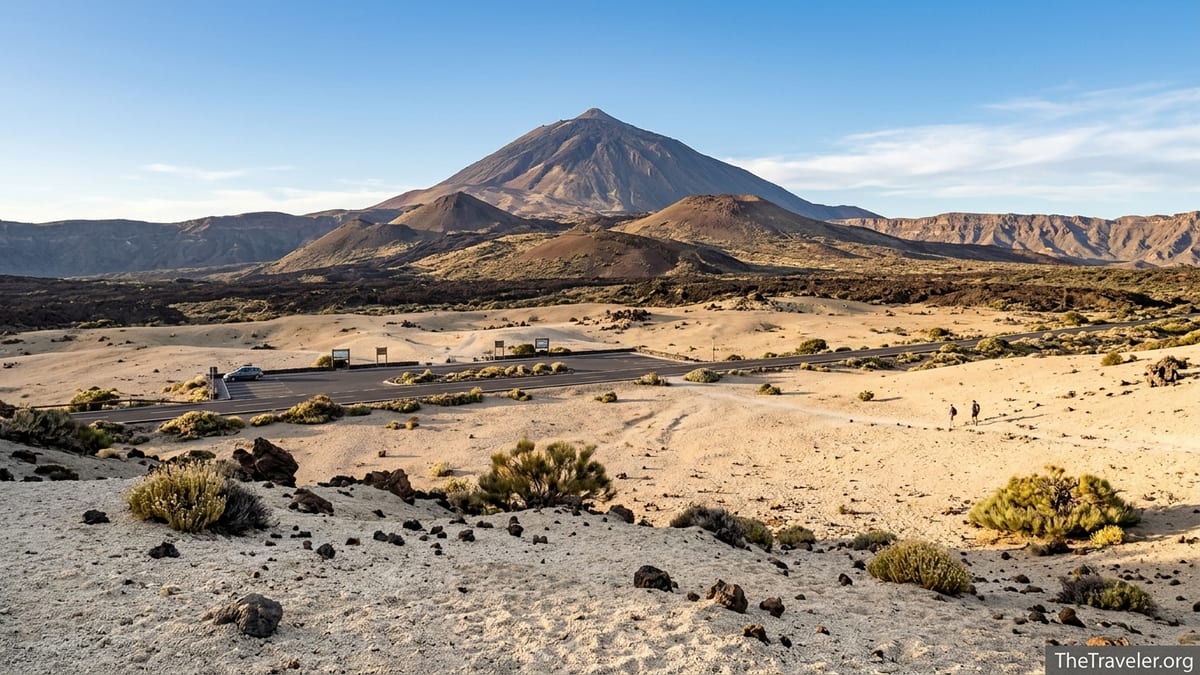
Minas de San José is one of the most otherworldly corners of Teide National Park: a flat, pale expanse of pumice and volcanic gravel sliced by the TF‑21 road, framed by dark lava tongues and the sheer walls of the Las Cañadas caldera. It sits in the central plateau of the park within the municipality of La Orotava and is clearly signposted along the TF‑21 at roughly kilometre 38 to 38.5, with a small parking area on both sides of the road. This easy-access “lunar” landscape has become a favourite quick stop for photographers, geology lovers and stargazers, and is an excellent candidate for inclusion in a Teide day trip if you know what to expect.
Get the latest updates straight to your inbox!
What and where is Minas de San José
Minas de San José is a roadside viewpoint and pumice plain inside Teide National Park, roughly midway between El Portillo and the cable car base station on the TF‑21. Official park materials list the mirador at around kilometre 38.5 of the TF‑21, with two small parking areas flanking the road where it cuts through an old open-cast pumice extraction zone. This whole sector lies on the broad floor of the Las Cañadas caldera and falls within the municipality of La Orotava, in the north of Tenerife.
Despite the name, there are no active mines today. The “minas” refer to historic quarrying of pale pumice and other loose volcanic material, clearly visible in low cuttings and banks. The area is almost entirely open, with no built infrastructure beyond the asphalt road, informal paths on the pumice, and basic signage. For visitors already driving across the park, it is one of the easiest places to pull over and immerse yourself in Teide’s surreal high-altitude desert without committing to a strenuous hike.
The elevation here exceeds 2,000 metres and rises gently towards nearby cones such as Montaña Rajada and Montaña Blanca. The combination of altitude, thin dry air and expansive horizons gives Minas de San José its distinctive clarity of light by day and its reputation as a superb dark-sky spot at night when conditions and regulations allow.
Landscape and geology in plain language
The first impression at Minas de San José is the colour. Instead of black basalt or reddish lava, the ground is a pale cream to light beige, made up of loose pumice gravel and ash. Pumice is a highly porous volcanic rock formed during explosive eruptions when gas-rich magma froths and solidifies, creating a light, frothy stone that can even float on water. In this sector of Teide, thick deposits of pumice and ash settled across the caldera floor during explosive phases of activity linked to the Teide and Montaña Blanca system.
Scattered across this pale carpet are darker blocks and tongues of denser lava, particularly from nearby Montaña Rajada and other vents. These darker rocks tend to form small ridges, hummocks and rough fields that contrast sharply with the smooth pumice. The result is a textbook example of how successive eruptions can layer different materials: light explosive deposits blanketed by or wrapping around later, more fluid lava flows.
Vegetation is sparse but resilient. You will see isolated high-altitude shrubs and broom, small cushion plants and lichens clinging to the pumice, all adapted to intense ultraviolet radiation, wide temperature swings and minimal soil. The openness of the plain means you have almost uninterrupted views of Teide’s main cone, the long ridge of La Fortaleza and the near-vertical inner walls of the caldera that rise in jagged cliffs to the south and east.
Even without specialist knowledge, visitors can appreciate the story written in the colours, textures and shapes. It is an ideal place to explain to travel companions how Teide’s landscape was built in episodes: first the formation and partial collapse of a huge volcanic complex to create the Las Cañadas depression, and later the growth of the younger Teide–Pico Viejo system inside it, punctuated by explosive eruptions that sprayed out the pumice now under your feet.
What to do on site: short walks and viewpoints
For most visitors, Minas de San José is a short scenic stop rather than a half-day objective. From the parking areas you can step directly onto the pumice plain and wander along informal paths and shallow tracks. The terrain is almost flat, with only very gentle undulations, but the ground is loose and slightly uneven. Closed-toe shoes or light hiking footwear make walking more comfortable than sandals, especially if you plan to explore for more than a few minutes.
Allow around 30 to 60 minutes for a typical visit that includes walking a few hundred metres from the car, stopping for photographs and simply taking in the 360-degree views. If you combine Minas de San José with an official trail that starts or finishes here, you might comfortably spend 1 to 2 hours in the immediate area, not counting driving time. These time suggestions are planning aids only; there are no fixed limits on how long you can stay, subject to any evolving park regulations and daylight or night-time rules.
The photographic possibilities are excellent even if you never venture far from the road. Classic compositions include the pale pumice foreground leading the eye to the volcanic dome of Montaña Blanca, the dark contorted flows from Montaña Rajada, and more distant views of Teide’s summit rising above the caldera rim. The low, rolling texture of the pumice plain also works beautifully for minimalistic close-ups of rocks, plant clumps and boot tracks that emphasize the “lunar” feeling.
The complete lack of shade is both a blessing for wide panoramas and a hazard under strong sun. In the middle of the day the light can be harsh, but in early morning and especially late afternoon, long shadows and warmer tones make the pumice glow. If your Teide itinerary is flexible, consider timing Minas de San José for these softer light windows.
Signed hiking routes involving Minas de San José
Minas de San José also serves as a junction for several official park trails. One key route is PNT 30, commonly referred to as Los Valles. According to the latest descriptions published by the Teide National Park authorities, this trail begins near the Minas de San José parking area and descends gradually across the pumice and lava fields towards the lower area known as Los Valles, eventually connecting with the long Siete Cañadas route, designated as trail 4, in the vicinity of Risco Verde. Distance, elevation change and estimated walking times are specified in official materials and can be subject to adjustment, so writers and visitors should always confirm the most up-to-date figures and numbering before setting out.
PNT 30 generally offers a moderate, descending walk that reveals how the pumice plain gives way to more dissected terrain on the edge of the caldera floor. It is suitable for reasonably fit walkers used to loose surfaces, and it dovetails neatly with Siete Cañadas if you want to extend your outing. If you are relying on public transport or a tour vehicle, note that through-routes may require careful planning or a pick-up at a different trailhead.
A second key trail is PNT 39 Montaña Blanca – Minas de San José. The current official description from the park administration characterises this as an easy, linear route of about 3.1 kilometres one way, with a gentle gradient and a walking time of roughly 50 minutes under normal conditions. The path links the Montaña Blanca area, near the popular ascent route towards Teide’s summit, with the pumice plains around Minas de San José, passing at the base of the Montaña Blanca dome and traversing spectacular lava fields.
PNT 39 is particularly interesting for visitors who want a short, non-strenuous hike with big volcanic scenery. It also offers a way to move between the dense network of trails and infrastructure at Montaña Blanca and the quieter pumice fields without walking along the road. However, the park has occasionally updated trail codes and connections, so guidebook authors and independent hikers should verify on official Teide National Park maps and notice boards whether any renumbering, rerouting or seasonal closures affect PNT 30, PNT 39 or their junctions with other paths.
Access, parking and getting there
Most visitors reach Minas de San José by car. The TF‑21 is the backbone road crossing Teide National Park from north to south, linking La Orotava with Vilaflor and Granadilla de Abona. From the north, you typically climb from La Orotava through forest and lava fields until you reach the El Portillo sector, then continue across the central plateau towards the cable car. Minas de San José lies between El Portillo and the Montaña Blanca and cable car junctions, clearly signposted, with small roadside car parks considered part of the park’s medium or small parking inventory.
From the southern resort belt around Costa Adeje and Los Cristianos, common approaches are either via Vilaflor on the TF‑21 or via Chío on the TF‑38 before joining the TF‑21 near Boca de Tauce. In normal traffic and weather, driving times from these resort areas to the Minas de San José sector are typically around 1.5 hours, sometimes a little less or more depending on your exact starting point. From Puerto de la Cruz in the north, many travellers drive up via La Orotava and the TF‑21, usually allowing around 1 to 1.25 hours. From Santa Cruz and La Laguna, the most direct scenic route into the park is the TF‑24, the La Esperanza road, which meets the TF‑21 near El Portillo; from there it is a short additional drive to Minas de San José.
Parking is free at the time of writing and does not require pre-booking, but capacity at Minas de San José is limited to small roadside bays. On peak days such as weekends, public holidays, school vacations and mid-summer, parking spaces across the park often fill from late morning onwards. Recent mobility studies and visitor reports emphasise that the busiest time window typically runs from about 10:00 to mid-afternoon, when the main viewpoints and trailheads can be saturated. To improve your chances of finding a space at Minas de San José, aim to arrive earlier in the morning, later in the afternoon, or combine your visit with other stops during shoulder hours.
Public transport to the interior of Teide National Park is limited. Island bus routes operated by the public company that serve the park have historically focused on connecting major towns with popular nodes such as the Parador, El Portillo and the cable car base, but not every service stops at every intermediate mirador. Timetables and routes are periodically revised, and not all currently include a stop directly at Minas de San José. Anyone planning to rely on buses should consult the latest official bus schedules and route maps shortly before travelling, and be prepared for relatively infrequent services. In practice, most visitors still arrive by private car, rental vehicle or as part of organized excursions that package several short viewpoint stops along the TF‑21 and TF‑24.
Regulations, fees and access schemes
Teide National Park is undergoing a period of regulatory change aimed at reducing vehicle pressure and better managing visitor numbers. As of 2026, local authorities have introduced an ecotax for access to certain high-demand trails and are working towards more comprehensive control of vehicle access and parking. Initial measures focus on specific paths and time slots, particularly the summit routes that require prior permits, but the broader mobility plan anticipates some form of regulation at the main entrances to the park along La Esperanza, La Orotava and Vilaflor–Chío within the coming years.
Special operations have already been implemented during major astronomical events. For example, during peak nights for the Perseid meteor shower and a recent eclipse, access to the Teide area was temporarily restricted to public transport only, with private cars barred from driving up the mountain. Although such operations may not explicitly target Minas de San José, they effectively govern access along the TF‑21 and other park roads, making it essential to check for exceptional measures or event-specific restrictions if your visit coincides with meteor showers, eclipses or other large gatherings.
At the time of writing, no general entrance fee is charged merely to drive the TF‑21 through the park or to stop at roadside viewpoints such as Minas de San José. The ecotax applies primarily to certain walking routes and specific activities, with different prices and rules for residents and non-residents and for particular time bands, especially on trails leading towards the summit. These schemes are still being refined under the new management framework, and any guide or article should explicitly instruct readers to verify the latest rules, charges and possible timed-entry requirements on official Teide National Park or island government channels before their trip.
In addition to fees and mobility controls, a revised park management plan has tightened behaviour rules. Smoking is now prohibited throughout the park due to fire risk and environmental protection, and enforcement of existing bans on camping outside designated areas, lighting fires, leaving marked trails where this is not permitted and littering has been strengthened. Minas de San José is subject to the same regulations as the rest of the park, so visitors should treat it not as a roadside picnic ground but as a fragile protected landscape.
Safety, altitude and weather conditions
Minas de San José sits well above 2,000 metres of elevation, on a high volcanic plateau. At this altitude the air is thinner and the ultraviolet radiation is significantly more intense than at sea level. Even on cool days, unprotected skin can burn quickly, particularly because the pale pumice surface reflects sunlight. Visitors should bring and use high-factor sunscreen, sunglasses, a hat, and clothing that covers shoulders and legs if spending more than a brief period outdoors.
Temperature swings are another key factor. While coastal resorts can be warm or hot year-round, the interior of Teide National Park, including Minas de San José, is often chilly in the mornings and evenings and can be genuinely cold in winter. Sudden changes in weather are common, with strong winds developing over the plateau and cloud banks forming along the caldera rim. In the cooler months, snowfall and icy conditions are not unusual on the higher roads and trails, sometimes leading authorities to close sections of the TF‑21 or restrict access until conditions are safe.
Visitors should make a habit of checking same-day weather forecasts and any official alerts for Teide before driving up. Local news outlets and the island authorities regularly report on storms, heavy rain, snow or high wind episodes that can affect both driving and walking conditions. When advisories are in place, roads and trails may be temporarily closed or require extra caution. In such cases, it is wise to be flexible with your itinerary, prepared to skip Minas de San José or other high stops if conditions deteriorate.
Even for short strolls on the pumice, sturdy shoes with some grip are recommended, along with enough drinking water to stay hydrated in the dry, high-altitude air. People with cardiovascular or respiratory issues should be aware that exertion at altitude can feel harder than expected, although the easy, flat terrain at Minas de San José generally makes it one of the less demanding stops in the park. As always, follow marked routes where available, respect barriers or closure signs, and avoid approaching unstable cut faces or steep pumice banks that could crumble underfoot.
Stargazing and astrophotography
The same qualities that make Minas de San José photogenic by day turn it into a magnet for astrophotographers at night. The central plateau of Teide National Park enjoys some of the darkest skies in Europe, with low humidity, minimal light pollution and frequent clear nights. The open pumice plain provides unobstructed horizons and interesting foregrounds, such as isolated rocks, twisted lava and delicate shrubs, that frame the Milky Way or constellations without clutter.
Teide National Park has long been used by space agencies and researchers as a test ground because its volcanic fields resemble extraterrestrial terrain. Areas not far from Minas de San José have hosted rover and instrument trials for missions to Mars and other planets, leveraging the park’s combination of harsh sun, rocky regolith and sparse life. Knowing that this landscape has stood in for alien worlds only adds to the thrill of photographing it under a star-filled sky or watching meteor showers sweep across the caldera.
However, anyone planning night photography should treat current regulations as the starting point for their plans. Park authorities may limit night-time presence at certain sites, prohibit sleeping in vehicles in parking areas, or close specific roads and lay-bys after dark to prevent overcrowding and environmental damage. During special events like the Perseids, access has already been restricted to organized public transport, effectively ruling out spontaneous self-drive stargazing in some periods.
Conditions also demand greater care at night. Temperatures drop sharply after sunset, and the wind can feel much stronger out on the open pumice. Good headlamps, spare batteries, warm layered clothing and clear awareness of where the road and your vehicle are located are essential. Guidebook authors should emphasise that visitors must always check the latest rules on night access, stargazing etiquette and parking, and that any instructions from park rangers or posted signage take precedence over anecdotal advice.
How Minas de San José compares to other Teide highlights
For travellers already planning to visit Teide, the key decision is not whether to go to the park but which stops to prioritise. Minas de San José offers a very different atmosphere from Roques de García, Llano de Ucanca, the Montaña Blanca trailhead or the cable car area. Where Roques de García features dramatic, crowded pinnacles of dark lava backed by the cliff of Guajara, Minas de San José is all about open space, muted colours and subtle textures. It is quieter, easier to wander without a fixed route, and better for wide, uncluttered panoramas.
Compared with Llano de Ucanca, the largest flat “cañada” at the foot of Teide, Minas de San José feels more intimate and slightly higher, with lighter ground tones and a stronger presence of pumice. Llano de Ucanca has grand, almost amphitheatre-like views and is very popular with tour buses, whereas Minas de San José tends to see shorter, more dispersed stops. If you are chasing the most iconic postcard view of Teide reflected in a vast valley floor, Llano de Ucanca might come first. If you want to stroll quietly on pale volcanic gravel that looks like a moonscape, Minas de San José stands out.
Montaña Blanca is the springboard for one of the classic ascents towards Teide’s upper slopes and summit. The atmosphere there is more “alpine basecamp,” with many hikers beginning long, strenuous climbs or returning weary at the end of the day. The PNT 39 link between Montaña Blanca and Minas de San José provides a way to taste both environments in a relatively short, easy walk: the dome and rough flows of Montaña Blanca on one side, the gently sloping pumice plains on the other, connected without needing to walk along the TF‑21.
The cable car area is perhaps the busiest single node in the park, dominated by machinery, ticketing, queues and infrastructure. It offers unmatched rapid access to Teide’s upper slopes but lacks the sense of empty wilderness that defines Minas de San José. Many visitors find that balancing one or two high-intensity, infrastructure-heavy stops like the cable car with quieter, free-roaming pauses at places like Minas de San José and Siete Cañadas makes for a more satisfying overall experience.
Who it suits and how to fit it into your Teide itinerary
Minas de San José is particularly well suited to travellers who want an easy, short, low-commitment encounter with Teide’s “lunar” side. It is ideal for photographers looking for strong landscapes without long hikes, for geology enthusiasts who enjoy reading volcanic stories in the terrain, and for visitors who may not be able or willing to tackle steep climbs at altitude but still want to feel deep inside the caldera. Families with older children, mixed-ability groups and road-trippers will usually find it an accessible and rewarding stop.
As a planning framework, you might weave Minas de San José into a full Teide day from the north by starting at the Portillo Visitor Centre to understand the park’s geology and ecology, then continuing along the TF‑21 to stop at Minas de San José for a 30 to 60 minute walk and photo session. From there you could drive on to the Montaña Blanca area or the cable car base for either a ride up or a short hike on one of the lower trails, before looping towards Roques de García and Llano de Ucanca and descending via Vilaflor or back through La Orotava.
From the south, a classic sequence might be Costa Adeje or Los Cristianos to Vilaflor and Boca de Tauce, a stop at Roques de García, then Minas de San José and El Portillo before returning via the TF‑24 to Santa Cruz or La Laguna. In either case, keep in mind that cable car operations are weather-dependent and increasingly subject to reservation systems or capacity limits, and that any trail involving the summit area requires advance permits and may fall under ecotax rules.
Above all, any article or guide about Minas de San José should highlight the need to double-check practical details close to the travel date. Driving times can vary with traffic and roadworks, trail distances and coded numbers may be updated, and access regulations and any ecotax thresholds are being refined as the new management regime beds in. What does not change is the core appeal: a serene, surreal pumice landscape, easily reached yet feeling far removed from Tenerife’s busy coasts, offering a powerful sense of the volcanic forces that shaped the island.