


Bryce Canyon National Park looks deceptively simple: one road, a handful of overlooks and a few famous trails dropping into a bowl of orange hoodoos. Yet many first-time visitors leave frustrated, exhausted or feeling they missed the best of the park. With Bryce now drawing roughly 2.5 million visitors a year and summer crowds growing, small planning errors can easily snowball into lost time, blown budgets and safety issues.
Get the latest updates straight to your inbox!
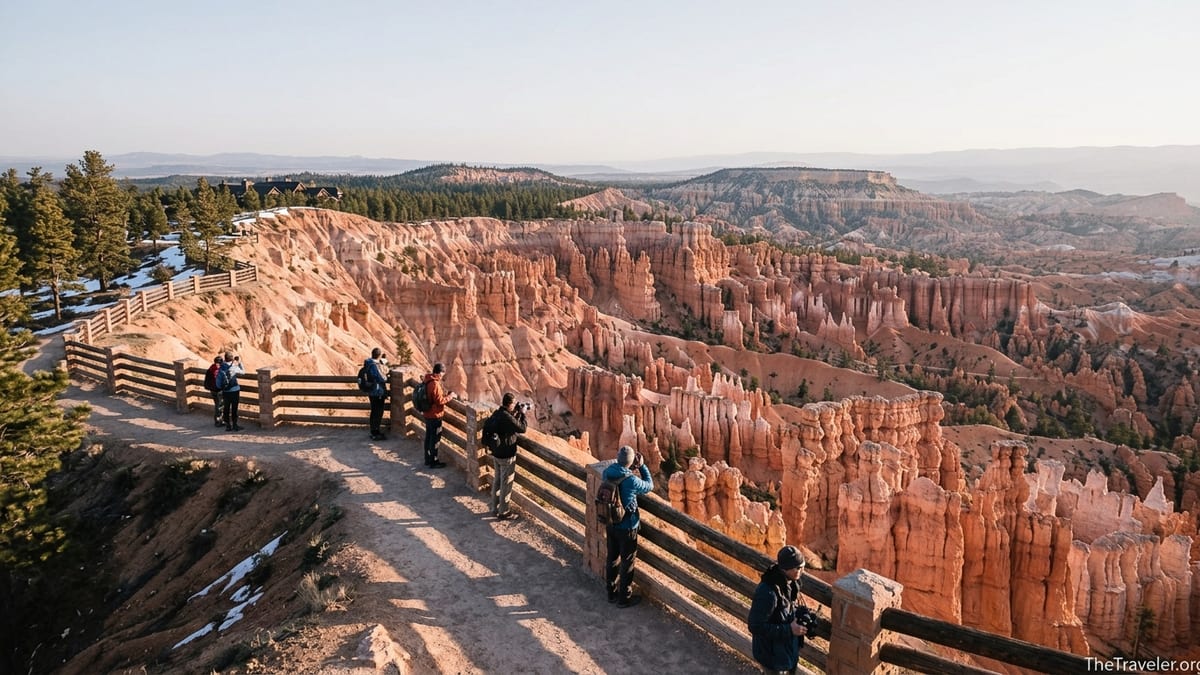
Arriving With a “Quick Stop” Mindset
One of the most common mistakes is treating Bryce Canyon as a two-hour roadside stop between Zion and Moab. On the map it looks compact, and some travelers figure they can “swing through” on the drive from Las Vegas to Salt Lake City. In practice, people who arrive at noon expecting to be back on the highway by mid-afternoon often find themselves stuck in parking queues, rushing viewpoints and skipping hikes entirely. Bryce rewards slow travel: sunrise at Sunrise Point, a mid-morning hike into the hoodoos, an afternoon drive to Rainbow Point and stargazing after dark. Trying to cram that into a pit stop leaves most visitors underwhelmed.
For example, it is common to see tour buses roll in around 11 a.m., unload at Sunset Point for 30 minutes of photos, then move on. Those passengers technically “see” Bryce, but they never experience the silence on the Queen’s Garden Trail or the changing colors as the sun moves across the amphitheater. Independent travelers sometimes fall into the same trap when they book a night in Springdale near Zion and try to do a same-day round trip to Bryce, logging five hours of driving for an hour on the rim. A better approach is to dedicate at least one full day and ideally a night in Bryce Canyon City or inside the park so you can build your plans around the park’s best light rather than your driving schedule.
Misjudging Weather, Altitude and Seasons
Another major planning error is forgetting that Bryce Canyon sits at around 8,000 to over 9,000 feet above sea level, much higher than Zion or Las Vegas. Even in June and September, daytime highs can feel pleasant in the 70s while overnight temperatures drop close to freezing. In winter, snow and ice are the norm and the main road beyond mile 3 can temporarily close after storms while plows work, sometimes for a day or more. Travelers who pack only desert clothing because they are also visiting lower-elevation parks often end up buying overpriced gloves, beanies and traction devices at the Bryce Canyon Visitor Center.
Altitude also hits harder than many people expect. Visitors flying in from sea level and driving straight to Bryce frequently report shortness of breath just walking from the parking lot to the rim. Starting an ambitious hike like the Figure 8 combination (Navajo, Peekaboo and Queen’s Garden) right after arrival can quickly lead to dizziness or exhaustion, especially on warm afternoons. A smarter plan is to spend your first few hours on short, mostly flat rim walks between Sunrise, Sunset and Inspiration points while your body adjusts, then descend into the hoodoos the following morning.
Seasonal expectations trip people up too. Summer crowds mean that parking lots at Sunset and Sunrise points can be full by mid-morning on busy days, especially in July. In contrast, winter visitors may assume everything is open because the park is technically a year-round destination, only to discover that the Wall Street side of the Navajo Loop and parts of the Rim Trail can close all season due to rockfall danger and snow cornices. Those who build their whole visit around a specific trail they saw on social media sometimes arrive to find it gated, leaving them scrambling for backup options they never researched.
Ignoring the Shuttle and Parking Realities
Although Bryce Canyon’s shuttle is not mandatory, failing to factor it into your plan is a mistake that costs many travelers precious time. From roughly April through mid-October, free park shuttles circulate between the visitor center, major viewpoints and Bryce Canyon City. The buses typically come about every 15 minutes and allow you to leave your car either at the large shuttle station near Ruby’s Inn or in the additional parking area across from the visitor center, which the park explicitly recommends. Yet every summer, drivers circle Sunset Point lots over and over trying to wedge an RV into spaces designed for sedans, while empty shuttle buses roll by.
Real-world experience shows just how big the difference can be. Travelers who park at the shuttle station in Bryce Canyon City around 8 a.m., hop on the first bus to Sunset Point and start hiking before 9 often finish a loop through Queen’s Garden and Navajo before day-trippers even make it through the entrance station. By contrast, those who arrive in a 30-foot motorhome at 10 or 11 a.m. can spend an hour or more searching for a suitable space or end up parking far from the rim altogether. When the shuttle is not operating in shoulder seasons, this same lack of planning leads people to underestimate how limited larger-vehicle parking is at the amphitheater viewpoints.
Small oversights with the shuttle system also hurt. Visitors frequently assume they must board inside the park when in fact the easiest option is often to leave the car at the Bryce Canyon City shuttle station, check trail conditions at the information kiosk there and ride straight into the amphitheater area with no parking stress. Others forget that proof of park admission is required to ride from outside the entrance and only realize at the bus door that their pass is in a partner’s wallet back at the hotel. A few minutes spent understanding when and how the shuttle operates can turn a chaotic morning into a seamless one.
Underestimating Trail Difficulty and Safety Risks
The classic Bryce hikes look short on paper, which leads many visitors to underestimate how tough they can feel. The Navajo Loop is only about 1.3 miles, and Queen’s Garden roughly 1.8 miles, and that tempts people in flip-flops and street shoes down the switchbacks. The catch is that every hike into the amphitheater starts with an easy descent and finishes with a steep climb out at high elevation, often in full sun. Rangers repeatedly describe seeing families who bounded down Wall Street in excitement then spent two sweaty hours inching their way back up, out of water and patience.
Footwear is an everyday example. On summer mornings, you will see people starting the Queen’s Garden Trail in flat fashion sandals or worn-out sneakers with slick soles. By the time they reach the steeper, gravel-covered sections below the rim, they are sliding on the switchbacks or nursing rolled ankles. In winter, the stakes are higher: shaded sections of the Navajo or Peekaboo trails can be coated in hard-packed snow and ice. Park information points out that traction devices are often recommended, and the visitor center bookstore sells them for a reason. Travelers who assume “it’s just a short walk” sometimes end up turning around a few hundred yards down the trail or, worse, taking a painful fall.
Weather can make an easy hike dangerous quickly. Afternoon thunderstorms are common in late summer, and it is not unusual for lightning to approach right as crowds are at their peak on exposed viewpoints like Inspiration Point. Visitors who ignore building clouds or stay on metal railings for a final selfie risk more than just getting wet. In shoulder seasons, a sunny morning can turn into flurries by late afternoon. People who venture deep into the amphitheater in cotton hoodies and no hats may find themselves chilled on the climb back up. Building your hikes around early starts, carrying more water than you think you need and checking the latest conditions at the visitor center are simple steps that prevent common emergencies.
Booking the Wrong Lodging in the Wrong Place
Bryce’s lodging geography is unusual, and misunderstanding it is one of the most costly planning mistakes. Many visitors do not realize until late in the process that Bryce Canyon City is essentially a company town built around Ruby’s Inn, sitting just outside the park entrance, while the historic Bryce Canyon Lodge and a pair of campgrounds sit inside the park boundary. Nightly rates at Ruby’s Inn, Best Western Plus Grand, and other Bryce Canyon City hotels can climb significantly during peak summer dates, especially if you are booking within a month of arrival, leaving late planners with only distant towns like Panguitch or Tropic as options and an extra 30 to 45 minutes of driving each way.
Choosing between inside and outside the park matters in practical ways. Guests at Bryce Canyon Lodge can walk from their cabins to Sunrise Point in five minutes to watch the first light hit the hoodoos, then return for breakfast without ever getting in a car. That sunrise access is invaluable for photographers and families who do not want to wrangle kids into jackets in a dark parking lot at 5:30 a.m. On the other hand, lodging inside the park is rustic and limited, and it typically books out months in advance for summer weekends. Travelers who assume they can “just find something nearby” often end up at generic motels farther down Scenic Byway 12, adding commuting time to every hike and viewpoint.
Campers frequently misjudge options too. North Campground is open year-round, while Sunset Campground closes seasonally, and both can fill quickly in peak periods. RV drivers sometimes arrive late in the day expecting full hookups inside the park, not realizing that the most extensive RV facilities, with hookups and showers, are actually at the Ruby’s Inn RV Park and Campground just outside the gate. Arriving without a reservation on popular summer weekends or holiday periods is a gamble. Those who reserve sites or rooms months ahead secure walkable access to the shuttle, grocery store and trails; those who do not may be left driving in from 20 or more miles away each morning.
Budgeting Incorrectly for Entrance Fees and Passes
Entrance fees and passes are another area where avoidable misunderstandings cause frustration. Most travelers arrive aware that U.S. national parks charge entrance fees but do not check the specific cost or consider how multiple parks add up. Travelers on longer Utah road trips that include Bryce, Zion, Capitol Reef, Arches and Canyonlands often pay individual vehicle entrance fees at each gate, only to find out later that an America the Beautiful annual pass would have cost less overall. Others forget that the Bryce shuttle is free only once you have paid for park entry; they arrive at the Bryce Canyon City shuttle stop without having purchased admission online or at the entrance and have to double back.
International visitors sometimes encounter even more confusion. They may be used to free access at parks back home and assume the same applies in the United States, or they misunderstand how many people are covered under a single vehicle pass. This can lead to unexpected charges for multi-car groups or delays at the gate while they sort out payments. The simplest solution is to check the current Bryce Canyon National Park fee schedule a few weeks before your trip and run the numbers honestly. If you are visiting multiple federal sites over the course of a year, an annual pass is often the best value; if Bryce is your only park, paying the per-vehicle fee at the entrance may be all you need.
Travelers also forget that some lodging and tour packages do not include park entrance. A family might book a popular horseback ride that departs from near Bryce Canyon Lodge, assuming their tour confirmation doubles as admission. It does not. They still need a valid park pass to drive to the corral or ride the shuttle. Sorting this out the morning of your activity, especially with departure times that require you to arrive 30 to 45 minutes early, creates unnecessary stress. Verifying what is and is not included in any package deal before you arrive is a small step that avoids these last-minute surprises.
Overplanning or Underplanning the Itinerary
Planning mistakes at Bryce tend to fall into two opposite camps: overstuffed itineraries that treat the park as another box on a checklist, and vague non-plans that rely on winging it entirely. Overplanners will often schedule sunrise at Bryce, a long mid-morning hike, an afternoon drive to Rainbow Point, and then expect to be in Capitol Reef by dinner, underestimating drive times and the toll of hiking at altitude. They arrive at each stop behind schedule and too tired to enjoy it. Underplanners, on the other hand, show up at noon without even glancing at a park map, then lose an hour in the visitor center and gift shop before realizing the most popular hikes drop into the amphitheater and require a serious climb back out.
A realistic one- or two-day plan makes a huge difference. For a single full day in peak season, you might park at the shuttle station around 7:30 a.m., ride straight to Sunrise Point for sunrise, hike a combined Queen’s Garden and Navajo loop while it is still cool, then take a long midday break at your hotel or campsite. Later, you drive or ride the shuttle between accessible viewpoints in the amphitheater and, if you still have energy, join a ranger program or night-sky talk. With two days, you can add the full scenic drive to Rainbow and Yovimpa points, shorter walks like Mossy Cave and, in winter, snowshoeing or cross-country skiing along closed spur roads. Building in buffer time for weather, crowds and unexpected closures turns a rigid schedule into a flexible but focused plan.
Technology can help if used correctly and hinder if it is assumed to be infallible. Many visitors expect fast mobile coverage and rely on real-time navigation or last-minute lodging searches as they approach the park. In reality, cell service is spotty once you leave larger towns, and inside the park it can be unreliable away from the visitor center and Bryce Canyon City. Downloading offline maps, saving confirmation emails and even printing or screenshotting the park’s official map before you lose service are low-tech solutions that prevent a high-tech headache when you arrive.
The Takeaway
Bryce Canyon is not the largest or most complex national park, but it is one of the easiest to misjudge. Visitors regularly underestimate the altitude, overestimate how much they can do in a short stop, and misunderstand how the shuttle, parking and lodging pieces fit together. A carelessly planned visit can mean hiking in the hottest part of the day, paying more than necessary for fees and rooms, or missing the best light entirely. A thoughtfully planned one can mean standing almost alone at Sunrise Point as the first light hits the hoodoos, returning to a cabin or campsite a short stroll away and finishing the day under some of the darkest skies in the region.
Investing an hour or two in research before you arrive is the most effective way to avoid common mistakes. Check current entrance fees and road conditions, understand the seasonal shuttle schedule, book lodging or campsites as early as you reasonably can and build a simple, realistic itinerary that respects the park’s elevation and weather. With those basics in place, Bryce rewards you with everything travelers dream about: quiet trails winding between orange spires, sweeping overlooks with room to breathe and a night sky so bright it can reset your sense of the universe. A little forethought before your visit is all it takes to trade stress and crowds for that kind of experience.
FAQ
Q1. Do I really need more than half a day at Bryce Canyon?
Many travelers try to rush Bryce in a few hours, but a full day allows you to catch sunrise, hike into the hoodoos and drive the scenic road without feeling hurried.
Q2. Is the Bryce Canyon shuttle mandatory?
No, the shuttle is not required, but in busy months it is the easiest way to avoid crowded parking lots at popular viewpoints and trailheads.
Q3. How early do I need to arrive to find parking in summer?
In peak season, lots at Sunrise and Sunset points can fill by mid-morning. Arriving by 8 a.m. or parking at the shuttle station is a safer bet.
Q4. Are the trails safe to hike in winter?
Many trails remain open, but snow and ice can make sections slippery. Expect seasonal closures on certain segments and consider traction devices for your boots.
Q5. Should I stay inside the park or in Bryce Canyon City?
Staying inside the park gives you unmatched sunrise and sunset access. Bryce Canyon City offers more services and RV facilities but requires short drives or shuttle rides.
Q6. Is Bryce Canyon suitable for young children or older travelers?
Yes, as long as you adjust expectations. Stick to rim viewpoints and shorter, less steep trails if altitude, heat or mobility are concerns.
Q7. What is the most common hiking mistake visitors make?
People often underestimate the climb out of the amphitheater, starting hikes late in the day with little water and wearing shoes that do not grip steep, dusty switchbacks.
Q8. Do I need a special permit to hike or take photos?
Regular day hikes and personal photography do not require special permits. Commercial tours, workshops or large organized groups may need additional approvals.
Q9. How does Bryce’s altitude affect visitors?
The high elevation can cause shortness of breath and fatigue, especially for those from sea level. Take it slow on arrival, drink plenty of water and avoid overexertion.
Q10. Is Bryce Canyon still worth visiting if I have only one day?
Absolutely. With a realistic plan that focuses on a sunrise, one amphitheater hike and a few key viewpoints, a single day can still be memorable and rewarding.