


On a weeklong road trip through Utah’s national parks, I expected Angels Landing in Zion or the slickrock domes of Capitol Reef to steal the show. Instead, it was a cold, wind‑bitten sunrise at Bryce Canyon National Park that became the undisputed highlight of the entire journey. Watching the first light ignite thousands of orange and pink hoodoos below the rim felt less like checking off a viewpoint and more like witnessing the park wake up in real time.
Get the latest updates straight to your inbox!
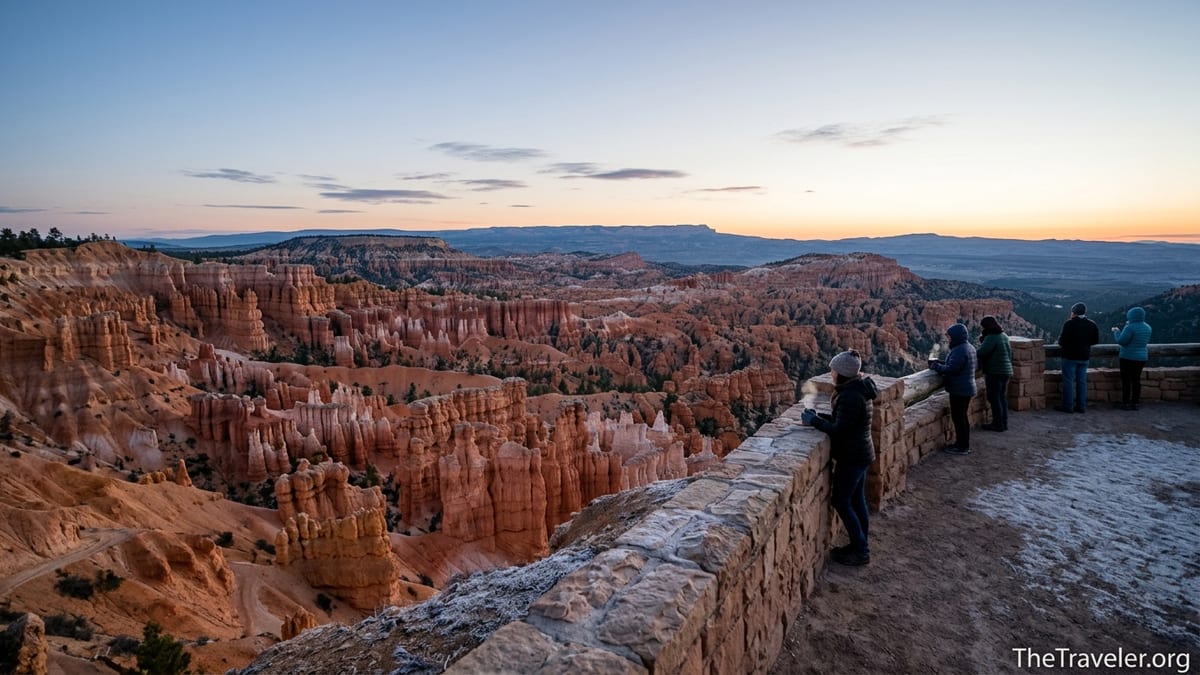
Arriving in the Dark: The Quiet Before the Color
My alarm went off at 4:45 a.m. in Bryce Canyon City, the small cluster of lodgings and cafes just outside the park entrance. In late spring, sunrise at Bryce creeps in a little after 6:00 a.m., and every ranger I spoke with advised arriving at the rim at least 30 to 45 minutes before official sunrise. That meant leaving town in the dark, layering up against temperatures that hovered just above freezing even in May, and driving the short 10-minute stretch from the hotels near Ruby’s Inn to the park gate.
The entrance station was quiet. I had already purchased an America the Beautiful annual pass earlier in the trip, but for anyone driving in without one, Bryce currently charges a per‑vehicle fee that covers everyone in the car for seven consecutive days. For international visitors, there is now an additional nonresident fee, which is worth factoring into a Utah parks itinerary. A lot of travelers I met had bought the annual pass at Zion first, specifically so they could roll into Bryce for sunrise without stopping to sort out payments at dawn.
From the gate, it is only a few more minutes to the Bryce Amphitheater area, where the park’s famous viewpoints cluster along the rim. Every guidebook seems to champion a different spot for sunrise, but rangers consistently suggested two: Sunrise Point, true to its name, and Inspiration Point, which offers a slightly more elevated and dramatic angle on the main hoodoo amphitheater.
I parked at Sunrise Point, pulled my beanie down over my ears, and joined a small, sleepy crowd walking toward the guardrail. Below us, the canyon was a dark, silent sea of stone spires. Overhead, the eastern sky was just starting to pale, with a thin band of orange pushing up behind the black outline of the distant plateau.
The Moment the Hoodoos Catch Fire
What makes sunrise at Bryce Canyon different from other western vistas is the way the light hits the landscape. The Bryce Amphitheater faces mostly east, so when the sun clears the horizon, it pours directly onto the hoodoos instead of illuminating them from behind. The effect is dramatic. First, a few isolated spires catch the light in neon orange. Then, within minutes, entire ridges look as if they have been lit from within, while nearby walls still sit in deep blue shadow.
At Sunrise Point that morning, a hush fell over the overlook as the first rays reached the formations known informally by rangers as the Silent City. People who had been shuffling and chatting fell quiet. Phones came out, of course, but just as many people put their cameras down after a few shots and simply watched. I remember the crisp sound of ravens’ wings overhead and the occasional click of a tripod more than any conversation.
For the next 20 minutes, the colors shifted constantly. The white tops of the hoodoos turned blush pink, while the orange bases glowed almost red. Low pockets between ridges filled with mist, briefly giving the scene a layered, otherworldly depth. It is the kind of subtle, evolving spectacle that no single photograph really captures. I took a handful of frames and then slid my phone back into my pocket so I could watch the sunlight creep slowly up the canyon walls.
Only once the sun was fully above the horizon did the crowd start to thin. A few people headed back to their cars, content with their sunrise show before driving on toward Capitol Reef or Moab. Others tightened their boots and stepped down onto the Queen’s Garden Trail, using that golden early light to drop into the canyon for a morning hike among the formations that had just been glowing from afar.
Choosing Your Sunrise Viewpoint: Sunrise vs Inspiration vs Bryce Point
Although Sunrise Point was my chosen perch, I spent time the previous evening and later that day scouting other viewpoints, and each one offers a different take on sunrise. Sunrise Point is the most straightforward choice: it is close to the main parking area, connects directly to the easy, mostly flat section of the Rim Trail, and gives you a front‑row seat to the northern portion of the Bryce Amphitheater. It is popular, but crowds here at dawn tend to be civilized, with plenty of room along the railing to spread out and avoid jostling for position.
Inspiration Point, a short drive or Rim Trail walk away, may actually be the most dramatic sunrise vantage. From its higher, tiered overlooks, you look down into the densest collection of hoodoos in the park, with the deeply carved gullies and fins catching side light in sharp, alternating bands of bright orange and dark blue. Travel photographers I spoke with there praised Inspiration Point for its depth and leading lines. The trade‑off is that the climb from the parking lot is steeper, and the viewpoint is more exposed to cold wind. On our trip, a neighboring couple who had tried both said they loved Inspiration Point’s view but were glad for the slightly more sheltered feel at Sunrise Point on a blustery morning.
Bryce Point, a bit farther along the road, offers a more expansive, sweeping vista that captures a broader slice of the amphitheater and the distant plateau. It is fantastic for a sense of scale, and its orientation makes it a strong choice for both sunrise and early morning light as it sweeps across the canyon. If you have two mornings in the park, a lot of repeat visitors recommend watching sunrise once from Sunrise or Inspiration Point and once from Bryce Point to appreciate how much the character of the scene changes.
For travelers relying on the free seasonal park shuttle that runs between Bryce Canyon City, the visitor center, and the main viewpoints, it is important to check the current year’s schedule. In recent seasons, the first shuttle buses have typically started running after the actual sunrise time on many dates, which means sunrise purists and photographers still prefer to drive their own vehicle to the rim in the dark, then switch to the shuttle later in the morning once service begins.
Walking Into the Light: Pairing Sunrise With a Hoodoo Hike
What turned sunrise at Bryce from a beautiful view into the highlight of my Utah trip was what happened afterward. As soon as the sun cleared the horizon and began to soften, I followed the signed path from Sunrise Point toward the Queens Garden Trailhead. This trail is often cited by the National Park Service as the easiest route from the rim down among the hoodoos, and it shows off the amphitheater’s colors and formations exceptionally well in early morning light.
The descent begins gently, with packed dirt paths carving wide switchbacks between weather‑sculpted fins of orange and cream limestone. Within minutes, the crowds at the overlook were out of sight and sound. The only constant reminders of company were the occasional crunch of another pair of boots on the trail and the distant, excited voices of early risers from Europe and Asia, who, like me, had decided that sunrise was worth losing a bit of sleep over.
About halfway down, the hoodoos that had looked like a single glowing mass from above resolved into individual towers and arches. In one alcove, the trail passed through a short rock tunnel that frameed the sky in a perfect blue oval. Farther along, signed side paths led to formations that hikers nicknamed the Queen and her court, where weathering has freestanding spires into shapes that spark human imagination. It is not hard to see why the Queens Garden and neighboring Navajo Loop have become two of the most photographed trails in the park.
From Queens Garden, many hikers link onto the Navajo Loop Trail and climb back to the rim at Sunset Point, creating a figure‑eight route that covers roughly 3 miles with a couple of steep, switchbacking climbs. If you do this after sunrise, the timing works well: you descend in the soft, low‑angle light and climb back up as the sun rises higher, so the temperatures are still cool. Rangers emphasize sturdy footwear and bringing more water than you think you need. Rescue reports commonly mention people attempting this loop in casual sneakers or without enough water, especially later in the day during summer heat.
Planning Around Weather, Seasons, and Crowds
Bryce Canyon’s elevation, roughly 8,000 to 9,000 feet along the amphitheater rim, is one reason sunrise there feels so crisp and luminous. The air is thinner and cooler than in nearby Zion or Arches, and that affects both comfort and safety for travelers planning a dawn outing. In shoulder seasons like April, May, late September, and October, it is normal to encounter sub‑freezing dawn temperatures while mid‑day highs climb into the 50s or 60s Fahrenheit. In winter, the rim can be snowy and icy, and the contrast between white snow and red hoodoos at sunrise can be spectacular, but traction aids and serious layers become almost mandatory.
Summer brings warmer mornings but also larger crowds. Tour buses drop visitors at the main viewpoints not long after sunrise, and parking at Sunrise and Sunset Points can fill by mid‑morning. If your priority is a quiet, contemplative dawn experience, this is another reason to aim to arrive at the rim 45 minutes before sunrise, when only the keenest early risers are around. By the time most guests emerge from the park lodges or drive in from Bryce Canyon City, the most magical light has already passed and the amphitheater shifts into bright daytime mode.
Wind can be another factor. On my sunrise morning, gusts cut straight through thin gloves. It is easy to underestimate how exposed the rim is; there are few windbreaks along the guardrails, and you spend a lot of time standing still while you wait for the sky to change. A lightweight down or synthetic jacket, hat, and something to protect your ears can make the difference between savoring the moment and counting the minutes until you can retreat to the car heater.
Weather can also affect which trails are open. Sections of the Navajo Loop, especially the dramatic Wall Street slot between towering orange walls, sometimes close due to rockfall risk or seasonal conditions. The park’s official website posts current trail statuses, and rangers at the visitor center are honest about what is safe on any given day. Even when portions are closed, out‑and‑back options on Queens Garden or the Rim Trail still pair beautifully with a sunrise viewing.
Logistics: Lodging, Shuttles, and Timing Your Morning
From a practical standpoint, pulling off a satisfying sunrise at Bryce Canyon comes down to three main choices: where you sleep, how you move around the park, and how early you are willing to get up. Staying in Bryce Canyon City or at the in‑park lodge offers the most convenient access. Many visitors book into the historic Bryce Canyon Lodge inside the park or into one of the hotels and campgrounds clustered around Ruby’s Inn just outside the boundary. In peak season, rooms can sell out well in advance, so flexible travelers sometimes look 20 to 40 minutes away in nearby towns, but that longer drive stretches the pre‑dawn wake‑up even earlier.
For transportation, the park’s free shuttle typically runs from spring into fall, connecting Bryce Canyon City with the visitor center, Sunrise Point, Sunset Point, Inspiration Point, and Bryce Point. It is a smart way to avoid parking frustration later in the morning and helps reduce congestion near the amphitheater. On our trip, we drove ourselves to Sunrise Point while it was still dark, then left the car parked near the lodge and used the shuttle afterward to hop between viewpoints and trailheads without hunting for additional spaces.
Checking the current year’s shuttle schedule before you travel is essential. In some recent seasons, the first shuttle departure from Bryce Canyon City came after sunrise on many dates, which meant sunrise chasers still preferred to use their own vehicle before switching to the shuttle later. The same logic applies if you are detouring from another base, such as Springdale near Zion. I met one couple who left Springdale around 3:00 a.m., drove the roughly two and a half hours to Bryce, and still had a few quiet minutes at Sunrise Point before the sky began to brighten.
As for timing, I found the 45‑minute rule of thumb to be ideal. Arriving that far in advance allowed my eyes to adjust, gave me time to walk a short stretch of the Rim Trail to scout different angles, and left a buffer for setting up a tripod without feeling rushed. It also meant witnessing the full transition from starry darkness through blue hour and into golden sunrise, rather than just the final burst of color that appears on most social media feeds.
Why This Sunrise Outshone the Rest of Utah
Utah is not short on memorable light. I watched alpenglow wash over the cliffs in Zion, saw afternoon sun explode off the white domes of Capitol Reef, and ended a long day in Arches with the last rays pouring through Delicate Arch. Yet the sunrise at Bryce stayed with me more vividly than any of those moments. Part of it was the surprise. I had always filed Bryce mentally as a “second‑tier” stop on a loop that would be dominated by Zion and Arches. But standing at the rim that morning, I realized the park offers something entirely different from its neighbors: an amphitheater of color and texture that comes alive precisely as the first light hits it.
There was also an emotional dimension that is harder to quantify. Maybe it was the combination of travel fatigue, early‑morning quiet, and thin, cold air, but that gradual brightening over the hoodoos felt both intimate and expansive. I watched a family next to me, three generations wrapped in blankets, sharing a thermos of coffee. A solo traveler from Germany set up a tripod, snapped a few frames, and then simply sat cross‑legged by the railing, eyes fixed on the changing sky. Strangers swapped whispered tips about their plans for the day: one couple heading for the Fairyland Loop, another driving on toward Escalante after breakfast.
Practically speaking, sunrise at Bryce also shaped the rhythm of the entire day in a satisfying way. By 10:30 a.m., when bus loads of visitors began to fill the overlooks, I had already watched sunrise, hiked the Queens Garden and Navajo combination, and enjoyed a late breakfast back near the lodge. Instead of fighting midday crowds, I used that time to drive the park’s 18‑mile scenic road, stopping at viewpoints like Natural Bridge and Rainbow Point when they were relatively quiet, then returned to the amphitheater again in late afternoon for softer light.
When I look back on that Utah road trip, it is not the adrenaline spikes or the most famous Instagram spots that stand out. It is that slow, steady unfurling of light over Bryce Canyon, where the day started quietly and beautifully long before most visitors had even parked their cars.
The Takeaway
If you are planning a swing through Utah’s national parks, it can be tempting to treat Bryce Canyon as a quick stop between Zion and points farther east. Do yourself a favor and give it at least one sunrise. Build your itinerary so that you can sleep close by, set an early alarm, and walk to the rim in the dark. Pack a warm layer, a thermos, and a willingness to stand still in the cold for half an hour.
Pick a viewpoint that matches your style: Sunrise Point for convenience and a classic view, Inspiration Point for drama and depth, or Bryce Point for a grand, sweeping panorama. Pair your sunrise with an early hike into the hoodoos while the light is still soft and the air cool. Check shuttle schedules and trail conditions ahead of time, but remember that even if certain routes are temporarily closed, the essence of the experience is simply being there as night gives way to color over the amphitheater.
In a state filled with big landscapes and bigger expectations, that simple act of watching the canyon wake up might quietly become the moment you remember most long after your Utah road trip is over.
FAQ
Q1. Where is the best place to watch sunrise in Bryce Canyon National Park?
Sunrise Point and Inspiration Point are the two most popular sunrise viewpoints. Sunrise Point is convenient and close to parking, while Inspiration Point offers a higher, more dramatic perspective of the main hoodoo amphitheater.
Q2. How early should I arrive for sunrise at Bryce Canyon?
Arrive at least 30 to 45 minutes before the posted sunrise time. This gives you time to find a good spot, let your eyes adjust, and experience the full progression from blue hour into golden light.
Q3. Do I need a reservation or special permit to see sunrise at Bryce Canyon?
No reservation is required for sunrise itself. You only need a valid park entrance pass or annual pass. In busy seasons, parking can fill quickly after sunrise, but the very early hours are usually manageable.
Q4. What should I wear for a sunrise visit to Bryce Canyon?
Even in late spring and early fall, sunrise temperatures can be near or below freezing at Bryce’s 8,000‑plus‑foot elevation. Wear warm layers, a hat, gloves, and sturdy shoes, and bring a windproof outer layer for the exposed rim.
Q5. Can I use the park shuttle to get to the sunrise viewpoints?
The free seasonal shuttle serves the main viewpoints, but its first departures often start after sunrise on many dates. For a true dawn experience, most visitors drive their own vehicle to the rim, then use the shuttle later in the morning.
Q6. Which hike pairs best with watching sunrise?
The Queens Garden and Navajo Loop combination is a classic choice, starting at Sunrise Point and ending at Sunset Point. It lets you descend among the hoodoos in soft early light and finish with a steady climb back to the rim.
Q7. Is sunrise at Bryce better than sunset?
Because the main amphitheater faces east, sunrise usually delivers more dramatic, direct light on the hoodoos than sunset does. Sunsets can still be beautiful, but many repeat visitors consider sunrise the signature experience.
Q8. What are the entrance fees, and how long is the pass valid?
Bryce Canyon charges a per‑vehicle entrance fee that is valid for seven consecutive days and covers everyone in the car. International visitors now pay an additional nonresident fee, so it can be cost‑effective to buy an annual pass if you plan to visit several U.S. national parks on the same trip.
Q9. Is sunrise at Bryce Canyon suitable for families with young children?
Yes, if everyone is dressed warmly and you plan ahead for the early start. The paved section of the Rim Trail between Sunrise and Sunset Points is relatively flat, and families often bring blankets, snacks, and a thermos to keep kids comfortable.
Q10. What if the weather is cloudy on the morning I plan to see sunrise?
Clouds do not necessarily ruin sunrise. A low band of clouds can create dramatic color and texture in the sky, and the hoodoos still glow when the sun breaks through. If a storm is moving in or visibility is very poor, check with rangers about safety and consider shifting your main hike or scenic drive to later in the day.