


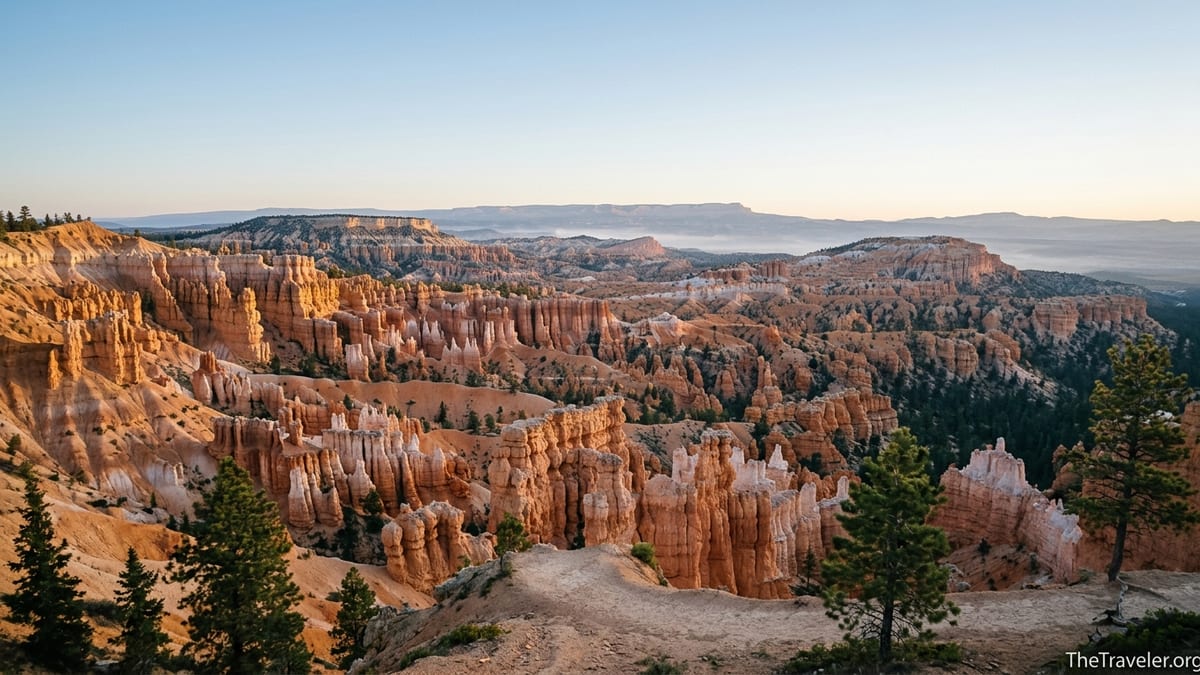
Stand on the rim of Bryce Canyon at sunrise and the American Southwest suddenly looks unfamiliar. Instead of broad desert basins or a single yawning gorge, the earth drops away into a jagged amphitheater packed with stone spires and fins that glow orange, pink, and cream in the first light. These formations, called hoodoos, crowd together in ranks so dense they resemble a petrified city. Add thin, crisp mountain air and a night sky blazing with stars, and it becomes clear why Bryce Canyon National Park feels like nowhere else in the region.
Get the latest updates straight to your inbox!
A High Plateau on the Edge of the Desert
Most travelers first encounter the American Southwest in places like the Grand Canyon, Zion, or Sedona, where desert heat and low elevation define the experience. Bryce Canyon overturns those expectations. The main viewpoints along the park road sit between roughly 8,000 and 9,100 feet above sea level on the Paunsaugunt Plateau, a high shoulder of the Colorado Plateau that rises sharply above surrounding desert basins. On a June morning, you might leave St. George, Utah, in short sleeves at 3,000 feet and arrive at Bryce wearing a fleece as temperatures sit 20 degrees cooler on the rim.
This abrupt jump in elevation creates a hybrid landscape: Ponderosa pines, spruce, and fir forests normally associated with alpine zones frame views of red rock that most travelers mentally file under “desert.” Walk the short path to Sunrise Point and you will pass through conifers and meadows before the ground simply falls away into a maze of hoodoos and ravines. The contrast between tree-lined plateau and eroded amphitheater is part of what makes Bryce feel so disorienting, especially if you have just driven up from lower, sandier parks like Canyonlands or Arches.
Elevation also shapes how and when people visit. The park’s main season is still summer, but snow is common from late fall into spring, and trails like the Navajo Loop can be icy or closed for safety. It is not unusual for travelers who planned a classic desert road trip in March to arrive in Bryce and find snowbanks lingering along the Rim Trail, or to rent traction devices at Ruby’s Inn in Bryce Canyon City before attempting a descent among the hoodoos. That mix of desert scenery and alpine conditions is rare anywhere in the Southwest.
Because the park sits on a plateau edge rather than in a canyon floor, access to big views is surprisingly easy. The paved park road runs along the rim, with pullouts to overlooks like Inspiration Point and Bryce Point often just a short walk from parking or the free shuttle stop. You do not need to hike miles into a canyon to experience its heart; at Bryce, the drama begins the moment you step to the railing and look down.
The Hoodoo Factory: Geology You Can See Working
Plenty of parks in the Southwest show off colorful sedimentary rocks, but Bryce’s claim to fame is its sheer density of hoodoos. These spindly towers of eroded limestone and sandstone fill natural amphitheaters below the rim in numbers unmatched elsewhere. The main Bryce Amphitheater, visible from viewpoints like Sunrise, Sunset, Inspiration, and Bryce Point, is essentially a massive hoodoo “factory” in mid-production, with new spires constantly emerging as older ones collapse.
The recipe behind this landscape is unusual. Bryce’s cliffs are built mainly from the Claron Formation, a relatively soft, fine-grained limestone and mudstone deposited in an ancient freshwater lake. Because the rock is riddled with tiny cracks, it is especially vulnerable to freeze-thaw weathering. Every winter night, meltwater seeps into those fractures, freezes, and expands, wedging the rock apart bit by bit. Repeat that process thousands of times and entire walls of limestone break down into thin fins, then windows, and finally individual towers capped by harder rock that erodes more slowly.
You can see this process clearly on the Queens Garden Trail, one of the park’s most popular walks. As you drop below Sunrise Point, the path passes under natural windows carved in those eroding fins, and you can run your hand along the crumbly, almost chalk-like limestone. Rangers often describe Bryce as “erosion in 3D,” because visitors are literally walking through cross sections of an active geologic experiment instead of observing a static cliff from far away.
Unlike river-carved canyons such as Zion or the Grand Canyon, Bryce’s amphitheaters are primarily the product of headward erosion and frost action working on a plateau edge. There is no major river slicing through the park to focus erosion into a single deep gorge. Instead, countless small gullies and seeps nibble at the rim. That means hoodoos form in thick clusters that step away from the plateau edge, creating the amphitheater shape you see from viewpoints like Bryce Point. The result is an environment that feels more like a stone forest than a conventional canyon, and one that is changing visibly on human timescales as new rockfalls and collapses reshape familiar formations.
Color, Light, and Air: How Bryce Feels Different
Part of Bryce Canyon’s uniqueness comes from geology; part of it comes from how that geology interacts with high-elevation light and air. At nearly 8,000 feet, the atmosphere is thinner and clearer than in many other parks. On dry days, distant plateaus more than 100 miles away stand out in sharp blue layers, and the hoodoos below your feet glow more intensely than they would under the thicker air of lower elevations.
Color is the first thing most first-time visitors mention. The hoodoos transition from deep orange to salmon pink to pale cream, sometimes within a single spire. On the Navajo Loop Trail, sections like Wall Street are flanked by nearly vertical orange fins, while nearby ridges carry a dusting of white “frosting” where mineral content and erosion differ. In early morning or late afternoon, when the sun skims across the formations at a low angle, those colors intensify dramatically. Tour groups often time their visits to arrive at Sunrise or Sunset Point just before dawn or dusk because the difference between midday and golden hour can feel like switching from a flat photograph to a backlit stained-glass window.
The thin, dry air also changes how sound and temperature feel. Stand at Inspiration Point on a calm October morning and you may notice how quiet the amphitheater is; traffic noise drops away, and you can sometimes hear individual ravens calling from far below. Even in July, midday heat is tempered by elevation. While thermometer readings can still climb into the 80s Fahrenheit, it rarely feels as oppressive as a similarly hot afternoon in nearby Moab or Page. Many travelers report hiking the Queens Garden – Navajo “figure eight” loop comfortably in mid-summer with an early start, then driving down to lower elevations later the same day and being shocked at the blast-furnace feel of the desert.
The combination of color, clarity, and relative coolness creates a sensory package that feels markedly different from other Southwestern icons. Where the Grand Canyon can feel vast and distant, and Zion’s walls can feel enclosing and vertical, Bryce presents an intimate, almost intricate foreground of formations, all rendered in unusually vivid light.
A Sky Sanctuary: Bryce as a Dark Sky Park
Another reason Bryce stands apart is overhead. In 2019, the park was designated an International Dark Sky Park, recognizing its unusually pristine night skies and the staff’s efforts to protect them. Visitors quickly understand why this matters. On a clear summer night, the Milky Way arches from horizon to horizon with a brightness that is increasingly rare in North America, and familiar constellations are drowned in a spray of lesser-known stars.
Several factors make this possible: Bryce’s elevation, its distance from major cities, and the lack of intrusive lighting in surrounding communities. Bryce Canyon City, the small gateway town just outside the park entrance, still keeps lighting relatively subdued compared with larger hubs like Springdale near Zion. Inside the park, fixtures are shielded and aimed downward, preserving darkness along the rim. On busy summer evenings, it is common to see families wrapped in blankets at Sunset Point or on the lawn near the visitor center, waiting for ranger-led astronomy programs that include telescopes and naked-eye sky tours.
These programs underscore how unusual Bryce has become in a country where most travelers rarely see more than a dozen bright stars from home. A ranger might trace the shape of Scorpius above the hoodoos or point out the fuzzy glow of the Andromeda Galaxy just above the horizon. On particularly clear nights, some visitors schedule private astrophotography sessions with local guides, capturing long exposures of the Milky Way rising over formations like Thor’s Hammer. The park’s own materials often encourage visitors to plan at least one night on the rim rather than just a day trip, so they can experience this “second shift” of Bryce’s personality.
Dark skies also change how people move through the space. Even a short nighttime walk from Bryce Canyon Lodge to Sunrise Point can feel transformative as your eyes adjust and the hoodoos fade into silhouettes. It is a powerful reminder that this is not just a daytime scenic stop, but an environment where natural darkness is treated as a resource in its own right.
Trails That Drop You Into the Stone Labyrinth
From the viewpoints, Bryce’s hoodoos can look almost too delicate to approach. One of the park’s surprises is how inviting its core trails are, and how quickly they immerse you in the landscape. Unlike many Southwestern parks where reaching a dramatic feature requires a long, hot trek, some of Bryce’s best experiences start just steps from shuttle stops and parking areas.
The Queens Garden Trail, often combined with the Navajo Loop, is a prime example. Starting at Sunrise or Sunset Point, you descend a series of switchbacks that take you from cool, breezy rim to the sheltered floor of the amphitheater in less than half an hour. Suddenly, formations that looked like miniature chess pieces from above rise dozens of feet overhead. Erosion patterns become tactile rather than theoretical; you can see individual frost-wedged blocks piled at the base of fins and watch how rainwater has carved narrow runnels in the soft rock.
Longer routes like the Peekaboo Loop and the Under-the-Rim Trail reveal other sides of the park. Peekaboo, accessed from Bryce Point or via connecting trails, winds through some of the densest hoodoo fields in the amphitheater, passing arches, windows, and rock “cathedrals” with few flat sections. The Under-the-Rim Trail, by contrast, spends long stretches in forested terrain below the rim, occasionally emerging to viewpoints where you can look back and see the plateau edge as a distant, serrated wall. It feels surprisingly remote for a park that welcomed nearly two million recreation visits in 2025, and it highlights the extent to which Bryce extends beyond the famous amphitheater.
Trail design here is a story in itself. Many of the classic day hikes, including segments of the Rim Trail and the Queens Garden and Navajo routes, are part of a historic trail system built in the early 20th century to showcase the hoodoos without overwhelming them. Stone retaining walls, carefully graded switchbacks, and strategically placed viewpoints reflect early National Park Service ideas about how to guide visitors through fragile landscapes. For modern travelers, this means you can experience world-class scenery on half-day walks that are challenging but accessible to most reasonably fit hikers.
Human Scale in a Landscape of Extremes
One of the paradoxes of Bryce Canyon is that, despite its wild topography, it often feels more approachable than other Southwestern parks. Distances are short, services are concentrated, and the area of primary interest for first-time visitors is compact. From the park entrance to Rainbow Point at the end of the scenic drive is about 18 miles, and the four main Bryce Amphitheater viewpoints are clustered within a few miles of each other, easily served by the seasonal shuttle that runs from Bryce Canyon City through the park.
This compactness shapes the human experience. Travelers frequently base themselves at one of the hotels or campgrounds in Bryce Canyon City, then ride the shuttle into the park in the morning, hopping off at Sunrise, Sunset, or Inspiration Point for hikes and viewpoints before returning for dinner. Unlike Zion, where parking at the main canyon often fills early and visitors may need to line up at the Springdale shuttles, Bryce’s traffic patterns are generally simpler, and shoulder seasons in May, September, and October can feel surprisingly calm given the park’s rising profile.
The park’s scale also makes it easy to experience multiple perspectives in a single day. A family might catch the firstlight show from Sunrise Point, hike the Queens Garden – Navajo loop mid-morning, drive the full scenic road to Rainbow and Yovimpa Points in the afternoon, and then return to Sunset Point for golden hour and stargazing. That compressed arc, from dawn to dark-sky astronomy, is harder to replicate in larger, more sprawling parks like Grand Canyon or Glen Canyon National Recreation Area, where distances and logistics stretch experiences into separate days.
At the same time, Bryce’s small footprint magnifies change. When snow or trail repairs temporarily close iconic segments like the Wall Street side of the Navajo Loop, it noticeably reshapes visitor flows. When monsoon storms roll in during late July, the difference between a crowded midday viewpoint and an almost empty, post-rain amphitheater can be dramatic. That sense of a landscape that is both grand and intimate contributes to visitors’ feeling that they are not just looking at Bryce from the outside, but participating in its daily rhythms.
The Takeaway
Ask a dozen travelers what makes Bryce Canyon National Park special, and you will likely hear a dozen variations on the same theme: there is simply nowhere else like it. The high plateau setting, dense hoodoo amphitheaters, and freeze-thaw sculpted cliffs would be distinctive enough on their own. Layer in the crisp mountain air, intense color shifts at sunrise and sunset, and some of the darkest skies left in the American Southwest, and Bryce begins to feel less like a stop on a standard desert loop and more like its own category of landscape.
That uniqueness does not require advanced mountaineering skills or multi-day backcountry trips to appreciate. From front-country overlooks just steps from the shuttle, to half-day hikes that spiral you down into the hoodoos, to evening astronomy programs under the Milky Way, Bryce offers a series of experiences that are both accessible and profound. For many visitors, the moment everything clicks is simple: standing on the rim in the cool morning, watching the first light ignite thousands of stone spires, and realizing that even in a region packed with icons, Bryce Canyon has a character all its own.
FAQ
Q1. How is Bryce Canyon different from other parks in the American Southwest?
Bryce sits on a high forested plateau where erosion has carved dense amphitheaters filled with hoodoos, creating a cooler, more compact and intricate landscape than most desert parks.
Q2. Is Bryce Canyon actually a canyon?
Despite its name, Bryce is not a single river-carved canyon. It is a series of amphitheaters eroded into the edge of the Paunsaugunt Plateau by frost, snowmelt, and small drainages.
Q3. Why are there so many hoodoos in Bryce Canyon?
Bryce’s soft, cracked Claron Formation limestone and frequent freeze-thaw cycles make it particularly prone to breaking into fins and towers, producing one of the world’s densest hoodoo landscapes.
Q4. What makes the colors of Bryce Canyon so vivid?
Iron and other minerals tint the rock orange, red, and pink, while high-elevation light and generally clear, dry air intensify those colors at sunrise and sunset.
Q5. Why is Bryce Canyon cooler than other Utah parks?
Most viewpoints sit between about 8,000 and 9,000 feet, so temperatures are often noticeably lower than in nearby low desert areas like St. George, Moab, or Lake Powell.
Q6. What is special about Bryce Canyon’s night sky?
Bryce is an officially designated International Dark Sky Park, with minimal light pollution and high elevation that allow exceptionally bright views of the Milky Way and stars.
Q7. Do I need to hike to enjoy Bryce Canyon?
No. Classic views into the main amphitheater are available from rim overlooks like Sunrise, Sunset, Inspiration, and Bryce Point, all reachable by car or park shuttle with short walks.
Q8. What is the best easy hike to experience the hoodoos up close?
Many visitors choose the Queens Garden and Navajo Loop combination, which quickly drops from the rim into the amphitheater and offers close-up views of fins, windows, and hoodoos.
Q9. How long should I plan to stay at Bryce Canyon?
A full day lets you see major overlooks, hike among the hoodoos, and experience sunset. Staying one or two nights adds time for the scenic drive and dark-sky stargazing.
Q10. Can I visit Bryce Canyon year-round?
Yes, the park is open all year, but winter brings snow and ice. Some trails and facilities may close or require traction, and conditions can change quickly at high elevation.