


Monterey, on California’s central coast, blends classic Pacific scenery with serious marine wildlife encounters, family friendly attractions and one of the most scenic stretches of road in the United States. With whale watching boats leaving daily from the harbor, coastal drives that skirt wave-pounded cliffs, and the world renowned Monterey Bay Aquarium anchoring Cannery Row, it is a compact, easy to navigate destination that works as well for long weekends as it does for extended family holidays.
Get the latest updates straight to your inbox!
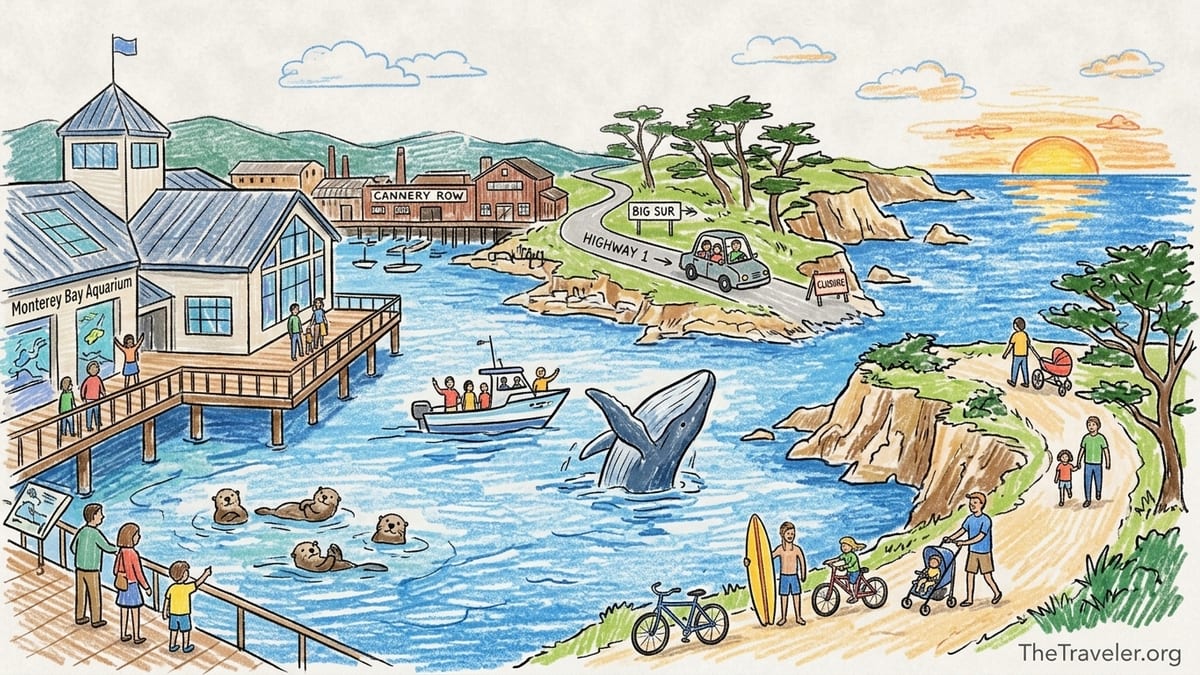
Why Monterey Belongs on Your California Itinerary
Monterey sits roughly two hours south of San Francisco by car, yet it feels much smaller and slower paced than the Bay Area. The historic downtown around Alvarado Street, Fisherman’s Wharf and Cannery Row is walkable, which matters if you are visiting with children or older relatives who may not want to be in and out of the car all day. Many visitors base themselves near the waterfront so they can walk to the aquarium in the morning, return to the hotel for a rest, and head back out in the evening for dinner overlooking the bay.
What sets Monterey apart from other California beach towns is the combination of protected marine environment and developed visitor infrastructure. Monterey Bay is part of a vast national marine sanctuary, which means that boat operators, hoteliers and local authorities work within strict conservation rules. You can board a whale watching vessel at Old Fisherman’s Wharf in the morning, spend the afternoon among kelp forests and sea otters at the Monterey Bay Aquarium on Cannery Row, and end the day driving the coastal route toward Carmel or Pacific Grove to watch the sun drop into the Pacific.
Major booking platforms highlight Monterey as a family base because it offers a rare mix of wildlife, kid focused attractions and full service hotels. On any given weekend, you will see multi-generation trips checking into Cannery Row properties, surfboards and strollers packed into the same SUV at breakfast, and couples using Monterey as a calmer overnight before or after tackling longer drives to Big Sur or Los Angeles.
Monterey Bay Aquarium: Planning a Visit
The Monterey Bay Aquarium is the single biggest draw in town, housed in a former sardine cannery at the ocean end of Cannery Row. Exhibits focus on the local marine ecosystem, from towering live kelp forests to galleries of jellies, open-ocean viewing tanks and a popular sea otter habitat. The aquarium operates on timed tickets, which must be purchased in advance directly through its official ticketing system for specific dates through at least December 31, 2026. Same day tickets sometimes sell out during school holidays and summer weekends, so advance planning is essential if the aquarium is a centerpiece of your trip.
Recent published information for 2026 indicates that adult tickets are priced around 65 dollars, with lower prices for children, students and seniors, and free admission for children aged four and under. Exact prices can change, and the aquarium periodically adjusts its structure, so it is wise to confirm current rates shortly before booking. Families watching their budget sometimes look for discounts through regional programs, hotel packages that bundle admission with rooms, or special library pass schemes available to local residents, although many of these benefits are restricted to those living in Monterey County rather than visitors.
To make the most of your visit, aim for opening time in the morning, when crowds are lightest and the lighting in many exhibits is at its best for photography. A common real world itinerary for a family staying near Cannery Row is to walk over for the first time slot, stay until late morning, exit for lunch at one of the casual sandwich or taco spots nearby, and then re-enter in the afternoon for feeding demonstrations and the outdoor decks overlooking the bay. The aquarium allows same-day re-entry, which helps families manage nap times and breaks.
Several Booking.com listed hotels sit within a ten to fifteen minute walk of the aquarium, which means you can leave strollers and extra clothing in your room rather than carrying everything all day. Parents often look specifically for properties that advertise suites or rooms with two queen beds and a sofa bed, mini-fridges for snacks, and on-site or nearby parking, as Cannery Row’s public garages can fill during peak periods.
Whale Watching in Monterey Bay
Monterey Bay is known among marine biologists and wildlife photographers as one of the premier whale watching destinations on the West Coast, thanks in part to a deep submarine canyon that brings nutrient rich waters close to shore. From Old Fisherman’s Wharf, several operators, including Discovery Whale Watch and Monterey Bay Whale Watch, run daily trips year round, adjusting schedules based on daylight and migration patterns. Public schedules for December 2026, for example, show sunset cruises departing around 5 pm, with passengers asked to check in roughly 30 minutes before departure.
Pricing varies by operator and season, but recent listings for standard three to four hour tours in 2026 show adult tickets often in the range of 70 to 95 dollars, with reduced rates for children and occasional family packages. Some companies operate larger vessels with indoor seating, snack bars and multiple decks, while others use smaller boats that get out to feeding areas quickly but offer less shelter from wind and spray. When comparing options on booking platforms, look closely at departure times, boat size, minimum age requirements for children and any cancellation policies related to sea conditions.
Wildlife viewing changes with the seasons. Winter and early spring tend to focus on gray whales migrating along the coast, while summer and early fall can feature humpback whales feeding on anchovies and sardines in the bay. On some days, lucky passengers also encounter dolphins, sea lions, harbor porpoises and, more rarely, orcas or blue whales. A realistic day on the water often involves scanning empty ocean for stretches of time punctuated by sudden bursts of activity when a humpback lunge feeds at the surface or a pod of common dolphins races the bow.
Families should prepare for cold, damp conditions even in mid-summer. Real world reviews frequently mention that guests from warmer climates underestimate how chilly it can feel on the open water, especially for children standing at the rail. Dressing in layers, bringing knit caps and gloves, and packing ginger candies or non-drowsy motion sickness remedies can make the difference between a memorable outing and a miserable one. Operators usually recommend arriving 30 to 45 minutes early to find parking near Fisherman’s Wharf, check in at small harbor offices, and use restrooms on land before boarding.
Coastal Drives and Current Highway 1 Conditions
Monterey is a natural starting point for exploring the Pacific Coast Highway, particularly the storied Big Sur section to the south. The drive from Monterey through Carmel-by-the-Sea and along Highway 1 rewards travelers with ocean overlooks, trailheads and turnouts that have filled guidebooks for decades. However, in recent years this stretch of road has seen repeated closures from landslides and, in 2026, wildfire activity known as the Timber Fire. Official updates from California’s transportation authorities in early September 2026 noted that the northern closure supporting fire operations had been lifted, while a southern closure remained in place further down the coast.
For practical trip planning, this means you should never assume Highway 1 is fully open between Monterey and San Luis Obispo without checking the latest state transportation alerts shortly before your drive. As of late 2026, travelers can often access the northern portion of Big Sur from Monterey for day trips, enjoying viewpoints and state park pullouts before encountering any remaining full closures farther south. Some visitors choose to drive only as far as the last open vista point, turning back to stay in Monterey rather than detouring inland on long backroads. Others adjust itineraries entirely, using Monterey as a base for coastal walks and short drives rather than attempting a through route to Southern California.
Even on open sections of Highway 1, real world driving conditions can be slower than many first time visitors expect. The road is narrow and winding, with frequent single lane construction areas, tight turnouts and heavy weekend traffic during high season. A drive that looks short on the map between Monterey and a specific Big Sur landmark can take significantly longer once photo stops and construction delays are factored in. Families may find it helpful to pair a half day drive south along Highway 1 with an easier, more forgiving outing, such as a visit to Carmel Beach or the coastal recreation trail between Monterey and Pacific Grove.
For those who encounter closures that block their intended route, inland alternatives exist but require careful navigation and, in some cases, comfort with remote roads. Cyclists and long distance road trippers sometimes bypass closed portions of Big Sur by routing through the Salinas Valley and Fort Hunter Liggett via roads like Jolon Road and Nacimiento-Fergusson Road, though these options can be steep, narrow and occasionally affected by their own maintenance work. Most vacationing families choose to adjust expectations instead, accepting Monterey as the scenic endpoint of their coastal drive rather than forcing a complicated workaround with tired passengers in the car.
Booking.com Highlights: Where to Stay With a View
Accommodation in Monterey ranges from budget motels near the fairgrounds to waterfront inns and full service hotels on Cannery Row and along the beach. On platforms like Booking.com and other major reservation sites, properties near Cannery Row and Fisherman’s Wharf tend to rank highly for travelers interested in walking access to the aquarium, dining and harbor activities. These include boutique inns with partial ocean views, mid-range hotels offering family suites, and larger branded properties with amenities such as valet parking and on-site restaurants.
Families often filter search results by distance to the Monterey Bay Aquarium and the presence of features like complimentary breakfast, free parking and indoor or outdoor pools. Real world examples include small inns that market “kids stay free” policies when sharing existing bedding in parents’ rooms, motels offering rooms with two queens plus a sleeper sofa to fit larger groups, and beach-adjacent hotels that feature fire pits where families gather in the evening after a day of sightseeing. Some Cannery Row properties provide balconies overlooking the bay, which can be a memorable upgrade if you hope to spot sea otters or harbor seals from your room.
Price points fluctuate sharply based on season and demand. On shoulder season weekdays outside of major holidays, it is often possible to find mid-range rooms in the wider Monterey area for under 200 dollars per night on large booking platforms, particularly in neighborhoods a short drive from the waterfront. During summer weekends or festival periods, waterfront rooms can rise well above 400 dollars per night, and minimum stay requirements may appear. Savvy travelers sometimes book cancellable rates several months ahead and then watch for price drops or promotions closer to arrival.
Parking is a practical concern that surfaces frequently in guest reviews. Some downtown and Cannery Row hotels charge nightly parking fees, while others on the outskirts of Monterey advertise free on-site parking as a value perk. When comparing Booking.com listings, read amenities sections carefully to understand whether parking is included, whether spaces are guaranteed, and whether there are height restrictions in garages that might affect vehicles with roof boxes or bike racks.
Designing a Family Friendly Itinerary
A realistic family itinerary in Monterey balances structured attractions with unhurried time along the coast. One common three day plan for visitors with school-age children begins with arrival and a walk along the Monterey Bay Coastal Recreation Trail, which runs roughly parallel to the shoreline and connects Fisherman’s Wharf, the aquarium and Pacific Grove. Many families rent bicycles or surreys from shops near the trail for an hour or two to stretch their legs after the drive. Dinner on the first night might be at one of the casual seafood restaurants along Fisherman’s Wharf, where children can watch harbor seals and sea lions from the deck.
The second day often centers on the Monterey Bay Aquarium. Families staying on Cannery Row walk over at opening time and spend the morning in the exhibits, break for lunch nearby, and then return in the afternoon for feedings and touch pools. Evening can be a quieter affair, with pizza or tacos back near the hotel and a sunset stroll along the waterfront. This pattern works well for young children who may tire quickly in loud, stimulating spaces and need predictable meal and nap times.
On the third day, some families schedule a morning whale watching tour from Old Fisherman’s Wharf, followed by an unscheduled afternoon to rest or explore Pacific Grove, Asilomar State Beach or Carmel-by-the-Sea, depending on how everyone feels after the boat. Real world feedback suggests that stacking a whale watching trip and a long Highway 1 drive on the same day can be exhausting, particularly if anyone in the group is prone to motion sickness. Allowing flexibility in the latter part of the day means you can cut activities short if the sea conditions were rough or the weather turns foggy along the coast.
Parents traveling with infants or toddlers may prefer to reverse the order, taking a shorter coastal drive or beach visit first while energy is high, and holding aquarium tickets for a day with less rigid timing. Because aquarium tickets are dated and timed, while coastal drives and beach walks are more flexible, many families find it easier to anchor their schedule around those fixed commitments and let the rest of the trip flow around them.
Practical Tips: Getting There, Getting Around and Best Seasons
Monterey is reachable by car via Highway 101 and Highway 68 from the north and east, or by Highway 1 along the coast from Santa Cruz. The local regional airport receives flights from several West Coast hubs, though many visitors still choose to fly into San Francisco or San Jose and drive. Once in town, you can park the car for much of your stay if you book near the waterfront. The waterfront districts are compact, and ride-hail services, local buses and bike rentals can fill most gaps for short hops.
Weather along the Monterey coast is notably cooler and more variable than inland California. Even in July and August, daytime highs along the water often sit in the low 60s Fahrenheit, and morning fog is common. Layering is essential, especially if your plans include whale watching or evening walks. Travelers arriving from hotter parts of the United States are frequently surprised to find that they need jackets and beanies on summer nights. Winter storms between December and March can bring heavy rain and periodic coastal flooding, which in turn affect Highway 1 and some beach access points.
As for timing, late spring and early fall often bring a pleasant balance of milder weather and manageable crowd levels, though shoulder seasons are narrowing as more travelers work flexibly and avoid traditional school holiday periods. If your trip depends on Highway 1 being open for a specific through drive, it is wise to keep dates flexible and to monitor official transportation updates closely as your travel window approaches. For visitors primarily focused on the aquarium, whale watching and local beaches, occasional closures farther south along Big Sur may have limited impact on the quality of the overall stay.
Finally, build a little slack into your schedule and budget. Parking fees, admission tickets, meals on Cannery Row and spur-of-the-moment activities like kayak rentals or additional aquarium snacks can add up quickly for families. Leaving space in the daily plan for unstructured time along the coastal path or in one of Monterey’s small parks not only keeps costs in check, it also allows children and adults alike to absorb the coastal atmosphere that makes Monterey a favorite return destination.
Conclusion: A Compact Coastal Escape With Big Experiences
Monterey delivers an impressive range of experiences within a small geographic area: close-up encounters with marine life at the Monterey Bay Aquarium, the chance to see whales and dolphins in the wild a short boat ride from shore, coastal drives that have appeared in films and advertisements for decades, and a spectrum of lodging options highlighted across major booking platforms. Its walkable waterfront, temperate climate and layered history give it a quieter charm than some of California’s louder beach cities, making it especially appealing for families and travelers seeking a mix of education and relaxation.
By grounding your plans in current information about aquarium tickets, whale watching schedules and Highway 1 conditions, and by choosing accommodations that match your family’s rhythm and budget, you can shape a Monterey itinerary that feels both efficient and unhurried. Whether you are watching humpback whales breach beyond the harbor, tracing the stories of the old canneries, or simply sharing an ice cream along Cannery Row at dusk, Monterey offers a coastal escape that lingers in memory long after the drive home.