


Montreal Trudeau Airport has quietly transformed how Uber and other rideshare services operate on its curbside. If you last flew into YUL a few years ago, you will find a very different system in 2026, centered on Door 28 for UberX, a PIN-based matching process, and a growing reliance on the P4 Express Drop-Off area just away from the main terminal. Understanding how these pieces fit together can save you time, stress, and, in some cases, a surprising amount of money.
Get the latest updates straight to your inbox!
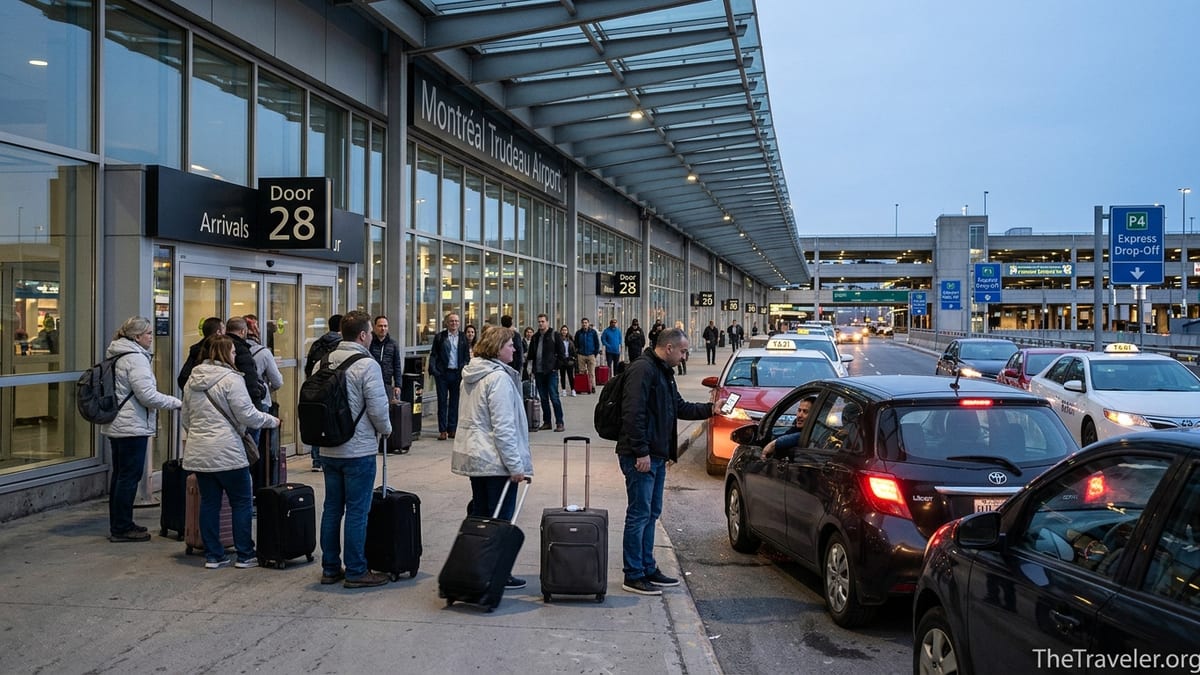
How Uber Works at Montreal Trudeau Airport in 2026
Montreal Trudeau (YUL) officially allows Uber and Lyft, but it channels them through specific zones to control congestion. For most travelers arriving at the airport, the two main locations to know are Door 28 on the arrivals level and the P4 Express Drop-Off area, a short shuttle ride from the terminal. Which one you use depends on the Uber product you choose and how much you are prepared to walk or ride a shuttle.
As of mid-2026, the airport authority states that standard UberX pickups for arriving passengers take place directly at Door 28 on the arrivals level. For other Uber products, such as UberXL or Comfort, and for Lyft, pickups are moved to the P4 Express Drop-Off zone in the P4 parking structure. In practice this means a traveler with two carry-ons heading alone to a downtown hotel is usually better off using UberX from Door 28, while a family of five with ski gear might deliberately choose UberXL and follow signs to P4.
Door 28 is accessed by exiting the baggage claim area onto the arrivals curb at the far end of the terminal, where ground staff and signage point riders toward the dedicated Uber line. P4 Express, by contrast, is reached either by a short shuttle bus from the arrivals curb or by following indoor wayfinding through the terminal to the P4 parking elevators and walkways. Travelers arriving late at night, in winter conditions, or with limited mobility may find the direct curbside pickup at Door 28 significantly more convenient.
Departing passengers using rideshare have more flexibility. There is no single mandatory drop-off point for Uber; drivers can still pull up at the regular departures curb. However, the airport strongly encourages drivers to use express areas like P4 during the afternoon peak, roughly 1 p.m. to 8 p.m., when traffic to the terminal ramp can back up. In July and August, when transatlantic departures peak, this can easily mean a 10 to 20 minute time difference between being dropped at P4 and taking a quick shuttle, versus sitting in a line of cars slowly inching toward the main doors.
Door 28 and the Uber PIN System: What Actually Happens
The most visible change at YUL for Uber riders is the PIN-based pickup system at Door 28. Instead of being matched to a specific driver and car when you request your trip, the app assigns you a short numeric code, the PIN, and instructs you to walk to the Uber pickup area at Doors 27–28. Drivers already waiting in the holding loop are then matched on a first-come, first-served basis by entering your PIN in their app.
In practice, this is how a typical arrival looks. You land from Toronto, collect your luggage, and open the Uber app while walking toward the exit. You select UberX, confirm your destination, and the app displays both a fare estimate and a PIN, often a simple four-digit code. Rather than seeing a specific license plate, you see directions like “Proceed to Door 28, look for the Uber line, and share your PIN with the next available driver.” When you reach the curb, airport agents or signage indicate the queue where passengers line up.
When it is your turn at the front of the line, the next UberX car in the queue pulls up and the driver asks for your PIN. The driver enters this PIN into their app, which confirms your destination and locks in the trip. Only then should you get into the vehicle. The system is designed to speed up throughput by reducing the number of individual car-meets-passenger moments at the curb, especially when dozens of flights land within the same hour.
There are, however, practical points to keep in mind. Because you are not initially matched to a specific vehicle, you must pay closer attention to safety checks. Always verify that the driver’s name and photo in the app match the person in front of you after they enter your PIN, and ensure the app shows your correct destination before closing the door. Travelers have reported situations where unofficial drivers tried to copy the PIN system by approaching passengers in the line; if someone asks for your PIN but their app does not confirm your ride with your name and destination, decline and wait for the next official Uber vehicle.
Finding Door 28 and Navigating Leigh-Capreol / Curbside Crowds
Door 28 is located at the far end of the arrivals level, near the Leigh-Capreol drop-off and pickup area. After customs and baggage claim, follow the signs for “Arrivées / Arrivals” and ground transportation, then continue walking along the indoor corridor until you see signage indicating higher door numbers. The standard pattern is that door numbers increase as you walk away from the central terminal, with Door 28 toward the end of the curb. Travelers who are used to waiting outside the first set of sliding doors they see often miss the Uber area; it is worth the extra two to three minutes to walk directly toward Door 28.
Outside, the Leigh-Capreol area functions as a multi-purpose curb. Private cars, friends and family, and some shuttles all converge here, so at busy periods like Sunday evenings in August it can feel chaotic. Ground staff often direct traffic aggressively, waving cars through if they stop too long. For rideshare users, this means you should keep your luggage together and be ready to move as soon as your turn in the Uber queue comes up. Standing well back from the curb until your driver has confirmed the PIN and stopped completely helps avoid feeling rushed.
An example from a typical afternoon arrival shows how timing plays out. A traveler landing from Paris at around 4:30 p.m. might clear immigration and bags by 5:30 p.m., then walk to Door 28 and join a modest Uber queue. With the PIN system moving steadily, they could be in a car within 10 minutes, even when the curb lane looks jammed. In contrast, a local friend trying to pick them up in a private car might circle for 15 to 20 minutes just to find a legal stopping space near the same doors, which is why more locals are shifting to using the P4 Express Drop-Off instead.
In winter, conditions at Leigh-Capreol and Door 28 add another wrinkle. Snowbanks, slush, and strong winds along the exposed curb can make waiting outside uncomfortable. If you arrive on a particularly cold evening in January or February, consider requesting your Uber only once you are within two or three minutes of the queue rather than while still in the baggage hall. You can also wait just inside the sliding doors, watching the line through the glass and stepping out only when it is close to your turn, minimizing time in the wind.
P4 Express Drop-Off: When It Beats the Main Curb
P4 Express Drop-Off has become a key part of YUL’s traffic management strategy. Located in the P4 parking structure, this area serves as both a drop-off point for departing passengers and a pickup zone for certain rideshare categories like UberXL, Comfort, and Lyft. Rather than battling for space at the main terminal ramp, cars use dedicated lanes inside the parking complex, while passengers reach the terminal via a short shuttle or an enclosed walkway, depending on the exact route in use during ongoing construction phases.
The airport specifically suggests that drivers dropping off passengers during peak hours, roughly 1 p.m. to 8 p.m., use P4 Express instead of the main departures curb. For a real-world example, imagine a family of four heading to a late-afternoon flight to Vancouver on a Friday in July. Their Uber driver, seeing heavy traffic reported on the access road, might choose P4, where the family unloads luggage in a calmer environment and then rides a five-minute shuttle to departures. In heavy holiday traffic, this can mean arriving at the check-in counters 10 to 15 minutes earlier than if the car had queued for the main ramp.
For arriving passengers, P4 also plays a role in rideshare pickups beyond basic UberX. If you select UberXL for extra luggage space, the app may direct you to P4 instead of Door 28. The usual sequence is to exit the terminal, follow signs to the P4 shuttle stop near arrivals, and ride a brief, free shuttle directly into the parking structure, where a dedicated pickup area has space for larger vehicles to wait without blocking regular traffic. This can feel like an extra step when compared with simply walking to Door 28, but for groups carrying ski bags, stroller systems, or multiple large suitcases, the additional room at P4 can be worth it.
Local drivers also use P4 Express strategically when dropping off friends and family. A Montreal resident driving a relative to the airport for a 6 p.m. flight on a busy Sunday might opt for P4 to avoid being stuck in bumper-to-bumper traffic approaching the main departures level. They park briefly in the express area, say their goodbyes in relative calm, and let their passenger continue by shuttle. The time trade-off is typically a couple of minutes on the shuttle in exchange for potentially twenty minutes saved in traffic.
Prices, Surge, and When a Taxi May Be Cheaper
Uber pricing at YUL, as in most cities, fluctuates with demand. On a quiet Tuesday morning, a typical UberX fare from Montreal Trudeau to a hotel near Place des Arts or Old Montreal might fall in the range of roughly 40 to 55 Canadian dollars, similar to what many travelers report paying from the airport to central neighborhoods. During busy periods or when severe weather hits, that same trip can surge significantly higher, especially in the early evening when both airport arrivals and city commuters are competing for cars.
Traditional taxis from YUL to downtown Montreal, by contrast, operate on a regulated flat fare set by Quebec’s transport regulator. As of 2026, that flat rate sits just under 50 Canadian dollars during the day, with a modest premium for late-night or very early morning rides. The exact numbers are subject to regulatory adjustments, but the key point is that the price is fixed for trips between the airport and the defined downtown zone, regardless of traffic or route. This predictability can make taxis an excellent value during periods when Uber surge pushes dynamic fares above the regulatory flat rate.
Consider a Saturday evening in August when a major festival is happening downtown and thunderstorms pass through around 6 p.m. In that type of scenario, travelers have reported UberX quotes from YUL to the downtown core rising well above the flat taxi fare, occasionally into the 70 to 80 Canadian dollar range. In these moments, joining the official taxi line outside arrivals and paying the fixed rate can mean saving 20 to 30 dollars per trip. Conversely, at off-peak times such as mid-morning on a weekday, an UberX might undercut the taxi flat rate by a few dollars, especially if you are traveling alone with light luggage.
Surge pricing also affects trips that are not heading downtown. The flat taxi fare applies only between the airport and the specified downtown zone; for other neighborhoods such as NDG, Plateau Mont-Royal, or Laval, taxi fares are meter-based and reflect distance and time. For these routes, comparing the Uber estimate with the expected taxi meter fare becomes more nuanced. A family traveling to an Airbnb in the Plateau might find UberXL more competitive than a taxi van during quiet hours, while someone heading to a suburban address on the North Shore could find either option similar in price but choose based on wait times and comfort with the app.
Taxi and Public Transit Alternatives to Uber
Montreal Trudeau still maintains a strong traditional taxi presence. Official airport taxis queue in a dedicated lane outside arrivals, and agents direct passengers to the next available car. For most English-speaking visitors, the process is straightforward; drivers are used to tourists and know the main hotel zones well. The key advantage is that you do not need an app or mobile data. You simply walk out, state your destination, and either pay the regulated flat fare for downtown or the meter rate for areas outside the fixed zone.
For travelers on a budget, the 747 express bus remains a popular alternative to both taxis and Uber. This airport bus connects YUL with downtown Montreal, stopping at major hubs such as Lionel-Groulx and Berri-UQAM, where you can transfer to the metro. A typical adult fare is roughly the cost of a single transit ticket with airport supplement, offering a substantial saving compared with a 50 dollar car ride, especially for solo travelers. A backpacker arriving late afternoon might opt for the 747 to reach downtown for a small fraction of what an UberX would cost, then walk or use the metro to reach their hostel.
Hotel shuttles and private transfer services fill out the landscape. Several larger hotels near the airport, particularly those clustered around Cote-de-Liesse and the Trans-Canada Highway, operate complimentary shuttles, making Uber unnecessary for guests staying nearby. For groups or business travelers, pre-booked private transfers, including black-car services and dedicated vans, can sometimes rival or beat Uber Black pricing on a per-person basis when divided among four or more passengers, though they typically must be arranged in advance.
When choosing between Uber, taxi, and the 747 bus, your decision will likely come down to three factors: time, comfort, and predictability. Uber offers app-based convenience and potential savings during quiet periods. Taxis provide fixed downtown pricing and the advantage of bus lanes and express lanes in certain traffic conditions. The 747 bus shines for budget-conscious solo travelers or couples with light luggage and a bit of patience for a 40 to 60 minute ride into town.
Practical Tips for a Smooth Uber Experience at YUL
A little preparation goes a long way at Montreal Trudeau. Before your flight lands, it is worth updating the Uber app, ensuring you have data service that will work in Canada, and checking that your payment method is current. If you are roaming from the United States, activating a short-term data plan allows you to request your ride at Door 28 without hunting for airport Wi-Fi, which can be congested during peak times.
When you reach arrivals, resist the urge to request your Uber the moment you clear customs. Instead, walk toward Door 28 first, check how long the queue is, and only then request the ride so that your PIN remains valid and you are not delaying drivers. If the Uber app shows long estimated arrival times, compare its quoted fare to the regulated taxi flat rate for downtown or the estimated meter fare to your neighborhood. You can do this by briefly switching to the taxi line outside and asking an agent for an approximate cost.
Safety-wise, maintain the same discipline you would in any busy rideshare environment. Share your trip with a friend or family member through the app, confirm that the driver’s name and photo match what you see on your phone after they enter your PIN, and keep your luggage close to you until you are fully seated. If you ever feel pressured by staff or drivers to hurry into a vehicle before details are confirmed, step back and let the next car take your spot. The system will still match you; one or two extra minutes is a small price to pay for peace of mind.
Finally, remember that conditions at YUL can change due to construction or seasonal adjustments. Signage directing Uber riders to Door 28 or P4 Express may be updated, and shuttle pick-up points can shift slightly. If you are unsure, ask an official airport agent inside the terminal for the current rideshare procedure. They deal with confused travelers every day and can quickly point you toward the right door, shuttle stop, or elevator, helping you avoid wandering with luggage in tow.
The Takeaway
Montreal Trudeau’s Uber setup in 2026 is more structured and, at times, more complicated than what many travelers remember. Door 28 and the PIN system aim to keep the arrivals curb moving, while the P4 Express Drop-Off area offloads some of the pressure during peak hours. For most solo travelers and couples with standard luggage, UberX from Door 28 offers a convenient, app-based ride straight into the city, provided you are comfortable with the PIN process.
At the same time, the regulated flat taxi fare to downtown, the 747 express bus, and hotel shuttles all offer viable alternatives that can beat Uber on price or predictability, especially during surge conditions. The smartest strategy is to treat Uber as one of several tools rather than the automatic default: check the app, glance at the taxi line, and remember that that five-minute shuttle from P4 can be the difference between sitting in gridlock and breezing to your gate.
Armed with a clear sense of where Door 28 is, what P4 Express offers, and how surge pricing compares to flat taxi rates, you can step off your flight at YUL with a plan. Whether your priority is saving money, minimizing walking in a Montreal snowstorm, or getting downtown in time for dinner in Old Montreal, the airport’s evolving rideshare system can work for you instead of against you.
FAQ
Q1. Where exactly do I meet my Uber at Montreal Trudeau Airport?
Most arriving passengers using UberX meet their driver at Door 28 on the arrivals level, where there is a dedicated pickup area and queue for the PIN-based system.
Q2. How does the Uber PIN system at Door 28 work?
When you request UberX, the app gives you a numeric PIN instead of a specific car. You line up at Door 28, give your PIN to the next available driver, and once their app confirms the match and destination, you get into the vehicle.
Q3. When do I need to go to the P4 Express Drop-Off area instead of Door 28?
If you choose a larger or premium rideshare option like UberXL or Comfort, or if you are using Lyft, the app may direct you to the P4 Express Drop-Off zone in the P4 parking structure rather than Door 28.
Q4. How do I reach P4 Express Drop-Off from the terminal?
You can follow airport signs to the P4 shuttle stop outside arrivals and take a short, free shuttle ride, or follow indoor wayfinding to P4 via elevators and walkways, depending on current construction and traffic patterns.
Q5. Is Uber cheaper than a taxi from YUL to downtown Montreal?
It depends on demand. Taxis have a regulated flat fare for the downtown zone that stays constant, while Uber pricing can be lower during quiet periods but often rises above the taxi flat rate during surge times or bad weather.
Q6. How long does it usually take to get an Uber at Door 28?
At off-peak times, many travelers report being in a car within 5 to 15 minutes of joining the queue at Door 28, but during busy evenings or holiday periods the wait can be longer, especially when many flights arrive at once.
Q7. Can my Uber driver drop me at the main departures curb when I leave Montreal?
Yes, Uber drivers can use the main departures curb, but the airport encourages using express areas like P4 during peak afternoon and evening periods to avoid congestion around the terminal ramp.
Q8. What is the best option if I arrive during a big surge in Uber prices?
If the Uber quote is significantly higher than the regulated taxi flat fare to downtown, joining the official taxi line or taking the 747 express bus into the city can be more economical, especially for solo travelers.
Q9. Is it safe to use the Uber PIN system at YUL?
The system is designed to be safe, but you should still confirm the driver’s name and photo in the app after they enter your PIN and ensure your destination is correct before getting into the car, just as you would with a standard Uber ride.
Q10. Are there any alternatives if I do not want to use Uber or a taxi?
Yes. The 747 express bus connects the airport to downtown metro stations, several nearby hotels offer free shuttles, and private transfer services can be pre-booked if you prefer a dedicated vehicle waiting on arrival.