


Montreal Pierre Elliott Trudeau International Airport (YUL) is a major Canadian hub with a single terminal serving domestic, international and U.S.-bound flights. Its compact layout can make connections efficient, but the mix of Canadian, U.S. preclearance and international border rules also creates confusion, especially around baggage and customs. This guide breaks down how connections really work at YUL in 2026, with concrete examples and realistic transfer times so you can decide whether that tight layover is worth the risk.
Get the latest updates straight to your inbox!
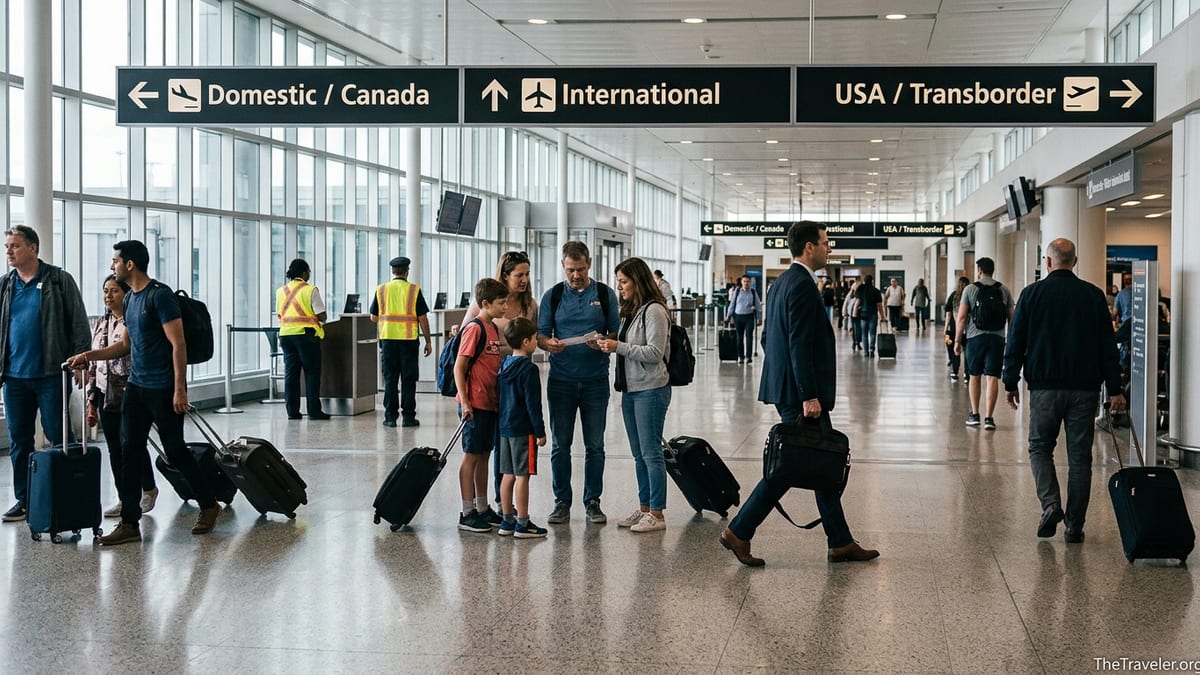
How Montreal Trudeau Airport Is Laid Out
Montreal Trudeau operates as a single continuous terminal, but it is divided into three secure zones: a domestic jetty for flights within Canada, an international jetty for flights to and from destinations outside Canada and the United States, and a transborder jetty for flights to and from the United States that use U.S. preclearance. All departing passengers start in the same public departures hall with common check-in areas, then branch out after security toward their respective zones. Domestic and international departures share one larger secure area, while the U.S. transborder wing splits off through a further checkpoint after U.S. screening.
In practice, this means that many connections at YUL are simply a walk through the secure departures level, while others require you to clear Canadian border control or U.S. preclearance. For example, a passenger flying Halifax to Montreal to Vancouver stays on the domestic side for the entire connection, whereas someone flying Boston to Montreal to Paris preclears into the United States before leaving Boston, then arrives into the sealed transborder area at YUL and must transfer from that zone to the international jetty.
Because everything is under one roof, walking distances are reasonable by international hub standards. From a typical domestic gate in the 20s to a mid-range international gate in the 50s, most travelers report around 10 to 15 minutes of normal-paced walking. However, when you add in security, customs, or preclearance, connection times rise quickly, which is why scheduled minimum connection times at YUL vary depending on whether a border is involved.
All arrivals converge on a lower level used by Canadian border services for international passengers and standard baggage claim for domestic flights. After you clear customs, you rejoin the public arrivals hall, which leads up to check-in and security if you are starting a new itinerary or rechecking bags. Understanding whether you can stay airside or must enter Canada through arrivals is the single most important factor in planning a safe layover at Montreal Trudeau.
Domestic to Domestic Connections within Canada
Domestic to domestic connections at YUL are the simplest scenario. If you arrive on a flight from another Canadian city and connect onward to a second Canadian destination on the same ticket, you stay entirely within the secure domestic and international departures area. There is no Canadian customs or immigration, no baggage reclaim and no additional security screening if you remain inside the connections path. You simply follow the “Connections / Correspondances” signs, check the departure screens for your next gate and walk there.
On these itineraries, airlines often sell legal connection times as low as 30 minutes, which reflects the official minimum connection time used in global schedules. In reality, most experienced travelers prefer at least 45 to 60 minutes to allow for a minor arrival delay, a slow deplaning process from a full narrow-body aircraft, and the 10-minute walk between distant gates. For instance, a 35-minute connection from Ottawa to Montreal to Quebec City might be technically legal, but a 10-minute delay on the first leg or a late pushback due to deicing in winter could easily wipe out your buffer.
Checked luggage normally transfers automatically on a through domestic ticket. If you are flying, for example, Calgary to Montreal to St. John’s entirely on Air Canada or WestJet, your bags are tagged to your final destination at your origin airport and move behind the scenes between aircraft. You would only need to reclaim bags and recheck them if you booked completely separate tickets on different airlines and had to exit to the public hall to check in again, which converts a simple domestic transfer into a self-connection more like two separate trips.
Because there is no border step, domestic to domestic connections are where a short layover at YUL is least risky. Even so, frequent winter weather disruptions in Quebec and across Canada mean that travelers connecting to the last flight of the day to a smaller city, such as Moncton or Fredericton, should consider padding their schedule with at least 90 minutes. Missing that final leg could mean a forced overnight in Montreal rather than a quick rebooking an hour later.
Domestic to International and International to Domestic
When you connect between a Canadian domestic flight and a non-U.S. international flight, the key variable is whether you must pass through Canadian border controls in Montreal or can use a dedicated connections corridor. For many itineraries from Europe, there is now a streamlined process that allows you to remain essentially in transit, completing only a brief identity and customs declaration check before re-entering the departures area. For other routes, especially those from regions without specific aviation security agreements with Canada, you may still need a more traditional passport and baggage inspection.
Suppose you fly Vancouver to Montreal to Paris on a single ticket with checked luggage tagged straight to France. Leaving Vancouver, you clear security as usual. On arrival in Montreal, you follow signs marked “International Connections” instead of “Baggage Claim / Exit.” You scan your boarding pass at a connection checkpoint, complete an electronic customs declaration at a kiosk, and may pass by a Canadian border officer who can ask routine questions. Your checked baggage stays within the system and automatically transfers to the Paris flight, and you emerge back into the international departures zone without ever going down to the public arrivals hall.
The reverse direction, such as Paris to Montreal to Winnipeg, has become easier in 2026 thanks to Canadian border initiatives that allow eligible through passengers to bypass full customs. In many cases, if your bags are tagged through to Winnipeg and your arrival and onward flight are on the same day, you scan your documents at a connection kiosk, briefly meet a border officer and proceed directly to domestic departures without collecting bags. This process assumes your airline participates in the streamlined program and that Canada has accepted security screening from your point of origin. If you are arriving from certain regions or on separate tickets, you may still have to collect your luggage in Montreal, clear Canadian customs in the main hall and then recheck bags with your onward airline.
Officially, the scheduled minimum connection time between domestic and international flights at YUL is generally around 60 minutes, but that figure assumes an on-time arrival and a smooth transfer through the connections facility. In practice, many travelers target at least 90 minutes for domestic to international and 2 hours for international to domestic, particularly if they need to clear passport control with a non-Canadian passport or have children, mobility issues or checked luggage that might need to be reclaimed and rechecked.
U.S. Transborder Flights and Preclearance Nuances
Montreal Trudeau hosts a U.S. preclearance facility, which means that passengers traveling to the United States clear U.S. Customs and Border Protection (CBP) immigration and customs in Montreal instead of on arrival. Once through preclearance, the transborder jetty is treated as if it were inside the United States for arrival purposes. Flights land at regular domestic gates in cities like New York, Chicago or Miami, and passengers walk straight into the terminal without meeting CBP again.
For departing passengers, this arrangement adds an extra stage beyond standard Canadian security. For instance, a traveler leaving Montreal for New York checks in and tags bags in the public hall as usual, passes through the main security checkpoint, and then follows signage to the U.S. transborder area. Before reaching the gates, they complete the U.S. primary inspection, often through automated kiosks followed by a CBP interview, and their checked baggage is made available for potential inspection by U.S. authorities behind the scenes. At busy times, especially early weekday mornings when many business flights depart for U.S. hubs, the preclearance line can add 30 to 60 minutes to the departure process.
For connections into U.S.-bound flights, such as Quebec City to Montreal to Washington, passengers arriving on a domestic flight follow “Connections to U.S.” signage toward the transborder corridor. Depending on the specific pathway in use, they may or may not need to pass through security again, but they will always complete U.S. preclearance before entering the transborder gate area. Official minimum connection times in airline systems for these transfers are often around 60 to 70 minutes, but a comfortable buffer of 90 minutes or more is advisable, particularly during peak morning and afternoon departure banks.
On the inbound side, a passenger flying Boston to Montreal to Edmonton arrives at YUL as a precleared U.S. passenger and is offloaded directly into the sealed transborder zone. They then follow “Connections to Canada / International” signs that lead back into the main departures area. Because U.S. immigration has already been completed at the origin, there is no further passport control in Montreal. If their bags were tagged to Edmonton, they stay in the system; the passenger only has to walk from the transborder wing to their domestic gate. Instances where a traveler must collect checked luggage during a U.S. connection at YUL are increasingly rare and usually involve separate tickets or special handling instructions given at check-in.
Baggage, Customs and Staying Airside: What Actually Happens
Baggage rules at YUL follow the standard North American model but are strongly influenced by whether you are changing countries and whether your journey is on a single through ticket. If your entire trip is booked under one reservation, such as Los Angeles to Montreal to Rome on Air Canada and a partner airline, your bags are typically tagged to your final destination, and you only see them at the end of the trip. In Montreal you follow connections signage and avoid the public baggage hall entirely, unless instructed otherwise by airport staff or your airline.
The main exception is when Canadian customs rules require you to present your baggage before rechecking it, which has historically been the case for many international to domestic connections. In 2026, this process is gradually being replaced by systems where airlines provide passenger and baggage information directly to the Canada Border Services Agency, allowing many connecting passengers to bypass physical baggage reclaim in Montreal. When the streamlined system applies, you complete an electronic customs declaration in advance, often via the ArriveCAN app, and follow a dedicated lane in the connections area that keeps you airside while CBSA performs risk-based assessments in the background.
For passengers traveling on separate tickets, the situation is very different. Imagine you book an inexpensive transatlantic flight from Paris to Montreal on a low-cost carrier, then a separate ticket from Montreal to Toronto on another airline. In that case, your first airline will almost certainly tag your luggage only to Montreal. You must collect it in the international baggage hall, clear Canadian customs, exit into the public arrivals area, then walk upstairs to check in again and clear security as if you were starting your journey in Montreal. This process typically requires at least 3 hours of layover to be reasonably safe, more if you are arriving in the late afternoon rush.
Carry-on baggage rules depend on the airline and destination. A bag that is acceptable on a European carrier for an overseas segment may be tagged at the gate in Montreal if your onward North American airline has stricter size limits or a full overhead bin situation. This can slightly slow down boarding and deplaning during tight connections. Travelers with important items like medication, electronics or high-value goods should keep them in a small personal item that remains with them at all times, in case a last-minute gate-check is required for their main carry-on during the connection.
Security Checkpoints, Trusted Lanes and Realistic Minimum Connection Times
Montreal Trudeau has a primary security screening area that feeds both domestic and international departures, along with specific access control points for the U.S. transborder area. Within the secure zone, additional boarding-pass-controlled gates separate domestic, international and transborder jetties. Connection flows are designed to limit the number of times passengers must fully re-clear security, but certain routings, particularly those that involve exiting to arrivals and then re-entering departures, inevitably require another trip through a checkpoint.
Several programs can help reduce security wait times at YUL, including NEXUS, which offers dedicated lanes at some security checkpoints and at the U.S. preclearance facility, and an appointment-based express lane system that allows departing passengers to reserve a time window at security. These options are most helpful when you are starting your journey in Montreal or have had to exit and reenter during a connection. They are less relevant for purely airside connections where you move between gates without leaving the secure zone.
Official minimum connection times at YUL, as used in airline reservation systems, are generally in the range of 30 minutes for domestic to domestic, 60 minutes for domestic to international and 70 to 90 minutes for itineraries involving U.S. flights or back-to-back international segments. Those figures describe the shortest schedules an airline can legally sell on a single ticket and assume an on-time arrival, quick deplaning, light queues at border and security points and gates that are reasonably close together.
In practice, most seasoned travelers build in extra time. As a rule of thumb at Montreal Trudeau in 2026, many people aim for at least 45 to 60 minutes for domestic to domestic connections, 90 minutes for domestic to international or international to domestic connections where they can remain airside, and 2 to 3 hours for any transfer that involves reclaiming and rechecking baggage, clearing Canadian customs in full or completing U.S. preclearance. For example, a 70-minute connection from Toronto to Montreal to Orlando on a single through ticket is generally manageable, while a self-connection from London to Montreal on one ticket and Montreal to Halifax on another is far safer with a 4-hour buffer.
Sample Itineraries: What Your Connection Will Look Like
To understand how all of these rules come together, it helps to walk through a few real-world examples. Consider a traveler flying Calgary to Montreal to Cancun on a single through ticket with a large Canadian carrier. Leaving Calgary, they clear security as usual. In Montreal, they land at a domestic gate and follow signs for international connections. They scan their boarding pass at a connection checkpoint, complete a quick customs declaration if required and emerge in the international departures zone. Their checked bags remain in the system and automatically transfer to the Cancun flight. With a 75-minute scheduled layover, this connection is typically comfortable unless the inbound flight is significantly delayed.
Now imagine a traveler from New York flying to Montreal and then on to Quebec City, all on one ticket. They have already cleared U.S. exit procedures and CBP has a record of their departure. Upon landing in Montreal, they arrive in the transborder jetty, then follow clearly marked connections signs toward domestic departures. There is no need to meet Canadian border officers if their journey is recognized as a same-day international transit and their bags are tagged through to Quebec City. They simply make the 10- to 15-minute walk to a domestic gate, check the departure board for an updated gate number and board the turboprop or regional jet for Quebec City.
A more complex case is a budget-minded traveler who books a low-cost ticket from Barcelona to Montreal arriving mid-afternoon, and a separate ticket from Montreal to Vancouver departing three hours later on another airline. On arrival in Montreal, this passenger must collect their baggage at the carousel, join the main queue for Canadian customs, answer routine questions, and then exit into the public arrivals hall. From there, they go upstairs, find the check-in desks for their next airline, recheck luggage, pass through security screening with all other departing passengers, and finally walk to their domestic gate. A 3-hour layover is workable here, but if the transatlantic flight is late or customs queues are unusually long, even that margin can feel tight.
Finally, consider a family of four flying Miami to Montreal to Rome, all on a single through ticket. They clear U.S. exit formalities and board in Miami, then land in the sealed transborder area of YUL. They follow “International Connections” signage, which leads them out of the transborder jetty and back into the shared international departures area. Because both segments are international and on one booking, their checked bags remain within the secure system. A scheduled 95-minute layover gives them time to visit restrooms, pick up snacks, and walk to a more distant gate in the 60s without needing to rush, even if deplaning from Miami takes a bit longer due to families and carry-on bags.
The Takeaway
Montreal Trudeau’s single-terminal design makes many connections feel straightforward, but the mix of Canadian customs rules and U.S. preclearance means that your experience can vary widely depending on routing and ticket type. Domestic to domestic and many same-ticket domestic to international connections are essentially airside walks that can be managed comfortably in about an hour, while international to domestic and U.S.-involving itineraries are more sensitive to border control wait times and benefit from layovers closer to 90 minutes or more.
Travelers on separate tickets, or those whose journeys require reclaiming and rechecking baggage in Montreal, should treat YUL like any major international hub and allow at least 3 hours between flights, particularly in winter or during busy holiday periods. Using tools such as advance customs declarations, trusted traveler programs and reserved security times can add a safety margin, but they are not a replacement for a realistic buffer. When in doubt, build in more time, not less; a relaxed coffee in the terminal is preferable to a sprint through the jetties and an anxious wait at a rebooking counter.
FAQ
Q1. Is a 45-minute layover enough to connect at Montreal Trudeau?
For simple domestic to domestic connections on a single ticket, 45 minutes can work if flights are on time and gates are close, but it leaves little room for delays. For itineraries involving customs, U.S. preclearance or separate tickets, 45 minutes is generally too short.
Q2. Do I have to collect my baggage in Montreal on an international to domestic connection?
On many through tickets, especially from Europe, you can now remain airside and let your bags transfer automatically while you complete a brief customs process in the connections area. However, if your flights are on separate tickets, or you are arriving from a region not covered by streamlined procedures, you will likely need to collect your luggage, clear customs and recheck it.
Q3. How much time should I allow to connect from a Canadian domestic flight to a U.S. flight at YUL?
Official minimum connection times are often around 60 to 70 minutes, but U.S. preclearance can add unpredictability. A buffer of 90 minutes or more is recommended, particularly during peak morning and afternoon departure periods or if you are traveling with children or checked bags.
Q4. Can I leave the secure area during a layover at Montreal Trudeau?
Yes, you can exit to the public area between flights, but you will then need to pass through security again to board your onward flight, and in some cases you may also need to deal with border formalities. For shorter connections, it is safer to remain airside and use the time to eat, shop or rest near your departure gate.
Q5. What happens if my first flight is delayed and I miss my connection at YUL?
If both flights are on a single ticket, your operating airline is usually responsible for rebooking you on the next available service at no additional cost, subject to conditions of carriage. If you built the connection yourself on separate tickets, the onward airline can treat you as a no-show and require you to buy a new fare, so extra buffer time is critical in that case.
Q6. Is Montreal Trudeau a good airport for tight international connections?
YUL’s compact layout makes gate-to-gate walking times relatively short, but border and security processing can still be a bottleneck. For back-to-back international flights on a single ticket, many travelers find 90 minutes a comfortable target; anything much shorter becomes risky if your inbound flight is late or the connections area is busy.
Q7. Do I go through U.S. customs in Montreal or when I land in the United States?
For flights departing YUL to the United States, you go through U.S. preclearance in Montreal before boarding. When you land in the U.S., you arrive at a domestic gate and do not meet U.S. Customs and Border Protection again for that flight, which can simplify onward domestic connections.
Q8. Are there trusted traveler or fast-track options at YUL?
Yes, travelers with NEXUS often have access to dedicated security and preclearance lanes, and there is an appointment-based express lane system for security that lets you reserve a time slot. These options can help shorten queues, but they do not change official minimum connection times and should not be used to justify extremely tight layovers.
Q9. How long should I allow for a self-connection with baggage at Montreal?
If you need to collect bags, clear customs, exit to arrivals, recheck baggage and pass through security again, plan for at least 3 hours between flights. This is especially important in winter, during holidays or for late-afternoon arrivals when customs lines can be longer and weather-related delays are more common.
Q10. Is Montreal Trudeau easy to navigate for first-time visitors?
The terminal is compact and well signed, with clear color-coded directions to domestic, international and U.S. transborder areas. First-time visitors generally find it straightforward to move between zones, but should still pay close attention to overhead signage, flight information screens and instructions from airline and airport staff during connections.