


Landing at Montreal Trudeau Airport and heading straight to atmospheric Old Montreal is one of the great city arrivals in North America. Between the cobblestone streets, heritage hotels and riverfront promenades, it feels a world away from the terminal. This guide walks you through the best real-world routes from the airport to Old Montreal, with clear advice on the 747 airport bus, taxis, Uber and Lyft, private transfers, how to handle luggage on stone streets, and what to do if you arrive late at night.
Get the latest updates straight to your inbox!
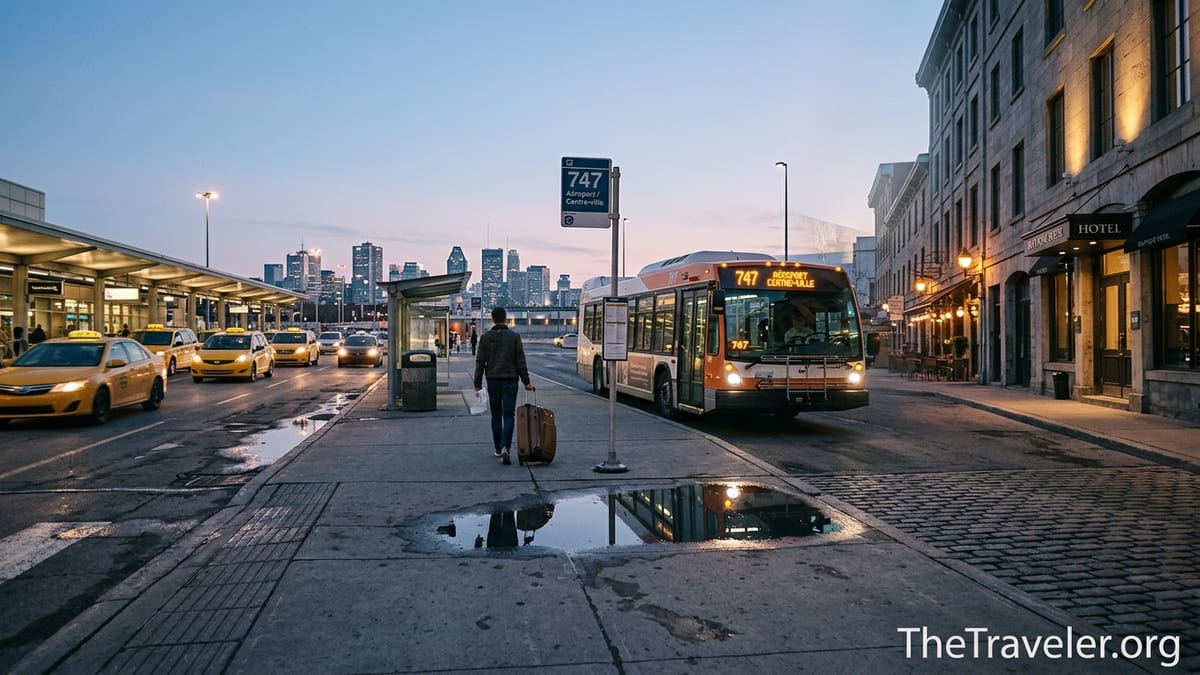
Understanding the Journey: YUL to Old Montreal
Montreal Trudeau Airport (YUL) sits roughly 14 kilometers west of downtown, and under normal traffic conditions the trip to Old Montreal takes about 25 to 35 minutes by car. In heavy rush hour or summer construction season, that can easily stretch to 45 minutes or more, especially as you reach the dense one-way grid around the historic district. Planning your route with realistic timing matters, particularly if you are jet-lagged or carrying heavy bags.
Old Montreal itself is a compact historic area along the St. Lawrence River, roughly bounded by rue Saint-Antoine to the north and rue de la Commune to the south, and centered on landmarks such as Notre-Dame Basilica, Place Jacques-Cartier and the Old Port. Many of the streets closest to the river, like rue Saint-Paul and parts of rue de la Commune, have cobblestone or uneven stone paving and are increasingly pedestrian-priority, which affects exactly where taxis and rideshares can drop you. Expect to be left on a nearby cross street and to walk the final short stretch to your hotel.
The majority of chain hotels and larger convention properties are actually just uphill from Old Montreal, along Boulevard René-Lévesque and rue Saint-Antoine around Square-Victoria–OACI and Place-d’Armes metro stations. If you booked a property like the Westin Montreal, Hotel Monville, or one of the bigger conference hotels near the Palais des congrès, your drop-off will likely be on a wide, modern street even though you are only a few minutes’ walk from the oldest cobblestones.
Because of this mix of historic lanes and modern avenues, choosing the right mode of transport depends on three main factors: your budget, how much luggage you have, and what time of day you arrive. A solo backpacker landing at noon will likely choose differently from a family of four arriving at 23:30 with rolling suitcases and tired children.
The 747 Airport Bus: Budget-Friendly Gateway to Downtown
Montreal’s 747 YUL Aéroport Montreal-Trudeau / Centre-ville bus is the workhorse of airport public transit and runs 24 hours a day between the terminals and downtown. The adult fare is about 11 to 12 Canadian dollars and, crucially, it works as a 24-hour pass on buses and metro within the central transit zone. That means if you arrive at 15:00, you can ride the 747 into town, then later use the metro from Place-d’Armes or Square-Victoria to explore, all on the same ticket.
The bus stops at several downtown points, typically including Lionel-Groulx metro station in the southwest of the core and central locations closer to Berri-UQAM and the main bus terminal. Schedules can vary, but departures are frequent during daytime and evening, with slightly reduced service overnight. At the airport, follow signs for public transit and look for the clearly marked 747 stop near the arrivals area; staff or volunteers can usually confirm the correct bay if you are confused by temporary construction changes.
For Old Montreal, many visitors use the 747 to reach Lionel-Groulx or Berri-UQAM, then transfer to the metro orange line and exit at Place-d’Armes or Square-Victoria–OACI. From Place-d’Armes station, for instance, it is about a five-minute downhill walk to Notre-Dame Basilica and another few minutes to many Old Montreal hotels along rue Saint-Paul or rue de la Commune. This is a good option if you are traveling light with a backpack or a single wheeled suitcase and are reasonably comfortable on stairs and urban sidewalks.
There are a few caveats. At peak periods, especially Friday afternoons or during festival season, the 747 can get caught in traffic as it approaches downtown and can be crowded with standing passengers and luggage. The buses do have luggage racks, but you may find yourself standing with bags if you board later along the route. Transit is generally safe, including in the evening, but if you arrive very late at night and feel particularly tired or disoriented, you may prefer a door-to-door option despite the extra cost.
Taxis: Flat-Rate Simplicity to Old Montreal Hotels
For many first-time visitors, a licensed taxi from the airport strikes the right balance between convenience and cost. Trips between Montreal Trudeau Airport and the central downtown zone, which includes the area around Old Montreal, are charged at a regulated flat rate. As of mid-2026, this flat fare is in the upper 40s Canadian dollars in daytime and a bit higher overnight, typically just over 55 dollars between 23:00 and 05:00. The amount is per car, not per passenger, so a family of four pays the same total as a solo traveler.
The taxi rank is just outside arrivals; follow yellow taxi signs and join the organized queue. An attendant usually manages the line and directs you to the next available cab. Payment is straightforward: most taxis accept major credit cards in addition to cash, and tipping around 15 percent is customary if service is good and your driver helps with luggage. For a daytime arrival, a typical ride to a hotel near Place Jacques-Cartier or rue Saint-Paul might take around 30 minutes in moderate traffic.
One advantage of taxis in the Old Montreal context is that drivers are usually familiar with the particular drop-off constraints of the historic district. If your hotel is on a pedestrianized or heavily cobbled lane, they may stop on a parallel asphalt street such as rue Saint-Antoine, rue Notre-Dame or Boulevard Saint-Laurent, explaining that vehicles are restricted closer in. For example, if you are staying at a boutique property by Place Jacques-Cartier, you might be dropped at the top of the square and walk downhill about three minutes over stone paving to reach the door.
This door-to-near-door service is especially valuable if you are carrying two large checked bags or traveling with someone who has reduced mobility. While taxis cost more than the 747 bus, the price difference narrows quickly if you are two or three people. For a couple sharing the flat fare, the per-person cost can be similar to buying individual 747 tickets, but with far less effort and no transfers.
Uber, Lyft and App Cars: What to Know Right Now
Uber and Lyft both operate in Montreal and serve the airport, but in 2026 pickup logistics at YUL have been in flux. At the time of writing, app-based rideshares typically use a dedicated pickup area near one of the airport parking structures rather than the traditional arrivals curb. Travelers report being directed, via the apps and airport signage, to a specific parking level, sometimes in the P4 garage, with a short shuttle or signed walk from arrivals.
Pricing can vary widely depending on demand. In calm periods, visitors have reported rides from the airport to central neighbourhoods in the 35 to 45 Canadian dollar range. During peak times, particularly weekday late afternoons or evenings when many flights land and traffic is heavy, surge pricing can push app rides higher than the regulated taxi flat rate. It is common for arriving passengers to open both the Uber or Lyft app and compare the live fare against the known taxi rate displayed on signage in the arrivals area.
For Old Montreal specifically, app drivers face the same access limitations as taxis: they may not be able to enter certain narrow or pedestrian-priority streets near Notre-Dame Basilica or along rue Saint-Paul. Expect to be dropped at an accessible cross street and to walk the final block or two with your bags. On rainy or snowy days, that short walk can feel longer, so consider this when choosing between an app ride and a metered taxi waiting right outside the terminal.
If you favor rideshares, a practical strategy is to check fares immediately upon exiting customs. If the app quotes are close to or higher than the posted taxi flat rate, take a regular cab instead and avoid the extra walk to the pickup area. If you see a significantly lower app estimate and minimal wait time, especially outside rush hour, an Uber or Lyft can be a good-value door-to-near-door option into Old Montreal.
Private Transfers, Shuttles and Hotel Cars
Travelers who value certainty above all, such as families with young children or older travelers, often book a private car or shuttle in advance. Several local companies and global platforms work with licensed drivers to provide pre-booked sedans or vans from YUL to downtown hotels. Prices vary, but for a private sedan you might expect something in the 80 to 120 Canadian dollar range for up to three passengers, with larger vehicles costing more. This is usually more expensive than taking a taxi on arrival, but you gain the reassurance of having a driver meet you after baggage claim with your name on a sign.
Some higher-end hotels in or near Old Montreal, including certain boutique properties along rue de la Commune or near the Old Port, can arrange transfers for their guests. These are typically billed through the hotel, and the car will wait even if your flight is delayed. If your arrival is close to midnight in the depths of winter and you are worried about navigating the terminal in heavy snow and cold, a pre-booked transfer that takes you straight to the closest legal stopping point to your hotel entrance can be worth the premium.
Shared shuttles are less common in Montreal than in some cities, and many services that once ran fixed-route hotel shuttles in the downtown area have shifted toward on-demand models or combined operations with private car services. If your hotel advertises an airport shuttle, double-check whether it is complimentary, how often it runs, and whether it stops in Old Montreal itself or at a central downtown hotel zone from which you must walk or taxi onward.
One detail to confirm in advance is vehicle size relative to your group and luggage. Old Montreal hotels often attract cruise passengers and long-stay travelers with large suitcases. If you are a group of four with two bags each, a standard sedan will be cramped; a pre-booked minivan or SUV with room for both passengers and luggage will make the arrival much less stressful, particularly when navigating tight cobblestone streets where quick loading and unloading is important.
Luggage, Cobblestone Streets and Choosing the Right Drop-Off
Old Montreal is beautiful precisely because so much of its 17th to 19th century street grid remains intact, but that charm comes with practical challenges for arriving guests. Cobblestone and rough stone paving are common on streets closest to the river and around Place Jacques-Cartier. Wheelie suitcases can rattle and snag on uneven surfaces, and narrow sidewalks mean you may sometimes roll your bags on the street itself. In winter, snowbanks and slush can add another layer of difficulty.
When booking your hotel, pay attention to its exact address and nearby cross streets. A property on rue Saint-Paul between two narrow alleys will require more careful luggage handling than a hotel on wider rue Saint-Antoine or Boulevard Saint-Laurent. If you have heavy bags or mobility concerns, you may want to choose a hotel close to a main artery where taxis and ride apps can easily stop, such as a boutique hotel on rue de la Commune with a side entrance on a wider street, or a property just uphill near the convention center where sidewalks are smoother.
On arrival, it can help to ask your driver to stop at the flattest possible point close to your hotel, even if it is not directly in front of the door. For instance, if your hotel entrance faces a busy pedestrian square, the driver might legally stop on a parallel side street, leaving you a short, gently sloping walk instead of a longer, bumpier route over cobbles. Many drivers serving Old Montreal regularly know these nuances, especially those assigned to airport runs, and a quick conversation before you reach the historic core can save you from dragging bags over unnecessary distance.
If you anticipate difficulty handling luggage over stone streets, consider packing with this in mind. Two smaller wheeled bags are often more manageable than one oversized suitcase when you need to lift them over a curb or carry them a short flight of steps. Lightweight duffel bags with backpack straps can also be helpful for the final approach from taxi drop-off to hotel lobby. While this planning is not strictly a transport choice, it directly affects how comfortable you will feel no matter which route you took from the airport.
Hotel Zones: Old Montreal vs Downtown for First Timers
Many visitors arriving at Montreal Trudeau Airport need to decide whether to stay directly in Old Montreal or in the adjacent downtown hotel zone. Old Montreal offers character-rich boutique hotels, loft-style properties and riverfront rooms that open onto cobblestone streets and stone facades. You might step out of your door to see the spires of Notre-Dame Basilica or to stroll along the Old Port boardwalk before breakfast. For pure atmosphere and proximity to history, this is hard to beat.
By contrast, the main downtown zone running along René-Lévesque and Sherbrooke is home to many of the city’s large chain hotels, conference properties and extended-stay suites. From the perspective of airport arrivals, these streets are easier for vehicles and often more direct for drivers who want to avoid the slowest parts of the Old Port. A taxi or Uber can drop you right at a wide, well-lit entrance, and from there you can walk or metro down to Old Montreal, which is usually only 10 to 15 minutes away on foot.
If you are arriving late at night, traveling with limited mobility, or planning to take the 747 bus and metro rather than a taxi, a hotel just uphill from Old Montreal can be a smart compromise. For example, staying near Square-Victoria–OACI or Place-d’Armes stations puts you on the orange metro line and within walking distance of the historic district, while avoiding the most challenging cobblestones and tight streets for your arrival and departure days.
On the other hand, if this is a short leisure trip and you have chosen Montreal specifically for its old-world riverfront district, it may be worth accepting a slightly trickier arrival in exchange for waking up directly on those storied streets. In this case, leaning toward a taxi or private transfer from the airport will minimize the friction of getting yourself and your luggage to that dream address.
Late-Night and Winter Arrivals: Extra Considerations
Arriving at Montreal Trudeau after 22:00 feels different from a sunny afternoon touchdown. Although the 747 bus operates 24 hours and the city remains generally safe at night, you will likely be more tired, the weather may be colder, and connections on foot or by metro may feel less appealing. In winter, freezing temperatures, snow or freezing rain can make the walk from bus stop or metro station to your Old Montreal hotel uncomfortable, especially if sidewalks are partially cleared or icy.
For flights landing between roughly 22:00 and 05:00, budget allowing, a taxi or pre-booked private transfer is often the most sensible choice. The regulated night flat rate is higher than the daytime rate, but you gain the security of staying within a supervised airport-to-door bubble and avoiding late-night transfers with luggage. If your hotel is in a quieter part of Old Montreal, you will also appreciate being dropped as close as legally possible to the entrance rather than navigating dim side streets with rolling suitcases.
If you do choose the 747 overnight, plan your way from the final bus stop to Old Montreal carefully. One common strategy is to ride the bus to Berri-UQAM, then take the orange line metro one or two stops to Place-d’Armes or Square-Victoria–OACI, both of which sit close to the edge of the historic district. From there, identify the most direct lit route to your hotel, even if it means taking a slightly longer but better-lit sidewalk instead of the narrowest shortcut. Montreal’s core is generally safe and you will find late-night workers, residents and other travelers still about, especially on weekends.
In all seasons, remember that late-night roadworks and detours around the downtown core can affect taxis, rideshares and buses alike. Your driver may need to take a longer way around, and the 747 could make temporary stops a block or two from its usual location. Leave mental room for these small surprises, particularly if you are arriving on a Friday night or during a major festival when the Old Port and surrounding streets can host events and closures.
The Takeaway
Getting from Montreal Trudeau Airport to Old Montreal is straightforward once you understand how the city’s historic geography and modern transport options intersect. The 747 bus provides a cost-effective, 24-hour link that works best for light packers comfortable with transit and short walks over city streets. Licensed taxis offer predictable flat-rate pricing and the most convenient all-weather choice for most travelers, especially when splitting the fare or arriving late at night.
Uber, Lyft and other app-based services can provide competitive pricing at off-peak times but currently require a bit more navigation at the airport and in the narrow streets of Old Montreal. Private transfers and hotel-arranged cars, though pricier, are ideal if you prioritize certainty and door-to-near-door comfort, particularly in winter or when traveling with young children or older relatives.
Whichever mode you choose, factor in the realities of cobblestone streets, limited vehicle access, and the exact location of your hotel within or just above the historic district. A few minutes of pre-trip planning can transform your arrival from a confusing post-flight chore into a fitting introduction to one of North America’s most atmospheric urban quarters.
FAQ
Q1. What is the cheapest way to get from Montreal Trudeau Airport to Old Montreal?
The cheapest practical option is usually the 747 airport bus, which costs a bit over 11 Canadian dollars and includes 24 hours of unlimited use on local buses and metro in the central zone. You can combine it with a short metro ride to Place-d’Armes or Square-Victoria–OACI and then walk downhill into Old Montreal if you are traveling light.
Q2. How much does a taxi from the airport to Old Montreal cost?
Taxis between Montreal Trudeau Airport and the central downtown zone operate on a regulated flat fare. As of mid-2026 that is in the high 40s Canadian dollars during the day and just over the mid 50s overnight. The fare is per car, not per person, so the cost per traveler drops when you share with companions.
Q3. Is Uber or Lyft cheaper than a taxi from Montreal Trudeau Airport?
At quiet times, Uber or Lyft can sometimes be a bit cheaper than the regulated taxi flat rate, with fares into central neighborhoods occasionally in the 35 to 45 Canadian dollar range. During peak hours or when demand is high, surge pricing can push rideshare fares above the taxi flat rate, so it is wise to check the app quotes and compare them with the posted taxi price before deciding.
Q4. Can taxis and Ubers drop me directly in front of my Old Montreal hotel?
It depends on your hotel’s location and current street restrictions. Many streets in Old Montreal near the river and around Notre-Dame Basilica are cobblestoned, narrow or partially pedestrianized. Drivers often stop on a nearby wider street such as rue Saint-Antoine, rue Notre-Dame or Boulevard Saint-Laurent and let you walk the last block or two. This is normal and usually only adds a few minutes to your journey.
Q5. Is the 747 bus safe to use late at night?
The 747 bus runs 24 hours and is generally considered safe, including late at night. Buses can be quieter in the small hours, and you may share the space primarily with airport workers and fellow travelers. As in any city, keep an eye on your belongings, sit near other passengers if that feels more comfortable, and plan your walk from the final stop to your hotel along well-lit streets.
Q6. What is the best option if I arrive very late or during a snowstorm?
If your flight lands close to or after midnight, or in the middle of a heavy winter storm, a taxi or pre-booked private transfer is usually the best choice. You avoid waiting outdoors for a bus, minimize time spent walking with luggage on icy sidewalks, and benefit from a direct, supervised journey from the terminal to a point very close to your hotel entrance.
Q7. How long does the trip from the airport to Old Montreal usually take?
By taxi or rideshare, the journey commonly takes around 25 to 35 minutes in moderate traffic. In heavy rush-hour conditions or during major roadworks, it can stretch to 45 minutes or more. The 747 bus can be similar or slightly longer, depending on downtown congestion and your connection to the metro or final walk into Old Montreal.
Q8. Is it manageable to take the 747 and metro with large luggage?
It is possible but not ideal. The 747 buses have luggage racks, but you may need to stand with your bags if the bus is crowded. Montreal metro stations in the older central core have many staircases and limited elevators, which makes moving large or multiple suitcases more tiring. If you have heavy luggage or mobility concerns, a taxi or private transfer is likely to feel more comfortable and less stressful.
Q9. Should I stay in Old Montreal or in downtown for easier airport transfers?
Downtown hotels along major arteries like René-Lévesque generally offer easier vehicle access and more straightforward arrivals, especially if you plan to use the 747 and metro. Old Montreal hotels provide more historic charm but often involve short walks over cobblestones from the nearest drop-off point. If ease of transfer is your top priority, downtown slightly uphill from Old Montreal is a good compromise. If atmosphere is more important, choose Old Montreal and budget for a taxi to reduce the hassle.
Q10. Are there accessible options for travelers with limited mobility?
Yes, but they require a bit of advance planning. Many taxis and private transfer companies can accommodate folding wheelchairs, and some offer vehicles with ramps on request if booked ahead. Old Montreal itself has uneven paving and limited step-free access in some areas, so choosing a hotel near a major street with smoother sidewalks and confirming accessible entrances in advance will make your arrival and daily movements much more comfortable.