


More news on this day
More than 2,200 flights were delayed and at least 546 canceled across the United States during a single day of widespread disruptions, creating long lines, missed connections and cascading headaches for travelers across the country.
Get the latest news straight to your inbox!
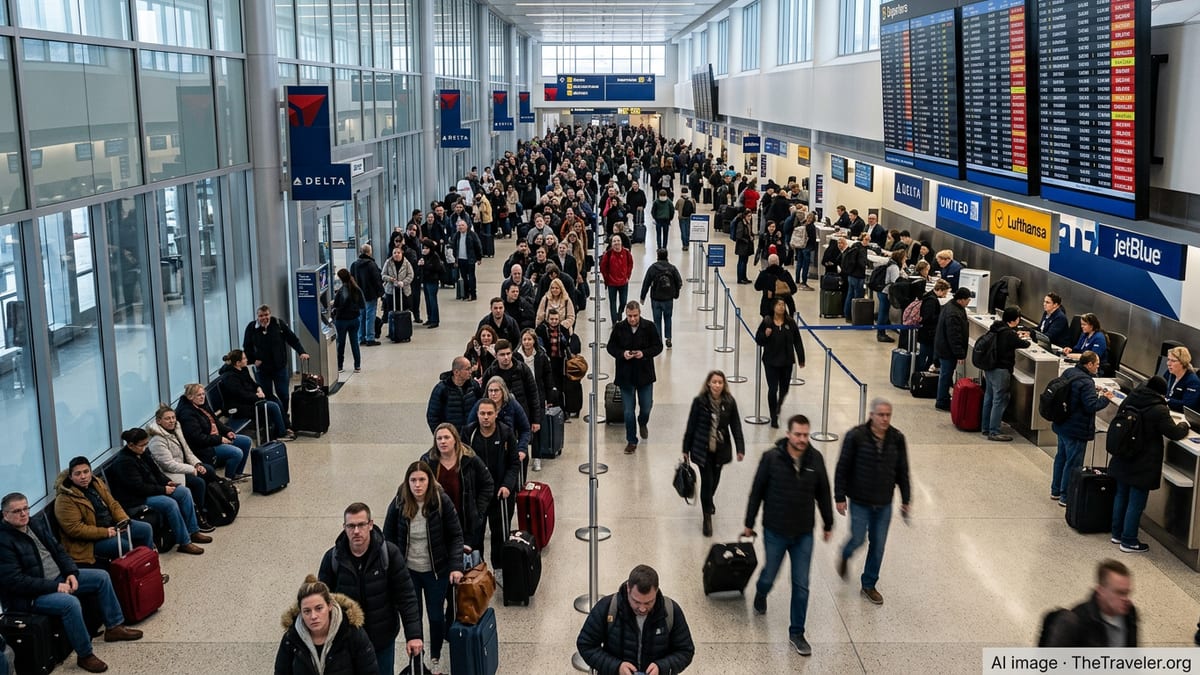
Nationwide Disruptions Hit Major U.S. Hubs
Tracking data from major flight-monitoring services indicates that the disruptions affected flights across all major U.S. regions, with the heaviest impact at large hub airports. Carriers saw hundreds of delays each as operational bottlenecks rippled through the system, affecting both domestic and international routes.
Airports with dense schedules, such as those serving New York, Atlanta, Chicago and Dallas, experienced the most visible strain, with departure boards showing clusters of delayed and canceled services. Travelers reported wait times stretching for hours and frequent gate changes as airlines attempted to re-sequence aircraft and crews.
The tally of more than 2,200 delayed flights and 546 cancellations represents a noticeable spike above an already busy summer and early-fall travel pattern, in which elevated disruption levels have become more common. Publicly available historical data shows that large single-day disruption events are no longer limited to major holidays or winter storms, but increasingly appear during routine high-demand periods.
Connections at medium-size airports were also affected as aircraft and crews failed to arrive as scheduled from larger hubs. This secondary impact left passengers in cities far from the worst congestion scrambling to rebook and, in some cases, facing overnight stays.
Weather, Congestion and Staffing Challenges Converge
Published coverage of recent disruption events points to a familiar mix of causes that also appears to be at work in the latest wave of delays: fast-moving severe weather systems, constrained airspace capacity and pockets of staffing pressure in critical operations. Thunderstorms around heavily trafficked corridors can quickly force ground stops, ripple through departure queues and lead to knock-on delays hundreds of miles away.
Analyses by academic researchers and transportation specialists have underscored how sensitive the U.S. air network is to such shocks. When storm cells stall over major hubs or choke key east coast routes, the system’s tightly timed schedules leave limited room to recover, particularly during peak travel periods. As aircraft fall out of position and crews approach regulated duty-time limits, what begins as a weather problem can rapidly become a broader operational disruption.
Recent government and industry reports have also highlighted ongoing challenges in air traffic control staffing, with some facilities operating under long term constraints. While not solely responsible for any specific day’s disruptions, these structural factors can exacerbate the impact of sudden weather or technology issues, leaving airlines and passengers with fewer options when conditions deteriorate.
The combination of weather volatility, constrained infrastructure and high demand has led to repeated days in recent years when thousands of flights have been delayed nationwide. The latest figures fit into that broader pattern, underscoring how even short lived triggers can generate a full day of turbulence for the network.
Impact on Travelers: Missed Connections and Overnight Stays
For travelers, the statistics translate into missed family events, lost business opportunities and unexpected expenses. With more than 2,200 flights running behind schedule, even relatively short delays can cause tight connections to unravel, especially at large hubs where passengers often rely on narrow transfer windows.
Reports from affected airports describe crowded customer service counters and long lines at rebooking desks as passengers sought alternative routes. Those on the last flights of the evening frequently had few options beyond waiting for morning departures, leading to overnight stays in airport terminals or nearby hotels.
While some carriers provide hotel or meal assistance during severe disruptions, published policies vary widely, and weather related problems are often excluded from compensation. Travelers caught in the wave of cancellations and extensive delays therefore faced a patchwork of support, depending on their airline, ticket type and specific circumstances.
Passenger advocates have noted that the emotional toll can be as significant as the logistical one. Families traveling with young children, older passengers and those with tight personal schedules often experience disproportionate stress when disruptions drag into late night hours or when information about rebooked flights changes repeatedly over short periods.
How Airlines and the System Struggle to Recover
Industry data and prior disruption analyses show that flight networks do not reset instantly once the immediate trigger passes. When hundreds of flights are delayed or canceled in a single day, equipment and crews wind up in the wrong place, causing secondary cancellations and further delays on subsequent days as airlines work to reposition resources.
Operational case studies from earlier large disruption events illustrate how quickly crew scheduling limitations can become binding after an initial shock. Even when planes are available, pilots and flight attendants can time out under federal duty rules, leaving flights without a complete crew. As staff are shifted to cover the most critical routes, less frequented markets can temporarily lose connectivity.
Airlines have introduced more sophisticated planning tools and irregular-operations playbooks in recent years, aiming to prioritize core routes and reduce systemwide chaos. However, high seat demand and tight aircraft utilization mean that spare capacity is limited, which can slow recoveries after particularly disruptive days like the one marked by more than 2,200 delays and hundreds of cancellations.
For the broader system, the recovery process also involves coordination with air traffic control facilities, airport operators and ground handling services. When disruption days coincide with peak leisure or holiday travel, congestion at security checkpoints, baggage belts and rental car facilities can persist even after flight schedules begin to stabilize.
What Travelers Can Do Ahead of Disruption Days
Although travelers cannot control weather systems or infrastructure constraints, aviation analysts and consumer advocates highlight several strategies that can help reduce the personal impact of large disruption events. Booking earlier flights in the day, for example, often provides more options for same day rebooking if delays accumulate, while avoiding tight self made connections on separate tickets can limit risk.
Choosing routes with longer layovers at major hubs can give travelers a buffer when traffic backs up, though it may add time to the overall journey. Some passengers also opt for nonstops whenever possible, even at a higher fare, to eliminate the vulnerability of missed connections when large numbers of flights are delayed.
Experts typically recommend monitoring flight status closely through airline apps and airport displays on the day of travel, particularly during active weather patterns. Keeping essential items, medications and a change of clothes in carry on luggage can make unexpected overnight disruptions more manageable.
The latest day of disruptions, with thousands of delays and more than 500 cancellations, reinforces that significant schedule volatility remains a feature of U.S. air travel. While the industry continues to invest in technology and planning to absorb shocks more effectively, passengers are increasingly building their own contingency plans into every trip.