


The silence at Andrews Bald did not arrive all at once. It settled in slowly, like the fog that so often drapes the high ridges of the Great Smoky Mountains. Somewhere between the last spruce on the Forney Ridge Trail and the first sweep of open grass, the crowds vanished, the chatter faded, and the soundscape thinned to wind, distant birds, and the steady rhythm of my own breathing. It was that quiet, more than the famous views, that stayed with me long after the hike.
Get the latest updates straight to your inbox!
From Kuwohi’s Crowds to a Quieter Trail
The contrast begins in the parking lot beneath Kuwohi, the Cherokee name for the peak long signed as Clingmans Dome, the highest point in Great Smoky Mountains National Park. On a clear afternoon in late spring, the paved access road was lined with rental cars and family minivans bearing plates from half a dozen states. Children chased one another between interpretive signs, selfie sticks flashed in the sun, and the short, steep walkway to the observation tower pulsed with visitors. It felt less like wilderness and more like a busy overlook on an interstate.
Just a few steps away, the Forney Ridge Trail to Andrews Bald begins almost unnoticed, slipping off the pavement and into deep spruce fir forest. Where the tower path is wide and exposed, the trail is narrow and immediately shaded, the air cooler and sharper. Within minutes, the sounds of the parking lot dim to a distant murmur. Gravel crunching under hundreds of shoes is replaced by the soft give of dirt and moss, the quick rush of a hermit thrush taking flight, the low creak of trunks swaying against one another.
The numbers help explain the change. Kuwohi’s tower is one of the most visited spots in the entire park, while the 1.8 mile path to Andrews Bald attracts only a fraction of those who stop at the lot. On a weekday in May, I passed several small groups early on the trail, but they thinned quickly. Five minutes after leaving the pavement, I could walk for long stretches without seeing another person, a rare luxury in one of the busiest national parks in the United States.
For travelers used to the bustle of Gatlinburg craft shops and the traffic of Newfound Gap Road, the shift feels immediate and physical. Your shoulders drop. Your voice lowers. You notice the smell of wet earth, the ragged silhouettes of standing dead firs against the sky, the way mist threads in and out of the understory. Kuwohi may be about panoramic views, but Forney Ridge begins as an immersion in texture and sound.
The Descent Through Spruce Fir Forest
Unlike many mountain hikes that begin with a grind uphill, the route to Andrews Bald descends from the trailhead. Wooden and stone steps, rebuilt in recent years to stem erosion, lead down through high elevation spruce fir forest. This is a landscape that feels more like parts of New England or Canada than typical southern hardwood woods: dense stands of evergreens, cool temperatures even in midsummer, and a faint resinous scent almost like Christmas trees soaked in rain.
Parts of the forest still bear scars from past insect damage. Silver-gray snags stand among the living trees, their bare branches reaching like antlers. In low clouds, these trunks appear suddenly and vanish just as quickly, turning the trail into a shifting corridor of shadow. The trail underfoot is often damp, threaded with roots and slick rocks. In early June, when the park’s lower elevations can be heavy with heat and humidity, this section can feel ten or fifteen degrees cooler, a natural air-conditioned tunnel.
Silence here is not an absence but a layering of small, constant sounds. In the early morning, there may be the distant whistle of a thrush or the soft drumming of a woodpecker. After rain, water collects in shallow ruts and seeps, adding a faint trickle to the mix. When the wind picks up, the treetops hiss and sway, drowning out everything else for a moment. You find that you start matching your stride to these rhythms instead of to the distant noise of traffic that follows many valley hikes in the Smokies.
This section can be muddy and uneven in places, and hikers in mesh running shoes occasionally pause to pick their way around puddles. Lightweight trekking poles, often rented from outfitters in Gatlinburg or Bryson City for around 10 to 15 dollars a day, can help with footing on the way back out when the grade tilts uphill. Yet the modest difficulty also acts as a filter. Families who happily make the half mile climb to Kuwohi’s observation deck sometimes skip this longer trail, which keeps the corridor relatively quiet even on busy weekends.
Breaking Out Into the Bald
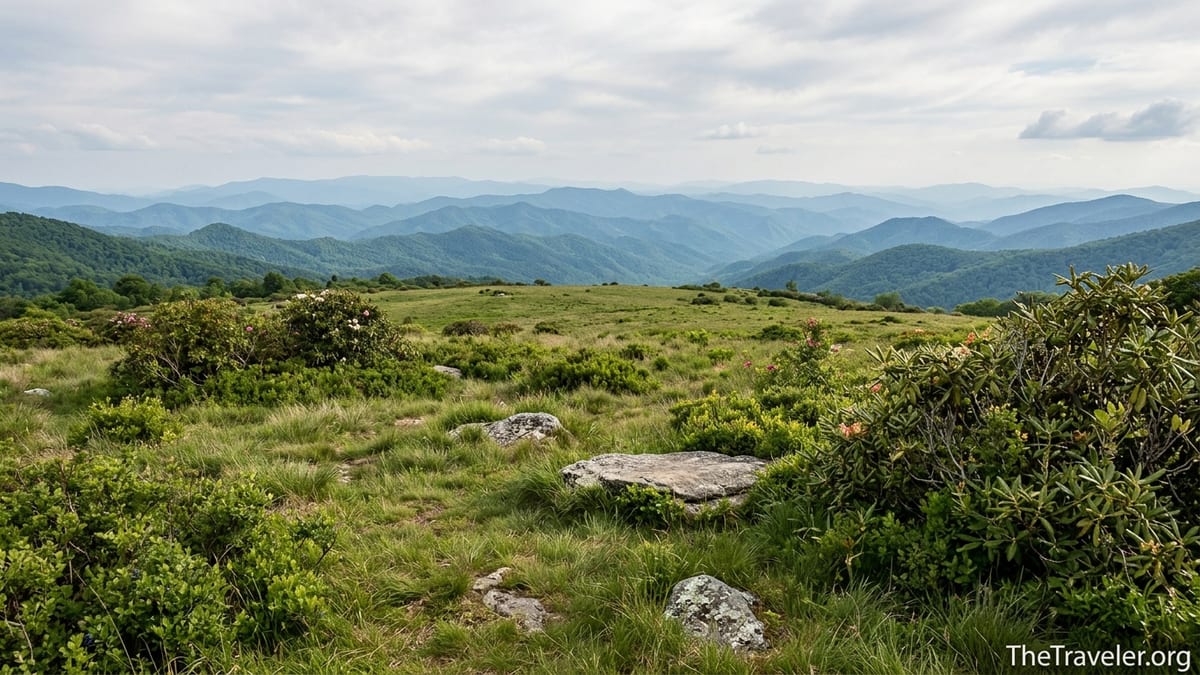
After roughly 1.8 miles, the forest begins to thin. Light brightens ahead, and the sharp silhouettes of spruce give way to an open sky. Without any firm boundary, the trail simply spills out into Andrews Bald, a high elevation meadow at roughly 5,920 feet, considered the highest grassy bald in Great Smoky Mountains National Park. Under clear conditions, the view south stretches across wave after wave of blue ridges into North Carolina, the long folds of the Nantahala Mountains rolling toward the horizon.
The first thing I noticed here was not the view but the sudden expansion of space and stillness. The trail, hemmed in tightly by trees for more than an hour, opens onto a wide, uneven lawn of grasses, blueberry and blackberry bushes, and scattered thickets of rhododendron. Large, flat rocks dot the meadow, perfect for sitting or spreading a light daypack that might hold a grocery store sandwich and an orange bought that morning in Cherokee or Gatlinburg.
On a late June afternoon, small clusters of hikers were scattered at the meadow’s edges. A couple from Ohio sat near a patch of flame azalea, passing a pair of compact binoculars between them as they traced ridgelines. A family with school-age children had found a sheltered spot behind a low rhododendron clump, their voices dropping to whispers as they unwrapped trail mix and peanut butter crackers. A solo backpacker, who had started from a lower trailhead before dawn, lay on his back with a rolled fleece under his head, eyes closed. No one played music. No one shouted across the grass. The open setting seemed to invite quiet without any posted rules.
Grassy balds in the southern Appalachians are a curiosity as well as a pleasure. Most mountaintops at this elevation would naturally be forested, and there are still debates among ecologists about how and when these meadows first appeared. Today, the park service actively maintains only a couple of them, including Andrews Bald, clearing encroaching trees and shrubs so that hikers can continue to experience their blend of sky, grass, and distance. That human effort means the silence you find here is not untouched wilderness so much as carefully tended calm.
The Silence That Lingers
What makes the quiet at Andrews Bald so memorable is its texture. It is not the deep, almost oppressive silence of a desert at midday, nor the hushed stillness of a snow-covered bog. Instead, it is a shared, low conversation between landscape and visitors, punctuated by long pauses. People speak, but they speak softly. Children laugh, but their voices drift and fade before they reach the far side of the meadow. The constant background of engines, generators, and compressors that hums through much of modern life is absent.
On my visit, I found a flat rock at the meadow’s southern edge and simply sat. The visible world narrowed to details: the way individual grass blades moved in slightly different directions with each gust, the shimmer of distant haze along the spine of the Plott Balsams, the faint ticking sound of insects in the brush. Somewhere behind me, a hiker zipped a jacket; the sound carried clearly for a moment, then was absorbed into the larger quiet. Time lost its usual urgency. Lunch hour in Gatlinburg restaurants would have come and gone without notice.
Many travelers today carry their noise with them. It is not unusual, on popular trails worldwide, to encounter portable speakers broadcasting pop playlists or sports commentary. Here, perhaps because the trail is just challenging enough to attract hikers who value the journey itself, or perhaps because the open meadow encourages a kind of unspoken courtesy, the only electronic sounds I heard were the occasional shutter clicks of phones and cameras. Even those were sporadic. Most people took a few photos, then put their devices away.
That quiet lingered long after the hike ended. Back in the bustle of Pigeon Forge traffic, with its neon go karts and dinner theaters competing for attention, I found myself thinking less about the sweeping vista from the observation tower and more about the fifteen or twenty minutes I had spent sitting on that rock, listening to almost nothing. The memory felt like an internal room I could step into whenever the outside world grew too loud.
Planning Your Own Retreat to Andrews Bald
For travelers who want to experience that same sense of quiet, timing and preparation matter. The road to Kuwohi’s parking area typically opens in early April and closes by late November, but temporary closures for snow, ice, or maintenance are common in shoulder seasons. Before you commit a day of a Smokies trip to this hike, it is wise to check the day’s road status through park information channels or by asking at visitor centers such as Sugarlands near Gatlinburg or Oconaluftee near Cherokee.
Weather at nearly 6,000 feet can change quickly, even in midsummer. Temperatures can be ten to twenty degrees cooler than in the valleys below, and afternoon thunderstorms are frequent from June through early September. On my hike, a morning forecast of mild sun in Gatlinburg translated to a damp, foggy start at the trailhead, with gusty winds on the bald itself. A light waterproof shell and a thin insulating layer took up little room in my daypack but made a significant difference in comfort. Trail runners and hiking shoes with decent traction handled the mix of rock, mud, and wooden steps well.
Water and food are not available at the trailhead, so it is important to arrive prepared. A reusable one liter bottle or hydration reservoir per person, refilled at your lodge or cabin before you drive up, is usually sufficient for this moderate half day hike in mild weather. In hotter months, carrying a bit more is prudent, especially if you plan to linger in the meadow for a long lunch. Simple grocery store items from town can become part of the ritual: a local blackberry bar picked up in a Gatlinburg market, or cheese and crackers from a larger supermarket in Sevierville, feel somehow more special when eaten sitting on sun-warmed stone at 5,920 feet.
Parking at Kuwohi fills quickly on fair weather weekends and in peak foliage season, which now often stretches across October and into early November. Arriving before 9 a.m. can make the difference between a straightforward start and a frustrating search for a space. Early starts also reward hikers with quieter trails and gentler light sweeping across Andrews Bald. In the first hours after sunrise, the meadow often basks in soft, angled light, while the lower valleys remain partially in shadow, enhancing the sense of separation from the busy world below.
Balancing Popularity and Solitude in the Smokies
Great Smoky Mountains National Park has seen visitor numbers climb in recent years, a testament to its accessibility and appeal. Towns like Gatlinburg and Cherokee have built entire economies around that steady stream of travelers. For many visitors, iconic spots such as Kuwohi’s tower, Cades Cove loop, and Laurel Falls feel almost obligatory. Yet the same popularity that keeps hotel rooms, campgrounds, and pancake houses full can make the park’s main overlooks feel more like crowded viewpoints than escapes into nature.
Andrews Bald offers a different balance. Because it shares a trailhead with Kuwohi, it is easy to pair the two destinations in a single outing. Families can walk the short, paved path to the tower in the morning, then those who are willing can continue down Forney Ridge to the bald. Others might choose to skip the tower entirely, heading directly for the meadow to avoid the thickest crowds. Either way, the hike creates a buffer between you and the busiest parts of the park without demanding a full day or high level of fitness.
This pattern is repeating across many heavily visited parks. In Zion, travelers who step away from the packed shuttle stops along the Virgin River to explore side canyons discover pockets of quiet within minutes. At Yosemite, those who walk beyond the railing at Tunnel View and onto longer trails quickly leave most of the crowds behind. The lesson in the Smokies is similar: you do not always need an arduous backcountry trek to find solitude. Sometimes it is enough to follow a less obvious path leading away from the main viewpoint.
There are, of course, other balds and meadows in the region that offer similar atmospheres, from Gregory Bald with its summer flame azaleas to longer routes like Hemphill Bald. Andrews Bald stands out because it matches relative ease of access with a feeling of remoteness. The drive to the trailhead is on paved, well maintained road, and the hike’s roughly 3.5 to just over 4 miles round trip, depending on which guide you consult, place it within reach of most reasonably active visitors. Yet when you are sitting in its grass, Gatlinburg’s attractions feel many worlds away.
The Takeaway
When I think back on my time in the Smokies, I remember the postcard scenes: the layered blue ridges at sunset from Newfound Gap, the mist curling through coves at dawn, the arc of Kuwohi’s concrete ramp reaching skyward. Yet the memory that surfaces most often is quiet and almost entirely still. It is the feeling of sitting at Andrews Bald with a simple trail lunch, listening to the soft rush of wind through high grass and the occasional distant call of a bird, as everything else receded.
For travelers who crave a break from constant noise, Andrews Bald offers an accessible invitation to silence. It does not demand advanced navigation skills or specialized gear. It asks only that you turn away from the busiest path for a few hours, accept a bit of mud and uneven footing, and allow yourself to sit without agenda when you reach the meadow. The reward is not just a sweeping view but a temporary reordering of attention. You hear your own thoughts more clearly, and perhaps even realize how rare that is.
If your next Smokies itinerary is built around major sights and short roadside stops, consider setting aside half a day for this trail. Pair it with a dawn start, a thermos of coffee filled in your cabin kitchen, and a simple lunch carried from town. Let the walk down through spruce fir forest act as a slow release valve on the pressures you brought with you. And when you reach the bald, resist the urge to rush through a few photos and hurry back. Sit. Listen. The silence you find there may stay with you far longer than any snapshot.
FAQ
Q1. How long is the hike to Andrews Bald and how difficult is it?
The hike is roughly 3.5 to just over 4 miles round trip, depending on which guide or GPS track you follow, with around 800 to 900 feet of elevation change. Most hikers describe it as moderate: manageable for reasonably active visitors, but with rocky sections, stairs, and a noticeable uphill climb on the return.
Q2. Where does the trail to Andrews Bald start?
The trail to Andrews Bald begins at the Forney Ridge Trailhead beside the large parking area near the summit of Kuwohi, often still labeled Clingmans Dome. After you park, look for the signed trail leading away from the paved path to the observation tower and into the trees.
Q3. When is the best time of year to visit Andrews Bald?
Most hikers visit between late April and early November, when the access road to Kuwohi is typically open and the trail is free of winter ice and deep snow. Late spring and early summer can bring blooming wildflowers, while clear fall days often offer the farthest views and colorful foliage in the surrounding valleys.
Q4. Will Andrews Bald be crowded like the observation tower at Kuwohi?
The trail can be busy on peak weekends and during popular seasons, but it is usually much quieter than the paved walkway to the observation tower. Starting early in the day, choosing a weekday, or hiking in shoulder seasons can all increase your chances of finding long, peaceful stretches on the trail and a relatively calm meadow.
Q5. What should I bring for a half day hike to Andrews Bald?
Plan to carry at least one liter of water per person, snacks or a simple packed lunch, a light rain jacket, and an extra warm layer even in summer. Closed toed shoes with good traction are important, and trekking poles can help with balance on rocky or muddy sections. A basic first aid kit, sun protection, and a fully charged phone round out a sensible daypack.
Q6. Is the trail suitable for young children or less experienced hikers?
Many families with school age children complete the hike successfully, especially if they take their time and build in breaks. However, the trail is not stroller friendly, and some parts can be uneven, stepped, or muddy. Less experienced hikers should start early, pace themselves, and be ready to turn around if weather, fatigue, or footing become concerns.
Q7. Can I combine Andrews Bald with a visit to the Kuwohi (Clingmans Dome) observation tower?
Yes. The tower and the trail share the same parking area, so many visitors walk to the tower first, then continue to Andrews Bald, or reverse the order to enjoy a quieter start to the day. Allow three to five hours if you plan to do both at a relaxed pace, including time to sit and enjoy the views at the bald.
Q8. What kind of weather should I expect at Andrews Bald?
Expect cooler temperatures and more wind than in nearby towns like Gatlinburg or Cherokee, especially outside midsummer. Conditions can shift quickly at this elevation, with fog, drizzle, or a fast moving thunderstorm possible on otherwise pleasant days. Always check the forecast before driving up and be prepared with layers and rain protection.
Q9. Are there any facilities at the trailhead or at Andrews Bald itself?
Near the parking area by Kuwohi there are seasonal restrooms and informational displays, but no food or water sales. Andrews Bald itself is undeveloped: there are no shelters, toilets, or trash cans. Plan to pack out all your litter and follow Leave No Trace practices while you enjoy the meadow.
Q10. Why does Andrews Bald feel so quiet compared to other Smokies viewpoints?
Several factors combine to create that sense of quiet: the slightly longer, rougher trail filters out some casual crowds, the open meadow encourages people to spread out, and most visitors naturally lower their voices in the wide, wind brushed space. That combination makes Andrews Bald a rare place in a busy park where the dominant sounds are wind, birds, and your own footsteps.