


Munich Airport is one of Europe’s most efficient hubs, but departure days can still feel hectic if you do not know the layout, timing expectations, and where to find key services. This guide walks you through a typical departure from Munich, from the moment you arrive at the terminal to the moment you board, with practical examples of where to check in, how security works, which lounges and food options are worth your time, and how to avoid last minute stress at the gate.
Get the latest updates straight to your inbox!
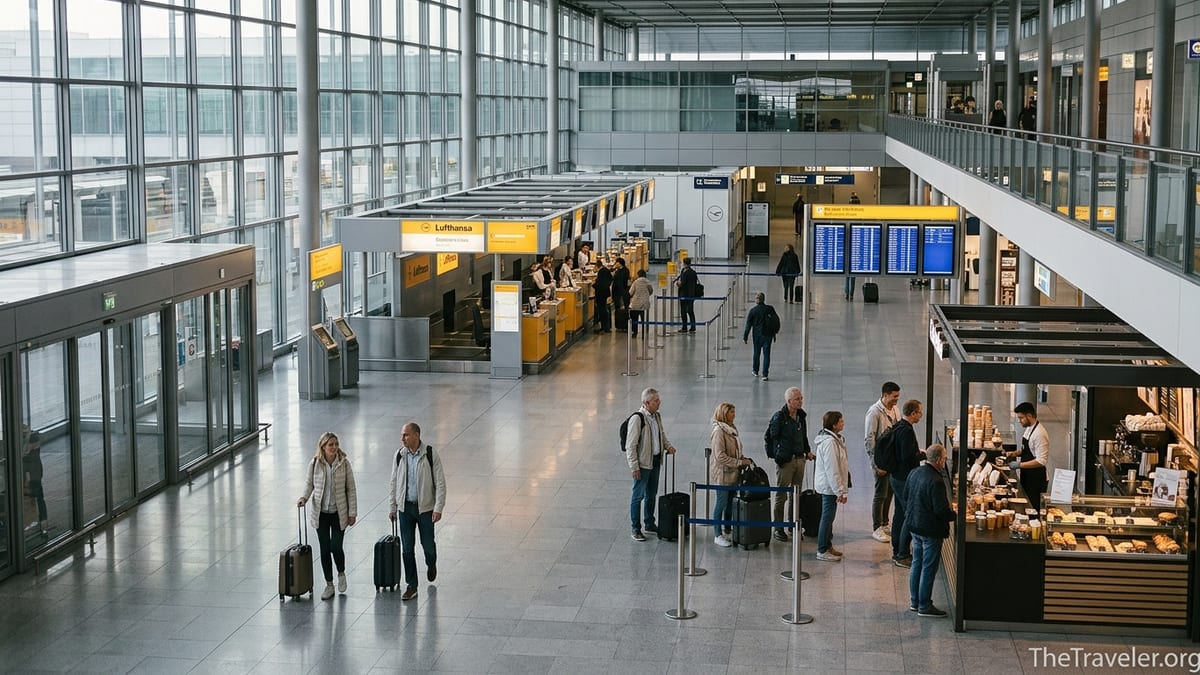
Understanding Munich Airport’s Terminals and Departure Areas
Munich Airport has two main passenger terminals, Terminal 1 and Terminal 2, plus a satellite building connected to Terminal 2. Most non Star Alliance and leisure airlines depart from Terminal 1, which is divided into modules A to E and a central check in area called T1Z in the Munich Airport Center. Terminal 2 and its satellite are primarily used by Lufthansa and Star Alliance partners for both Schengen and non Schengen flights. Checking your booking or boarding pass to see “T1 A,” “T1 D,” or “T2” will tell you exactly where to go when you arrive at the airport.
In practice, this means, for example, that a Lufthansa flight to New York will usually depart from Terminal 2 or its satellite gates K or L, while a Condor or Turkish Airlines flight to holiday destinations will use Terminal 1 modules. The Munich Airport Center sits between the two terminals and houses shops, restaurants, and the S Bahn train station, so if you arrive by train you will walk directly into this central plaza and then follow the overhead signs to your terminal and module.
The walking time between Terminal 1 and Terminal 2 through the covered central area is usually around 10 to 15 minutes at a normal pace, but it can feel longer with luggage and crowds. If you discover that a Priority Pass lounge you want to visit is in Terminal 1 but your Lufthansa flight leaves from Terminal 2, you should factor in that extra transfer time and additional security checks. Most departing passengers will not need to switch terminals at all, as your ticket and airline website will specify your departure terminal and area.
Each terminal has its own security and passport control system, so you go through these checks in the terminal from which your flight departs. You cannot generally clear security in one terminal and walk airside to the other, which is a common point of confusion for first time users of Munich Airport. Plan your route so that once you enter security, you are in the correct building for your flight.
When to Arrive and How Check In Works
Munich Airport itself advises passengers to plan enough time for arrival, baggage drop, and control procedures because traffic, construction, or seasonal peaks like the Oktoberfest period can quickly extend queues. As a rule of thumb, arriving about two hours before a European flight and about three hours before a long haul departure works well for most airlines, but you should always check your airline’s own recommendations. Some carriers at Munich open their counters three hours before departure, while others open two hours before; if you show up five hours early, you may simply end up waiting in front of closed counters.
Most major airlines at Munich offer online or mobile check in, which lets you obtain a boarding pass in advance and sometimes choose your seat. For instance, Lufthansa, United Airlines, and many European low cost and leisure carriers allow mobile boarding passes, so if you are traveling with only hand luggage you can go straight to security on arrival at the airport. If you have bags to drop, you follow the check in area printed on your booking, such as “T2” or “T1C,” where you will find either staffed desks or self service bag drop machines.
Munich also supports evening or “night before” check in for some airlines, typically for flights departing before noon the next day. In practice, this means that if you have a 7:00 a.m. Lufthansa flight to Frankfurt, you may be able to check your luggage the previous evening, then arrive the next morning with only hand luggage and proceed straight to security. Some airlines charge a small fee for this service and not all routes are eligible, so it is essential to confirm details on your airline’s website rather than assuming it will be available.
At the check in desk or bag drop, you will need your passport or official ID and your ticket or confirmation, which can usually be shown on your phone. The agent will tag your checked luggage, provide a bag tag receipt, and may check that you meet any document requirements for your destination. If you are connecting beyond Munich, for example from Munich to Singapore with a final destination in Australia, your baggage is typically checked through and you will receive boarding passes for all sectors, but you should always verify this at the counter.
Security Screening and Passport Control: What to Expect
Once you have your boarding pass and have checked any luggage, you proceed to the security checkpoints indicated by overhead signs. In Terminal 2 there are central security lanes with automatic boarding card readers, plus additional checkpoints closer to some gate areas. Terminal 1 usually has cluster based security points that serve groups of gates, for example a set of lanes just before gates in module D. Airport authorities have been gradually upgrading both terminals with modern scanners and more automated processes to speed up flows, but peak times can still see long lines.
On busy travel days, such as Friday afternoons in ski season or mornings during major trade fairs, queues can stretch well beyond the official waiting time estimates displayed on the airport website. There have even been reported instances where security lines in Terminal 2 looped around multiple levels of the building during exceptional disruptions. This is why arriving early is wise; even if the airport typically manages security within about 10 to 20 minutes, unusual spikes can and do happen. Families, travelers with medical devices, and anyone who dislikes time pressure will benefit from adding an extra buffer.
The usual European security rules apply: liquids must be in small containers, placed in a transparent bag, and electronics like laptops and large tablets may need to be removed from your bag, depending on the specific scanner lane you use. Munich has introduced advanced CT scanners in several locations that let you keep electronics and liquids in your bag, but not every line is equipped with these machines yet, and staff will guide you on what to remove. Sharp objects and other prohibited items will be confiscated or, in some cases, stored for a later retrieval service, although fees and procedures can vary.
After security, you may need to pass through passport control if you are leaving or entering the Schengen Area. For example, a flight from Munich to Paris uses Schengen gates and typically requires no passport check for EU and many European travelers once they are inside the Schengen zone. A flight from Munich to the United States or the United Kingdom departs from a non Schengen gate, so you will go through German exit immigration first. Automated eGates are available for many nationalities with biometric passports, but staffing levels and passenger volumes can still create queues around peak departure banks for long haul flights.
Navigating the Gates, Shops, and Food Options
Once you clear security and, if applicable, passport control, the departure concourses open up into long corridors of shops, cafes, and gate areas. In Terminal 2 and its satellite, the design makes it relatively easy to orient yourself, with clear signage for Schengen gates labeled G or K and non Schengen gates labeled H or L. Terminal 1 modules can feel a little more fragmented, as each module has its own collection of gates, duty free outlets, and snack bars, and walking between modules airside is more limited.
Munich Airport offers the standard range of duty free shops selling cosmetics, fragrances, and spirits, along with fashion outlets for brands such as Hugo Boss, electronics stores where you can buy travel adapters or headphones, and souvenir shops selling Bavarian themed gifts. Prices for convenience items like bottled water after security are broadly in line with other large European airports; you might pay a little over three euros for a half liter bottle at a kiosk or slightly less in a sit down cafe when ordered with food. If you forget a travel charger or need a SIM card, electronics retailers in both terminals stock these items, though at airport markups compared with downtown Munich.
Food options are notably strong for an airport of this size, especially in the Munich Airport Center and Terminal 2. Passengers can choose from Bavarian style beer halls serving pretzels and sausage plates, international chains selling burgers or sandwiches, and coffee bars with fresh pastries. For a quick, practical example, a cappuccino and croissant from a well known coffee chain in Terminal 2 might cost in the range of six to seven euros, while a sit down Bavarian meal with a drink could easily reach 15 to 20 euros per person. Vegetarian and vegan options have expanded in recent years, with salad bars, wraps, and meat free dishes appearing in many outlets.
If your time is limited, it is generally safer to choose a food option close to your gate rather than at the far end of the concourse. Large departure screens show boarding times and “time to gate” estimates, but these assume a normal walking speed and no delays at internal checkpoints, such as an extra identity check for some non Schengen flights. As boarding time approaches, announcements in German and English will guide you to the gate, but do not rely solely on audio; keeping an eye on the monitors is especially important if weather or air traffic control create last minute gate changes.
Lounges and Quiet Spaces for Different Budgets
Munich Airport has a wide range of lounges, from pay per use spaces accessible with lounge membership programs to exclusive airline operated first class lounges. In Terminal 1, two of the most commonly used pay in lounges are Airport Lounge Europe on the Schengen side and Airport Lounge World on the non Schengen side. These lounges are popular with travelers holding memberships like Priority Pass or DragonPass and typically offer snacks, light meals, soft drinks, beer and wine, workspaces, and showers. Entry prices for walk up passengers without membership can vary, but are often broadly in the range you would expect at a major European hub, making them worthwhile if you have a long delay or need a quiet environment.
Terminal 2 is dominated by Lufthansa and Star Alliance lounges. Business and frequent flyer passengers may have access to multiple Lufthansa Business Lounges and Senator Lounges across both the main building and the satellite. These lounges generally provide hot and cold buffet options, a good selection of soft drinks and alcoholic beverages, shower facilities, and, in some locations, quiet zones for working. There are also dedicated Lufthansa First Class Lounges in Terminal 2 and in the satellite, which include made to order dining, bar service, bathtubs and quiet rooms, and in some cases a terrace overlooking the runways, reserved for first class passengers and top tier status holders.
For travelers without lounge access, there are still quieter corners to be found, especially in less busy gate areas at the ends of concourses or in some upper level seating zones. Terminal 2 and the satellite also host Napcabs style sleep pods rented by the hour, which can be a good option during long layovers or overnight delays, allowing you to rest in privacy without paying for a full airport hotel stay. If you prefer a real bed, the Hilton Munich Airport, located between Terminals 1 and 2, offers day rooms and overnight stays, accessible within a short covered walk from both terminals.
Many lounges at Munich fill up during peak banks of flights, especially early morning departures to major European capitals and late evening long haul departures to Asia and North America. If your ticket or status allows lounge access, plan to arrive early enough to enjoy it but not so early that you risk waiting for security to open. On days with significant disruptions, lounge access can be temporarily restricted to protect comfort levels for eligible passengers, so it is sensible to have a backup plan, such as a particular cafe where you are comfortable waiting if the lounge reaches capacity.
Smart Boarding Strategies and Day of Travel Tips
Boarding at Munich is generally well organized, with most airlines using clearly marked group boarding or priority lanes. Lufthansa and many of its partners, for example, typically board by groups printed on the boarding pass, starting with families or passengers needing assistance, followed by premium cabins and then economy zones. In Terminal 2 satellite gates serving long haul flights, boarding can begin 45 minutes or more before scheduled departure, so if your gate is labeled K or L for a non Schengen flight, aim to be at the gate at least that early to avoid standing in the last boarding queue with limited overhead bin space.
Some gates at Munich are bus gates, particularly for regional and low cost flights. In these cases, boarding involves walking down stairs or an escalator to a holding area, then riding a bus across the apron to the aircraft. This can easily add 10 to 15 minutes to the boarding process, especially in poor weather. If you are traveling with small children, limited mobility, or heavy carry on bags, allow extra time and do not wait until the last boarding call before approaching the gate, as buses may depart in waves and you may be held in a queue.
A practical boarding strategy at Munich is to use the “in between” time after security wisely. For example, if your Lufthansa flight to London boards from a G gate at 18:10, aim to finish any food or last minute shopping by around 17:30 and physically move toward the gate. You can still sit nearby and keep an eye on the screen, but being in the correct part of the terminal before boarding groups are called will reduce stress if the airline announces an earlier start or a last minute gate change.
Because Munich Airport is a major hub for connections, your flight may arrive with a large number of transfer passengers already on board or boarding from other gates. Overhead bin space can fill quickly in these situations, even on larger aircraft. Keeping your most valuable items in a small personal bag that fits under the seat means you will not be forced to gate check essential items if bins are full. As at any large hub, you should also have a plan for what happens if your flight is delayed, such as knowing whether your fare or travel insurance covers meals or lounge passes during long waits.
The Takeaway
Departing from Munich Airport is usually a smooth experience, provided you understand the basic layout, arrive in good time, and make use of the facilities suited to your needs and budget. Knowing whether you are flying from Terminal 1 or Terminal 2 will shape your entire departure experience, from where you check in to which shops and lounges you can realistically visit before your flight. Checking in online where possible, allowing generous time for security and passport control during peaks, and staying close to your gate as boarding approaches all reduce the risk of last minute anxiety.
Whether you spend your waiting time in a pay per use lounge in Terminal 1, a Lufthansa lounge in Terminal 2, or simply at a Bavarian style bar in the Munich Airport Center, the airport offers enough variety to make those pre departure hours comfortable and productive. With a little preparation and realistic expectations about queues and walking times, Munich can be one of the more pleasant major airports to depart from, whether you are heading to a nearby European city or boarding a long haul flight halfway around the world.
FAQ
Q1: How early should I arrive at Munich Airport before my flight?
For most passengers, around two hours before a European flight and three hours before a long haul departure works well, but you should always follow your airline’s own guidance and add extra time during peak seasons like summer holidays or large trade fairs.
Q2: How do I know whether my flight leaves from Terminal 1 or Terminal 2?
Your booking confirmation and boarding pass will show the terminal and sometimes the module, for example “T1 D” or “T2.” Airlines such as Lufthansa and most Star Alliance partners generally use Terminal 2, while many other full service and leisure carriers use Terminal 1.
Q3: Can I use security and lounges in Terminal 1 if my flight departs from Terminal 2?
In most cases you must go through security in the terminal from which your flight departs, and you cannot simply walk airside between Terminal 1 and Terminal 2, so using a lounge in the “other” terminal would usually require an extra security check and additional walking time.
Q4: Does Munich Airport offer night before check in for early flights?
Some airlines at Munich allow passengers to check in and drop bags the evening before an early morning departure, typically for flights before midday, but availability, hours, and any fees depend on the airline and route, so you should confirm details directly with your carrier.
Q5: How long does security screening usually take at Munich Airport?
Under normal conditions security in either terminal can often be completed in around 10 to 20 minutes, but heavy traffic, school holidays, or disruptions can produce much longer queues, so it is wise to arrive with a comfortable buffer.
Q6: Are there good food options after security, or should I eat in the city first?
Munich Airport has a wide range of cafes, international chains, and Bavarian style restaurants both before and after security, so it is perfectly realistic to plan on having a meal at the airport, especially in Terminal 2 and the Munich Airport Center where the choice is broadest.
Q7: Which lounges can I use with a Priority Pass or similar membership?
Travelers with independent lounge memberships typically use Airport Lounge Europe in the Schengen area of Terminal 1 or Airport Lounge World on the non Schengen side of Terminal 1, while most lounges in Terminal 2 are airline operated and reserved for eligible premium or frequent flyer passengers.
Q8: Is the walk between Terminal 1 and Terminal 2 long?
The walk through the covered Munich Airport Center between the two terminals usually takes around 10 to 15 minutes at a normal pace, but if you are carrying heavy bags or traveling at busy times it can feel longer, so you should avoid unnecessary terminal changes when you are close to departure time.
Q9: Are there places to rest or sleep if my departure is delayed?
Yes, beyond the seating areas at the gates, Munich offers pay per use sleep pods in Terminal 2 and its satellite, several quiet corners in less busy gate zones, and the Hilton Munich Airport hotel between the terminals, which offers day rooms and overnight stays for passengers who need a proper bed.
Q10: What is the best way to avoid stress when boarding at Munich?
Check your gate and boarding time on the screens, aim to be near the gate at least 30 to 45 minutes before departure, especially for long haul or bus boarded flights, and keep essential items in a small personal bag so that you are not forced to check important belongings if overhead bins fill up.