


Landing at Munich Airport, most travellers have a single question on their mind: what is the best way to reach the city centre? Munich’s airport is about 40 kilometres north of the Altstadt, and you can choose between the S-Bahn suburban trains, the Lufthansa Express Bus, taxis and ride-hailing, prebooked private transfers, and rental cars. Each option comes with its own trade-off between cost, travel time, comfort and how easy it is to manage luggage. This guide walks you through each mode using realistic 2026 prices and situations, so you can pick the one that fits your arrival, your budget and your bags.
Get the latest updates straight to your inbox!
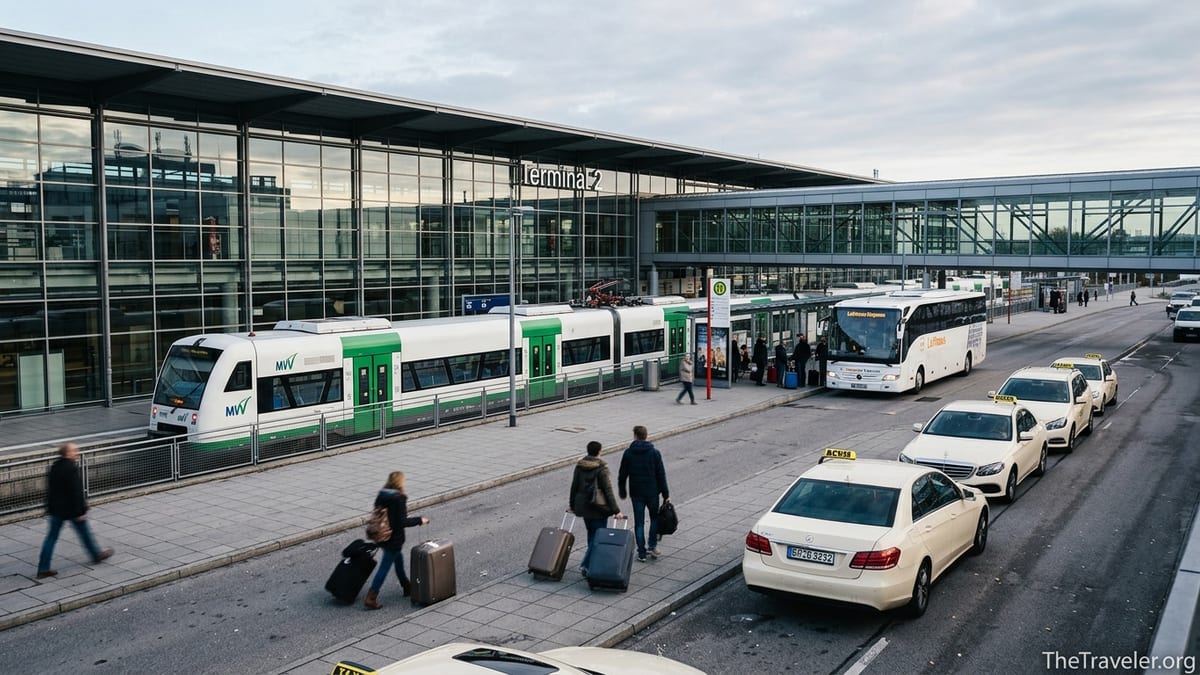
Understanding the Journey From Munich Airport
Munich Airport (MUC) sits in the countryside to the north of the city, roughly a 35 to 45 minute journey from the central districts like Hauptbahnhof, Marienplatz or Karlsplatz. The airport has its own S-Bahn station directly below the terminals, clearly signed with a large white "S" in a green circle and the blue "M" logo for Munich’s transport network. Trains run through the northern suburbs and into the city tunnel, stopping at all major central stations.
Most visitors will be choosing between the S-Bahn and the Lufthansa Express Bus, since both are regular, relatively affordable public options. For door to door convenience, taxis and prebooked private transfers are available right outside the arrivals halls. Rental cars make sense if Munich is just your first stop on a wider Bavaria or Alps road trip rather than your final destination.
As of mid 2026, a typical one way taxi or transfer from Munich Airport to a central hotel near the Hauptbahnhof or Marienplatz costs somewhere in the region of 65 to 100 euros depending on traffic, exact address and vehicle type. By contrast, public transport tickets tend to be in the mid teens per person for a single trip from the airport zone into central zone M, with day tickets available for only a little more and group tickets reducing the cost sharply if you are three or more people travelling together.
The right option for you will depend heavily on when you land, how much luggage you have, whether you are travelling solo, as a couple, or in a family group, and whether you value saving time, saving money, or saving effort. Below, we look at each option in turn, using common itineraries like “evening arrival with two suitcases”, “short city break with hand luggage only”, and “family of four on a ski trip” to show what each mode feels like in practice.
Taking the S-Bahn: The Workhorse Option
The S-Bahn is the backbone of airport transport in Munich and is what many locals use. Two lines, the S1 and S8, run between the airport and the city centre. They operate every 20 minutes during the day, with slightly reduced frequency late at night and early in the morning. Typical travel time from the airport station to central stops like Marienplatz or Hauptbahnhof is around 40 to 45 minutes, sometimes a little faster on the S8 depending on the time of day.
Ticketing is integrated into the Munich public transport system. The airport lies outside central zone M, and a one way adult ticket from the airport to the city centre currently costs in the mid teens in euros. Travellers staying in Munich for the day can often get better value by buying an Airport-City day ticket, which costs a little under 20 euros for one person and slightly more than 30 euros for a group of up to five adults travelling together. This type of ticket covers your S-Bahn ride from the airport to the city and then gives you unlimited travel on U-Bahn, tram, bus and S-Bahn in the entire network zones for the rest of the day.
In terms of luggage, the S-Bahn is manageable but not luxurious. Trains have wide doors, level boarding and dedicated multi-purpose spaces where you can stand with a suitcase, stroller or backpack. You are responsible for lifting your bags on and off, and at busy times, particularly weekday rush hours and weekend evenings, the central sections of the train tunnel can feel crowded. If you arrive around midday on a weekday with one suitcase and a cabin bag, you will generally find it straightforward to board and find a corner or standing space. If you are coming with two large ski bags and several suitcases at 17:00 on a Friday, you may find the train much more cramped.
For a solo traveller landing at 10:00 from a European flight with only hand luggage, the S-Bahn is typically the best value choice. You simply follow the signs down to the station, buy a zone M to airport ticket from the machines or the official app, and board the next S1 or S8. In under an hour and for a modest price, you will step out at Marienplatz, walk five minutes to a hotel in the Altstadt, and you will have spent far less than a taxi. If you are a couple or small family staying close to an S-Bahn or U-Bahn connection, the S-Bahn day or group passes can also pay off quickly, especially if you plan to use public transport throughout your stay.
Lufthansa Express Bus: Simpler and More Comfortable for Many
The Lufthansa Express Bus is a dedicated airport coach service running between Munich Airport and the city centre. In practice, it operates like a high quality airport bus open to all passengers, not just Lufthansa ticket holders. It provides a nonstop or limited stop connection from the terminals to key points in the city, usually Munich Central Station and often a second stop near Schwabing or Nordfriedhof, depending on the current route pattern.
Journey time is typically around 40 to 45 minutes, similar to the S-Bahn, though it can vary with traffic, particularly in peak commuter hours or during major events like Oktoberfest. Buses usually run every 15 to 20 minutes throughout the day. Tickets are priced above the S-Bahn but below a taxi: in mid 2026, a one way adult fare is in the low to mid teens in euros if bought online in advance, and a little higher if bought at the airport counter or from the driver. Return tickets and family tariffs can reduce the average cost further, especially if you book a round trip at once.
Where the Lufthansa Express Bus really wins is luggage convenience and comfort. Coaches have large underfloor luggage holds, so you can stow big suitcases, sports equipment and bulky bags before boarding and then relax in your seat without wrestling with bags in the aisle. Inside, you have coach-style seating, air conditioning and usually Wi-Fi. Seats are more spacious than on the S-Bahn, and you do not have to change trains or navigate deep underground stations once you reach the city centre if your accommodation is near the Central Station or on an easy tram route from it.
For a couple arriving from North America with two checked bags each and some jet lag, the bus can be a sweet spot. Imagine landing at 07:15, clearing passport control and customs, and stepping into the arrivals hall around 08:10. Instead of dealing with ticket machines and stairs, you walk to the clearly marked Lufthansa Express Bus stop outside the terminal, buy a ticket from the staffed counter, hand your suitcases to the driver to load into the hold, and take a window seat. By about 09:00, you are at Munich Central Station, a short walk or tram ride from most business hotels, having paid perhaps one third of the price of a taxi but enjoyed a more relaxed ride than the S-Bahn at rush hour.
Taxi and Ride-Hailing: Door-to-Door Convenience
Taxis are lined up at designated ranks directly outside both terminals at Munich Airport. Licensed taxis are cream coloured with a "Taxi" sign on the roof, and drivers are required to use the official tariff set by the City of Munich. In 2026, the city adjusted its taxi fare structure, including a set fixed price for trips between the airport and the main railway station: that city regulated flat fare is now just under 100 euros one way. In practice, many rides to hotels in central districts come in a little below that fixed price when travelling at off-peak times, and a little above it for addresses further south or west of the centre.
Online fare calculators and recent traveller reports suggest that a typical ride from the airport to a hotel near Marienplatz, Sendlinger Tor or the Hauptbahnhof falls in the range of roughly 65 to 85 euros under normal traffic conditions, higher if you encounter congestion on the A92 or Mittlerer Ring. Larger vehicles, such as minivans or station wagons arranged for families with lots of luggage, can cost more. It is not customary to tip heavily in Germany, but many travellers round up to the next euro or add around 5 percent if they have received help with heavy bags.
Ride-hailing services and app based taxi bookings, such as those offered by Free Now or various ride-hail platforms, are available in Munich but are subject to the same regulatory framework. As of 2026, the City of Munich has introduced minimum fares for ride hailing that bring their prices close to, or aligned with, taxi rates, particularly for airport trips. This means you should expect an app based car from Munich Airport to central Munich to cost broadly similar to a taxi booked at the rank, though you gain the security of a pre-quoted price and app based payment.
In real terms, taxis and ride-hailing are the most convenient option if you are a group of three or four people with several suitcases, particularly if your accommodation is not close to an S-Bahn or tram stop. A family of four arriving for a ski week, with four large suitcases and two ski bags, might pay around 90 euros for a spacious taxi van that drops them directly at a hotel in the Glockenbachviertel. Split between four, that is just over 20 euros per person, only slightly more than the S-Bahn plus local tickets and far more comfortable. Similarly, if you are checking in late at night after an intercontinental flight and staying in a residential area like Neuhausen or Haidhausen, paying for a taxi can be worthwhile to avoid night time transfers on public transport with luggage.
Private Transfers: Predictable and Personalised
Private airport transfers are prebooked car or van services that meet you in the arrivals hall with a sign and then drive you directly to your accommodation. These services are offered by international brands and local operators alike, and can be booked through dedicated transfer companies or major booking platforms. Prices are typically quoted per vehicle rather than per person and are set in advance, so you know exactly what you will pay before you fly.
For a standard sedan, typical 2026 pricing for a private transfer from Munich Airport to a central hotel is in the region of 80 to 110 euros, depending on cancellation flexibility, vehicle class and any extras such as child seats. Larger minivans that can accommodate five or six passengers plus several suitcases usually run a little higher, often 110 to 140 euros. Some premium services use high end vehicles like BMW 7 Series or Mercedes S Class limousines and charge accordingly.
The great advantage of a private transfer is the low stress experience, especially for first time visitors, families with young children, or older travellers who may find public transport with stairs and luggage challenging. You provide your flight number in advance, and the driver tracks your arrival so they can adjust for delays. After you collect your bags, you walk out to the arrivals hall, see your name on a sign, and are guided to the car. If you have requested a child seat or two, they are already installed. You avoid queues at the taxi rank and the uncertainty of meter based fares.
Private transfers are particularly good value when split between several adults. For example, three couples sharing a six seater van to a shared apartment in the Maxvorstadt might pay around 120 euros in total. Divided six ways, each person pays roughly 20 euros for a door to door ride, only modestly more than public transport, while also gaining the convenience of not having to navigate with luggage. For business travellers on expense accounts, the reliability of a prebooked car waiting after a delayed evening flight or an early morning arrival is often worth the additional cost compared to navigating ticket machines and platforms.
Rental Cars: Best for Road Trips, Not Short Stays
Munich Airport has a substantial rental car centre located in the Munich Airport Center (MAC) area between the terminals. Major international companies such as Sixt, Avis, Budget, Europcar, Hertz and Enterprise all operate desks here, typically open from early morning until late evening. You can reserve in advance and go straight to the counter on arrival, or make a last minute booking through an aggregator if cars are available.
Daily base rates for small compact cars at Munich Airport in 2026 often start at the equivalent of around 25 to 40 euros per day if booked ahead in quieter periods, but once you add mandatory insurance, a one way fee if you are dropping the car in another city, and optional extras like GPS or child seats, the real daily cost frequently ends up between 45 and 80 euros. Fuel and Munich’s relatively expensive parking fees, especially in central garages, add further costs. For example, parking overnight in an underground car park close to Marienplatz can easily cost 30 euros or more.
For most city stays of two or three nights, a rental car is not the smartest way to get from the airport to your hotel. Munich’s inner districts are compact and well served by U-Bahn, tram and bus, and driving into the centre involves dealing with one way streets, tram lines and environmental regulations. If your hotel is in the pedestrianised Altstadt, you may not be able to park at the door at all and will need to use a nearby garage instead. In that case, combining the S-Bahn or Lufthansa Express Bus with walking or short tram rides is simpler and typically cheaper.
Where rental cars make sense is when Munich Airport is just your starting point for a wider journey. If you land at 09:00 and are heading straight to the Bavarian Alps, Salzburg, or a lakeside guesthouse on the Chiemsee, picking up a rental car at the airport is highly practical. You load your luggage directly into the car at the rental centre and drive south on the autobahn without having to change trains in the city. Similarly, if you plan a circular trip through Bavaria, Austria and back to Munich over a week, keeping a rental car throughout can work well. Just be sure to factor in city parking costs and consider returning the car before spending your final night in central Munich.
Comparing Cost, Time and Luggage Convenience
Looking at all options side by side, several patterns emerge. In pure money terms, the S-Bahn is usually the cheapest choice for solo travellers and couples, especially if you will also be using public transport within Munich and can make full use of a day ticket. A single S-Bahn ticket from the airport to central Munich is significantly less than a taxi, and even a day ticket that includes unlimited travel on U-Bahn, tram and bus is only around a quarter to a third of a typical taxi fare.
The Lufthansa Express Bus sits in the middle in terms of price. For one person, it costs more than the S-Bahn but far less than a taxi. For two or three people, a return ticket purchased in advance can be competitive with the S-Bahn, particularly when you factor in the comfort and the simplicity of going straight from terminal to bus to central station without changing. For four or more people, especially families, the balance starts to tilt towards taxis or private transfers. A group S-Bahn or day ticket still keeps public transport relatively cheap, but the total cost edges close to that of a prebooked van, which offers far greater luggage and door to door convenience.
In terms of travel time, all options are broadly similar under normal conditions. Both the S-Bahn and Lufthansa Express Bus take around 40 to 45 minutes to reach the city centre. A taxi, private transfer or rental car is often slightly faster in free flowing traffic, but not dramatically so. During peak rush hours or major events, road traffic can slow to the point where the S-Bahn is actually the more predictable option, since it is unaffected by congestion. Travellers catching a tight onward train connection from Munich Central Station often favour the Lufthansa Express Bus for its direct routing and relatively reliable schedule, while budget minded travellers who are less sensitive to minor delays tend to favour the S-Bahn.
Luggage convenience is where the modes differ most clearly. The S-Bahn is fine for one suitcase and a backpack, and many locals use it that way, but it can be stressful with two or three large bags during busy times. The Lufthansa Express Bus improves matters substantially, giving you a seat and a luggage hold but still requiring you to walk from the bus stop at the Central Station to your hotel. Taxis, ride-hailing and private transfers are the clear winners for travellers with a lot of luggage, young children, or mobility issues: you and your bags move directly from airport curb to hotel entrance with minimal lifting and no need to navigate stairs or crowded platforms.
Real-World Scenarios and Recommendations
To make the decision easier, it helps to imagine a few typical travel scenarios. Consider a solo business traveller arriving on a weekday mid morning with only a laptop bag and a cabin suitcase, heading to a meeting near Marienplatz. In this case, the S-Bahn is a logical choice: you can buy a one way ticket, ride directly to Marienplatz in about 45 minutes, and walk upstairs to your meeting, having spent a fraction of what a taxi would cost.
Now imagine a couple arriving on a long haul flight from Asia at 06:00, staying at a hotel near Munich Central Station and carrying two large checked suitcases and two carry-on bags. They are tired and jet lagged, but also conscious of costs. The Lufthansa Express Bus gives them a comfortable seat, space to stretch out, and a straightforward ride to the station area where their hotel is likely a five to eight minute walk away. The fare is more than the S-Bahn but less than half the likely taxi cost, and the extra comfort with luggage feels worth it.
For a family of four flying in for a skiing holiday in the Alps, with four large suitcases and multiple ski bags, the equation changes again. Even with group tickets, managing that amount of luggage on the S-Bahn, changing later to a regional train and then perhaps to a bus can be tiring, especially if children are young. A prebooked private van or spacious taxi from the airport directly to their first night hotel near the station, or even directly to a resort like Garmisch-Partenkirchen if the family prefers, can be a justifiable expense. Divided by four people, the cost per person is often comparable to public transport day tickets while massively reducing hassle.
Finally, consider a couple starting a ten day road trip through Bavaria and Austria with a base night in Munich at the beginning and end. They might sensibly skip renting a car on arrival day altogether, take the S-Bahn into the city, enjoy two nights car free in the Altstadt, and then return to the airport to pick up their rental car when they are ready to leave for the countryside. This avoids paying high city parking fees and dealing with central traffic when they do not really need a car.
The Takeaway
There is no single best way to get from Munich Airport to the city centre, but there is usually a best way for your particular situation. The S-Bahn offers unbeatable value and acceptable comfort for most solo travellers and couples with modest luggage, especially if you intend to use public transport extensively during your stay. The Lufthansa Express Bus adds a layer of comfort and simplicity, particularly for those staying near Munich Central Station or arriving jet lagged with a couple of large suitcases.
Taxis, ride-hailing and private transfers come into their own when you value door to door convenience, are travelling as a group, or are managing bulky luggage or young children. While more expensive in absolute terms, they can be quite reasonable per person when split between four or more travellers. Rental cars are rarely the smartest choice purely for the airport to city leg, but they are ideal if you are turning Munich into the starting point of a broader road trip across Bavaria or into the Alps.
By weighing up cost, time, comfort and luggage convenience, and by picturing what your arrival at Munich Airport actually looks like in terms of bags, companions and energy levels, you can choose the mode that will make your first hour in Bavaria as smooth and stress free as possible.
FAQ
Q1. How long does it take to get from Munich Airport to the city centre?
Typical travel time is around 40 to 45 minutes whether you take the S-Bahn, the Lufthansa Express Bus or a taxi in normal traffic conditions.
Q2. What is the cheapest way to reach central Munich from the airport?
The S-Bahn suburban trains are usually the cheapest option, especially if you buy an Airport-City day ticket or travel as a group using a shared day pass.
Q3. Is the Lufthansa Express Bus only for Lufthansa passengers?
No, the Lufthansa Express Bus is open to all travellers regardless of airline. You can buy tickets online, at the airport counter or directly from the driver.
Q4. How much does a taxi from Munich Airport to the city centre cost?
In 2026, most taxi rides to central areas like the Hauptbahnhof or Marienplatz cost roughly between 65 and 100 euros depending on traffic and exact destination.
Q5. Do I need to tip taxi drivers in Munich?
Tipping is not mandatory, but many passengers round up to the next euro or add about 5 percent, especially if the driver has helped with heavy luggage.
Q6. Is the S-Bahn practical with large suitcases?
The S-Bahn is manageable with one medium suitcase and a carry-on, but it can be crowded at peak hours. For multiple large bags, the Lufthansa Express Bus or a taxi is more comfortable.
Q7. Are private airport transfers in Munich worth the extra cost?
Private transfers are worthwhile for families, groups, first time visitors and anyone arriving late at night or with mobility issues who wants a low stress, prebooked door to door service.
Q8. Should I rent a car at Munich Airport just to stay in the city?
For a short city stay, renting a car is usually not recommended because public transport is excellent and parking in central Munich is expensive and sometimes hard to find.
Q9. Can I buy Munich public transport tickets with a card at the airport?
Yes, ticket machines at the S-Bahn station generally accept major credit and debit cards, and you can also buy digital tickets through the official transport app on your smartphone.
Q10. What is the best option for a family of four with lots of luggage?
A prebooked private van or large taxi from the airport to your hotel often offers the best balance of comfort and cost when shared between four people with several suitcases.