


Munich Airport (MUC) is one of Europe’s most efficient hubs, but if it is your first time flying through, the scale, choice of transport and number of services can feel overwhelming. This practical guide walks you step by step through the airport’s layout, how to get into Munich, where to sleep, how parking works, and what first-time visitors should expect from arrival to departure.
Get the latest updates straight to your inbox!
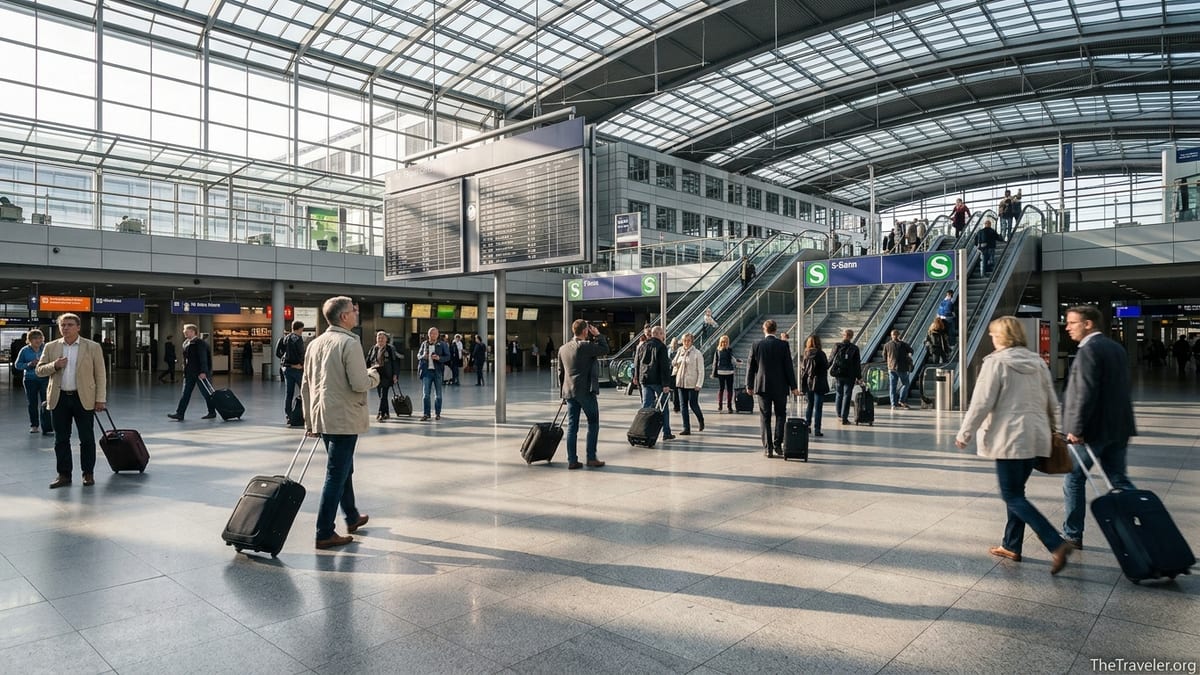
Orientation: Terminals, Layout and Airlines
Munich Airport sits about 30 kilometers northeast of central Munich and has two main passenger terminals plus a satellite building. Terminal 1 handles a mix of international and European carriers, while Terminal 2 and its satellite primarily serve Lufthansa and its Star Alliance partners. Between the terminals is the Munich Airport Center, a covered plaza with shops, restaurants and access to the train station below, which is the main landmark most first-time travelers use to orient themselves.
Terminal 1 is divided into several modules labeled A, B, C, D and E, each with its own check-in desks and security lanes. Many non-Star Alliance airlines use this terminal, such as British Airways, Turkish Airlines and airlines from the Middle East and North Africa. For example, flights to cities like London, Istanbul or Doha commonly depart from these modules. The building is long but mostly on one level, so navigation is straightforward: once you clear security, you follow the signage to your gate letter and walk along the concourse.
Terminal 2 is newer and more compact, built as a joint project with Lufthansa. It serves Lufthansa, Austrian, Swiss, Brussels Airlines and other Star Alliance members, with Schengen flights usually departing from gates G and H and non-Schengen from K and L. The K and L gates sit in the separate Satellite building, opened in 2016, which you reach via a short underground people mover after security. The ride takes around one minute and runs continuously, so even tight connections between the main terminal and satellite are usually manageable.
For most first-time travelers, the easiest way to keep track of where you need to be is to focus on the airline rather than the terminal. If you are flying Lufthansa or a Star Alliance carrier, you will almost certainly use Terminal 2 and possibly the Satellite. If you are flying with other European brands like easyJet or with many long-haul carriers from outside the alliance, you will generally depart and arrive through Terminal 1. Airline apps, boarding passes and airport monitors clearly show the terminal and gate letter, and signage in English and German is prominent throughout.
Arrivals: From Plane Door to Munich City Center
On arrival, Munich Airport is usually calm and orderly. After disembarking, you follow clear “Arrivals” signs to passport control if you are coming from outside the Schengen zone, or directly to baggage claim if you are arriving from within Schengen. Immigration formalities are typically efficient, although early morning long-haul banks from Asia and North America can mean queues of 20 to 40 minutes. Baggage delivery can take a little time, so it is normal for travelers to wait around the carousels for 20 minutes or more after landing, particularly in busy periods.
Once you have your luggage, you pass through customs and emerge into the public arrivals hall of either Terminal 1 or 2. From here, the priority for most first-time visitors is to reach the train station for the journey into Munich. The simplest route is to walk toward the Munich Airport Center, which sits between the two terminals. In practice, that means exiting baggage claim, walking straight ahead past car rental counters and kiosks, and following the signs with a large white “S” in a green circle that mark the S-Bahn suburban trains. In the Airport Center you will also find a large blue and white “M” symbol above the escalators that descend to the platforms.
The S1 and S8 S-Bahn lines connect the airport to central Munich. They run roughly every 10 minutes during the day and usually every 20 minutes in the early morning and late evening. Travel time to the main station, München Hauptbahnhof, is around 40 to 45 minutes in normal conditions, with S1 looping through the western suburbs and S8 through the eastern side of the city. Many travelers heading directly to major sights opt to get off at Marienplatz, the central square, which both lines serve. As of 2026, a one-way adult ticket from the airport to the city center typically costs in the mid-teens of euros, and there are day tickets that include unlimited travel in Munich for only a little more.
If you have a lot of luggage or arrive late at night, you might consider alternatives to the S-Bahn. Several express bus services run between the airport and Munich North or the central station, providing a direct route that can be more comfortable during rail construction. Metered taxis queue outside each terminal, and the ride into the city center generally takes 30 to 45 minutes depending on traffic, with typical fares falling somewhere in the range of a medium to high double-digit euro amount. Ride-hailing services also operate at Munich Airport, with designated pick-up points outside both terminals clearly signposted as ride app zones.
Departures: Check-in, Security and Boarding
For departing flights, Munich Airport recommends arriving two hours before a European flight and at least three hours ahead of a long-haul departure. This is generally realistic, especially in the morning and early evening peaks when many business travelers and holiday flights are scheduled. For a mid-morning Lufthansa flight to another European destination, for example, arriving at Terminal 2 at 8:00 for a 10:00 departure usually leaves enough time for check-in, security and even a quick coffee.
Check-in areas are directly in front of the entrances of each terminal. Lufthansa and Star Alliance carriers in Terminal 2 maintain extensive self-service check-in kiosks and automated bag drops, although staffed counters remain available for special assistance, families and premium passengers. In Terminal 1, many carriers still rely on traditional counters where you join the queue, check your passport and hand over bags. During busy holiday seasons, such as school breaks and Christmas markets, it is common to see long lines in the Terminal 1 modules used by sun destinations and low-cost carriers, so first-time travelers should plan extra time if flying in peak periods.
Security screening in both terminals is modern and generally efficient. Germany has been gradually introducing new CT scanners that allow liquids and laptops to stay in your bag at certain checkpoints, but procedures can differ between lanes. To avoid surprises, plan as if you will need to remove laptops and large electronics, and pack liquids in a clear one-liter bag. Families with small children and passengers with reduced mobility can ask staff for assistance or use dedicated lanes when available. Once past security, duty-free shops, bakeries and snack bars appear almost immediately, making it easy to pick up a pretzel, coffee or bottle of water before heading to your gate.
Boarding typically begins 30 to 40 minutes before departure, with announcements in German and English. Lufthansa and its partners often board by groups or zones to streamline the process, while other airlines may board back-to-front or by seat row. If your boarding pass mentions a bus gate, expect to be taken to your aircraft by coach from a remote stand, which is common for regional and some short-haul flights. In those cases you may want to arrive at the gate a little earlier to secure a spot near the front of the bus, which can mean getting off sooner and having more time to stow cabin baggage once on board.
Transport Options: Trains, Buses, Taxis and Rental Cars
For most first-time visitors, the S-Bahn remains the default way to travel between Munich Airport and the city. The S1 and S8 lines are part of the Munich public transport network, which means your ticket can also cover onward travel by U-Bahn, tram or bus within the city on the same day, depending on the type of ticket you purchase. Visitors staying near Marienplatz, Karlsplatz (Stachus) or the main station find the S-Bahn particularly convenient, as these stations are major interchanges for moving around Munich without needing a car or taxi.
Several bus options provide alternatives to the S-Bahn. Airport express buses connect the terminals to key points such as Munich North, which can be handy if you are staying in neighborhoods like Schwabing or need to connect to long-distance coaches. Regional buses also run from the airport to towns in Bavaria, including Freising, which has rail links toward cities like Regensburg. Tickets are usually sold directly by the driver, at kiosks in the arrivals halls, or through online booking apps, and timetables are posted at the bus stops outside both terminals and the Munich Airport Center.
Taxis line up outside arrivals around the clock. Typical fares into central Munich can vary but often fall into a range that many travelers consider reasonable for the convenience, especially late at night, early in the morning, or when traveling as a family with multiple suitcases. Official Munich taxis are easily identified by their light color and rooftop signs, and most accept card payments. Ride-hailing companies also operate at the airport, using designated pick-up and drop-off areas so that private vehicles do not clog the terminal roads. For example, travelers might order a ride to the Hilton Munich City in the Haidhausen district and be there in about 35 minutes in light traffic.
If you plan to explore Bavaria beyond Munich, rental cars are readily available at the airport. Major international brands have desks in both terminals and in the Munich Airport Center, and their car pick-up garages sit just a few minutes’ walk away. Many travelers arriving on a morning flight use the airport as a starting point for trips to the Alps, Neuschwanstein Castle or lakes like Chiemsee. Keep in mind that driving into central Munich involves environmental zones and limited parking, so one common strategy is to rent a car only for the days you will be exploring the countryside and rely on public transport while staying in the city itself.
Hotels and Sleeping Options at and near the Airport
For early departures, late arrivals or long connections, staying near Munich Airport can remove a lot of stress. The most convenient option is the Hilton Munich Airport, located directly between Terminals 1 and 2 at the Munich Airport Center. You can walk from baggage claim to the hotel lobby in a few minutes under cover, without needing any transport. The hotel offers rooms with soundproofing, an indoor pool and spa, and an on-site bar where many airline crews and frequent flyers unwind between flights.
Just outside the main airport grounds, several mid-range hotels provide good value and quick access to the terminals. The Novotel Munich Airport, for instance, sits a short bus ride from the terminal complex and offers modern rooms, breakfast buffets and on-site parking. Travelers often choose this kind of property when they have a rental car to return in the morning or want a quieter overnight stay than the terminal-side hotel. Other recognizable brands have properties in nearby towns such as Freising, often reachable by a short taxi or local bus ride, giving you more dining options in a traditional Bavarian setting.
Inside the terminals, there are also options for short rests rather than full hotel stays. Nap cabins and day rooms can sometimes be booked by the hour, which is useful if you have a daytime layover and need a quiet place to recharge. Even if you do not book a dedicated space, both terminals have relatively comfortable seating areas, and some travelers choose quieter corners near the less busy gates for a short rest. However, overnight sleeping in the public areas of the terminals is not always comfortable, and lighting and announcements can be disruptive, so a nearby hotel is usually a better choice for anything more than a brief nap.
When comparing where to stay, consider your timing and direction of travel. If you arrive late from a long-haul flight and continue by train from Munich Hauptbahnhof the next day, you might prefer to go straight into the city and stay near the station rather than at the airport. On the other hand, if you have a 7:00 flight to another European city, an airport hotel can let you wake at 4:30 or 5:00, walk straight to check-in and avoid the worry of early-morning transport delays.
Parking, Car Access and Drop-off Zones
Munich Airport provides extensive parking, from large multi-storey garages right next to the terminals to more economical open-air lots a few minutes farther away. Parking garages such as those adjacent to Terminal 2 offer covered spaces and direct pedestrian bridges into the departure halls, which many business travelers and frequent flyers use for short trips. Prices for parking close to the terminals are relatively high by regional standards, particularly for same-day and walk-up customers, but pre-booking online can significantly reduce costs, especially for stays of several days.
For longer vacations, many travelers opt for economy parking areas situated a short shuttle ride from the terminals. These lots usually offer lower daily rates and frequent free shuttles, which run every few minutes during peak times. A typical example would be a family driving from elsewhere in Bavaria, parking for a week in an economy lot, taking the shuttle to Terminal 1 for a holiday flight to Spain, and then returning to their car in the same lot after their trip. Some private parking companies around the airport advertise even cheaper rates, often bundling an included shuttle or car valet service, though travelers should check reviews and operating hours carefully before booking.
Short-stay drop-off and pick-up zones are available directly outside both terminal departure halls. These areas are designed for quick loading and unloading, so stopping times are limited, and parking charges can rise quickly if you stay longer than a few minutes. For meeting arriving passengers, many locals prefer to use the parking garages and walk to the arrivals hall, especially when flights may be delayed or luggage is slow to arrive. Rental car returns are clearly signposted from the access roads, sending you into dedicated multi-story garages where each brand has its own return area and inspection bays.
The road network around Munich Airport is modern and well signposted, connecting directly to major highways that lead toward Munich, Nuremberg, Regensburg and the Alps. However, during busy holiday weekends or in winter weather, traffic on the approach roads and highway sections near the airport can slow significantly. If you are driving yourself to catch a flight, particularly at peak times like Friday afternoons, allow extra time not only for the journey but also for finding a parking space and transferring from your lot or garage to the terminal.
Lounges, Food and Services for Transit Passengers
Munich Airport is well regarded for its passenger amenities, which is welcome news if you have a layover or arrive early. Both terminals offer a mix of airline-operated lounges and independent lounges that you can access with certain cards or paid entry. Lufthansa runs several lounges in Terminal 2 and the Satellite, ranging from Business and Senator Lounges to First Class facilities for eligible passengers. These typically provide hot and cold food, showers, comfortable seating and quiet workspaces, giving long-haul travelers a chance to refresh between flights.
In Terminal 1, a selection of contract lounges serves passengers from various airlines as well as travelers using lounge programs or day passes. These spaces often include snacks, drinks, Wi-Fi and newspapers, and they can be a calm haven compared with the sometimes crowded gate areas used by leisure carriers. For example, if you arrive from a transatlantic flight with a partner airline and have a few hours before your connecting flight to a Mediterranean holiday destination, you might spend that time in a contract lounge to rest and recharge devices.
Food and shopping options are plentiful throughout both terminals and the Munich Airport Center. In the public areas before security, you will find bakeries selling fresh pretzels, sandwiches and pastries, plus coffee shops and convenience-style stores where you can pick up travel essentials and snacks. Airside, after security, there are larger restaurants, bars and international chains catering to a wide range of tastes, from Bavarian dishes and sausages to Asian and vegetarian options. Prices are comparable with many other large European airports, with a quick airport breakfast of coffee and a pastry often costing roughly what you would pay in central Munich.
Additional services at Munich Airport include pharmacies, duty-free shops, currency exchange counters, mobile phone shops and even small exhibitions or seasonal events in the Munich Airport Center’s covered plaza. During winter, for instance, the outdoor area sometimes hosts festive markets or ice-related activities. There are also playgrounds and children’s corners, prayer rooms, and medical facilities that can assist with minor health concerns. Free Wi-Fi is available throughout the terminals, and charging points for phones and laptops are increasingly common around gates and seating areas.
Practical Tips for First-Time Travelers
First-time visitors to Munich Airport benefit from treating the airport as a small, well-organized city. Signage is consistently color-coded and bilingual, with departures and arrivals clearly separated and arrows pointing toward trains, buses, taxis and parking. Downloading your airline’s app before you travel is particularly useful here, as it keeps you updated about gate changes or delays without having to constantly monitor the departure boards. In addition, the airport’s own app and digital maps can help you locate services such as baby changing rooms, play areas or prayer rooms.
When connecting through Munich, one of the most important tips is to understand whether your bags are checked through to your final destination and whether you need to clear passport control. If you are flying, for example, from North America to a final destination in Italy via Munich on one ticket with the same airline group, you will usually clear immigration in Munich but not collect your bags until Italy. In that scenario, following the purple or yellow “Transfer” signs and paying attention to “Non-Schengen” and “Schengen” indicators is key. Connection times as low as 45 minutes are technically possible in Terminal 2 for some itineraries, but if you are unfamiliar with the airport, allowing at least 60 to 90 minutes can make the experience much less stressful.
Weather can also influence your experience. Munich has cold winters with possible snow and hot summers with strong sun. In winter, give yourself extra time for de-icing procedures before departure, which can delay morning flights. In summer, keep a reusable water bottle handy to refill after security, and consider wearing layers so you can adjust between air-conditioned cabins, shaded terminal interiors and warm outdoor areas. Regardless of season, comfortable walking shoes are a wise choice, as you may walk several thousand steps from check-in to gate, particularly if using the Terminal 2 Satellite or a remote stand.
Finally, keep some cash or a contactless payment method ready for small transactions such as luggage trolleys, quick coffees or bus tickets. While card payments are widely accepted, occasional machines or kiosks may not support every card type. If you are arriving from outside the eurozone, many travelers choose to withdraw a small amount of euros from an ATM at the airport rather than relying solely on exchange counters, then top up in the city where fees may be lower. As with any major hub, keeping valuables close, using bags with zippers and being mindful in crowded areas such as security lines and train platforms will help ensure a smooth start or end to your journey.
FAQ
Q1. How long does it take to get from Munich Airport to the city center?
In normal conditions it takes around 40 to 45 minutes by S-Bahn from the airport to central stations like Marienplatz or München Hauptbahnhof.
Q2. Which terminal does Lufthansa use at Munich Airport?
Lufthansa mainly operates from Terminal 2 and the Terminal 2 Satellite, using gates G and H for most Schengen flights and K and L for many non-Schengen routes.
Q3. Is it easy to transfer between Terminal 1 and Terminal 2?
Yes, the walk between Terminal 1 and Terminal 2 through the Munich Airport Center usually takes about 10 minutes, with clear signage and level pathways.
Q4. How early should I arrive at Munich Airport for my flight?
Plan at least two hours before European departures and three hours or more for long-haul flights, adding extra time during peak holiday seasons.
Q5. What is the cheapest way to get into Munich from the airport?
The suburban S-Bahn lines S1 and S8 are usually the most economical and practical option, especially if you use a day ticket that includes city transport.
Q6. Are there hotels directly at Munich Airport?
Yes, the Hilton Munich Airport is located between Terminals 1 and 2, and several other hotels such as the Novotel Munich Airport are a short bus or taxi ride away.
Q7. Does Munich Airport have sleeping options inside the terminal?
There are nap cabins and day rooms available for short stays, plus seating in quieter gate areas, though most travelers prefer nearby hotels for full overnight rest.
Q8. Can I access a lounge if I am not flying business class?
Yes, several independent lounges sell access to travelers with certain cards or for a fee, offering snacks, drinks, Wi-Fi and more comfortable seating than the public areas.
Q9. What should I do if I have a tight connection at Munich?
Follow the transfer signs, check your gate on screens or your airline app, move promptly toward your next gate and inform staff if your incoming flight was heavily delayed.
Q10. Is Munich Airport friendly for English-speaking travelers?
Yes, announcements are made in German and English, most staff speak at least basic English, and signs throughout the terminals use clear bilingual wording and symbols.