


I boarded my first Lindblad Expeditions ship expecting a comfortable small-ship cruise with some wildlife viewing thrown in. What I did not expect was to feel like I had accidentally enrolled in the most fascinating field course of my life, complete with naturalists, scientists, microscopes, and daily debriefs that felt more like a National Geographic documentary than a vacation recap.
Get the latest updates straight to your inbox!
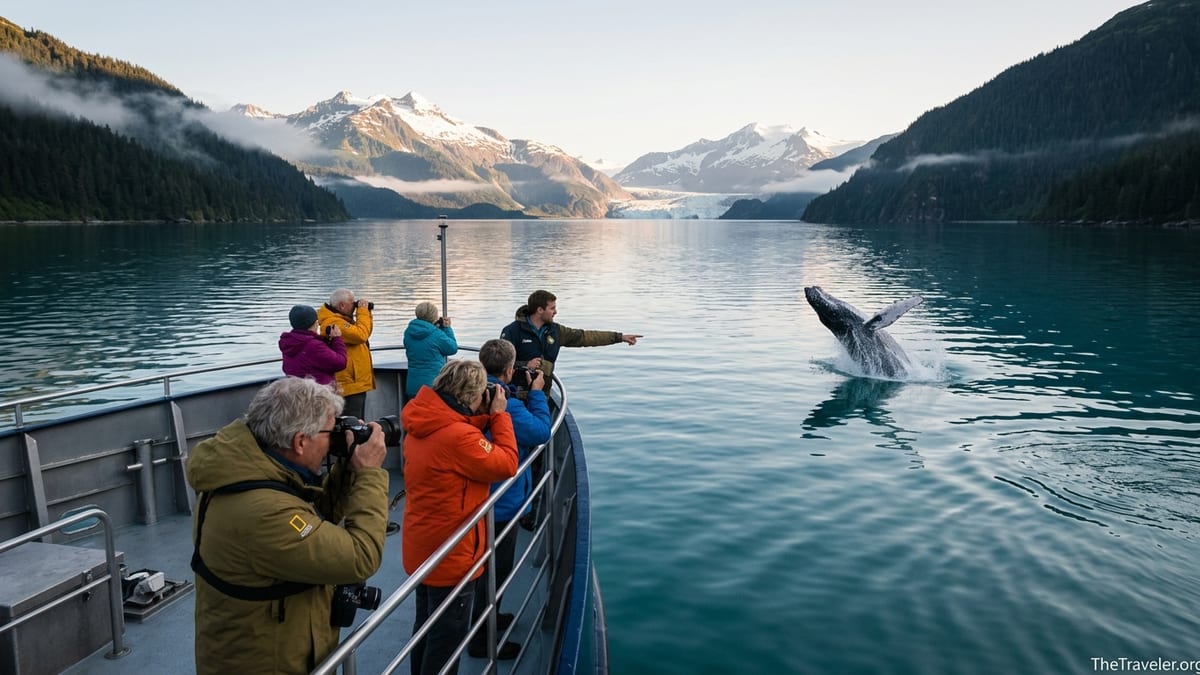
Arriving Expecting a Cruise, Discovering a Floating Classroom
The education started almost as soon as I stepped aboard. Before we had even left the pier, our expedition leader introduced a team that sounded more like the faculty page of a research station than a cruise roster: marine biologists, geologists, an ornithologist, a National Geographic certified photo instructor, and an undersea specialist. On some itineraries, such as Alaska’s Inside Passage or the Galapagos, Lindblad typically sails with roughly one naturalist or specialist for about every ten guests, which radically changes how personal the learning feels.
Rather than a generic safety talk followed by a sales pitch, the first gathering in the lounge was an orientation to the ecosystem we were sailing into. On an Alaska voyage, that meant a quick primer on humpback feeding strategies and tidewater glaciers; in the Galapagos, it might be an introduction to Darwin’s finches and why sea lions haul out on particular beaches. The tone was clear: we were not just passengers; we were participants in a shared field expedition.
What surprised me most was how informal and accessible it all felt. There were no PowerPoint marathons or stiff lectures. Instead, a geologist might pull out a chunk of volcanic rock on deck and explain how it formed as we sailed past a lava cliff, or a naturalist would lean over the rail with guests to identify seabirds in real time. I quickly realized that on a Lindblad trip, “class” can happen in the lounge, on the bow, in a Zodiac, or waist-deep in the water with a mask and snorkel on.
Naturalists on Call: Learning Never Really Stops
On mainstream cruises, enrichment often means an occasional talk tucked between spa promotions. On Lindblad, the experts are seemingly everywhere, all the time. On the National Geographic Quest in Alaska, for example, it is common to have multiple naturalists, a photo instructor, and an undersea specialist, all mingling with just over a hundred guests. They are on the bow with binoculars at dawn, in the dining room at lunch, and riding in your Zodiac in the afternoon.
One morning in Southeast Alaska, I remember spotting what I thought were two identical bald eagles in a tree. A naturalist casually pointed out that one was a juvenile, explaining how the mottled plumage changes over several years before the iconic white head appears. On a Galapagos sailing, a certified photo instructor walked me through how to anticipate a blue-footed booby’s dive so I could actually capture it mid-splash. These were five-minute interactions, but multiplied over a week, they added up to a crash course in field observation.
Formal presentations still happen, usually before or after dinner. On an Antarctica itinerary, that might mean an evening talk on penguin courtship, followed by another on climate science with a visiting researcher. On a Baja California expedition, one night may focus on gray whale behavior, while another dives into desert ecology. What surprised me was how these sessions were tailored to what we had just seen that day: if orcas appeared in the afternoon, expect orca ecology on the schedule by evening.
Underwater Worlds Brought On Board
Another unexpected aspect of Lindblad’s educational approach is how they reveal places you never physically visit. Many ships in the fleet, especially those sailing in Alaska, Baja California, and Antarctica, carry an undersea specialist whose job is to explore beneath the surface using scuba gear and cameras. While guests are hiking a shoreline or watching from the bow, the undersea specialist may be filming a kelp forest or a reef dozens of feet down.
That footage becomes part of the nightly recap, where you might suddenly find yourself looking at a close-up of a nudibranch inching across a rock or a starfish opening a mussel. On some itineraries, remotely operated vehicles are used to reach depths beyond normal diving range, revealing sponges, coral and strange invertebrates in near darkness. The effect is that you are not just visiting the coastline; you are being shown the entire vertical slice of an ecosystem, from seabirds overhead to deepwater life you will never see with the naked eye.
On warmer itineraries, like Baja California or the South Pacific, the line between guest and observer blurs even more. You might spend the morning snorkeling with sea lions or rays using the ship’s complimentary gear, then bring a bit of that world back aboard in the form of a plankton tow sample. Later that day, the same water that flowed past your mask ends up under a video microscope in the lounge, where the undersea specialist projects live images of tiny drifting organisms and explains how they drive the entire marine food web.
Hands-On Science: From Plankton Tows to Citizen Projects
Before sailing with Lindblad, I imagined “science at sea” as something done behind closed doors by researchers. In practice, much of it is surprisingly hands on. On certain voyages, guests are invited to help launch a plankton net off the stern, record water temperatures, or log wildlife sightings that contribute to broader databases. It is not a daily requirement, but the opportunities are there if you are curious.
On a voyage that included a National Geographic visiting scientist, we watched as they collected water samples in the Southern Ocean to study phytoplankton and microplastics. In the evenings they shared early observations and explained how our location fit into a larger research project. On another itinerary, birders and beginners alike were encouraged to log sightings into an app connected to eBird, helping contribute data used by conservation scientists while also sharpening our identification skills.
Families often notice this most through the Explorers-in-Training or Global Explorers programs available on select departures in places like Alaska, Baja California, Galapagos, and Antarctica. Kids might build a model glacier out of ice cream to understand how ice flows, then go out the next day to kayak beneath a real one. In Baja, young travelers sometimes help with a plankton tow in the morning and then enter whale tail photographs into a citizen science database that tracks individual whales through their unique markings. For parents used to kids’ clubs focused on video games and pool time, it can be startling to watch their child argue passionately at dinner about why krill populations matter.
Photography as a Gateway to Seeing More Deeply
One of the subtler educational surprises on a Lindblad expedition is how the photography program ends up teaching you about nature, even if you never considered yourself a photographer. Every National Geographic–flagged ship typically has at least one certified photo instructor on board, and many sailings host additional National Geographic photographers or experts. Their job is not just to help you bring home better pictures, but to help you see more.
On deck in Alaska’s Glacier Bay, for example, a photo instructor might show you how to use a longer shutter speed to capture the movement of a calving glacier, and in the process explain what causes the deep blue color in compressed ice. In the Galapagos, a session on composition will naturally include a discussion of endemic species and the strict guidelines that keep human footprints from disturbing nesting sites. Techniques like anticipating an animal’s behavior so you are ready to frame the shot become lessons in quietly observing patterns, respecting distance, and understanding habitat.
There are also spontaneous demos. One afternoon in the Sea of Cortez, a naturalist noticed several guests struggling to photograph a pod of dolphins racing the bow. Within minutes, the photo instructor had everyone adjust camera settings and stance, explaining how to track fast-moving subjects. The difference in images was obvious, but so was the shift in attention. People stopped simply pointing and shooting and started noticing subtle differences between individual animals, the way light hit the water, and how the pod changed formation as it fed.
Daily Recaps That Feel Like Documentary Debriefs
Perhaps the clearest sign that Lindblad treats each voyage as a learning journey is the nightly recap. While other cruise lines might schedule a revue show or trivia, these small ships gather everyone in the lounge to replay the day. It starts casually, with guests grabbing a drink and settling into chairs. Then the expedition leader introduces a series of short segments from the naturalists, undersea specialist, photo instructor, or visiting scientist.
On an Antarctica sailing, one recap might include a five-minute undersea video of soft corals swaying in frigid water, followed by a quick overview of leopard seal adaptations and a time-lapse of the ship navigating sea ice earlier that afternoon. On a Costa Rica and Panama voyage, the lineup might include a segment on leafcutter ants filmed on a forest walk that morning, a mini-lesson on how the Panama Canal locks work, and a reminder about the next day’s wake-up time.
Guests contribute too. Someone might stand up and share a favorite encounter with a sea lion or a surprising bird sighting. On family departures, kids sometimes present their field notebooks or a short project they completed with the Explorers program. The effect is cumulative. Over the course of a week, you subconsciously construct a mental map of the region, its wildlife, and its conservation challenges, stitched together from dozens of bite-sized explanations and images.
The Quiet Education of Simply Being There
Not all of the learning on a Lindblad expedition comes from microscopes and microphones. Some of the most profound lessons are quieter and more personal. In Alaska, kayaking close to a tidewater glacier in a ship-supplied kayak, you can literally hear the ice crackle and pop as ancient air escapes from deep within. Off the Galapagos, snorkeling alongside a sea turtle that barely seems to notice you changes how you feel about plastic bags drifting in the same currents back home.
Local guides and cultural interpreters deepen this further. In places like Southeast Alaska, you may hear from Indigenous Tlingit or Haida speakers about traditional relationships to the land and sea. In Panama, a naturalist might explain how mangroves protect coastlines and support fisheries, then lead a Zodiac cruise through a tangle of roots alive with birds and crabs. These encounters are not framed as lectures; they are simply conversations that happen to stay with you long after you disembark.
Even downtime is subtly educational. The ship’s library typically holds field guides, atlases, and regional history books, many personally annotated by staff. It is common to see guests flipping through a whale identification guide between Zodiac landings or comparing plant illustrations after a hike. Over coffee at breakfast, people chat less about last night’s dessert and more about whether the whales we saw were feeding or migrating, or how far a penguin colony is from its foraging grounds.
The Takeaway
By the end of my first Lindblad expedition, I realized I had spent a week doing what many of us rarely do on vacation: paying deep, sustained attention to a place. I learned to identify birds I had never heard of, to read the surface of the ocean for signs of life below, and to understand how my presence fit into fragile ecosystems from Alaska fjords to Galapagos shores.
What makes the experience feel so educational is not any single feature, but the layering of many: the ever-present naturalists, the undersea videos, the citizen science projects, the photography tips, the nightly recaps, and the thoughtful programming for kids. None of it feels compulsory or heavy. You can skip a talk to soak in the hot tub or linger over dinner, and no one will scold you. Yet even the most relaxation-focused guests I met could not help but absorb new knowledge simply by being surrounded by curiosity and expertise.
If you are considering a Lindblad voyage to Antarctica, Alaska, Baja California, the Galapagos, or beyond, it is worth adjusting your expectations. You will have comfortable cabins, good food, and remarkable wildlife encounters. But you may also find yourself coming home with a notebook full of species names, a phone full of better photographs, and a perspective on the planet that feels, in the best way, like the result of a short but intense course in how the natural world actually works.
FAQ
Q1. Are Lindblad expeditions suitable for travelers who do not consider themselves “science people”?
Yes. The educational content is designed to be accessible and informal, delivered through stories, short talks, and real-life encounters rather than technical lectures. You can engage as much or as little as you like, and many guests who arrive unsure about science end up captivated precisely because it is tied to what they are seeing each day.
Q2. How is the educational experience different from a typical large-ship cruise?
On large ships, enrichment is often an optional add-on. On Lindblad, naturalists, photo instructors, and undersea specialists are woven into almost every activity. Group sizes are smaller, experts are always available on deck or in the lounge, and daily recaps and field-focused excursions turn the entire voyage into a shared learning experience rather than a few isolated talks.
Q3. Will I have homework or feel pressured to attend every talk?
No. All lectures, briefings, and science activities are optional. Many guests attend most sessions because they are engaging and tied to the day’s adventures, but you are free to skip any program without judgment. The atmosphere is relaxed and vacation-focused, even as it remains intellectually rich.
Q4. What kinds of experts are typically on board?
Depending on the destination, you can expect a team that might include marine biologists, ornithologists, geologists, historians or cultural interpreters, a National Geographic certified photo instructor, and often an undersea specialist. Select departures also welcome visiting scientists or National Geographic experts who share their ongoing research with guests.
Q5. Is there special educational programming for children and teens?
Yes. On certain itineraries, especially to Alaska, Baja California, the Galapagos, and Antarctica, kids can join Explorers-in-Training or similar programs led by certified field educators. Activities might include simple experiments, field notebooks, photo projects, and hands-on science like plankton tows, all designed to be fun first and educational as a natural result.
Q6. Do I need prior photography skills to benefit from the photo instruction?
No. Photo instructors work with all levels, from guests using smartphones to experienced photographers with advanced cameras. Short, practical tips offered on deck, in Zodiacs, and during dedicated sessions help you improve your images while also deepening your understanding of animal behavior, light, and landscape.
Q7. How much of the learning happens on shore versus on the ship?
Both matter. Shore excursions and Zodiac or kayak outings provide the raw experiences: watching whales, walking among penguins, or exploring a rainforest trail. On board, experts connect those moments to the bigger picture through recaps, talks, and casual conversations. The combination of field time and thoughtful interpretation is what makes the learning feel so immersive.
Q8. Can I participate in real scientific projects during the trip?
On many voyages, yes. Opportunities may include logging wildlife sightings for global databases, assisting with simple oceanographic measurements, or learning about ongoing research from visiting scientists. Participation is voluntary, and activities are designed so that anyone with curiosity, not just scientists, can contribute.
Q9. Will the educational focus make the trip feel less like a vacation?
Most travelers find the opposite. The learning enhances rather than replaces relaxation, adding meaning to wildlife encounters, hikes, and time on deck. You still enjoy comfortable cabins, good meals, and free time, but you also return home with a deeper sense of connection to the places you visited.
Q10. How can I get the most out of the educational side of a Lindblad expedition?
Stay flexible and curious. Attend the nightly recaps when you can, ask questions of the naturalists and photo instructors, spend some time in the ship’s library, and join at least one hands-on activity like a plankton demo or a citizen science project. Even small efforts to engage will multiply the richness of what you take away from the voyage.