


I landed in Kittilä, deep in Finnish Lapland, with a suitcase full of merino wool and a head full of marketing images. Levi Ski Resort was supposed to be my perfect Arctic escape: silent forests, empty slopes, Northern Lights swirling above a tiny log-cabin village. What I found instead was noisier, brighter, more commercial and far more complicated than the Arctic fantasy I had booked. Yet somewhere between the lift queues, the snowmobile engines and a very imperfect Northern Lights hunt, Levi got under my skin in ways I did not expect.
Get the latest updates straight to your inbox!
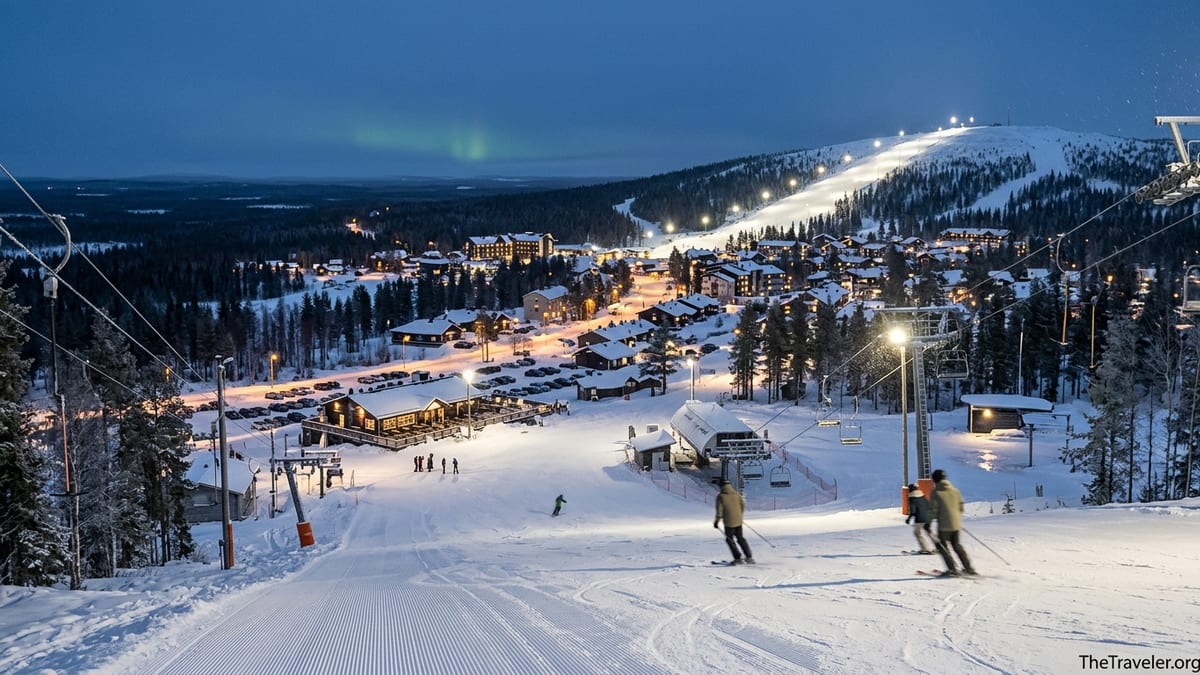
Expecting a Tiny Arctic Outpost, Finding Finland’s Biggest Ski Resort
When you read that Levi is “Finland’s premier ski resort” and the largest in the country, you might imagine a big mountain feel with a compact village wrapped around it. That part is accurate. The surprise is how extensive the infrastructure is for a place north of the Arctic Circle. The village of Sirkka, which forms the heart of Levi, is crammed with equipment rental shops, après-ski bars, karaoke lounges, fast-food counters and glossy hotel lobbies. It felt less like remote wilderness and more like a small, self-contained ski town that just happens to sit in the middle of Lapland.
I had pictured one or two sleepy lifts. Instead, Levi’s fell is laced with gondolas, chairlifts and surface lifts rising from different sides of the hill. You can ride a gondola from the front slopes straight up to Hotel Levi Panorama, or hop chairlifts that serve floodlit runs circling much of the fell. It is not the Alps in scale, but for Finland, it is a proper resort mountain, and that changes the entire mood: buzzing lift stations, music at the base, and a steady stream of people in brand-new technical wear.
Even the transfer shattered my Arctic-daydream. The drive from Kittilä Airport to Levi is only about 15 minutes, along a well-maintained road busy with shuttle buses and taxis. I had imagined a long journey into the wild with vast emptiness on all sides. Instead, by the time my phone finished roaming, we were already pulling into a village lit up like a Nordic Christmas mall, complete with neon signage and a supermarket that stays open into the evening.
That ease of access is a blessing in the cold, but it does mean Levi feels like a polished product rather than a frontier outpost. For anyone expecting nothing but quiet forest and a couple of cabins, the scale can be jarring. It certainly was for me on the first night, dragging my suitcase along a plowed sidewalk past a bowling alley and a nightclub in a place I had imagined as a hushed Arctic hamlet.
The Reality of Arctic Skiing: Wind, Ice and Short Days
I booked Levi dreaming of endless powder turns under pale polar light. In reality, Arctic skiing is its own animal. You do get snow, usually plenty of it, but during my stay in mid-winter the slopes veered between chalky hardpack and wind-scoured ice depending on the face of the fell. The front slopes, closest to the village, were the most crowded and polished. Early morning laps on the south-facing runs felt best, while late in the afternoon the main pistes had that familiar scraped sheen that makes every edge catch feel just a bit too exciting.
Then there is the light, or the lack of it. In deep winter, Levi can have just a few hours of daylight. One day, my ski “morning” started in something like civil twilight at around 10:30 a.m., and by 2:30 p.m. the sun was already sliding low, the sky fading into the soft pink-blue gradient Lapland is famous for. The resort leans on powerful floodlights to extend skiing hours, so you actually spend a lot of time on illuminated runs that can feel almost like night skiing even in the afternoon. Romantic in its own way, yes, but very different from sunny Alpine days that linger into late afternoon.
The weather also refused to play along with my expectations. I had prepared for brutal cold, mentally braced for minus 25 degrees Celsius and frozen eyelashes. I got a thaw. One day hovered just below freezing, snow turning slightly sticky at the base and light drizzle threatening at lower elevations. It made skiing less intimidating but also dulled the crisp, squeaky snow I had imagined. On other days, Arctic wind cut across the exposed upper slopes and quickly made standing still on the chairlift an exercise in strategic layering and face protection.
What Levi does well is give you options when the conditions are mixed. On the coldest, windiest afternoon I retreated from the exposed top and skied the tree-lined blue runs that weave down toward the village on the northern side. These sheltered slopes, flanked by birch and pine heavy with snow, felt closer to the Lapland postcard that had sold me on the trip. But it was clear that even here, reality plays by its own rules: snow can be soft, crunchy, icy or all three in the space of a single run, and the Arctic sun is more fleeting guest than daily companion.
Beneath the Fairy Lights: A Busy, Commercial Levi
Levi’s marketing paints it as a place where nature is always just outside your cabin door, and that is true, but only if you step beyond the resort’s polished core. The central streets around the main slopes are lined with everything you would expect from a full-service ski resort: branded sports shops, burger chains, cocktail bars, live-music pubs and tour desks offering snowmobile safaris, husky rides and Northern Lights excursions. Walking down the main drag in early evening, it felt more like a compact Alpine resort transplanted into Lapland than a quiet Arctic settlement.
Prices reflect that status. A simple bowl of reindeer soup and bread in a cozy wooden restaurant near the base cost noticeably more than a similar meal in Helsinki, and ordering a glass of wine could quickly turn what looked like a casual dinner into something approaching fine-dining prices. Activities add up fast: short husky safaris advertised on sandwich boards in the village ran into the high double or low triple digits in euros per person for less than an hour on the sled, and snowmobile tours were broadly in the same bracket. For families booking several of these activities, the cost of “Arctic magic” climbs quickly.
What I had not expected was how easy it would be to forget I was north of the Arctic Circle at all. Pop music drifted from bar terraces, English dominated most conversations in the lift lines, and glowing signs advertised everything from karaoke nights to happy-hour cocktail deals. If you come for nightlife, this is a plus. One evening, an après-ski bar at the front slopes turned into a full dance floor by late afternoon, with skiers still in their boots, fog machines running and a DJ spinning Scandinavian pop remixes.
Yet a ten-minute walk away, stepping off the main streets and past the last chalets, the mood changed completely. Street lights thinned, houses gave way to dark forest, and the crunch of snow under boots replaced the soundtrack of resort life. That contrast is Levi in a nutshell: an unapologetically busy commercial village pressed right up against genuinely wild Lapland. If you expect only one of those realities, the other can be quite a shock.
Chasing the Northern Lights and Meeting the Arctic on Its Terms
Like most people visiting Levi in winter, I came hoping to see the Northern Lights. Every tour desk in the village sells the promise, offering Aurora hunting by minibus, snowmobile, reindeer sled or even on snowshoes. On my first clear night, I joined a minibus group that drove out beyond the village glow to a frozen lake, where hot berry juice simmered in a kettle over an open fire as our guide scanned the sky and refreshed a solar-activity app on his phone.
In my imagination, this was the night when the sky would erupt in curtains of green and purple. In reality, we saw a faint pale arc, almost like a distant cloud, slowly intensify into a shy band of green that wavered and retreated. It was beautiful but modest, and most of the drama came from the cold seeping through our boots as we stamped our feet on the lake ice. Nearby, another group arrived by snowmobile, engines shattering the silence before they cut out and joined us in watching a sky that refused to fully cooperate.
What struck me was how orchestrated the whole experience was. Rather than quietly standing under the Arctic sky alone, we were a small crowd gathered around a fire pit, listening to stories about local folklore and camera settings. Our guide admitted that despite Levi’s reputation, there are plenty of nights when tours see nothing but clouds or a distant wash of light. Aurora season can stretch from late August to early spring, but the lights themselves remain stubbornly unpredictable. No amount of glossy photography in brochures can change that.
Oddly enough, the most magical moment came later, without a tour. Walking back from a late dinner in the village, I glanced up between the roofs of apartment blocks and saw a sudden bright streak cutting across the sky, then another, fanning into faint, fast-moving veils. The street lights muted the display, but seeing the Aurora appear unannounced above Levi’s parking lots and supermarkets, without hot juice or campfire stories, felt more real. The Arctic, it turns out, ignores your itinerary and tour vouchers.
Husky Safaris, Snowmobiles and the Ethics of Arctic Fun
No trip to Levi seems complete without husky sledding or snowmobiling, and I had planned to book both. Walking through the village, every second window displayed posters of sled dogs charging through white forests, riders leaning into snowmobile turns, and smiling families wrapped in jumpsuits and balaclavas. Several kennels within driving distance of Levi offer short 5 to 10 kilometer husky safaris that include transfers, warm gear and hot drinks, often promoted as family-friendly adventures.
The experience itself can be exhilarating. Guests are usually given a quick driving lesson, then set off in pairs on sleds pulled by teams of eager dogs following a guide. Yet conversations with staff and reading about the industry made the decision more complicated. Huskies are working animals in this part of the world, and many kennels emphasize their welfare, limiting daily distances and rest periods. At the same time, the sheer popularity of these safaris in Levi and across Lapland means a lot of dogs exist primarily because tourists want that perfect sledding photograph.
Snowmobile safaris raised similar questions. They are a fast way to leave the resort and reach open fells and frozen lakes, and guided tours often include safety briefings, warm gear and breaks at wilderness huts. But the roar of engines and the smell of exhaust feel starkly at odds with the silent, snow-draped forests that dominate Levi’s own marketing images. On a clear afternoon, I took a walk along a marked winter trail near the village and listened as the distant buzz of snowmobiles carried across the otherwise still landscape, a reminder that most people choose speed over solitude when sampling the Arctic.
In the end, I skipped both activities and opted instead for a slower, cheaper option: renting snowshoes from a shop near the front slopes and following a marked trail into the forest as dusk settled in. The silence there, broken only by the soft thump of snow underfoot and the occasional creak of loaded branches, came much closer to the Arctic escape I had pictured before the trip. It was not as photogenic as a husky sled ride, and there was no hot juice at the end, but it felt truer to the landscape and kinder to my budget and conscience.
Finding Quiet Corners and Small, Human Moments
The unexpected gift of Levi was not in the headline experiences but in the smaller, quieter moments that emerged once I adjusted my expectations. On one morning when the lifts were delayed because of strong winds higher up, I ducked into a modest café near the base where local workers were having breakfast. A simple plate of porridge with cloudberry jam and a strong coffee cost less than many of the tourist-oriented options on the main street and came with something more valuable: a sense of the everyday life that underpins the resort’s glossy surface.
Another afternoon, instead of chasing more ski runs, I took the gondola up to the fell top, walked a short way beyond the restaurant and just stood watching the light fade over the surrounding fells. The view stretched toward Ylläs and distant, rounded hills dotted with wind turbines, a reminder that Lapland’s landscape is both ancient and very modern. Below, the floodlit slopes of Levi glowed like bright ribbons sewn onto the side of the hill, while far beyond them, dark forest extended in every direction.
Even the much-advertised ice and snow attractions around Levi have a quieter side. Within driving distance are seasonal snow villages and ice galleries where you can walk through sculpted tunnels and see intricate ice carvings. On an early evening visit, our small group wandered through frozen corridors, our footsteps muffled on packed snow, while a guide described how the structures are rebuilt each winter as temperatures allow. It felt less like a theme park and more like a temporary art project at the mercy of weather, something that might not survive an early spring thaw.
Levi’s greatest strength, I came to realize, is not that it matches your Arctic fantasy but that it gives you the tools to piece together your own version of Lapland. If you want nightlife and convenience, you can have them. If you are willing to step one layer beyond the resort polish, you can have silence and snow-laden trees and maybe, if you are lucky, a stray ripple of green light in the sky.
The Takeaway
My trip to Levi was nothing like the Arctic getaway I had expected when I clicked “book now” on a flight to Kittilä. I imagined untouched wilderness, guaranteed Aurora shows and leisurely powder turns under a pale sun. I found busy lift lines, fluctuating weather, commercial tours with carefully designed campfires and an energetic little village that feels more like a Scandinavian ski hub than a remote outpost.
Yet it is precisely this tension between fantasy and reality that makes Levi worth visiting. The resort does not hide the fact that it is built for tourism; shuttle buses, tour desks and floodlit slopes are part of the package. But just beyond that infrastructure, Lapland still waits with its quiet forests, unpredictable skies and long, blue winter twilights. The key is to arrive with open eyes, a flexible plan and enough curiosity to look beyond the brochures.
If you go, think of Levi less as a pristine Arctic postcard and more as a gateway. Use the lifts and services, but also give yourself time to walk a dark road away from the village lights, to sit in a modest café rather than the loudest après-ski bar, and to accept that the Northern Lights may or may not appear on your schedule. The Arctic does not perform on demand, and in Levi, that might be the most important lesson of all.
FAQ
Q1. Is Levi Ski Resort suitable for beginners?
Yes, Levi has several gentle, wide blue runs and beginner areas close to the village, plus ski schools that offer lessons in English and other languages.
Q2. How cold does it actually get in Levi in winter?
Temperatures can drop well below freezing, sometimes below minus 20 degrees Celsius, but milder spells close to zero are also common, so layers are essential.
Q3. Do I need a car to enjoy Levi?
No, the village is compact and walkable, and many hotels are near the slopes. Airport shuttles and local transfers connect most activities and excursions.
Q4. Can I see the Northern Lights from the village itself?
It is possible on clear, active nights, especially away from the brightest lights, but leaving the village on a tour or by rental car usually improves your chances.
Q5. Are husky and snowmobile safaris worth the price?
They can be exciting, but they are expensive and can raise ethical and environmental questions. Cheaper, quieter options like snowshoeing or cross-country skiing are good alternatives.
Q6. What is the ski season in Levi?
Levi typically opens in autumn and can stay open into spring, with the main winter season running through the coldest months when snow coverage is most reliable.
Q7. Is Levi a good choice for non-skiers?
Yes, non-skiers can enjoy Northern Lights tours, husky and reindeer experiences, snowshoeing, ice and snow attractions, spas, and the general winter atmosphere.
Q8. How crowded does Levi get?
It can be quite busy during school holidays and peak winter weeks, especially on the front slopes and in the village center, while side areas and off-peak times are calmer.
Q9. What should I pack for a winter trip to Levi?
Bring thermal base layers, insulating mid-layers, a windproof outer shell, warm boots, gloves, a hat, a balaclava or neck gaiter, and hand warmers if you feel the cold.
Q10. Is Levi a good base for exploring more of Lapland?
Yes, its airport access, tour operators and nearby attractions make it a convenient hub, and you can combine it with visits to quieter fells or other Lapland towns.