


The first thing I noticed was what I did not hear. No traffic hum, no distant sirens, not even the soft rumble of a village snowplow. Standing on the crest of a fell in Pallas–Yllästunturi National Park, in the far north of Finland, the silence moved in like weather. It was so complete that my own heartbeat felt loud, every breath a small disturbance in a soundscape otherwise ruled by wind and snow. I had come for Arctic scenery and perhaps a glimpse of the northern lights. What stayed with me long after the trip ended was the silence, a rare and fragile commodity in modern travel.
Get the latest updates straight to your inbox!
Meeting the Quiet Heart of Lapland
Pallas–Yllästunturi National Park stretches across more than a thousand square kilometres of northern Finland, a landscape of rounded fells, old-growth forests and wide mires. For many visitors, the journey begins in the small municipality of Muonio or the ski villages around Ylläs, but the real destination lies on the ridgelines and in the forests where human noise falls away. Stepping out of the car at the Pallastunturi Visitor Centre parking area on a February afternoon, I heard only the squeak of my boots on dry snow and the soft hiss of wind through birch branches.
This part of Lapland prides itself on clean air and low light pollution, and those facts translate directly into how the place sounds and feels. There are no highways cutting through the park, no aircraft approaching a nearby hub airport, no loud nightlife venues spilling sound into the night. Even in high season, the Pallas side feels uncrowded compared with more commercial resorts further south. On a weekday in late winter, I shared the trail mostly with a handful of local skiers and the faint, looping tracks of Arctic hare across the snowfields.
The silence is not total absence of sound, but a recalibration. You become aware of details that urban life erases. Snow sliding from a spruce bough carries a soft thud that seems to travel a long way. A raven’s croak over the fell crest becomes a landmark as tangible as any signpost. After an hour of walking, I found myself pausing just to listen to the nothing in between those small sounds, as if the landscape were taking slow, deliberate breaths.
A Winter Ascent Into Stillness
My clearest memory of that silence formed on a short winter hike toward Taivaskero, one of the best-known peaks in the Pallas massif. From the Pallastunturi Visitor Centre, a well-marked trail leads out of the sparse birch forest onto the open fell. Climbing in temperatures around minus 15 degrees Celsius, my world shrank to the crunch of snow under my spikes and the white slope rising in front of me. The higher I went, the fewer traces of human presence I could see, until the only sign of others was a pair of ski tracks disappearing into the distance.
Halfway up, a snowmobile passed on a distant maintenance route, a brief mechanical murmur that faded almost as soon as I registered it. Once it was gone, the quiet felt even deeper, as if the landscape had closed the door behind a departing guest. On the ridge, the wind picked up, but even that felt different from coastal storms or city gusts that funnel between buildings. Here, the air flowed steadily across kilometres of open snow, a low, constant whisper more than a roar.
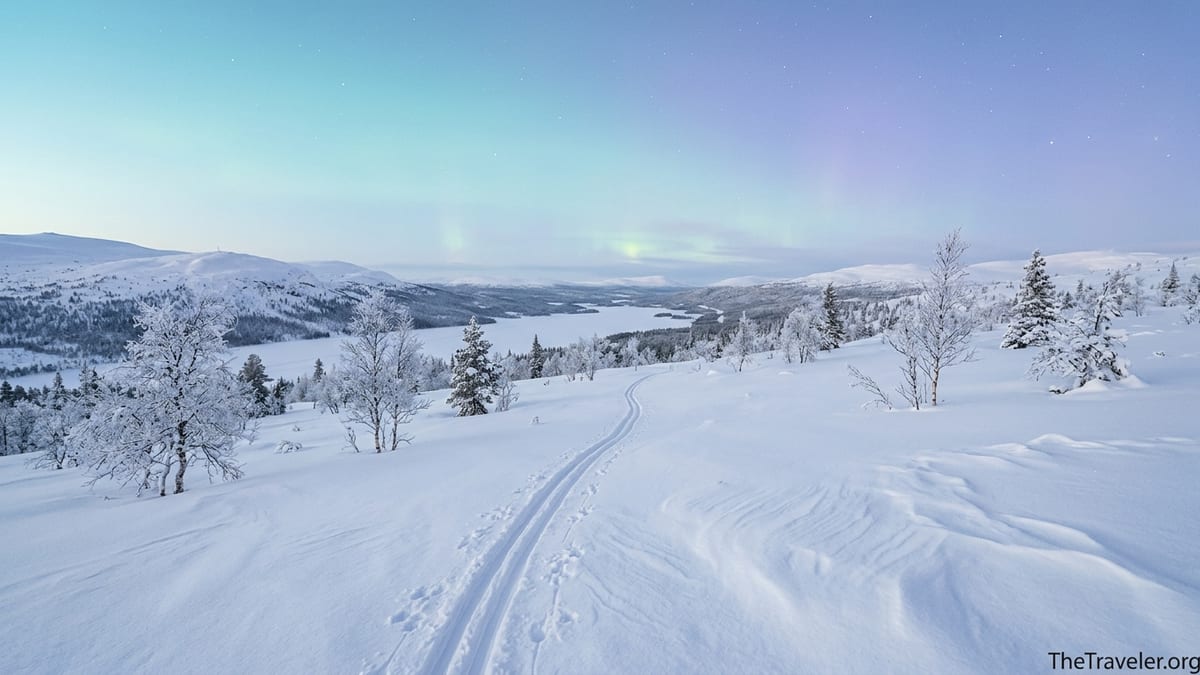
At the summit marker, I stopped and turned slowly in a full circle. Below lay Pallasjärvi lake frozen and snow-covered, its outline barely distinguishable from the forest and mires around it. In every direction, rounded fells rose and fell like a frozen sea. There were no roads in sight, no lifts, no buildings beyond the compact cluster of the hotel and visitor centre far below. When I switched off my headlamp to test the darkness, the silence arrived with it, as if someone had dimmed an entirely different sense.
What surprised me most was how my own movements suddenly felt intrusive. Zipping my jacket sounded rude. Adjusting my backpack straps seemed unnecessarily loud. I found myself moving more slowly and carefully, as though trying not to wake a sleeping house. That involuntary respect for the soundscape is part of what makes Pallas–Yllästunturi so different from many other winter destinations where the soundtrack is dominated by ski lifts, bar music and snowmobiles.
Finding Solitude on Classic Trails
Many visitors experience the quiet of Pallas–Yllästunturi on skis rather than on foot. The national park and surrounding villages maintain hundreds of kilometres of cross-country tracks each winter. Around the Pallastunturi and Muonio side, long-distance trails slip through spruce forests and over open mires, linking simple wilderness huts and lean-to shelters. A popular day outing follows a loop from the visitor centre to a laavu shelter overlooking the fells, where skiers stop to brew coffee over a small fire before gliding back into the trees.
Even on these groomed tracks, the sense of space and silence remains strong. On a late March morning, I followed a classic-ski trail that wound gradually uphill, the sound of my skis a gentle rhythm against the faint hum of the distant groomer that had passed earlier at dawn. Every few kilometres, a modest sign pointed toward a shelter or junction, but there were no crowds, no queues, no amplified music at intersections. For long stretches, I saw no one at all, just my own track beside the older lines of someone who had passed an hour or two before.
Over several days, I began to understand why local skiers and visiting enthusiasts speak of the Pallas trails as meditative. On a fifteen-kilometre loop not far from the Olos area, I fell into a pattern of skiing for half an hour, then stopping in a clearing simply to listen. Once it was the far-off bark of a dog from a farm near the park boundary. Another time, the soft clatter of hooves when a small group of reindeer crossed the trail ahead of me and disappeared into the forest without a sound beyond fresh prints in the powder.
In summer and early autumn, the same routes transform into hiking paths and, in some sections, mountain biking trails. The silence takes on a different character then. Instead of muffled winter sound, you move through the soft patter of rain on leaves or the subdued ticking of insects on low birch. On an August evening near Ylläs, I walked a short stretch of the longer Hetta–Pallas route and noticed how even the bird calls seemed sparse. The absence of human-made noise allowed each natural sound to stand alone, framed by quiet rather than competition.
How To Reach the Edge of Noise
Part of what shapes the soundscape in Pallas–Yllästunturi is how you get there. Reaching the park typically involves a series of gradually quieter stages. Many international visitors fly into Helsinki, then take a domestic flight to Kittilä or Rovaniemi in Lapland. From there, car rentals and regional buses connect to Muonio, Äkäslompolo or the smaller villages that serve as gateways to the park. With each transfer, the background hum of infrastructure diminishes. The four-lane highway narrows to a two-lane road lined with spruce, then to smaller local roads where traffic trickles past in ones and twos rather than streams.
Traveling by overnight train from Helsinki to Kolari or Rovaniemi adds another layer to this shift. The sleeper car pulls you north through hours of darkness, waking you to a landscape already dominated by forest and snowfields. From the train station, a bus journey of a couple of hours delivers you to the fell regions. When you finally step off at a roadside stop near Pallas or Ylläs, the sudden drop in noise feels physical, as if someone has turned down an invisible dial.
The final leg into the park often takes place by taxi or pre-arranged transfer to accommodation near the visitor centres or trailheads. Many lodges and cabin clusters sit a short distance away from main roads, tucked into forest clearings or on lakeshores. Choosing one slightly removed from ski village centres makes a real difference. For example, a family-owned cabin site on the shore of Pallasjärvi offers direct access to ski and snowshoe routes but almost no vehicle traffic after dark. Stepping outside your door at night, you may hear only the creak of trees and the distant hiss of a river under ice.
For travelers used to urban convenience, this gradual retreat from infrastructure can feel unfamiliar. Buses may run only a few times a day, and shops close earlier than in larger towns. Yet these constraints shape the atmosphere that many people come seeking. Fewer vehicles mean fewer engines. Limited nightlife keeps evenings subdued. When you are standing on a frozen lake under a sky alive with aurora, you will not miss the sound of late-night taxis or bar music echoing down the street.
When Silence Becomes the Main Attraction
In recent years, Finland has leaned into the idea of selling silence as a luxury, and few places embody that better than Pallas–Yllästunturi. Local tourism operators talk not only about northern lights safaris and husky sled rides, but also about slow snowshoe walks and guided “forest bathing” sessions where the main activity is attentive presence. On a snowshoe outing near the village of Jerisjärvi, our guide asked us to walk the last stretch to a hilltop lookout in complete silence, leaving space for the forest to fill our attention.
We moved single file through powder, each lifting feet carefully to avoid breaking the spell. At the top, the guide simply gestured toward the view and then to his ear, as if to say: listen. For several minutes, nobody spoke. Somewhere below, a small creek gurgled under snow, the sound faint but distinct. A breeze stirred the highest spruce branches while the lower ones stayed still. It was not dramatic, but it felt surprisingly moving. The absence of conversation allowed the small sounds of winter life to step into the foreground.
Silence tourism here does not mean isolation in a Spartan hut unless you want it to. Many accommodations near the park combine modern comforts with easy access to quiet. A typical cabin rented for a long winter weekend might offer a private sauna, a small kitchen and large windows facing the fells, all within a ten- or fifteen-minute walk of a trailhead. After a day outside, you can sit in the dim light of the living room, snow slowly piling on the terrace, and hear almost nothing from the outside world apart from an occasional car on the distant road.
What matters is not total absence of noise, but intention. People come to Pallas–Yllästunturi to hear something different from their daily lives: the crackle of firewood in a kota hut, the rustle of reindeer moving through a stand of birch, the soft click of ice crystals settling as temperatures drop at night. The silence becomes a frame that makes every small sound more meaningful, turning even the act of boiling coffee over a campfire into a moment of quiet focus.
Practical Ways to Experience the Silence
Experiencing the silence of Pallas–Yllästunturi does not require technical skills or extreme expeditions. Simple choices in timing and activity make a big difference. Traveling outside of the busiest holiday weeks in December and early March, for instance, means sharing trails with fewer people. Going out just after sunrise or in the blue hour of late afternoon often brings the calmest conditions, when day-trippers are still at breakfast or already heading back to their lodgings.
On the activity side, routes that lead away from ski resort infrastructure tend to be quieter. Short, family-friendly nature trails such as the Varkaankuru route near Ylläs or a lakeside loop near Pallas grow more tranquil within minutes of leaving the parking area. Snowshoe or backcountry ski tours that venture beyond groomed tracks open even larger pockets of solitude, though they require proper gear, navigation skills and respect for changing weather. Joining a small-group guided tour instead of a large excursion can also preserve more of the soundscape, especially if the guide builds in deliberate silent sections.
Accommodation choices can support your search for quiet. In villages like Äkäslompolo or Muonio, staying a short walk away from the main road reduces vehicle noise without sacrificing access to shops and services. Lakeside cabins on Pallasjärvi or smaller forest lakes give you a private launch point for dawn or late-night walks. In many places, prices in winter 2026 for a modest self-catering cabin for two or three people fall roughly in line with midrange hotel rates in European capitals, though costs rise during Christmas and ski holidays. Booking several months in advance usually yields better options in the quieter fringes of the villages.
Finally, remember that silence here is a shared resource. Keeping voices low on the trail, avoiding loud music from portable speakers and respecting quiet hours at accommodations all help preserve the quality that makes Pallas–Yllästunturi special. In return, you gain something rare: the opportunity to move for hours through a northern landscape where the loudest sound is your own breath meeting the cold air.
The Takeaway
Long after I left Pallas–Yllästunturi, what returned to me first was not a particular photograph or even a single dramatic moment, but the memory of how quiet it felt to stand alone on that wind-brushed ridge. Travel writing often reaches for superlatives about scenery or adrenaline, but some places work the other way, stripping things back until only the essentials remain. In this corner of Finnish Lapland, the essentials are snow, light, and silence.
For travelers weary of queues, crowded viewpoints and destinations that sound like construction sites, Pallas–Yllästunturi offers an alternative. It is not difficult to reach in practical terms, but it feels very far from the everyday world once you arrive. The reward for the extra steps north is a different kind of luxury: a landscape spacious enough that your own thoughts can stretch out, and quiet enough that the small sounds of winter, water and wind can take their turn at centre stage. Standing there, listening to almost nothing, you may find that the loudest change happens inside.
FAQ
Q1: Where exactly is Pallas–Yllästunturi National Park located?
Pallas–Yllästunturi National Park lies in Finnish Lapland, above the Arctic Circle, stretching between the Ylläs ski area and the municipality of Enontekiö, with Muonio and nearby villages acting as common gateways.
Q2: How do I get to Pallas–Yllästunturi from Helsinki?
Most visitors fly or take an overnight train from Helsinki to Kittilä, Kolari or Rovaniemi, then continue by rental car or regional bus to Muonio, Äkäslompolo or the Pallastunturi area near the park.
Q3: When is the quietest time to visit the park?
The calmest periods are usually late November to mid-December and late January to early February, as well as September after the main autumn foliage weeks, when there are fewer holiday crowds.
Q4: Do I need special skills to enjoy the silence and scenery?
No advanced skills are required for marked nature trails and short ski loops, but winter visitors should be prepared for cold temperatures and changing weather, and longer backcountry routes demand proper experience.
Q5: Is it possible to see the northern lights in Pallas–Yllästunturi?
Yes, the park sits under the auroral oval and often has clear, dark skies, so from roughly late August to April you have good chances when conditions and solar activity cooperate.
Q6: What kind of accommodation is available near the park?
The area offers a mix of hotels near visitor centres, self-catering cabins on lakeshores and in forests, and small guesthouses in villages like Muonio and Äkäslompolo, many with direct access to trails.
Q7: Can I visit without a car and still experience the quiet areas?
Yes, you can reach several villages by bus from Lapland airports or train stations, then walk or join guided tours to nearby quiet trails, though having a car increases flexibility for more remote trailheads.
Q8: Are there guided tours focused on silence or nature connection?
Local operators offer small-group snowshoe walks, forest bathing sessions and gentle ski tours where the emphasis is on slow pace, observation and quiet rather than speed or distance.
Q9: How cold does it get, and what should I pack?
Midwinter temperatures often drop well below freezing and can reach minus 20 degrees Celsius or lower, so pack layered clothing, insulated boots, windproof outerwear, warm gloves and a good hat.
Q10: Is Pallas–Yllästunturi suitable for families with children?
Yes, many short trails, sledding hills and easy ski routes near visitor centres work well for families, especially when combined with cabin stays and simple outdoor activities like building snow shelters or visiting reindeer farms.