


By the time the airport train slid into Oslo Central Station, I realized my first days in Norway were not going to match the tidy Nordic fantasy I had carried with me. I had come expecting a land of cold efficiency and ruinous prices, a place you endure for fjords and northern lights. Instead, almost immediately, Norway began quietly rearranging my assumptions about what Nordic travel feels like when you actually land, pay, wait for buses and walk home in the blue winter dark.
Get the latest updates straight to your inbox!
Landing in Oslo: When Sticker Shock Meets Small Surprises
Norway announces itself in numbers even before you leave the airport. At Oslo’s Gardermoen Airport, the sleek Flytoget airport express train to the city takes about 19 minutes and now costs a little over 240 Norwegian kroner one way for an adult, roughly 25 to 27 US dollars. The regular Vy regional train, leaving from the same underground station, costs about half that and gets you to Oslo S only a few minutes slower. On paper, it fits the cliché: Norway is expensive, and even the ride into town proves it.
But the lived experience is more nuanced. I arrived late on a Tuesday evening, jet lagged and braced for confusion. Instead, I found clear bilingual signs pointing to “Flytoget” and “Vy,” ticket machines that accepted my foreign card without drama, and a platform where the next services to Oslo were clearly listed. There was no hard sell, no touts, no odd unofficial taxis hovering at arrivals. My first Scandinavian shock was not the price of the train, but how little friction there was in spending that money. I paid once and did not think about logistics again until the doors opened onto Oslo Central.
Stepping outside, the second surprise was sound. I had pictured a capital city humming with traffic. Instead, in the streets around the station and the modern waterfront, electric trams slid by almost silently. People crossed wide bike lanes and car lanes in an orderly, unhurried way. A takeaway latte near the Opera House cost close to 60 kroner, nearly 6 US dollars, which would confirm every “Norway is crazy expensive” story you have heard. Yet the young barista spoke unforced English, explained the difference between the bakery’s cardamom bun and cinnamon roll, and handed over something that tasted as if it had just left a home oven. My first hours in Norway suggested a different rule: prices can be high, but what you get is rarely cynical.
Oslo’s Everyday Life Is More Relaxed Than Minimalist
Like many first time visitors, I expected Oslo to look like a minimalist catalog. In reality, much of the city feels softer and more lived in than the stereotype. The iconic sloped roof of the Oslo Opera House is as clean and white as any architectural photograph, and locals really do walk up it in all seasons. Yet if you turn away from the postcard image and wander the back streets of the Grønland or Grünerløkka neighborhoods, you find kebab joints, thrift shops and small bars where mismatched chairs outnumber designer lamps.
On my first full day, I took the tram up to the leafy Bygdøy peninsula, where several of Oslo’s maritime museums sit scattered among modest houses and narrow lanes. The Viking Ship Museum remains under redevelopment as of 2026, but the surrounding institutions, from the Fram Museum to the Norwegian Maritime Museum, are open and very much alive. Families pushed strollers along the waterfront trails, teenagers in hoodies leaned against railings and scrolled on their phones while waiting for the small public ferry back toward the city. It felt more like a quiet suburb than a showpiece of Nordic perfection.
Food provided another reality check. I had assumed that dining out on a moderate budget would mean generic fast food. Instead, I found “lunsj” deals around 180 to 250 kroner that included a hearty open faced sandwich piled with smoked salmon or roast beef, a small salad and coffee. Bakeries displayed towering loaves of dense rye and spelt bread, and supermarkets like Rema 1000 and Coop offered packs of smoked mackerel, cheese and crispbread that could turn a simple budget picnic into something distinctly Norwegian. I still felt each purchase, but instead of constant austerity I learned that planning one or two splurges, then building the rest of the day around supermarket food and hotel breakfasts, made Oslo surprisingly manageable.
Bergen Rewrote My Idea of “Fjord Capital”
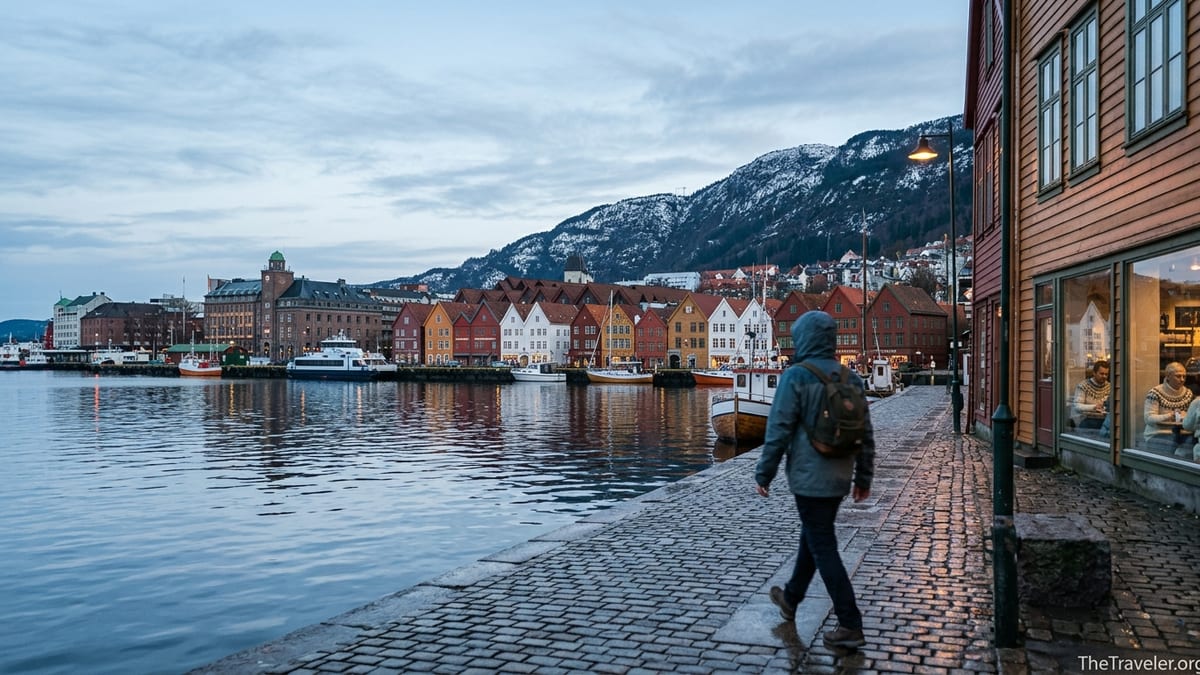
If Oslo was my introduction to how Norway works, Bergen was where my idea of Nordic scenery began to shift. Travel guides often call it the gateway to the fjords, a phrase so overused that it is easy to imagine something generic. In reality, emerging from the train station or arrival bus and walking down to the harbor feels like stepping into an amphitheater carved by water and weather. Colorful wooden warehouses at Bryggen line one side of the inner harbor, backed by steep hills patched with houses and trees.
On my first afternoon, a rain shower moved in off the North Sea, turning the cobblestones slick and dark. Locals barely acknowledged it. People simply raised hoods, zipped jackets and kept walking. A barista at a small café just back from the Bryggen waterfront told me that if you waited for a dry forecast, you would never do anything in Bergen. Instead, you keep a lightweight waterproof shell in your day pack, accept that your jeans will get damp at least once a day, and go anyway. The advice was not poetic, but it was deeply practical, and it changed how I thought about “bad weather” on Nordic trips.
The Fløibanen funicular, carrying visitors up Mount Fløyen, is an obvious tourist move. The ticket price, around 150 to 200 kroner for a return trip depending on seasonal offers, is not small. Yet that first ride up at sunset was where I realized why people willingly pay it. As the carriage climbed, Bergen’s seven surrounding mountains unfolded around the harbor, and the city’s colored houses became a scatter of points between forest and sea. At the viewpoint, children in bright snowsuits raced along gravel paths, and older locals walked their dogs on what, for them, was simply an after work loop. What the brochures could not convey was how ordinary it felt for residents to live with this view day after day. For a first time visitor, that ordinariness is the magic.
The Cost of Norway Feels Different Once You See What You Get
Every traveler who has even considered Norway has heard the warnings about cost. You will be told about beers that cost 120 kroner or more in a bar, about the price of a simple sit down dinner, about how a bus ticket can rival a budget flight elsewhere in Europe. All of that contains truth. In downtown Bergen, I paid nearly 110 kroner for a draft beer at a harbor side bar, and a main course of cod with local vegetables at a midrange restaurant came to around 320 kroner before drinks.
Yet those first days also highlighted the hidden side of the equation. Tap water is safe, cold and free everywhere. Public toilets in train stations and shopping centers are generally clean. The city tram in Bergen and the metro and tram lines in Oslo run on predictable schedules. In my midrange Bergen hotel, a generous breakfast buffet was included: dark bread, cheese, cold cuts, boiled eggs, vegetables, yogurt, fruit and coffee strong enough to wake the most jet lagged traveler. Eating substantially in the morning and turning lunch into a simple soup or bakery stop meant I could save the big spending for one memorable dinner or a fjord cruise.
Actual prices shocked me less once I began comparing them to what I saw around me. A barista in Oslo might be earning far more than their counterpart in another European capital. The sleek, modern buses and ferries, often run by county level operators, are part of a public transport network that locals use fiercely year round, even in ice and snow. That does not make a 60 kroner latte feel cheap, but it reframes it from an arbitrary tourist markup to a reflection of a system that, at least in my first days as an outsider, appeared to function with very little visible waste.
First Encounters With the North: Tromsø and the Reality of the Arctic
Nothing I had seen in Oslo or Bergen prepared me for the first hint of the Arctic in Tromsø. Landing in winter, the approach over snow covered islands and fjords looks almost monochrome from the airplane window. On the ground, the city is more colorful, but the sensation of latitude does not vanish. Even mid afternoon, the light has a soft, sideways quality, as if the day is permanently stuck in sunrise or sunset for weeks at a time.
On my first night, I booked a small group northern lights chase out of Tromsø. The price, around 1,600 to 2,000 kroner per person including warm overalls, hot drinks and transportation, felt steep on paper. On the ground, as the minibus rolled silently past snowbanks and closed petrol stations, with the guide checking cloud forecasts on a handheld device, it began to feel less like a tourist outing and more like chartering local expertise. We ended up in a lay-by hours outside the city, where the snow squeaked under our boots at each step. When the first pale arc appeared low on the horizon, I understood why northern lights photographers talk about “patience” more than “spectacle.”
Here, the gap between expectation and reality was widest. Online, aurora photos blaze with neon greens and purples, towering curtains of light that look almost unreal. To the naked eye, my first display was subtler, a shifting smear of greenish grey that slowly intensified, then briefly burst into movement overhead. It was powerful not because it looked like the internet, but because it existed at all in a sky that, an hour earlier, had been blank and indifferent. The guide brewed coffee from a thermos, and we stood in a small circle, mostly quiet. A few other vans had pulled up nearby, but Tour leaders kept headlights low and asked guests not to trample the surrounding snowdrifts, echoing local guidelines that stress protecting roadside rest areas and private driveways. The experience felt less like a show and more like being allowed into someone else’s winter routine.
Nature, Not Minimalism, Is the Real Organizing Principle
By the time I had completed a rough triangle of Oslo, Bergen and Tromsø, a pattern had emerged that had little to do with design clichés and everything to do with geography. Norwegians I met took it for granted that weather could change quickly, that ferries might be delayed by wind, that tunnels and bridges were as essential as sidewalks. On my second day in Tromsø, a planned fjord cruise was quietly canceled due to poor visibility and choppy seas. The operator immediately offered a refund or an alternative trip later in the week, without drama. No one in the small waiting group argued; everyone simply checked calendars and adapted.
That responsiveness, learned over generations of living with mountains, ice and sea, filters into how Norway receives travelers. In Bergen, a visitor center staffer explained carefully that a famous high altitude hiking route was effectively off limits outside the summer months, not because it was forbidden but because conditions were unforgiving and rescue resources finite. In Oslo, a local acquaintance advised me that studded shoe covers were more useful than a fancy winter coat in the shoulder seasons, when sidewalks near the fjord turned to slick sheets of ice after rain. Again and again, the practical trumped the pretty.
For a first time visitor used to treating city trips as separate from “nature trips,” this was perhaps the biggest shift. In Norway, even the largest urban areas feel only loosely separated from what lies beyond. A city tram in Oslo might drop you near a forest trail within half an hour. A local bus from Tromsø can put you on a beach where the Arctic Ocean washes up against snow. The idea that a Nordic vacation is all about tidy, controlled experiences starts to look misplaced once you realize how much of daily life, even in built up areas, is structured around weather forecasts, daylight hours and ferry timetables.
Small Cultural Moments That Stay With You
It would be easy to reduce Norway to scenery and prices, but some of the most enduring memories from those opening days came from smaller human encounters. In Oslo, I watched commuters queue calmly for the morning tram, but also saw someone jog to catch a closing door and have a stranger hold it without a word. At a neighborhood café, customers cleared their own plates and sorted waste into recycling bins without any sign instructing them to do so.
In Bergen, at a supermarket self checkout, a teenage employee stepped in to help an older customer battle with the barcode on a heavy bag of potatoes, chatting casually in Norwegian without a hint of impatience. Later that day, as a brisk wind funneled rain down the harbor, a group of teenagers in waterproof jackets and sneakers occupied an outdoor bench, laughing loudly and eating takeaway burgers. They could have been in any coastal town on earth, but above them, narrow timber sided houses clung to the hill in ways that suggested centuries of adjustment to the same climate.
In Tromsø, where winter tours and seasonal workers from across Europe now crowd streets in the peak aurora months, the reminders that this is a lived in town came quietly. At closing time in a small grocery store, the staff locked the doors and then patiently waited while a couple of tourists realized they had queued at the wrong register. On a city bus heading over the bridge, I saw students with backpacks, nurses in scrubs and a family carrying a bulk pack of toilet paper, all headed home under a sky that, that night, showed no sign of aurora at all. Norway’s draw, in the end, was not that it felt radically foreign, but that its normal life unfolded calmly in an environment that, for me, felt anything but ordinary.
The Takeaway
Those first days in Norway did not overturn every expectation I had about Nordic travel. Prices were indeed high, weather often changed without warning, and many services operated with a brisk punctuality that left little room for improvisation. Yet the reality on the ground proved far more flexible, textured and approachable than the image of an austere, perfectly ordered north.
Oslo demonstrated that a modern, efficient capital can still feel human scale. Bergen exposed me to a coastal culture where getting rained on is not a crisis but a fact of life. Tromsø introduced me to an Arctic where both locals and visitors negotiate night, snow and sky as partners rather than adversaries. The cost of a coffee or a train ticket stings less when you see the public infrastructure it supports and the quiet competence with which staff, from bus drivers to museum attendants, go about their work.
If you arrive in Norway expecting only curated views and glacial coolness, you may miss its deeper appeal. What my first days taught me was that the true luxury here is not just scenery, but trust: in systems that mostly work, in people who mostly help, and in a landscape that refuses to be fully tamed yet willingly shares flashes of its beauty with anyone patient enough to stand outside in the cold and look up.
FAQ
Q1. Is Norway really as expensive as people say for first time visitors?
Norway is undeniably pricey, especially for dining out and alcohol, but careful choices such as using supermarket food, hotel breakfasts and regional trains can keep daily costs manageable.
Q2. Should I choose Flytoget or the regular Vy train from Oslo Airport?
Flytoget is faster and more frequent, while the Vy regional train is significantly cheaper and only a few minutes slower, so the best choice depends on your budget and schedule.
Q3. How many days should I spend in Oslo on my first trip to Norway?
Two to three full days is usually enough to see central highlights, visit a couple of museums and get a feel for neighborhood life before moving on to the fjords or the north.
Q4. Is Bergen worth visiting if I am not taking a long fjord cruise?
Yes, Bergen’s historic Bryggen waterfront, mountain viewpoints like Mount Fløyen and easy day boat trips make it rewarding even without a multi day fjord itinerary.
Q5. What kind of clothing should I pack for Norway in the shoulder seasons?
Layering is essential: bring a waterproof shell, a warm midlayer, comfortable walking shoes with good grip and accessories like a hat and gloves rather than one heavy coat.
Q6. How much should I budget per day as a midrange traveler in Norway?
Many travelers find that a rough midrange budget of about 150 to 300 US dollars per person per day, excluding flights, covers accommodation, food and basic activities.
Q7. Do I need to book northern lights tours in Tromsø far in advance?
In peak months from around November to March, tours can sell out, so it is wise to reserve at least a few weeks ahead, especially for weekends and small group experiences.
Q8. Will I definitely see the northern lights if I go to Tromsø in winter?
No, sightings are never guaranteed because they depend on both solar activity and clear skies, but staying several nights and joining a guided chase greatly improves your chances.
Q9. Is it possible to experience Norwegian nature without renting a car?
Yes, many trails, viewpoints and coastal spots are reachable by public transport or organized excursions, although a car can provide more flexibility in remote regions.
Q10. Do people in Norway speak enough English for an independent trip?
Yes, English is widely spoken, especially in cities and tourist areas, so first time visitors rarely have trouble asking for directions, ordering food or buying tickets.