


Nadi International Airport is Fiji’s main gateway, and if you are watching your budget, the bus network that fans out from the terminal can be a smart way to reach Nadi town, Denarau, or even Suva along the Queen’s Highway. The system is simple once you understand the basics, but recent changes, hotel shuttle options and strict payment rules can catch new arrivals off guard. This guide walks you through how the buses work at Nadi Airport, typical routes and hotel connections, luggage realities, schedules, costs, and when it makes more sense to pay for a taxi or shuttle instead.
Get the latest updates straight to your inbox!
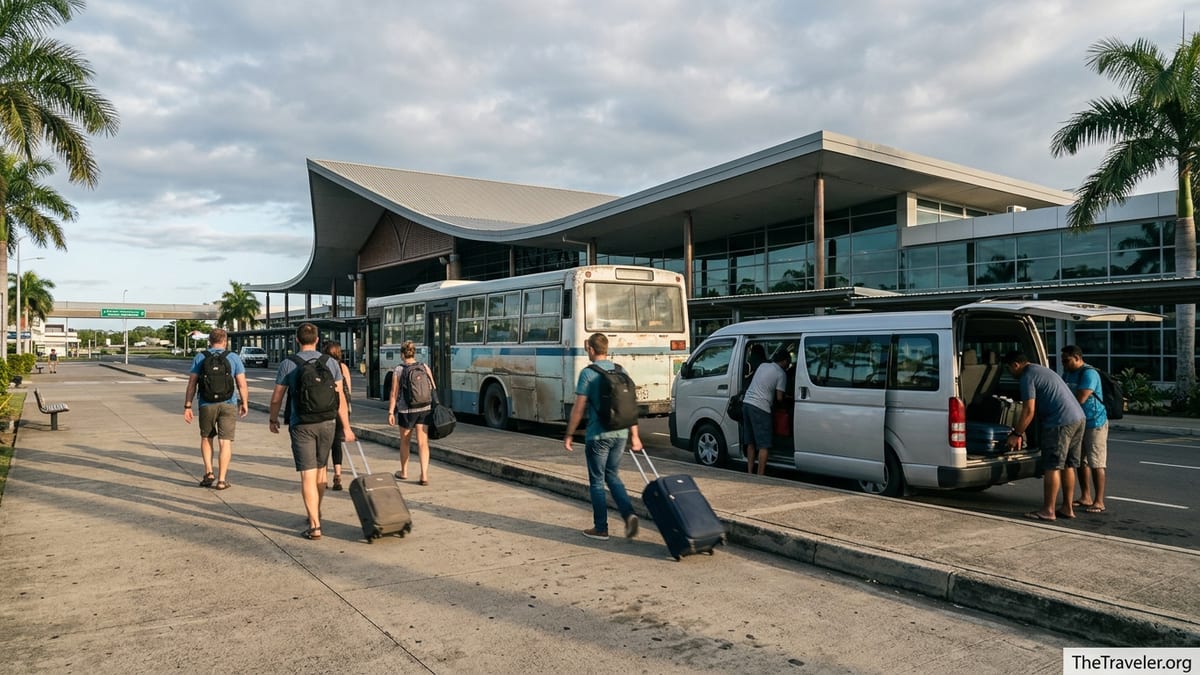
How Buses Work at Nadi International Airport
Nadi International Airport sits a few kilometres from Nadi town on Fiji’s main island, Viti Levu. Several public buses and long-distance coaches now call directly at the airport, pulling into bays just outside the terminal rather than forcing you to detour via Nadi town first. These buses primarily run along the Queen’s Highway, the main coastal road connecting Lautoka, Nadi, the Coral Coast and Suva, with the airport as one of their regular stops.
The airport bus bays are used by a mix of local and intercity operators. In practice, you will see air conditioned coaches heading for Lautoka in one direction and for Sigatoka, Pacific Harbour and Suva in the other, plus more local-style buses connecting the airport with Nadi town and nearby suburbs. Schedules vary by company, but services typically cluster around daylight hours and major flight banks in the early morning and late afternoon, when demand from arriving and departing passengers is highest.
For visitors, the key point is that these are regular public buses, not tourist shuttles. They do not wait for delayed flights, they may not have space for bulky luggage at peak times, and drivers are focused on staying on schedule rather than providing individual help with route planning. If you are comfortable with basic bus travel and have some time margin, they are a very cost effective option; if you are exhausted after an overnight flight, a taxi or pre-booked shuttle may better suit.
As of 2026, Fiji’s public buses operate under a national electronic ticketing scheme, often referred to as the eTransport card system. This affects how you pay your fare from Nadi Airport and is one of the most important details to understand before you line up at the bus stop.
Paying for the Bus: Cards, Cash and Where to Buy
Fiji has moved to a largely cashless payment system on public buses, enforcing a “no card, no ride” rule on most scheduled services. In practice, this means you tap an electronic fare card when you board and again when you get off, rather than handing cash to the driver. For a visitor landing at Nadi, this can feel like a hurdle, but it is manageable if you plan a few minutes in the arrivals hall before heading outside.
Short-term or disposable bus cards are typically sold in fixed values such as 2, 5, 10 or 20 Fijian dollars. At Nadi Airport you can usually buy one from a Vodafone-branded counter or kiosk in the arrivals area and top it up with cash at the same time. Staff are used to first-time visitors; if you tell them you are going to Nadi town and then Suva the next day, they can suggest a rough amount to load so you do not run out mid-journey. Any small remaining balance can often be refunded in cash at a Vodafone outlet in town as long as you do so within the card’s validity period.
The tricky part is timing and queues. If several international flights arrive close together, the line for SIM cards and bus cards at Vodafone can be long. In that situation, some travellers simply opt for a taxi into Nadi or their airport hotel and worry about getting a card later at a shop in town. That is a reasonable choice if you are arriving late at night or with children and a lot of luggage. But if you land in the early morning and hope to connect cheaply to a Coral Coast resort by bus, it is worth queuing, because you will not be allowed to pay cash on most intercity buses out on the road.
Certain tourist-oriented transfer services and private shuttles still accept cash or card payments directly, and a handful of smaller local buses may be more flexible in practice, but you should not rely on that. For a realistic example, a couple flying in from Sydney and heading straight to Suva could expect to pay under 25 Fijian dollars per person for the bus journey if they tap their cards correctly, compared with well over 100 dollars per person for a private transfer. Spending 10 minutes at the kiosk to secure that saving is often worthwhile.
Local Routes: Nadi Town, Denarau and Queen’s Highway Stops
For most budget travellers, the first bus leg from Nadi Airport is a short hop into Nadi town. Local buses between the airport and the Nadi bus station are frequent during the day and inexpensive, typically costing only a few Fijian dollars or less. The bus station in town is the main hub where you can change to services bound for Denarau Island, Lautoka, the Coral Coast and Suva, as well as smaller villages along the Queen’s Highway.
From the Nadi bus station, local yellow buses and other operators run to Denarau Island, where many large resorts such as the Sheraton, Hilton and Sofitel cluster around Port Denarau. There is also a dedicated island shuttle known locally as the Bula Bus that circulates around the Denarau resort area itself. A common budget strategy is to take a local bus from the airport to Nadi town, transfer to a Denarau bus, and then either walk or use the internal resort shuttle to your specific hotel, instead of paying for a direct taxi all the way from the airport.
Heading in the opposite direction, south toward the Coral Coast and Suva, long-distance coaches following the Queen’s Highway will pick up at Nadi Airport and then continue via towns such as Sigatoka and Pacific Harbour. Travellers staying at road-accessible resorts like The Naviti or The Warwick often ride these coaches and ask the driver to drop them at the closest roadside stop, from which the resort’s own staff or a short taxi ride completes the journey. Expect to pay a fraction of the cost of a pre-booked private transfer, at the price of a slower, multi-stop journey and a small walk or local taxi at the end.
Northbound, services toward Lautoka also call at Nadi Airport. This is useful if you are staying in budget guesthouses on the outskirts of Lautoka or connecting onward to ferries at Lautoka wharf. However, most island resort transfers to the Mamanuca and Yasawa groups depart from Port Denarau, not Lautoka, so it usually makes more sense for island-bound travellers to head toward Denarau instead and use the shuttle connections offered by ferry companies.
Airport Hotel Connections: Shuttles vs Buses
One of the most budget-friendly features of Nadi Airport is the dense cluster of hotels and guesthouses within a few minutes’ drive of the terminal. Several of these airport hotels, including long-standing options like Fiji Gateway Hotel directly opposite the airport entrance, operate complimentary or low-cost shuttle vans to and from the terminal throughout much of the day and night. If you are landing late or leaving at dawn, taking advantage of these shuttles is often easier than navigating the public bus network in the dark.
For example, a family arriving at 6 a.m. on a Fiji Airways flight and staying one night at an airport hotel before heading to the islands might walk across to their hotel’s reception or hop a free shuttle, check in or store luggage, and then later jump on a hotel-organised bus to Port Denarau to meet an afternoon ferry. Companies such as Malolo Cat and the operators of the Yasawa Flyer run dedicated transfer buses that collect guests from selected airport hotels and central Nadi accommodations and deliver them directly to the marina in time for boat departures. The cost is usually modest compared with a private taxi, especially if it is bundled into a resort or ferry package.
Independent shuttle operators based at Nadi Airport, such as Tourist Transport Fiji and other shared “seat in vehicle” services, also quote per-person rates between the airport, Nadi hotels, Denarau and further-flung resorts. These sit between local buses and taxis in both price and comfort: you share with other passengers, but enjoy air conditioning and direct hotel drop-offs. A realistic scenario might see a solo traveller paying around the equivalent of a few dozen Fijian dollars for a shared shuttle seat to a Coral Coast resort, compared with a bus fare in the low tens and a private taxi costing significantly more.
If your hotel advertises a free or paid airport shuttle, confirm in advance whether it meets all flights or runs on a timetable, whether you need to reserve a place, and where exactly to meet the driver. Some properties near Queen’s Highway expect guests to reach them using public buses or taxis from the main road instead, even if they offer shuttles to Port Denarau or local attractions once you are checked in.
Luggage and Comfort: When the Bus Makes Sense
From a purely financial standpoint, buses are hard to beat, especially along the Queen’s Highway. In broad terms, a one-way coach fare between Nadi and Suva often comes in under 25 Fijian dollars, while even a short hop from the airport to Nadi town is just a few dollars. However, luggage and comfort are where you need to be realistic about your own tolerance and the nature of your trip.
Most intercity buses serving Nadi Airport are modern coaches with basic luggage holds underneath or racks above the seats, but they are not designed for people hauling surfboards, dive gear and multiple checked suitcases all at once. If you are a solo backpacker with one large pack and a daypack, you will probably be fine loading your bag into the hold and keeping valuables with you. If you are a family of four with two or three big suitcases each, stroller and beach toys, a shared or private shuttle is usually far more practical and less stressful.
On short local routes like airport to Nadi town or Nadi to Denarau, buses may be older vehicles without sealed luggage holds. Here your bags ride with you in the main cabin. That works if you have a carry-on suitcase and are comfortable keeping it by your legs or the seat beside you, but it becomes awkward in crowded conditions or if the bus is making frequent stops. For safety and peace of mind, keep passports, phones and wallets in a small bag on your person, and avoid placing important items in the overhead rack where you cannot see them.
Comfort also varies with the time of day. The early-morning buses leaving Nadi Airport after the overnight arrivals are often pleasantly cool, but midday services along the Queen’s Highway can be hot and busy, even with air conditioning. If you are jet lagged or sensitive to heat, factor this into your decision. Spending extra on a direct shuttle or taxi for your first leg, then switching to buses once you are settled, is a sensible compromise many travellers choose.
Schedules, Frequency and Realistic Travel Times
Unlike some airports with a single branded “airport bus,” Nadi relies on a web of regular public and long-distance services that happen to serve the airport stop. That means there is no single official timetable for “the Nadi Airport bus.” Instead, each company runs its own schedule along the Queen’s Highway and through Nadi town. Several tourism and airport information sites provide sample timetables, but you should treat them as indicative rather than precise, because operators occasionally adjust departure times and frequencies.
In general, you can expect buses between Nadi Airport and Nadi town to run multiple times an hour during daylight, thinning out at night. Coaches toward Suva and Lautoka typically pass the airport every one to two hours during the day, sometimes more often around morning and late-afternoon peaks. If you just miss a bus, it is usually better to grab a snack or coffee inside the terminal and wait for the next one, rather than rushing out onto the road with heavy luggage looking for alternative stops.
Travel times are longer than the raw distance might suggest because buses stop frequently along the way. Nadi to Denarau by direct taxi might take 20 to 25 minutes in light traffic; by local bus plus an internal resort shuttle you should allow at least 45 minutes to an hour. Nadi to Suva on a stopping coach is often quoted as a 4 to 5 hour journey, but can stretch longer in bad weather, school commute peaks or if there are delays picking up passengers at intermediate towns such as Sigatoka and Pacific Harbour.
If you have a firm onward connection such as a ferry departure from Port Denarau or a domestic flight from Nadi, build in a generous buffer. For example, travellers heading from the airport to Port Denarau for a mid-morning Yasawa or Mamanuca ferry commonly book a dedicated transfer bus run by the ferry company instead of relying on public routes, because these shuttles are timed to meet specific boat sailings. Likewise, if you must reach Suva in time for work or a meeting, it is safer to leave on an earlier coach and treat published times as best-case estimates.
Budget Comparisons: Buses vs Taxis and Shuttles
When you lay the options side by side, buses remain the cheapest way to travel between Nadi Airport, Nadi town and points along the Queen’s Highway. A short local ride from the airport to town or vice versa might cost only a few dollars, while a taxi for the same stretch can be closer to ten times that amount once the airport flag-fall and distance are factored in. For longer trips like Nadi to Suva, the savings are even more stark, with coach fares in the tens of dollars while door-to-door private transfers sit deep into triple figures.
Shared shuttles occupy a middle ground. An airport-based operator offering “seat in vehicle” transfers from Nadi to major resort clusters typically charges a per-person rate that is significantly higher than a bus, but lower than a private taxi if you are travelling alone or as a couple. This makes shuttles particularly attractive to solo budget travellers who still value a straightforward, door-to-door experience without multiple changes. For a group of four or more, however, booking a whole taxi or van can narrow the cost gap considerably.
Taxis at Nadi Airport are regulated and use meters with a fixed flag-fall that is higher than in town. They are available 24 hours, which makes them the most reliable option for late-night and very early-morning arrivals, or if your flight is delayed beyond the span of most bus services. A realistic pattern might be to take a taxi straight to a nearby airport hotel on arrival, then switch to buses or shared shuttles the next day for longer journeys once you are rested and have had time to buy a bus card and gather information.
When planning your budget, remember to include small but predictable extras such as the cost of the bus card itself, luggage trolleys at the airport if you need them, and the occasional short taxi hop between a roadside Queen’s Highway stop and a resort driveway. These add up, but even with them, travellers who lean heavily on buses and shared shuttles usually spend far less on ground transport than those who default to taxis and private transfers for every leg.
When the Bus Is Not Practical
Despite the clear cost advantages, there are several situations where using the bus from Nadi Airport is simply not practical, and being honest about these can save you stress. Late-night arrivals are the most obvious. While taxis and some hotel shuttles operate around the clock, public buses do not. If your international flight lands close to midnight or in the small hours and your accommodation is not within a very short taxi ride, you should budget for a taxi or pre-booked transfer rather than hoping to catch an elusive bus.
Very early departures create similar problems. Buses may not run early enough or reliably enough to get you back to the airport for a 6 a.m. check-in, particularly if you are staying on Denarau or further along the Queen’s Highway. In those cases, many travellers arrange a taxi the night before or book a final night in one of the airport hotels that provide quick shuttles to the terminal, then travel by bus only during the middle portions of their trip.
Heavy or awkward luggage is another strong reason to skip the bus. If you are carrying surfboards, bicycles, dive tanks or several oversized suitcases, you may find that bus drivers simply cannot accommodate your gear, especially once the coach is partly full. Even when they agree, loading and unloading at multiple roadside stops can become tiring and expose your kit to bumps and scrapes. A private vehicle, where you can lay items flat and secure them properly, is a better choice in this case.
Finally, travellers with mobility challenges, small children or tight connections often find that the unpredictability and physical demands of bus travel outweigh the savings. Climbing steps into older buses, manoeuvring strollers, and stepping down onto uneven roadside verges along Queen’s Highway can be difficult. For these groups, booking a car with a child seat, or asking a specialist transfer company about accessible vehicles, tends to deliver a smoother and safer start to a Fiji holiday, even if it nudges the budget higher.
The Takeaway
Using buses from Nadi International Airport can be a smart way to stretch your Fiji travel budget, especially for flexible travellers comfortable with a bit of DIY navigation. The network of local and long-distance routes serving the airport connects conveniently with Nadi town, Denarau Island, Lautoka and destinations along the Queen’s Highway toward Suva, and fares remain low compared with taxis and private cars.
At the same time, the nationwide move to electronic fare cards, variable schedules and the physical realities of travelling with luggage mean that buses are not the best fit for every situation. For many visitors, a hybrid strategy works best: use free or low-cost hotel shuttles around the airport, tap into dedicated ferry buses for connections to Port Denarau, rely on public buses for relaxed daytime journeys, and reserve taxis or shared shuttles for late-night legs or when you are carrying heavy gear.
By understanding how the system works before you land, picking up the right payment card in the terminal, and choosing your routes with realistic expectations of time and comfort, you can thread buses, shuttles and the occasional taxi into an affordable, practical plan that gets you from Nadi Airport to exactly where you need to be.
FAQ
Q1. Can I pay cash on buses from Nadi International Airport?
Most regular public buses now require an electronic fare card and do not accept cash directly on board. You should plan to buy and load a disposable bus card at the airport or in town before you travel.
Q2. Where do I buy a bus card at Nadi Airport?
You can usually purchase a short-term or disposable bus card from a Vodafone-branded counter or kiosk in the arrivals area, then top it up with cash before heading to the bus bays.
Q3. How much does the bus from Nadi Airport to Nadi town cost?
Fares can change, but the ride is typically only a few Fijian dollars or less when paid with a bus card, making it one of the cheapest ways to leave the airport.
Q4. Are there direct buses from Nadi Airport to Denarau Island?
There may not always be a single direct public bus to Denarau. A common approach is to ride a local bus from the airport to Nadi town, then transfer to a Denarau-bound bus or hotel shuttle from there.
Q5. Do buses from Nadi Airport have space for large luggage?
Long-distance coaches usually have luggage holds beneath the cabin, but space is limited and not designed for very bulky items like surfboards. Local buses often carry bags inside the cabin, which can be awkward if you have several big suitcases.
Q6. How often do buses from Nadi Airport run?
Local buses to Nadi town generally run multiple times an hour during the day, while long-distance coaches toward Lautoka or Suva tend to pass every one to two hours. Services are less frequent at night.
Q7. Is it safe to take the bus from Nadi Airport at night?
Safety is generally good, but services thin out after dark and waiting areas are quieter. For late-night arrivals or very early departures, most visitors prefer taxis or hotel shuttles instead.
Q8. What is the cheapest way to get from Nadi Airport to Port Denarau for island ferries?
The lowest-cost method is usually the public bus via Nadi town and a Denarau bus, but many travellers choose ferry company shuttles or hotel transfers because they are timed to specific boat sailings and are still relatively affordable.
Q9. Do airport hotels near Nadi provide free shuttle buses?
Several airport-area hotels operate complimentary or low-cost shuttles to and from the terminal. Always confirm the timetable, whether you need to pre-book, and where to meet the shuttle when you land.
Q10. When should I avoid using the bus from Nadi Airport?
It is usually best to avoid buses if you arrive very late at night, have a tight onward connection, are travelling with heavy or awkward luggage, or have mobility challenges that make steps and roadside stops difficult.