


Landing at Nadi International Airport and continuing straight on to Suva is one of the classic long transfers in Fiji. The country’s primary international gateway sits on the dry, resort-lined west coast of Viti Levu, while Suva, the political and cultural capital, lies roughly 190 to 230 kilometers away on the opposite side of the island, depending on the route. How you choose to cross the island will shape the start or end of your trip: you can sit back on an air-conditioned coach, negotiate a private car, pick up a rental and follow the coast, or hop a short domestic flight. Each option has its own trade-offs in cost, comfort, luggage handling and flexibility, and for many travelers it is also worth considering whether to break the journey along the way.
Get the latest updates straight to your inbox!
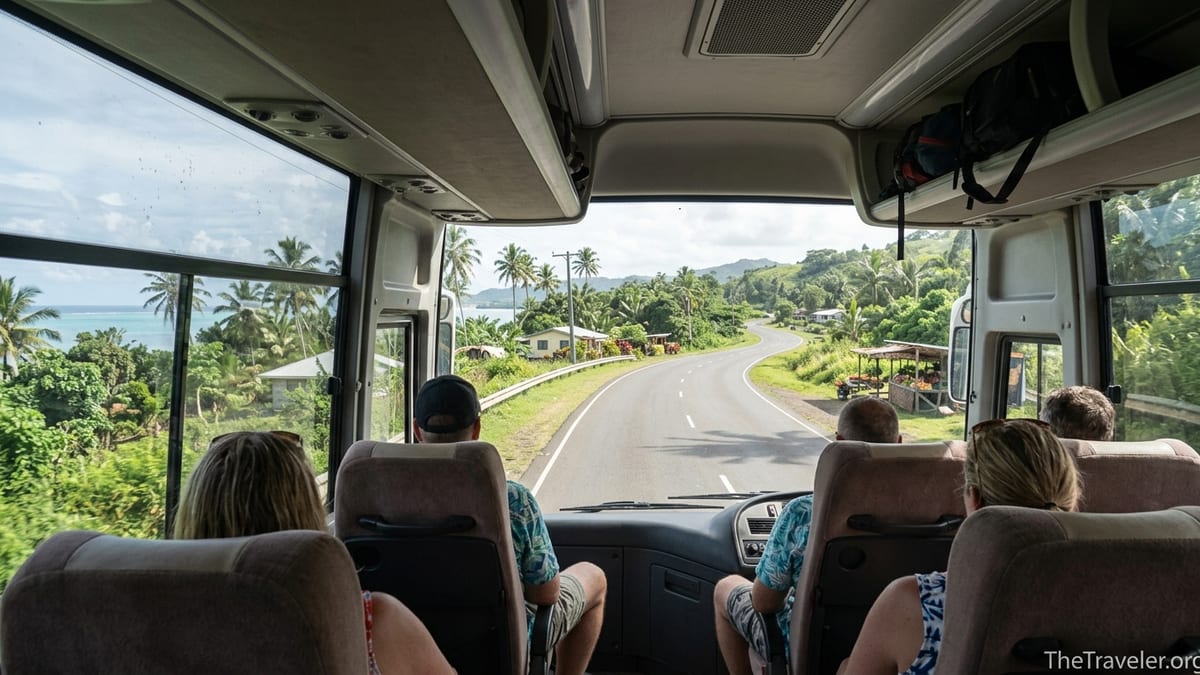
Understanding the Nadi to Suva Journey
Nadi International Airport lies on Viti Levu’s western side, near the town of Nadi and the resort enclave of Denarau Island. Suva is on the southeast coast, served by Nausori International Airport about 23 kilometers northeast of downtown. By road, the distance from Nadi Airport to Suva is generally quoted at just under 200 kilometers via the southern Queens Road and slightly longer via the northern Kings Road, based on official mileage tables used in Fiji. In practice, most travelers should expect 3 to 4 hours by road on Queens Road in light traffic, and 4 to 5 hours on the slower, more rural Kings Road.
The route you choose depends on what matters most that day. A solo backpacker arriving in the morning might prioritize cost and opt for a Fijian express bus from the airport itself. A family with young children arriving after dark may prefer the predictability of a pre-booked private transfer that meets them at the arrivals hall. Business travelers rushing to a meeting in Suva often use the short domestic hop between Nadi and Suva’s Nausori Airport on Fiji Airways or Fiji Link. And independent travelers planning to spend a week exploring Viti Levu’s Coral Coast, Pacific Harbour and Suva typically rent a car at Nadi Airport and turn the transfer into a mini road trip.
One key practical point is timing. International flights into Nadi often arrive early in the morning or late at night, while express buses and domestic flights follow specific daytime timetables. Before deciding on your mode, look at when you land, when you need to be in Suva, and whether you are comfortable waiting a few hours between connections. It is also essential to factor in immigration, customs and baggage collection at Nadi, which can easily add 45 to 90 minutes at busy times.
Luggage also shapes your choice. Surfboards, dive gear and bulky checked bags are common loads on Fiji-bound flights. A couple traveling light with carry-on backpacks can jump on almost any bus. A family with four suitcases, a stroller and a dive bag might find the walk between bus stands or domestic check-in much less appealing, and could value door-to-door private or rental car options even if they cost more.
Express Buses: The Most Affordable Route
For travelers watching their budget, express buses linking Nadi and Suva are usually the best-value overland option. Major operators including Sunbeam Transport, Pacific Transport and Coral Sun Express run along Queens Road, stopping at Nadi Airport, Nadi town, the Coral Coast resorts, Pacific Harbour and finally Suva. Their coaches are typically air conditioned, with luggage stored underneath and assigned or first-come seating in reclining seats similar to intercity buses in many countries.
Travel time on these express coaches is typically around 4 to 5 hours from Nadi Airport to Suva, depending on traffic, weather and intermediate stops. For example, Coral Sun Express timetables show morning and mid-day services leaving Nadi Airport and arriving in Suva early afternoon or evening, with the airport explicitly listed as a pickup point. Other operators run from the main Nadi bus station in town, which is a short taxi ride from the airport, but many long-distance services stop at the airport to cater to arriving passengers.
Fares are relatively modest by international standards. Recent traveler reports for full Nadi to Suva journeys on express buses mention one-way adult fares around the low-20s in Fijian dollars, with shorter sectors priced lower. Tickets are often purchased directly from the driver or at bus company counters rather than through online booking systems, and buses can depart a few minutes earlier than the printed time if they are already boarded. For this reason, if you plan to catch a specific departure, it is wise to be at the stop at least 20–30 minutes ahead.
Express buses are straightforward if your luggage is manageable and you are comfortable with a shared environment. Coaches are not luxury tourist buses but well-used workhorses serving local and visitor traffic. Air conditioning may be set high, so a light layer can be useful even in the tropics. Buses usually make short rest stops en route, for example near Sigatoka or along the Coral Coast, where passengers can buy snacks and use restrooms. If you land in Nadi mid-morning and want the cheapest same-day connection, catching an express bus from the airport is usually the simplest choice.
Private Transfers and Taxis: Door-to-Door Comfort
Private car transfers between Nadi Airport and Suva offer a middle ground between bus and self-drive: someone meets you at arrivals with a sign, loads your bags, and drives you directly to your Suva hotel or home. Several companies specialize in this service, including tourist-focused operators that also handle resort shuttles along the Coral Coast. Some online platforms quote approximate prices for a private one-way sedan transfer or SUV between Nadi and Suva that can run into the hundreds of Fijian dollars, especially for larger vehicles or nighttime transfers.
Travelers often consider private transfers worthwhile when they are traveling in a group, have plenty of luggage, or are arriving in the evening when they do not want to deal with bus stops. For example, a family of four landing at Nadi at 7 pm, with two sleepy children and three large suitcases, may prefer to settle into an air-conditioned van and head directly to an Airbnb in Suva, even if it means paying significantly more than four bus tickets. The journey time is similar to driving yourself, usually 3.5 to 4 hours via Queens Road under normal conditions.
Standard taxis based in Nadi are also an option, though long-distance fares to Suva should always be agreed in advance and confirmed with the meter or a fixed price to avoid misunderstandings. Nadi taxis are fine for short hops, such as from the airport to the bus station or Denarau, but using a regular city taxi for the full Nadi to Suva journey can be expensive and less comfortable than a dedicated transfer vehicle if it is not designed for long-haul trips.
When comparing quotes, ask whether the price includes fuel, road tolls if any, and late-night surcharges. Also confirm the vehicle type, as a basic sedan may feel cramped for three adults with gear, while a modern minivan or SUV will be more comfortable. For those planning to stop en route for sightseeing at places like Sigatoka Sand Dunes or Pacific Harbour, discuss potential detours in advance so the driver can give a realistic price for a more leisurely transfer.
Driving Yourself: Rental Cars and Scenic Routes
Picking up a rental car at Nadi Airport and driving yourself to Suva can be both practical and rewarding, especially if you intend to explore Viti Levu independently. Major international brands such as Avis, Budget, Hertz and Europcar, as well as local firms, have desks in the arrivals area. Vehicles range from compact hatchbacks to SUVs and 4WDs, with many rentals in Fiji being manual transmission. Expect typical airport-rental pricing rather than ultra-budget deals, and note that some companies may require a security deposit or hold on a credit card.
The primary route to Suva is Queens Road, a sealed coastal highway that winds through cane fields, small towns and the Coral Coast resort strip. Driving times are generally quoted at 3 to 4 hours from Nadi Airport to Suva in normal conditions. Traffic is usually heavier near Nadi and Suva and lighter in between. Road-safety guidance from Fiji’s tourism authorities emphasizes taking care with speed limits, watching for pedestrians and animals, and avoiding night driving where possible due to unlit stretches and occasional stray livestock.
Queens Road is also the scenic choice. The stretch between Nadi and Sigatoka takes you past villages and beaches. From Sigatoka to Pacific Harbour, you pass the Sigatoka Sand Dunes National Park area and the Coral Coast resort belt, where properties such as Shangri-La Yanuca Island or the Outrigger resort line the waterfront. Pacific Harbour, often marketed as an adventure hub, sits about two thirds of the way to Suva and offers river rafting, diving and island trips. Turning the transfer into a one- or two-day mini road trip by stopping overnight at a Coral Coast resort or guesthouse is a popular way to break up the drive, especially for those with jet lag.
An alternative is Kings Road, the northern route looping inland and along the north coast via towns such as Lautoka, Ba, Tavua and Rakiraki before cutting back toward Suva. This route is longer and typically slower, with fewer fuel stations and services compared with Queens Road. It appeals more to repeat visitors who want to see a different side of Viti Levu than to first-timers needing the most efficient transfer. Regardless of route, ensure you have a valid driver’s license recognized in Fiji and consider carrying an international driving permit if your license is not in English.
Domestic Flights: Nadi to Suva by Air
For those who value speed and are comfortable with a short domestic hop, flying from Nadi to Suva is a viable alternative to the long drive. Fiji’s domestic network is centered on Nadi and Nausori, and Fiji Airways, through its subsidiary Fiji Link, operates frequent non-stop flights between Nadi (NAN) and Suva’s Nausori Airport (SUV). Flight schedules published by airline and route-tracking services show multiple daily services, often up to several flights per day, using turboprop aircraft such as the ATR 72. Block flight time is typically around 30 minutes gate-to-gate, with actual airborne time even shorter.
In practice, travelers should allow significantly more than half an hour. You will need to clear immigration, collect your baggage and transfer from the international arrivals area to domestic check-in if you are connecting from an international flight. Fiji Airways passengers on through tickets often have their domestic leg coordinated, but self-booked connections should leave at least a couple of hours to buffer any delays. Some travelers report that ground staff in Nadi are proactive in assisting tight domestic connections, even pre-collecting bags from the carousel when necessary. Nevertheless, conservative planning is wise, particularly if you are on separate tickets.
One advantage of flying is predictability during heavy rain, roadworks or accidents on Queens Road, any of which can significantly extend driving times. For example, during prolonged wet spells, minor flooding can slow traffic around river crossings near Sigatoka or Navua. In such conditions, the short domestic hop can be less stressful than a four-hour drive, provided flights are running normally. Fares on the Nadi to Suva route vary by season and booking window, and are usually higher than a bus ticket but competitive with or lower than a private car for one or two passengers.
On arrival at Nausori Airport, taxis and shuttles connect you to Suva in about 30 to 40 minutes, depending on traffic. The airport is smaller and more straightforward than Nadi’s international terminal. For business travelers needing to be in Suva the same morning they land or returning residents who are used to the routine, the domestic flight is often the default choice, while leisure travelers may prefer the scenic overland route unless they are pressed for time.
Comparing Time, Cost, and Comfort
To choose between these options, it helps to think in terms of time versus money versus stress. Express buses generally win on cost. A solo traveler can cross the island for roughly the price of a simple meal at a resort restaurant, accepting a 4–5 hour ride, a shared environment and fixed departure times. For two people, the bus is still usually cheaper than renting a car for a single day once fuel and fees are included, unless you find a particularly good local rental rate.
Private transfers and taxis sit at the higher end of the cost spectrum but offer clear benefits in comfort and simplicity. For a group of four or more adults traveling together, a private van from Nadi to Suva can become cost-competitive per person compared with domestic flights, while delivering door-to-door service and plenty of luggage space. The major trade-off is that you will still be on the road for several hours, and you are dependent on one driver’s schedule rather than a published timetable.
Rental cars offer the greatest flexibility, mid-range cost and moderate comfort. A compact rental picked up at Nadi Airport and dropped in Suva might be good value if you plan to keep the car for several days to explore Suva and nearby areas, or if your itinerary includes stops along the Coral Coast and Pacific Harbour. If you only need a same-day transfer and will not use the car after reaching Suva, the value proposition declines, especially once you factor in fuel, insurance and potential one-way drop fees. However, for couples or families who enjoy independent travel, the chance to stop at viewpoints, small roadside fruit stalls and beaches can more than justify the expense.
Domestic flights are the time-saving option. Even counting check-in, security and transfers at each end, flying is usually faster door-to-door than driving, particularly if you have a same-day connection from an early international arrival to a late-afternoon commitment in Suva. The cost per person is higher than the bus and often comparable to or higher than a rental car shared between several people, but the reduction in travel fatigue can be significant. Travelers who are nervous about small aircraft should check what type of turboprop is used on their flight and decide accordingly.
When to Break the Journey and Where to Stop
For many visitors, especially those who have just traveled long-haul, breaking the Nadi to Suva journey is both more enjoyable and safer than attempting it all in one shot, particularly after a late-night arrival. Queens Road winds along one of the most scenic stretches of coastline in the South Pacific, so it makes sense to treat the transfer as part of the holiday rather than a hurdle. Popular halfway stops include Sigatoka, the unofficial capital of the Coral Coast, where small hotels and guesthouses sit alongside larger resorts, and Pacific Harbour, known for diving, river rafting and nearby Beqa Lagoon.
One common pattern for independent travelers is to spend two or three nights at a Coral Coast resort such as those near Sigatoka, enjoying beaches and day trips, then continue by bus or rental car to Suva. For example, you might pick up a rental at Nadi Airport, drive an hour to a resort near Sigatoka for a short stay, then continue for another two to three hours to Suva. Alternatively, those traveling by express bus can break their ticket into segments, riding from Nadi to Sigatoka one day and from Sigatoka to Suva another, storing large bags at hotels or carefully managing luggage on and off buses.
Families and older travelers may especially value the chance to check in, swim, eat and sleep before tackling the remainder of the journey, rather than spending what could be eight to ten hours going from an overnight international flight directly onto a bus and then straight into Suva’s sometimes rainy, humid climate. Even business travelers occasionally schedule a night on the Coral Coast if appointments in Suva do not begin until the following afternoon.
Breaking the trip also gives you flexibility in handling disruptions. If heavy rains wash out parts of the road or there is an incident delaying traffic, being based in Sigatoka or Pacific Harbour for a night can make it simpler to re-time your onward journey. Similarly, if your flight into Nadi is delayed and you miss a specific bus departure, staying overnight closer to Nadi and continuing the next day can be less stressful than trying to reshuffle everything that same evening.
The Takeaway
Traveling from Nadi International Airport to Suva is more than just a long transfer. It is your first real encounter with Viti Levu, whether you are watching sugar cane fields slide by from a bus window, chatting with a driver on Queens Road, or looking down on the island’s green ridges from a turboprop. There is no single best route for everyone. The ideal choice depends on your arrival time, budget, group size, luggage, appetite for driving and whether you would like to see more than just the inside of a vehicle before you reach Suva.
As a rule of thumb, express buses offer the cheapest and most straightforward overland option, especially for solo travelers and backpackers arriving in daylight hours. Private transfers and taxis buy comfort and door-to-door simplicity, which is particularly valuable for families, late-night arrivals and those with mobility concerns. Rental cars suit travelers who want to explore the Coral Coast and beyond at their own pace, turning the transfer into a flexible road trip with optional overnight stops. Domestic flights between Nadi and Suva’s Nausori Airport compress the journey into a short hop that can be worth the extra cost when time is tight.
Whichever route you choose, plan conservatively, build in time buffers and remember that in Fiji, the journey is very much part of the experience. A four-hour drive can pass quickly when you are sampling pineapple at a roadside stand, watching village rugby games from the bus window or pausing to photograph the Pacific from a hilltop lookout. With the right mode and mindset, your Nadi to Suva transfer can become a memorable chapter in your Fiji story rather than just a logistical chore.
FAQ
Q1. How long does it take to travel from Nadi Airport to Suva by road?
Typical driving time via Queens Road is around 3 to 4 hours in light traffic, while express buses usually take about 4 to 5 hours with intermediate stops.
Q2. Can I catch an express bus directly from Nadi International Airport to Suva?
Yes. Several express services stop at Nadi Airport, and others depart from Nadi town’s main bus station a short taxi ride away. Always check current timetables.
Q3. Is it safe to drive from Nadi to Suva at night?
While many people do, it is generally more comfortable and safer to drive in daylight due to unlit stretches, sharp bends, pedestrians and occasional animals on the road.
Q4. Should I pre-book a private transfer from Nadi to Suva?
Pre-booking is advisable if you arrive late, are traveling with children or have lots of luggage. It guarantees a driver will meet you and avoids haggling after a long flight.
Q5. How early should I arrive at Nadi Airport for a domestic flight to Suva?
For domestic flights, arriving 60 to 90 minutes before departure is usually sufficient, but allow extra time if connecting from an international flight or traveling during peak periods.
Q6. Are domestic flights from Nadi to Suva reliable in bad weather?
Flights can be affected by severe weather, but in many cases they are less impacted by local road flooding or landslides than long road journeys. Always monitor airline updates.
Q7. Do express buses between Nadi and Suva have air conditioning and luggage storage?
Most long-distance express coaches are air conditioned and store large bags in under-floor compartments, with smaller items carried on board with you.
Q8. Is renting a car for just one day from Nadi to Suva worth it?
For a simple point-to-point transfer, it may not be cheaper than buses or shared between friends, but it becomes more worthwhile if you also plan sightseeing stops or overnight stays.
Q9. Where is Suva’s airport located and how far is it from the city?
Suva is served by Nausori International Airport, which sits about 23 kilometers from central Suva. The drive into town usually takes 30 to 40 minutes by taxi or shuttle.
Q10. Is it better to break the journey between Nadi and Suva or travel in one day?
If you have just arrived on a long-haul flight or are traveling with children, breaking the trip with a night on the Coral Coast can be more relaxing than doing the full journey in one stretch.