


Landing at Nadi International Airport is the starting point for most Fiji holidays, whether you are heading straight to the resorts of Denarau Island or down the scenic Queens Road to the Coral Coast. Renting a car at the airport can give you the freedom to explore beaches, villages and viewpoints at your own pace, but it also comes with unfamiliar insurance terms, high deposits and island driving conditions that surprise many first-time visitors. This guide explains how Nadi car rentals work in practice, what to expect on the road to Denarau and the Coral Coast, and how to decide if hiring a car is really worth it for your trip.
Get the latest updates straight to your inbox!
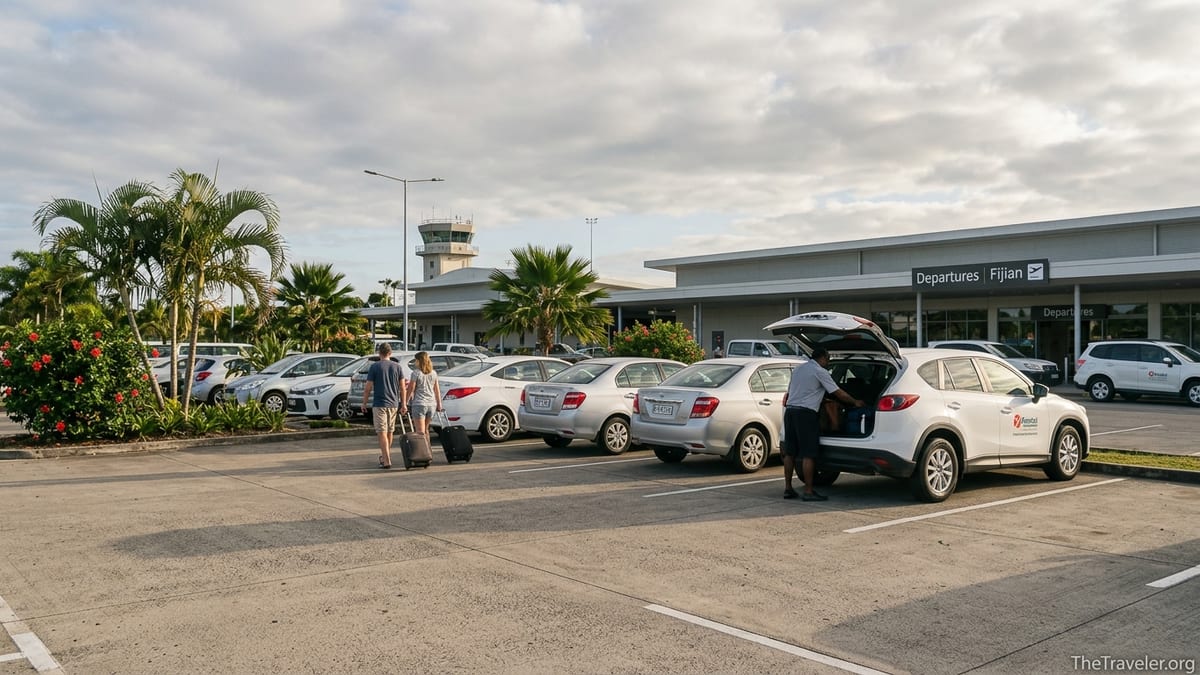
Nadi International Airport car rental basics
Nadi International Airport is Fiji’s main gateway and the easiest place to pick up a car for Denarau or Coral Coast trips. Inside the arrivals hall you will find counters for major brands such as Avis, Budget and Hertz, along with several Fiji-based companies that operate from small desks or booths. Most on-airport providers keep their cars in lots just a short walk from baggage claim, so after you clear customs it is usually a matter of signing paperwork, paying the deposit and walking out to your vehicle.
For a typical one-week holiday, many visitors book a compact or economy car, which often starts around the equivalent of 90 to 130 Fijian dollars per day in high season for international brands, sometimes less with local companies if you are flexible on vehicle age and mileage. Families heading to resorts like the Shangri-La Yanuca Island or Outrigger on the Lagoon often choose midsize SUVs for extra luggage space, which naturally cost more and may carry higher insurance excesses. Prices move a lot with demand, so it is worth comparing a few providers and not relying on a single global booking system.
Most airport rental companies in Fiji require drivers to be at least 21 years old and to have held a full licence for at least one or two years. Some charge a young driver fee for renters under 25. If you are from countries such as Australia, New Zealand, the United States, Canada or much of Europe, you can usually rent using your home licence if it is in English and clearly shows your photo and expiry date. If not, or if your licence is in another language, you may be asked for an International Driving Permit alongside your original licence.
Opening hours at Nadi International Airport typically track flight schedules, which means desks are usually staffed until the last evening arrivals. That said, remote staffing and “Fiji time” can mean slower service late at night. If your flight arrives close to midnight, confirm in advance that your rental company has your flight details and will wait, rather than assuming the counter will be open automatically.
On-airport vs local companies and how to book
At Nadi Airport you will find a clear split between major on-airport brands and smaller local firms. On-airport brands such as Avis, Budget and Hertz tend to offer newer fleets, standardised policies and straightforward returns. Local operators, which might include names you see mentioned in Fiji travel forums and social media groups, sometimes meet you in the arrivals hall or at a nearby office a few minutes from the terminal. They can be cheaper and more flexible on things like additional drivers, but the cars may be older and the paperwork more informal.
Booking in advance is strongly recommended, especially between June and October and again around Christmas and New Year when Fiji’s resorts are busiest. It is not uncommon for visitors to land, walk up to the counters and find that all small cars are sold out for several days. Some travellers report having to take taxis for their entire stay because no vehicles were available on arrival, which can be frustrating if you had planned day trips along the Coral Coast. Reserving at least a few weeks ahead significantly improves your chance of getting the class you want.
When comparing offers, look beyond the daily rate. Check whether your quoted price includes unlimited kilometres, airport fees, basic collision damage waiver and taxes. A compact car might be advertised at 75 Fijian dollars per day through a local agency, but end up closer to 110 dollars once you add compulsory airport surcharges and the extra driver fee for your partner. Conversely, a global broker might show a slightly higher base price but include extras like a free additional driver or limited zero-excess coverage that reduces your risk.
If you decide to go with a local company based on recommendations, confirm details by email before you travel. Ask where exactly you will meet the representative at Nadi Airport, whether there is a shuttle to an off-airport lot, the amount of the security deposit, and what happens if your flight is delayed. A brief written confirmation helps avoid misunderstandings when you are tired after a long flight.
Insurance, excesses and deposits: what to expect
Rental car insurance in Fiji can feel confusing because many contracts refer to “CDW” or collision damage waiver, theft protection and third-party liability, but then still list a sizeable “excess” or deductible that you must pay if the car is damaged. For a standard compact or midsize car hired at Nadi, that excess commonly sits somewhere in the range of roughly 2,000 to 5,000 Fijian dollars under the basic coverage that is included in the daily rate. The exact numbers vary by company and vehicle group, and larger SUVs can carry higher excesses.
To manage this, most companies offer optional excess reduction or a “super” cover at the counter. For example, you might be quoted an extra 25 to 40 Fijian dollars per day to bring the excess down from about 3,000 dollars to a few hundred, or to a near-zero amount. That can add several hundred dollars to a week-long rental, but many travellers choose it for peace of mind, particularly if they are not used to driving on the left or are planning long road trips past villages and free-roaming animals.
Credit card coverage and travel insurance policies that reimburse rental excess are increasingly popular with visitors from Australia, New Zealand, Europe and North America. If your card or policy includes this benefit, the rental company in Fiji will usually still block the full excess amount on your card as a security deposit, but you may be able to decline the counter add-ons, secure in the knowledge that your card or insurer would reimburse you if something happens. Always check that Fiji is covered and that you understand exclusions like off-road driving or alcohol-related incidents.
Be prepared for a substantial deposit hold when you collect the car at Nadi. It is common for companies to place a hold of 1,500 to 3,500 Fiji dollars or more, depending on the excess and vehicle category. This can significantly reduce your available credit for the first few days of your trip. If you are staying at high-end resorts in Denarau or along the Coral Coast where incidentals such as meals and activities are also charged to your card, it is wise to carry a second credit card or ensure that your primary card has ample limit.
Driving from Nadi Airport to Denarau Island
The drive from Nadi International Airport to Denarau Island is one of the easiest routes in Fiji and often the first test of your confidence behind the wheel. The distance is roughly 15 kilometres and, in light traffic, takes around 20 to 25 minutes. After you leave the airport, you join Queens Road for a short stretch before turning onto the Denarau causeway, which crosses wetlands and leads to the cluster of resort gates and the busy Port Denarau marina area.
Traffic between the airport, Nadi town and Denarau can be busy, especially in the late afternoon when locals are commuting and resort transfer buses are on the move. The posted speed limits are generally modest and it is important to keep them in mind, as police occasionally run roadside checks. Roundabouts and right turns across oncoming traffic (remember, Fiji drives on the left) are the main challenges for visitors used to driving on the right, such as Americans and Canadians. Taking it slowly and following local drivers’ cues helps.
Parking on Denarau is relatively straightforward. Most large resorts, such as the Hilton Fiji Beach Resort & Spa, Sheraton Fiji Golf & Beach Resort and Sofitel Fiji Resort & Spa, provide free outdoor parking areas for guests near the entrance or slightly off to the side of the main buildings. At Port Denarau, where you board day cruises to the Mamanuca and Yasawa islands, there is a large open car park with paid parking. The fees are usually modest by international standards, but it is worth carrying small Fijian notes and coins for machines or attendants.
For many visitors whose plans are limited to a Denarau resort stay and a couple of organised boat trips, a rental car may not be strictly necessary. Taxis from the airport to Denarau are relatively affordable compared with many other destinations, and resort shuttles or local buses connect Denarau with Nadi town. If your entire itinerary revolves around lounging by the pool and joining pre-arranged tours that include hotel pick-up, you might save money and stress by skipping the car for this part of your stay.
Queens Road and Coral Coast road trip essentials
The Coral Coast stretches roughly from around Natadola and Sigatoka through to Pacific Harbour, lining the southern shore of Viti Levu with a mix of beaches, villages and resort bays. From Nadi Airport to early Coral Coast resorts near Sigatoka, you follow Queens Road, which first skirts Nadi town and then winds southeast with frequent glimpses of the ocean. Typical driving time from the airport to Sigatoka is about one and a half hours in light traffic, and about two to two and a half hours to large resort clusters further along the coast.
Road conditions on Queens Road have improved in recent years, but visitors should still expect potholes, uneven surfaces and occasional roadworks. The route is mostly single carriageway, with limited overtaking lanes. You share the road with buses, sugarcane trucks, taxis and local drivers who sometimes overtake more aggressively than tourists are used to. Allow extra time, keep a generous following distance and be prepared to pull over to let faster traffic pass if you prefer to drive cautiously.
One of the pleasures of having a rental car along the Coral Coast is the ability to stop at small beaches, markets and viewpoints. Many travellers break the journey with a pause in Sigatoka town to pick up fruit at the market or to buy snacks before continuing to resorts like the Outrigger, Warwick or Shangri-La. Others detour to Natadola Beach, often recommended as one of the most beautiful beaches on Viti Levu, for a few hours of swimming on a day trip from Denarau or Nadi.
If you plan longer road trips beyond the Coral Coast, such as a loop around Viti Levu using both Queens Road and the more rural Kings Road, be realistic about daily distances. Distances that look short on the map can still take hours due to the combination of narrow roads, village speed limits, animals on the road and scenic stops. It is safer and more enjoyable to plan fewer hours behind the wheel each day and allow time for unexpected delays.
Practical tips for driving in Fiji
Fiji drives on the left-hand side of the road, similar to Australia, New Zealand and the United Kingdom. For visitors from right-hand traffic countries, such as the United States and most of Europe, the main adjustment is learning to look the correct way at intersections and to position the car slightly differently in the lane. Renting an automatic transmission car at Nadi Airport removes one layer of complexity, so you can focus on lane position and traffic rather than gear changes with your left hand.
The national speed limit on highways is relatively low, and in many sections of Queens Road you will be limited to about 80 kilometres per hour or less. Within villages and towns the limit drops further and is not always clearly signed, so slowing down whenever you see houses, schools, churches or groups of people along the roadside is a good rule of thumb. Local pedestrians, dogs and even horses and cattle sometimes wander onto the road, particularly near villages in the evening.
Night driving in Fiji is best avoided when possible, especially on unfamiliar rural stretches. Road markings and street lighting can be patchy, and oncoming drivers sometimes use high beams for longer than you might expect. If you do need to drive after dark, such as returning to a Coral Coast resort after dinner in Sigatoka or Nadi, keep your speed conservative and be prepared for sudden obstacles.
Fuel stations are reasonably spaced along Queens Road, but they thin out between towns. Many travellers fill up at a garage near Nadi or the airport before heading out, then top up again in Sigatoka or another larger centre. Some airport rental returns expect you to bring the car back full, and there is often a 24-hour station on Queens Road a short drive from Nadi International Airport where you can fill the tank before drop-off, which helps avoid premium refuelling charges from the rental company.
Is renting a car for Denarau and the Coral Coast worth it?
Whether a rental car is worth it for your Fiji holiday depends mainly on how much exploring you plan to do beyond your resort. If you are staying a week on Denarau and Coral Coast resorts but intend to venture out frequently to beaches, waterfalls and villages, a car can quickly pay for itself compared with repeated taxis and private transfers. For instance, a series of taxi trips between Denarau, Nadi town, the airport and Sigatoka can easily add up over several days, whereas a rental car gives you fixed daily costs and freedom to stop where you like.
On the other hand, if your schedule is built around all-inclusive resort life and pre-booked tours that include hotel pick-up, you may find that a rental car sits in the car park for much of your stay. Many boat excursions to the Mamanuca islands depart from Port Denarau and bundle in transfers from Denarau resorts and some Coral Coast properties. In such cases, paying for a car that you only use once or twice might not be worthwhile, especially once you factor in the insurance add-ons and the sizeable deposit hold on your credit card.
A hybrid option works well for some travellers. They take a taxi or pre-arranged transfer from Nadi Airport to their first resort, spend the initial days unwinding without a car, then rent for just two or three days from an on-island or local office to explore key sights. For example, a family might enjoy several car-free days at a Denarau resort, then hire a vehicle for a day trip to Natadola Beach and another day exploring the Coral Coast and Sigatoka Sand Dunes before returning the car and heading to the islands.
Ultimately, the decision comes down to your comfort with driving in a new environment, your budget and your appetite for independent exploration. Fiji’s main roads between Nadi, Denarau and the Coral Coast are manageable for most confident drivers who take their time, and the rewards include spontaneous stops at villages, viewpoints and local eateries that would be harder to reach on a fixed transfer or group tour schedule.
The Takeaway
Renting a car at Nadi International Airport is one of the most flexible ways to experience Denarau and the Coral Coast. The airport arrivals hall houses well-known rental brands alongside local companies, and within half an hour of landing you can often be driving toward your resort. Understanding the realities of insurance excesses, deposits and driving conditions, however, is essential before you hand over your credit card.
For travellers planning to move between several resorts, visit attractions independently and make impromptu stops along Queens Road, the freedom of a car is usually worth the cost and effort. Those who prefer a slower, resort-based holiday heavily reliant on organised tours and transfers may find taxis and shuttles simpler and cheaper overall. Taking a realistic look at your itinerary, comfort level and budget before you book will help you choose the option that makes your time in Fiji both enjoyable and stress-free.
FAQ
Q1. Do I need an international driving permit to rent a car at Nadi International Airport?
In many cases, visitors from countries such as Australia, New Zealand, the United States, Canada and the United Kingdom can rent using their standard driver’s licence if it is in English and clearly shows their photo and expiry date. If your licence is not in English or uses a different script, you are more likely to be asked for an International Driving Permit as a translation alongside your original licence, so it is sensible to obtain one before you travel.
Q2. How much does it typically cost to rent a car from Nadi Airport?
Prices vary by season, car type and provider, but as a rough guide many travellers pay somewhere around 90 to 130 Fijian dollars per day for an economy or compact car from a major brand in busier periods. Local companies may offer lower daily rates, especially for older vehicles, while SUVs and people carriers cost more. Always check what is included in the quoted price, such as insurance, taxes, additional drivers and kilometre limits.
Q3. How long does it take to drive from Nadi Airport to Denarau Island?
The drive from Nadi International Airport to Denarau Island usually takes about 20 to 25 minutes in normal traffic. The route is straightforward, following Queens Road for a short distance before turning onto the Denarau causeway. At peak times, such as late afternoon or when several flights arrive together, you should allow extra time for congestion around Nadi town and the resort entrance area.
Q4. Is parking easy at Denarau resorts and Port Denarau?
Most Denarau resorts offer free outdoor parking areas for guests, usually just outside or next to the main buildings. At Port Denarau, where you board island cruises and ferries, there is a large paid car park with clearly marked bays. Parking is normally uncomplicated, though it can feel busy when multiple day cruises depart at similar times, so arriving a little early for your boat is advisable.
Q5. What are the road conditions like on Queens Road along the Coral Coast?
Queens Road between Nadi and the Coral Coast is generally sealed and passable in a regular car, but visitors should expect single-lane sections, occasional potholes, uneven surfaces and roadworks. The road winds through villages and past coastal stretches, with moderate speed limits and mixed traffic including buses and trucks. Driving in daylight at a steady pace and allowing extra time for slower sections makes the journey far more comfortable.
Q6. Is it safe to drive in Fiji at night?
It is possible to drive at night in Fiji, but many visitors prefer to avoid it when they can, especially outside built-up areas. Street lighting and road markings can be inconsistent, and you may encounter pedestrians, animals or unlit vehicles on the road. If you must drive after dark, such as returning to a resort from dinner or the airport, reduce your speed, stay alert and use extra caution on unfamiliar stretches.
Q7. How big are the rental car insurance excesses in Fiji?
Rental car excesses in Fiji are often higher than many travellers expect. Under standard collision damage waiver, the excess for a typical compact or midsize car commonly falls somewhere in the low thousands of Fijian dollars, and it can be higher for SUVs and premium vehicles. Many companies sell optional excess reduction or “super” cover to bring this down, or you can rely on credit card or travel insurance coverage if it explicitly includes rental car excess in Fiji.
Q8. Do I need a four-wheel drive for Denarau and the Coral Coast?
For most visitors staying on Denarau Island and along the main Coral Coast resorts, a standard two-wheel drive car is sufficient, as the primary roads and resort access routes are sealed. A four-wheel drive is mainly useful if you plan to explore rougher inland tracks, remote villages or certain waterfall and adventure sites accessible via unsealed roads. Unless your itinerary specifically includes those areas, an ordinary sedan or compact SUV will usually be adequate.
Q9. Are taxis and transfers a realistic alternative to renting a car?
Yes, for many itineraries taxis and organised transfers work well, particularly if you are staying at a single resort or mostly joining tours that include pick-up. Airport taxis can take you directly to Denarau or Coral Coast hotels, and local buses or resort shuttles connect Denarau with Nadi town. If you only expect to leave the resort a couple of times, paying per trip may be cheaper and less stressful than managing a rental car, insurance and parking.
Q10. Can I rent a car partway through my stay instead of at the airport?
In some cases, yes. Certain international brands and local agencies have offices in Nadi town, at Denarau or near major Coral Coast resorts where you can arrange short-term rentals. A common approach is to use transfers to reach your resort, relax there for a few days, then rent a car locally for one or two days of exploring before returning it and continuing your holiday without a vehicle. Availability can be more limited away from the airport, so advance arrangements are recommended during busy seasons.