


More news on this day
A Philippine Airlines flight that made an emergency return to Ninoy Aquino International Airport on Sunday, November 29, 2026, closed Manila’s main runway for several hours and triggered diversions, delays and schedule changes across the Philippine air network, including at Mactan-Cebu International Airport, where authorities warned travelers to expect disruptions through the day.
Get the latest news straight to your inbox!
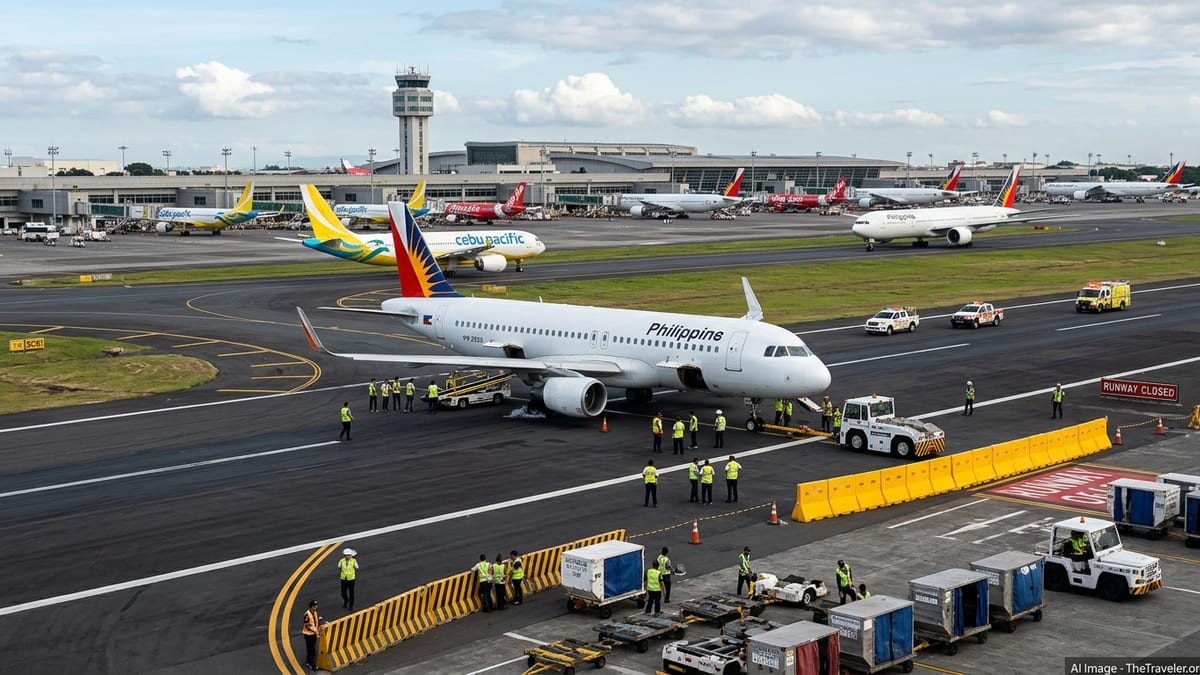
What happened at NAIA and how it affected the runway
According to advisories from the Civil Aviation Authority of the Philippines and statements from Philippine Airlines, flight PR 2923, an Airbus A320 operating from Manila to Daraga in Albay province, took off from Ninoy Aquino International Airport on the morning of November 29 but turned back shortly before reaching its destination after the crew reported a hydraulic system problem. The flight made an emergency landing at NAIA at around 11:45 a.m. local time. On landing, the aircraft suffered burst main landing gear tires and came to a stop on the main runway, designated 06/24, where it remained disabled while recovery crews assessed damage and prepared to move the jet.
The disabled aircraft forced NAIA to temporarily close runway 06/24 to traffic while the incident was managed. The Civil Aviation Authority reported that, during the closure, airport operations were consolidated on runway 13 for limited movements where feasible, with priority given to smaller narrowbody aircraft that could safely operate on the available pavement and under the prevailing conditions. Widebody arrivals and some heavily loaded aircraft were unable to land while the main runway was blocked and were instead instructed to hold or divert.
Philippine Airlines confirmed that all passengers and crew from PR 2923 disembarked safely and that there were no reports of injuries. In its public statement the carrier said it was working closely with the airport operator, New NAIA Infrastructure Corp, and relevant government agencies to recover the aircraft and restore normal runway capacity. At midafternoon on November 29, NAIA authorities were still reporting restricted operations on account of the disabled A320, and the main runway closure remained in effect while inspections and clean-up continued.
Flight diversions and delays, including impacts on Cebu
The immediate operational impact of the runway closure was felt in Manila but quickly spread across the wider domestic and international network. The Civil Aviation Authority reported that at least four flights bound for Manila were diverted to Clark International Airport in Pampanga: Philippine Airlines flight 891 from Taipei using a Boeing 777-300ER, Cebu Pacific flight 5J 313 from Taipei using an Airbus A330-900, Philippine Airlines flight 659 from Dubai aboard an Airbus A330-300, and Philippine Airlines flight 1454 from General Santos operated by an Airbus A350-900. Additional aircraft entered holding patterns around Manila as controllers sequenced traffic onto runway 13 or prepared them for diversion when landing was no longer feasible.
Although detailed tallies of delayed and cancelled flights for the whole system had not yet been published by late afternoon, live tracking data and airport advisories showed that both arrivals and departures at Mactan-Cebu International Airport experienced knock-on disruption. Manila is the country’s primary hub, and many flights to and from Cebu either originate from or connect through NAIA. When a significant portion of Manila-bound traffic is halted or diverted, aircraft and crews may be out of position, which in turn leads to late arrivals into Cebu, delayed departures back to Manila and onward destinations, and in some cases short-notice cancellations.
By around 3 p.m. on November 29, the Mactan-Cebu International Airport Authority had issued notices warning of delays on flights that either originated in Manila or required aircraft arriving from affected Manila services. These advisories emphasized that schedule changes would vary by airline and route and that the situation remained fluid while NAIA worked to reopen its main runway. Airlines serving Cebu, including Philippine Airlines, Cebu Pacific and Philippines AirAsia, updated their digital flight status pages and social media feeds through the afternoon as they adjusted rotations in response to diverted and delayed aircraft.
How Mactan-Cebu and airlines are managing the disruption
Mactan-Cebu International Airport, the main air gateway to Cebu and the wider Central Visayas region, continued to operate normally from a local infrastructure standpoint on November 29. There were no reported technical issues with its runway, taxiways or terminal systems. The disruption for passengers traveling through Cebu stemmed from the reduced capacity and temporary runway closure at NAIA, which constrained the flow of traffic along the country’s largest air corridor between Manila and Cebu and affected aircraft availability across several domestic routes.
In its notices, the Mactan-Cebu International Airport Authority advised passengers booked on flights to and from Manila on November 29 to monitor their flight status closely, arrive at the airport early, and maintain direct contact with their airline for the latest rebooking or rerouting options. Carriers have discretion to implement measures such as waiving rebooking fees, honoring no-show passengers on later services subject to seat availability, or rerouting travelers via alternative domestic gateways where connections are available, but such policies can differ significantly by airline and ticket type.
Philippine Airlines stated that it was coordinating not only with Manila authorities but also with other affected airports, including Clark and Cebu, to realign its aircraft and crew resources. For passengers originating in Cebu with onward international connections via Manila on November 29, the airline urged travelers to check for revised departure times, potential missed connections and any re-accommodation options. Low-cost carriers operating between Cebu and Manila issued similar guidance, pointing passengers toward online and app-based tools as the fastest way to obtain updated departure and arrival times during the unfolding disruption.
Context: previous incidents and why a single runway closure matters
The November 29 runway closure at NAIA occurred in a system that operates near capacity for much of the day, which makes it particularly sensitive to any obstruction on a primary runway. NAIA’s main runway 06/24 carries a significant share of the airport’s larger aircraft movements, including many international and widebody flights. When an aircraft becomes disabled on this runway, authorities must prioritize safety by halting operations on that strip until recovery teams clear the jet, inspect for structural or surface damage and remove any debris, processes that can take several hours depending on the severity of the incident.
Similar incidents in the past have highlighted how quickly an obstruction at a major Philippine airport can ripple through the country’s domestic network. In 2018, a Xiamen Airlines jet that skidded off the runway at NAIA led to an extended closure and widespread flight cancellations, while in 2022 a Korean Air Airbus A330 overran the runway at Mactan-Cebu International Airport after a partial hydraulic failure, forcing diversions and disruptions for travelers headed to or through Cebu. In each case, physical damage to runway surfaces and the complex logistics of moving a heavy, disabled aircraft contributed to longer-than-expected closures and exposed the limited margin for error at key air gateways.
The current situation at NAIA on November 29 differs in scale and context but demonstrates the same underlying vulnerability. Even though the affected Philippine Airlines A320 remained on the paved surface and there were no injuries, the combination of burst tires, hydraulic issues and the potential for foreign object debris meant that normal use of the main runway could not resume until engineering and safety teams completed their work. Until that process is finished, the airport must rely on remaining runway capacity, which is not sufficient to absorb a full day’s scheduled traffic without delays and diversions, particularly for larger aircraft types.
What travelers should do next and how long disruption may last
By late afternoon on Sunday, November 29, authorities had not yet provided a definitive timeline for fully reopening NAIA’s main runway 06/24. Recovery of the disabled Airbus A320, inspection of the runway surface and any necessary cleaning or minor repairs are all prerequisites before controllers can safely resume normal operations. The duration of these tasks depends on the condition of the aircraft and runway and on the availability of specialized equipment, such as lifting bags and towing vehicles, which are required to move a heavy jet that cannot taxi under its own power.
For travelers with flights on November 29 that involve either Manila or Cebu, the most practical step is to treat schedules as provisional until airlines confirm that normal operations have resumed. Passengers are advised to check their flight status directly with their carrier before leaving for the airport, using official websites, mobile apps, call centers or verified social media channels. Those with tight same-day connections, particularly from domestic Cebu services onto long-haul international flights via Manila, may wish to discuss earlier rebooking or overnight options with their airline if significant delays are already being reported.
Looking ahead into the late evening of November 29 and into November 30, some residual disruption is likely even after the runway fully reopens, as aircraft and crew rotation patterns gradually return to normal. Flights that were diverted to Clark will need to position back to Manila, and some services may continue to operate off their original slots while airlines work through the backlog. Travelers with departures or arrivals in the early hours of November 30 should therefore continue to monitor advisories from NAIA, Mactan-Cebu International Airport and their chosen carriers, and allow additional time at the airport in case of ongoing congestion at check-in, security or boarding.