


More news on this day
A preliminary investigation into the UK air traffic disruption that triggered widespread delays and cancellations has concluded the incident was caused by a software defect, not by any incorrect actions taken by civil or military operators.
Get the latest news straight to your inbox!
What the preliminary report says happened
Published coverage indicates the disruption centered on the systems underpinning the management of UK airspace, after a defect affected the processing of flight data in a way that forced traffic flow restrictions to protect safety. The report frames the issue as a technical failure rather than a human performance problem, using language that explicitly rules out incorrect actions by operators.
NATS, the UK’s principal air navigation service provider, has described the incident as stemming from a software defect in a small part of the National Airspace System. According to the published report summary, a process handling an aircraft code request resumed incorrectly, producing corrupted output that then affected subsequent flight data updates. This type of corruption can create uncertainty in the information controllers rely on, and the system response prioritised safe separation by reducing the rate of aircraft movements.
Coverage also notes that the exposure window involved was extremely narrow, with reporting describing it as a one millisecond defect. While that detail helps explain why the problem could evade routine detection, it does not answer the larger question travelers care about: why a fault with such outsized operational impact was able to reach live operations.
Scale of disruption and what travelers experienced
News reports put the number of affected flights in the thousands, with more than 2,000 cancellations widely cited in early coverage. The knock-on effects were felt well beyond the immediate window of the technical incident, as aircraft and crews ended up out of position, airports experienced congestion, and airlines worked through rebooking backlogs.
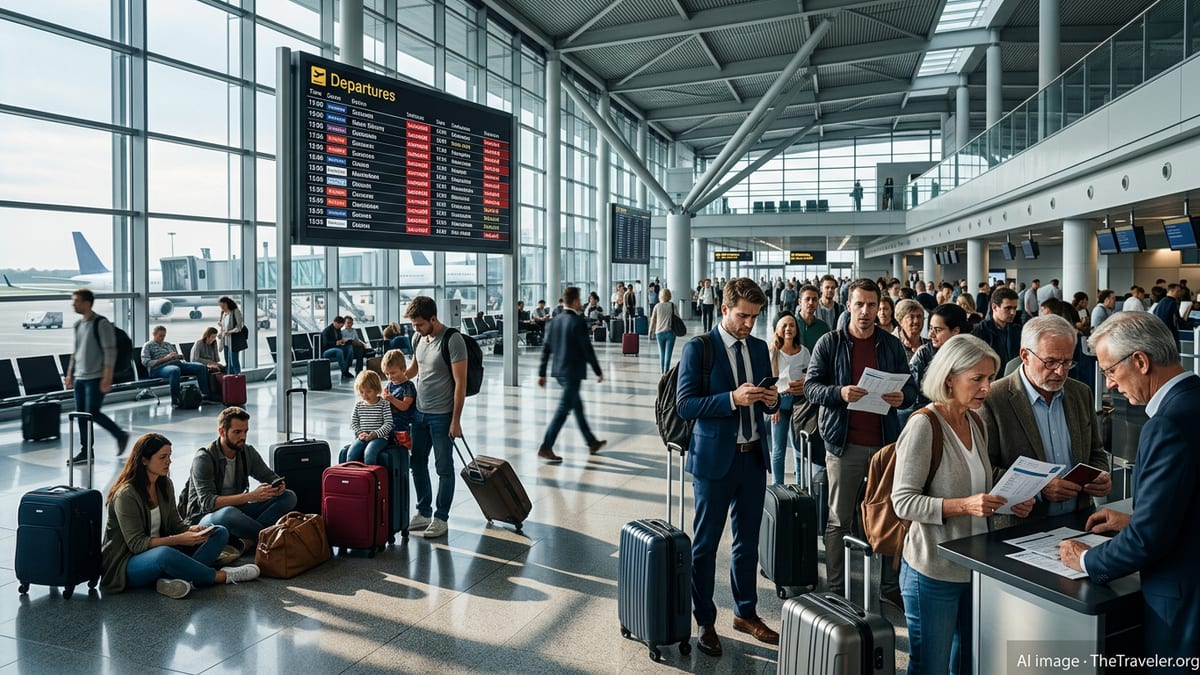
For travelers, the practical outcome was familiar: last-minute cancellations, extended airport waits, and rebookings onto later services that were already heavily booked. Even when flights eventually operated, some passengers faced longer routings, additional overnight stays, or missed connections as carriers tried to rebuild schedules.
The UK disruption also illustrated how quickly air traffic management issues can ripple across Europe and the transatlantic network. With UK airports acting as major hubs for connecting itineraries, constraints in UK airspace can force airlines to cancel rotations that would otherwise carry passengers onward to multiple destinations later the same day.
Why “not caused by incorrect actions” matters
In aviation, assigning cause is closely tied to what changes follow. A finding that incorrect actions were not involved shifts attention toward software assurance, system monitoring, and testing rather than retraining or disciplinary measures. It also places emphasis on how technical safeguards and contingency procedures perform when corrupted data or abnormal system outputs appear.
The preliminary nature of the report is also important. Published coverage indicates additional work is expected to determine why the defect existed, why it was not identified earlier, and whether characteristics of the broader system increased the likelihood or impact of the failure. Those distinctions can influence future investment decisions, including whether redundancy, simulation, or real-time validation should be expanded.
The incident arrives amid broader scrutiny of aviation resilience, especially when travelers perceive disruption as increasingly common. While weather and airline staffing constraints often dominate public discussion, air traffic systems and the data pipelines behind them can be just as consequential, and the NATS finding points to a failure mode that can be hard to predict but still must be planned for.
Passenger rights: what changes based on the cause
For travelers trying to understand reimbursement and compensation, the cause of disruption can determine which rules apply and what an airline must provide. In many systems, airlines have stronger duties of care for rebooking and assistance, while cash compensation rules may depend on whether the disruption was within an airline’s control.
In the United States, publicly available Department of Transportation guidance emphasizes a key baseline: when a flight is cancelled or significantly changed and a passenger chooses not to travel, a refund obligation continues to apply regardless of the cause of the disruption. That principle can be relevant for U.S. travelers impacted by foreign airspace events when tickets include U.S. carriers or U.S.-origin itineraries, though the exact process for requesting a refund varies by airline and ticket type.
In the UK and Europe, consumer outcomes often hinge on whether an event is treated as an “extraordinary circumstance” under passenger compensation frameworks. A technical failure in an air traffic management system is typically outside an individual airline’s direct control, which can affect eligibility for fixed compensation even when passengers face long delays. However, separate obligations around rerouting, meals, and accommodation can still apply depending on circumstances and the carrier’s policies.
What to watch next for operational fixes and oversight
With the investigation still underway, the next phase is expected to clarify both root cause and prevention. Travelers and airlines will be watching for any recommendations on software development practices, change management, testing coverage, and how quickly anomalies are detected and isolated before they cascade into broader operational constraints.
Another focus is communications and recovery: how quickly flight restrictions are implemented, how airlines receive operational guidance, and how rebooking is prioritised when capacity is constrained. Even when safety is protected, the speed at which schedules can be restored shapes how many passengers face cancellations versus manageable delays.
For future peak travel periods, the issue is less about this specific defect and more about resilience. The incident highlights the importance of contingency capability in air traffic services and the need for airlines and airports to plan for sudden, system-driven capacity reductions, including surge staffing for customer service and clear passenger-facing guidance on rebooking and refunds.