


More news on this day
Global airlines promised net zero carbon emissions by 2050, but a widening gap between climate ambition and the reality of sustainable aviation fuel supply, carbon markets and policy design is putting that target at risk at 35,000 feet.
Get the latest news straight to your inbox!
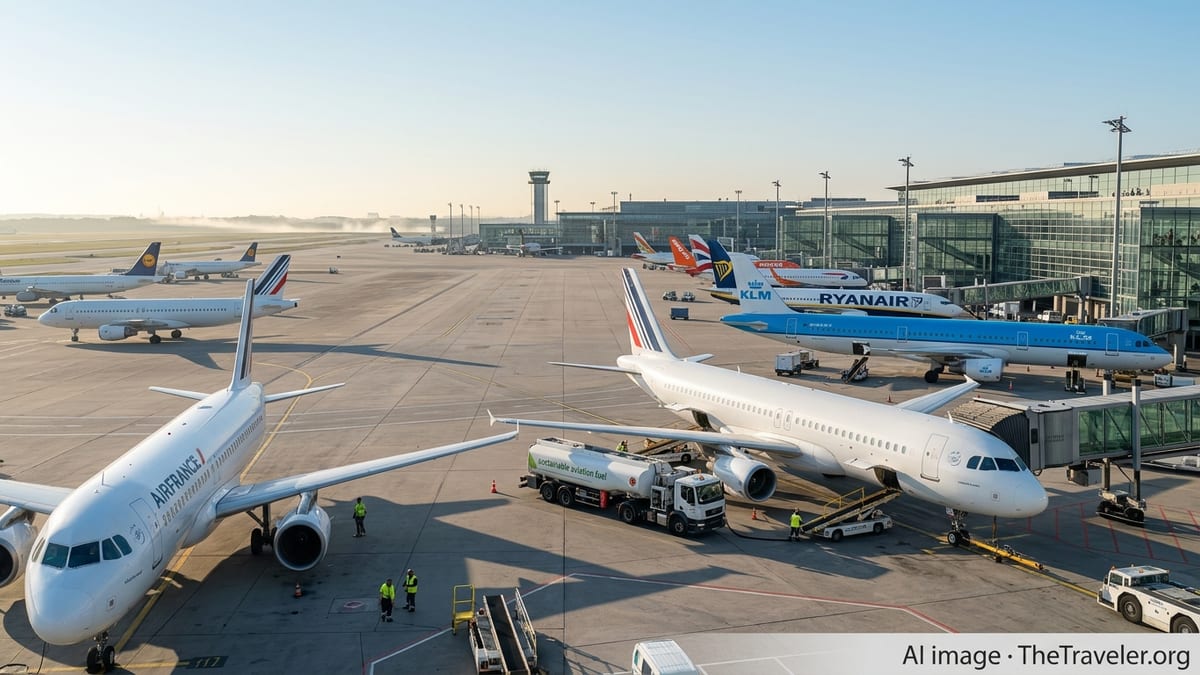
SAF Supply Barely Off the Runway
Industry road maps place sustainable aviation fuel, or SAF, at the center of aviation’s decarbonization plans, yet production remains a fraction of what is required. Recent estimates from airline and industry groups indicate that SAF could account for less than 1 percent of global jet fuel use in 2026, despite years of commitments and early offtake deals. Analysts note that volumes are rising, but from an extremely low base, leaving airlines heavily dependent on fossil-based kerosene.
Part of the problem is the mismatch between stated demand and bankable projects. Airlines have signed a wave of memoranda of understanding and conditional purchase agreements, but developers often struggle to convert these into the long-term, fixed-price contracts needed to secure financing. Publicly available analysis points to high capital costs, feedstock constraints and uncertain future policy as key reasons why many planned SAF plants remain on the drawing board.
Technology diversity is another brake on rapid scale-up. SAF can be produced from waste oils, agricultural residues, municipal waste and, in the case of power-to-liquids, from captured carbon dioxide and green hydrogen. Each pathway faces different bottlenecks, from competition for limited used cooking oil to the vast renewable electricity requirements for synthetic fuels. Recent peer-reviewed research has questioned whether current global energy and land systems can support the scale of SAF deployment assumed in some net zero scenarios without displacing other climate priorities.
For airlines, the near-term result is a tight market where available SAF is sold at a significant premium to conventional jet fuel. While some carriers use SAF blends on select routes as a flagship climate initiative, most global flying still relies on traditional fuel, postponing the sector’s deeper emissions cuts.
Mandates Take Off, but Markets and Credits Lag
Governments are increasingly turning to mandates to break the stalemate, but the policy architecture is uneven across regions. In Europe, the ReFuelEU Aviation regulation begins requiring a minimum share of SAF in jet fuel supplied at major EU airports from 2025, with the threshold rising in stages toward mid-century. The framework is designed to create guaranteed demand and discourage airlines from simply refueling outside the bloc to avoid higher-cost low-carbon fuel.
The United Kingdom has set out a similar trajectory, with a SAF mandate scheduled to start in the middle of this decade and tighten over time. Other jurisdictions, including Japan and some Gulf states, are exploring or piloting blending targets. These efforts are intended to give investors confidence that there will be a long-term market for SAF, even as costs remain elevated.
By contrast, some of the world’s largest aviation markets have leaned more heavily on incentives and carbon markets. In the United States, SAF producers have been able to access a temporary blender’s tax credit linked to lifecycle emissions performance, alongside broader clean fuel production incentives. However, certain SAF-related excise credits have firm expiry dates, creating uncertainty for projects with multi-year construction timelines. Market participants have warned that abrupt changes in credit availability or calculation methods can stall investment decisions.
Meanwhile, the international Carbon Offsetting and Reduction Scheme for International Aviation, known as CORSIA, is ramping up. Under this framework, airlines must purchase carbon credits or use eligible low-carbon fuels to compensate for growth in emissions from international flights above a baseline. Observers note that while CORSIA is intended to complement technological change, the scheme has faced criticism over the environmental integrity of some offsets and the volatility of credit prices, complicating its role as a reliable driver of decarbonization.
Carbon Credit Integrity and Accounting Gaps
As net zero timelines approach, scrutiny is intensifying on how airlines use carbon credits and book emissions reductions from SAF. Environmental groups and some research institutions have raised concerns that reliance on offsets can delay direct emissions cuts, particularly if credits are linked to projects with questionable additionality or monitoring. Publicly available assessments suggest that oversupply in parts of the voluntary carbon market has kept prices low, limiting the financial incentive to shift away from high-carbon fuel.
Questions about accounting rules also hang over SAF deployment. Life-cycle assessment models used to determine the emissions performance of different fuels can yield divergent results depending on assumptions about land use, indirect impacts and co-products. Recent guidance from authorities in major markets has attempted to standardize methods for calculating lifecycle emissions reductions, but debates remain over how to treat certain feedstocks or agricultural practices.
This lack of convergence has practical consequences. A batch of SAF might qualify for generous credits or compliance recognition in one jurisdiction but not in another, affecting its tradability and investment case. Developers seeking to export SAF or serve global airline customers face a patchwork of certification and verification regimes, increasing transaction costs and slowing project development. Analysts warn that without clearer, internationally aligned rules, high-integrity projects could lose out to options that simply exploit the gaps between regulatory systems.
For passengers, these technical details translate into uneven green claims. Airlines promoting “SAF-powered” flights may, in practice, be relying on book-and-claim systems, where emissions reductions are allocated via certificates rather than physical fuel use at a given airport. While such systems can accelerate early market growth, critics argue that they risk confusing consumers and overstating the immediate climate benefit of individual journeys.
Policy Mismatches Threaten Net Zero Trajectory
The emerging global policy landscape for aviation decarbonization is marked by overlapping objectives but divergent tools. Some regions are prioritizing volume-based mandates, others are leaning on tax credits and R&D funding, and still others are relying on offsetting schemes. Public reports from energy and climate analysts increasingly highlight the risk that this patchwork produces neither the scale of SAF needed nor the steady price signals that investors require.
One concern is sequencing. Several expert commentaries emphasize that, in markets where mandates arrive before robust supply-side support is in place, airlines may face sharp cost increases without a corresponding ramp-up in production capacity. That scenario could provoke political pushback, particularly if ticket prices rise or carriers argue that they are being placed at a competitive disadvantage compared with airlines in less-regulated jurisdictions.
Another challenge is the interaction between aviation policies and wider decarbonization goals. The same waste oils, residues and renewable electricity that could feed SAF plants are also in demand for road transport, shipping, industry and power generation. Academic research has questioned whether current net zero aviation road maps fully account for these cross-sector trade-offs, warning that poorly coordinated policy could allocate scarce low-carbon resources in ways that do not maximize overall climate benefits.
As a result, some analysts are calling for more integrated planning that links national and regional SAF strategies to broader energy system transitions. Proposals include aligning SAF mandates with binding renewable energy and efficiency targets, reforming carbon markets to reward high-integrity reductions, and setting clearer guardrails on acceptable feedstocks. Without such coordination, the aviation sector’s pledge to reach net zero by mid-century risks becoming increasingly difficult to reconcile with the realities on the ground.
Investors and Travelers Confront a Turbulent Transition
The growing tension between headline climate commitments and slow progress on SAF is resonating beyond airline boardrooms. Investors monitoring listed carriers and emerging SAF producers are tracking policy developments closely, aware that changes in credit schemes, blending mandates or lifecycle rules can alter project economics overnight. In financial commentary, SAF is often described as both a major growth opportunity and a regulatory minefield.
For airports and fuel suppliers, the transition is reshaping infrastructure decisions. Meeting rising SAF requirements will require new storage, blending and quality-control systems, often at facilities that already operate with tight margins and space constraints. Industry briefings indicate that some hubs are moving ahead with dedicated SAF logistics, while others are waiting for clearer signals on demand and cost recovery.
Travelers, meanwhile, are encountering a proliferation of green fare options, contribution schemes and emissions calculators. Surveys and public opinion research suggest many passengers support decarbonization but remain wary of paying substantially more for flights, particularly where trust in offsets and corporate climate claims is limited. Consumer advocates argue that greater transparency on how SAF and carbon credits are used, and on the true climate impact of different itineraries, will be essential to maintain public backing for the sector’s transition.
With global air traffic expected to continue growing over the coming decades, the stakes are high. Unless sustainable aviation fuel markets, carbon credit systems and climate policy frameworks evolve in a more coordinated direction, net zero at cruising altitude could shift from firm target to distant aspiration.