


I crossed into New Brunswick expecting a brief practical pause on a longer Atlantic Canada loop: a tank of gas in Moncton, a glance at the Bay of Fundy, maybe an overnight in Saint John before moving on to Nova Scotia or Prince Edward Island. Instead, the province kept tugging at my sleeve. A container village on a working port turned into an evening of live music; a highway detour became a walk on the ocean floor; a “sleepy” river city revealed murals, Acadian food and a tidal bore rolling through downtown at dusk. New Brunswick had more character than I gave it credit for, and it earned a proper place on the itinerary rather than the footnote I had planned.
Get the latest updates straight to your inbox!
First Impressions of a Place I Nearly Skipped
Like many travelers driving the Maritime circuit, I had treated New Brunswick as a corridor between better known names. My map was full of red circles around Cape Breton, Prince Edward Island’s beaches and Nova Scotia’s wine country. New Brunswick, by contrast, was a blank green space with a couple of pins for Hopewell Rocks and Fundy National Park. When I reserved a budget hotel near Moncton and penciled in a single night, it felt like a concession to road fatigue rather than curiosity.
The reality began to shift almost as soon as I left the Trans-Canada Highway. The four-lane asphalt narrowed to two, big-box plazas gave way to clapboard houses, and the road began to roll toward a coastline that the guidebooks undersell. Small bilingual signs pointed to coves, covered bridges and trails with names that the national parks marketing machine has not yet turned into hashtags. Gas stations had hand-lettered notices about lobster rolls and fiddlers’ nights taped to their doors. It felt less like passing through and more like stumbling into a small, self-contained world.
New Brunswick’s scale helped. This is a province where three of the main gateways for visitors Moncton, Saint John and Fredericton are all within about two hours of each other by car. That means the seemingly minor decisions you make at breakfast have a way of becoming full-blown detours by dinner. I would stop “just for a coffee” in an uptown square and end up listening to live fiddle music at the market; I would pull over “just to stretch my legs” by the Bay of Fundy and find myself ankle-deep in tidal mud, watching the ocean rise by the minute.
What surprised me most was how often those detours felt like real discoveries rather than consolation prizes. New Brunswick is not polished in the way of more famous coastal destinations. Boardwalks can be a little weather-beaten, cafes close earlier than you expect outside high season and the tourist information staff sometimes seem genuinely delighted to see you. That lack of gloss allows the province’s character to come through in small, memorable ways.
Saint John: A Working Port With a Playful Waterfront
Saint John was supposed to be a utilitarian stop: a place to refuel both the car and myself before catching a ferry farther along the coast. Instead, the city’s waterfront and uptown core kept me there an extra day. This is Canada’s oldest incorporated city and a busy port on the Bay of Fundy, and you feel that as soon as you see cranes and container ships lining the harbour. But in recent years, Saint John has turned parts of that industrial edge into a surprisingly playful public space.
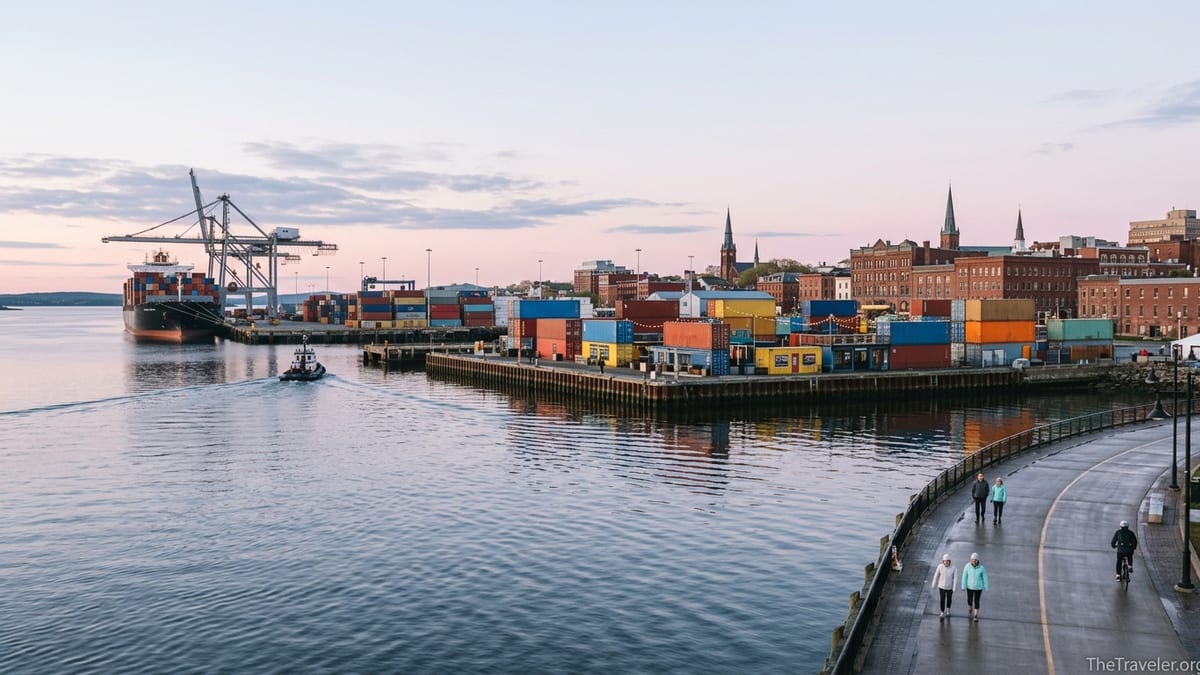
The clearest example is the AREA 506 Waterfront Container Village in Uptown Saint John, built from rows of repurposed shipping containers on the harbour side of the road. In season, it runs roughly from late May into the fall and bundles much of the province’s personality into one walkable site: local brewers pouring pints out of container bars, artisans selling prints of Fundy fog scenes, food stalls working through every imaginable variation on fish and chips. It sits right beside the cruise ship pier, yet it feels more like a community hangout than a made-for-cruise excursion. On some summer evenings a Canadian rock act plays the small stage while families queue for soft serve and kids climb on the painted container steps.
Step away from the containers and Uptown Saint John reveals another side. Gridded streets climb uphill from the harbour, lined with 19th century brick buildings with arched windows and elaborate cornices, a legacy of the city’s boom years as a lumber and shipping hub. King’s Square, the central park, has paths radiating in a Union Jack pattern, shaded by mature trees and anchored by a bandstand that still hosts concerts when the weather cooperates. The City Market, under a roof ribbed like an inverted ship’s hull, sells everything from dulse seaweed snacks to locally roasted coffee. Half the fun is simply eavesdropping on locals discussing the tide times or the latest news from the Port of Saint John.
One evening, I followed the paved Harbour Passage trail along the water and watched the sunset stain the cranes and stacked containers in pastel colors while a cargo vessel edged out to sea. It was an oddly beautiful scene, combining the romance of travel with the reality of a working city. That balance perhaps typifies Saint John’s character: it has not turned its back on industry, but it has carved out spaces where visitors and residents can enjoy the harbour on their own terms.
Moncton: More Than a Highway Stop
If Saint John felt like an underappreciated port, Moncton felt like the classic underdog city that quietly thrives. Officially, this is the “Hub City,” a transportation crossroads where highways and rail lines intersect. For travelers, it often functions as an interchange: a place where you switch rental cars, catch a flight or stock up on groceries before heading to cottage country. Walk or bike beyond the malls and you find a riverfront city investing in trails, museums and public spaces with a distinctly local flavor.
The Petitcodiac River defines much of Moncton’s character. Once cut off by a causeway, it has been slowly restored and now hosts the famous tidal bore, a single wave that rides the incoming Fundy tide upstream. There is a signposted viewing area near downtown where locals and visitors gather at predicted times, coffee cups in hand, to watch the river suddenly reverse direction. It takes less than a minute for the bore wave to pass, but the sense of shared anticipation feels disproportionately large for such a small natural spectacle.
Riverfront Park, stretching along the north bank, turns the Petitcodiac into Moncton’s main outdoor stage. A wide multi-use trail follows the river, used by joggers, dog walkers and cycle commuters heading toward residential neighborhoods and the neighboring town of Riverview. Benches face the water, and interpretive panels explain how the tidal restoration projects have brought life back to the mudflats. In the evening, when the light softens and the office workers thin out, it becomes one of the most relaxing places in the province to walk off a plate of poutine.
Two blocks inland, Resurgo Place consolidates Moncton’s history museum and Transportation Discovery Centre under a contemporary glass and steel roof. The exhibits trace the city’s evolution from shipbuilding to railway to modern logistics hub with interactive displays that keep children engaged, but they are equally interesting for adults trying to understand why this medium-sized city feels so busy. For a traveler who only expected a service center with gas stations and chain restaurants, it is jarring in the best way to end the day discussing railroad expansion routes with a local curator who is clearly proud of Moncton’s role in the Maritimes.
The Bay of Fundy and the Magic of Moving Water
Almost every brochure about New Brunswick references the Bay of Fundy’s tides, which are among the highest in the world, but it is hard to appreciate what that means until you stand on its shores. I drove from Moncton to the Hopewell Rocks Provincial Park expecting a scenic viewpoint and found a landscape that literally changes shape in the span of a single visit. The park, which typically operates from mid May to mid October, is designed around that dynamic, with staircases descending to the sea floor at low tide and clifftop overlooks that reveal the same rock formations half submerged at high tide.
At low tide, visitors in rubber boots thread between the so-called “flowerpot” sea stacks, carved by millennia of tidal erosion into columns topped with trees. Guides and rangers remind you to check the posted tide tables and listen for whistles that signal the need to clear the beach. A few hours later, many of the same people line the clifftop viewing platforms, watching kayakers paddle where they had been walking. The difference of several meters in water level between the two visits is intellectually familiar but emotionally startling.
Hopewell Rocks is just one node in a chain of Fundy experiences that circle the southern coast of New Brunswick. To the west, Fundy National Park near the village of Alma protects a swath of rugged shoreline and inland forest. Trails descend from spruce stands to cobble beaches where you can stroll on the exposed sea floor at low tide, then retreat uphill to waterfalls like Dickson Falls when the water returns. On rainy days, cafes in Alma serve chowder loaded with local seafood, and campers flip through their tide charts like weather forecasts.
Farther along, the Fundy Trail Parkway near St. Martins offers a coastal driving route with lookouts, beaches and suspension footbridges where you can pause and absorb the sight of the tide pouring into inlets below. Locals suggest stitching these spots together into a loose loop from Moncton, perhaps adding a night in Saint John or an inland detour to covered bridge country. The details of your route matter less than the realization that the Bay of Fundy does not sit still. Wherever you encounter it, the water is either coming or going, and planning your day around that simple fact becomes one of the quiet pleasures of traveling in New Brunswick.
Everyday Culture: Markets, Murals and Maritime Food
What ultimately convinced me to slow down in New Brunswick were not only the headline attractions but the smaller cultural moments threaded between them. In Saint John, a Sunday morning walk brought me to the Queen Square farmers’ market, where local growers set up tents under mature trees and sell carrots still dusted with soil alongside jars of pickled fiddleheads. A trio played traditional tunes on fiddle and guitar while kids weaved between the stalls with ice cream cones. It felt like the city showing itself to itself, with visitors welcome but not catered to.
Moncton has its own quieter rituals. On a weekday evening, the cafe patios along Main Street begin to fill as office workers finish their shifts. Conversations slip between English and French, a reflection of the province’s bilingual identity, and menus follow suit. You might find classic Maritime seafood chowder listed beside poutine, fried clams and Acadian specialties like fricot, a comforting chicken and dumpling soup. Prices are often lower than equivalent dishes in larger Canadian cities, which makes experimenting with local specialties less of a financial gamble.
Street art is another unexpected thread. In recent years, both Saint John and Moncton have embraced murals as a way to animate blank walls and underpasses. Some works reference Indigenous heritage, others depict marine life or abstract waves in bold colors, and a few simply play with typography and local slang. They turn casual walks into small treasure hunts and give visiting photographers a reason to detour down side streets. They also speak to a broader attempt to reimagine parts of these cities not just as arteries for commuters, but as lived-in neighborhoods worth lingering in.
Not all of this culture is polished. Some cafes and bars keep modest hours outside peak summer, and you may find an art gallery closed on a day that larger destinations would treat as prime business. Yet that contributes to the sense that you are glimpsing everyday life rather than a performance for tourists. When a Saint John bartender recommends a hidden cove for an afternoon swim or a Moncton server scribbles tide times on your receipt so you can catch the best view of the bore, those small acts of hospitality can matter as much as any formal attraction.
Planning a Stop That Deserves More Time
If New Brunswick is no longer just a corridor, the practical question becomes how to fit it into a broader Maritime itinerary. The good news is that distances are short by North American standards. Moncton to Hopewell Rocks takes roughly an hour by car in normal conditions. Moncton to Fundy National Park is a similar drive, with an extra stretch to Saint John if you choose to follow the coast. This makes it entirely feasible to use a single base for two or three nights and explore a cluster of sites without changing accommodation every evening.
In terms of costs, New Brunswick remains a relatively affordable corner of Canada. Entry fees for provincial attractions like Hopewell Rocks are modest compared with major national parks, and there are often family rates or multi-day passes in summer. Many of the most rewarding experiences are free or low-cost: walking the Harbour Passage in Saint John, cycling or strolling along Moncton’s Riverfront Park, or watching the tide roll in from a beach pullout outside the village of Alma. Accommodation spans everything from simple motels on highway spurs to family-run inns in coastal towns and fully serviced campgrounds inside Fundy National Park.
Seasonality is worth considering. Summer, roughly late June through early September, offers the most reliable weather, longest daylight hours and the widest range of open businesses, along with festivals in port cities and small towns. Shoulder seasons in May, early June and late September into October can be attractive for quieter trails and foliage, but some services operate on reduced hours. Winter brings its own charms for those interested in snowshoeing or cross-country skiing in provincial and national parks, but the Bay of Fundy’s coastal trails and certain viewpoints may be less accessible.
Transportation is straightforward but benefits from a bit of planning. A rental car remains the most flexible way to explore, particularly for reaching smaller coastal communities and trailheads. Within Moncton and Saint John, local transit networks and walkable cores allow you to park once and explore on foot for the day. If you are arriving by air, Moncton and Saint John both have airports with regular connections to larger Canadian hubs, and intercity buses knit the main urban triangle together for those who prefer not to drive every leg.
The Takeaway
By the time I left New Brunswick, what had begun as a quick functional stop had become one of the most memorable sections of the trip. The province did not win me over with spectacle alone, although watching the Bay of Fundy erase and reveal an entire shoreline in a single afternoon is hard to forget. Instead, it was the accumulation of smaller impressions: the hum of live music echoing off shipping containers in Saint John, the gentle rise of the tidal bore slipping past Moncton’s riverfront, the easy frankness of people who seemed genuinely pleased to share suggestions without any hard sell.
New Brunswick is unlikely to displace the more famous names on Maritime postcards in the immediate future, and that may be part of its appeal. It is a place still comfortable being itself, content to work at the pace of its tides rather than chase trends. For travelers willing to deviate slightly from the quickest route, that authenticity is the reward. If you had planned to treat the province as a brief refueling stop on the way to somewhere else, consider adding a day. New Brunswick has more character than it lets on from the highway, and it is in no hurry to reveal it to those who simply pass through.
FAQ
Q1. Is New Brunswick worth more than a quick overnight stop on a Maritime road trip?
Yes. With compact distances between Moncton, Saint John and the Bay of Fundy, you can easily fill two to four days with coastal drives, tidal experiences and small-city culture.
Q2. How many days should I plan in New Brunswick if I am visiting the Maritimes for the first time?
For a first visit, aim for at least three full days. That gives time for Hopewell Rocks, Fundy National Park, a Saint John waterfront evening and a walk along Moncton’s riverfront without feeling rushed.
Q3. When is the best season to visit New Brunswick’s Fundy coast and cities?
Late June through early September offers the warmest weather and the fullest range of open attractions, markets and festivals. May, early June and late September can be quieter and cooler but still rewarding.
Q4. Do I need a car to explore New Brunswick properly?
A car is strongly recommended, especially for reaching coastal viewpoints, Hopewell Rocks, Fundy National Park and the Fundy Trail Parkway. Within Moncton and Saint John, you can often park and explore on foot or by local transit.
Q5. Is New Brunswick expensive compared with other parts of Canada?
Overall, costs tend to be moderate by Canadian standards. Restaurant prices in Moncton and Saint John are often lower than in larger cities, and many highlights, such as riverfront trails and harbour walks, are free.
Q6. Can I visit Hopewell Rocks and Fundy National Park in one day from Moncton?
Yes, it is possible, but it makes for a full day. Many travelers prefer to focus on one main site and add a second day for the other to enjoy the tides and trails at a relaxed pace.
Q7. What kind of weather should I expect in summer on the Bay of Fundy?
Summer days are often mild to warm, but coastal areas can feel cool and breezy, especially when fog rolls in. Layers, a light jacket and waterproof footwear for tide walks are useful.
Q8. Are Saint John and Moncton walkable for visitors without a car?
Yes. Both cities have compact central areas. Uptown Saint John, the harbour walkway and King’s Square are easily explored on foot, as are Moncton’s downtown streets and Riverfront Park.
Q9. Is New Brunswick a good destination for families with children?
It works very well for families. Children usually enjoy the tidal bore in Moncton, walking on the ocean floor at Hopewell Rocks, interactive exhibits at Resurgo Place and easy coastal trails around Fundy.
Q10. How does New Brunswick fit into a broader Atlantic Canada itinerary?
Many travelers start or finish in New Brunswick, using Moncton or Saint John as gateways before continuing to Prince Edward Island or Nova Scotia. Building in a few extra days lets the province be a destination rather than just a transit point.