


More news on this day
Spain has completed its transition to the European Union’s new biometric Entry/Exit System, joining Belgium, Portugal, the Netherlands, France, Italy and other Schengen members in a digital border rollout that is already generating reports of hours-long queues, missed flights and mounting concern across Europe’s busiest gateways.
Get the latest news straight to your inbox!
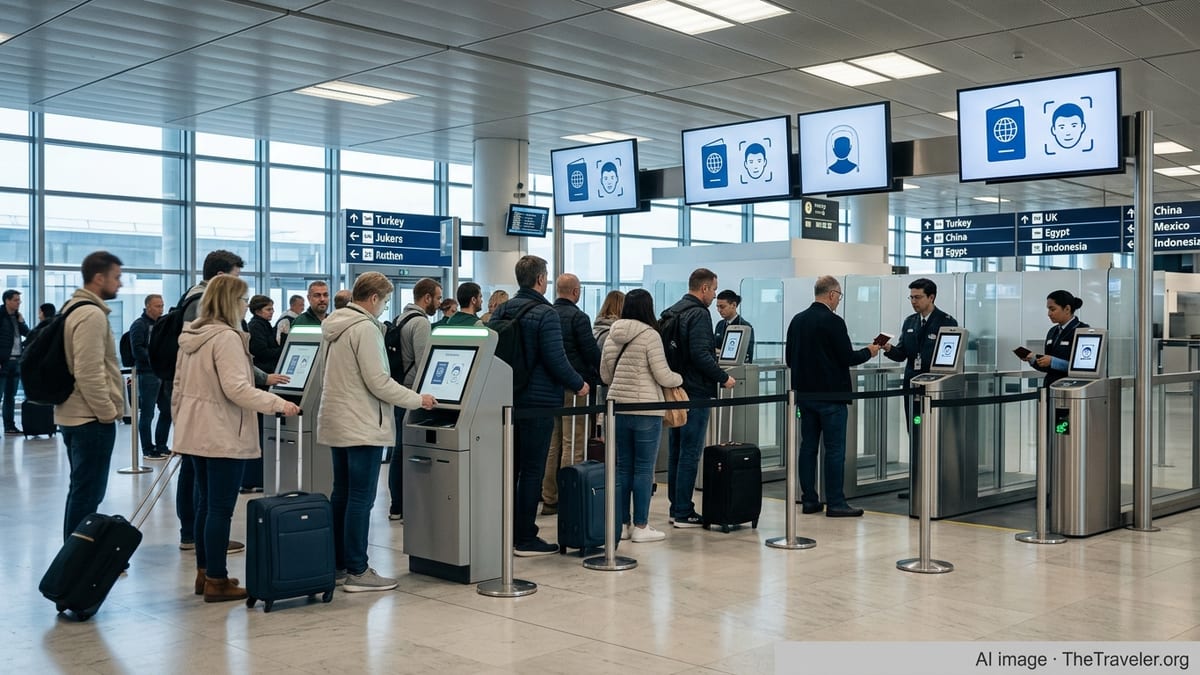
Spain’s rollout aligns with EU-wide April deadline
The EU’s Entry/Exit System, or EES, became fully operational across all external Schengen borders on 10 April 2026 after a phased deployment that began in October 2025. Publicly available information shows that all participating states, including Spain, Belgium, Portugal, the Netherlands, France and Italy, are now required to use the system for eligible non-EU travellers arriving at air, sea and land borders.
Spain entered final stress testing at major hubs such as Madrid Barajas, Barcelona El Prat and Málaga in early 2026, with round-the-clock trials of biometric kiosks designed to capture fingerprints and facial images and register each crossing digitally. Government notices indicated that Spanish border posts were technically ready by the EU’s April deadline, bringing the country into line with earlier adopters in northern and central Europe.
The Entry/Exit System replaces manual passport stamping for short-stay visits by non-EU nationals and records each entry and exit in a central database. EU institutions describe the change as a cornerstone of wider efforts to modernise border management, curb overstays and standardise checks across the Schengen area.
In practice, the transition means that first-time EES users must undergo a more complex screening process, with biometric enrolment carried out at staffed booths or self-service kiosks. Subsequent crossings are expected to be quicker, but the initial registration is currently driving the longest queues.
Lengthy queues, missed flights and uneven airport performance
From Brussels to Lisbon and Milan, the first months of live operation have been marked by widely reported bottlenecks. Coverage from aviation outlets and European media describes non-EU passengers at Brussels Airport facing queues of up to three hours at border control during the early days of the rollout, with similar accounts emerging from other Belgian and Dutch gateways as volumes increased.
Italian airports have also been under scrutiny. Recent reporting on Milan’s city airports highlighted incidents in which large groups of travellers bound for the United Kingdom missed departures after being held in prolonged EES queues. In one widely cited case at Milan Linate, more than 100 passengers were reportedly unable to board a flight to Manchester because of delays at passport control linked to the new procedures.
In Portugal, operators at Lisbon’s Humberto Delgado Airport have warned of 2–3 hour waits at peak times as border police juggle reduced booth capacity, infrastructure works and the additional steps required by the biometric system. Reports from travellers indicate that processing times can vary sharply by time of day, with some off-peak arrivals still clearing checks in under an hour while late-morning and evening waves see queues stretching through the terminal.
Experiences across Italy, France and Spain appear similarly uneven. Accounts from airports such as Venice, Bologna and Barcelona describe relatively smooth flows at quiet times contrasted with sudden spikes in waiting times when several long-haul flights land within a short window or when kiosks malfunction and passengers are redirected to manual lanes.
Business and leisure travel squeezed by processing-time shock
For business travellers and frequent leisure flyers, the most immediate impact is uncertainty. Industry analyses collating early data from airports suggest that border control processing times for non-EU passengers at some EES-equipped airports have risen by as much as 70 percent during the initial enrolment phase. Review documents from European airport associations note that waits of up to three hours have been recorded during peak traffic periods, particularly at large hubs in France, Germany, Greece, Iceland, Italy, Portugal and Spain.
Missed connections are emerging as a key risk. When inbound flights from the United Kingdom, North America or the Middle East arrive late into congested hubs such as Amsterdam Schiphol or Barcelona El Prat, passengers who must clear border control before boarding a Schengen connection can find their transfer windows eroded by unexpectedly long queues. Travel forums and local coverage have pointed to cases in which even a 90-minute layover has proved insufficient when EES lines swell beyond the terminal’s design capacity.
Corporate travel planners are starting to adjust itineraries and internal guidelines. Publicly accessible advisories from European business travel groups now recommend that companies build in longer minimum connection times at key Schengen gateways and encourage staff to avoid last flights of the day where possible. For leisure travellers, tour operators are updating pre-departure briefings to warn that border formalities may take significantly longer than in pre-EES summers, particularly for families and older passengers who may need more assistance with kiosks.
In cities where tourism is a major economic driver, there are growing concerns that high-profile scenes of congestion could influence destination choice. Travel industry commentators note that headlines about multi-hour queues at Venice or Amsterdam could push some visitors to opt for alternative routes or non-Schengen destinations if bottlenecks persist into the main holiday period.
Peak-hour congestion at flagship hubs in Spain, Italy, France and the Low Countries
Major tourist and business hubs are carrying the brunt of the strain. Monitoring by European institutions and airport bodies indicates that airports handling large volumes of non-EU point-to-point traffic face particular challenges, since a high proportion of arriving passengers are encountering the Entry/Exit System for the first time.
In Spain, Barcelona El Prat and Madrid Barajas have both seen busy scenes at peak hours, especially when transatlantic and UK flights arrive in clusters. Reports from Spanish media describe terminals where non-EU queues snake through cordoned-off areas while EU and Schengen citizens, who are not subject to EES checks in the same way, pass more quickly through separate lanes. Airport operator statements emphasise that additional staff have been deployed and lane allocations adjusted, but acknowledge that biometric enrolment remains the main limiting factor during rush periods.
Italy’s Venice and Milan Malpensa are wrestling with similar dynamics. Travel reports and passenger anecdotes from April and May point to congestion building quickly when several narrow-body flights from the UK and other non-Schengen origins land in close succession. In some instances, airport staff have been reported directing passengers with imminent departures to fast-track lanes in an effort to reduce the number of missed flights, while others with longer connections endure extended waits.
Further north, Amsterdam Schiphol and Brussels Airport have both featured prominently in coverage of EES disruption. Schiphol’s long-standing capacity and staffing challenges have combined with the new system to produce sporadic surges in waiting times, while Brussels has become an early case study in how infrastructure, staffing levels and equipment reliability shape the passenger experience under the new regime.
Airports and EU bodies race to stabilise the system before summer
European institutions maintain that the Entry/Exit System will ultimately speed up border checks once the majority of frequent travellers have been enrolled and systems are fully optimised. Official reviews published in early 2026 point to security benefits, including more accurate tracking of overstays and improved tools for verifying traveller identities at the border.
In the short term, however, airport associations are calling for urgent operational fixes. Recent position papers from airport groups urge the European Commission, the EU’s IT agency and national governments to coordinate software improvements, upgrade hardware and reinforce frontline staffing at the busiest border points. The same documents argue that clear public communication is essential so that non-EU passengers understand what will be required on arrival and can allow extra time.
Several member states have already adjusted their rollout strategies in response to the early turbulence. Publicly available guidance from some countries notes that, in specific locations and at certain times, authorities have temporarily reduced reliance on biometric capture, prioritising throughput and manual checks while technicians work on stabilising equipment. Other states have further staggered activation across border posts to avoid simultaneous pressure on all gateways.
With the northern hemisphere summer peak approaching, airlines, airports and travel companies are warning customers to prepare for longer queues at external Schengen borders, particularly at major hubs in Spain, Italy, Portugal, France, Belgium and the Netherlands. Industry observers suggest that the coming months will be a critical test of whether Europe’s ambitious biometric border project can deliver on its promise of more efficient and secure travel without undermining the continent’s appeal as an accessible destination.