


More news on this day
Newark Liberty International Airport is warning of continued delays after a telecommunications failure at a regional air traffic control center triggered ground stops and widespread flight disruptions across the Northeast at the start of a busy travel week.
Get the latest news straight to your inbox!
Equipment failure ripples across the Northeast
Published coverage indicates that the disruption began on Sunday, September 20, when a construction crew near New Brunswick, New Jersey, severed a Verizon fiber optic cable that served as a backup communications line for a Federal Aviation Administration facility in the Philadelphia area. That backup was designed to take over if the primary circuit failed, but both links went down, interrupting critical data connections used to manage traffic into several of the country’s most tightly packed air corridors.
Reports from national outlets describe how the communications failure affected air traffic control operations that serve Newark Liberty International Airport, as well as Philadelphia International, LaGuardia, John F. Kennedy and Teterboro. As the outage unfolded on Monday, New York City area airports implemented ground stops that paused many arrivals and departures, creating a rapid buildup of aircraft and passengers both on the ground and in the air.
According to data cited in multiple news reports, more than 1,000 flights across the region were canceled on Monday and more than 6,000 were delayed, with Newark experiencing some of the heaviest disruption. Flight tracking information summarized in published coverage shows that commercial traffic into Newark was reduced to a near standstill for several hours as controllers worked with limited communications capacity.
By Monday evening, transportation officials stated that damaged lines had been repaired and that the affected control center was again fully connected. However, the operational restart did not immediately clear the backlog of flights, especially at Newark, where congestion and tight scheduling leave little margin for major interruptions.
Delays and cancellations at Newark Liberty
Publicly available flight tracking data referenced by outlets such as ABC News and News 12 New Jersey indicates that Newark Liberty recorded more cancellations on Monday than any other airport worldwide. More than 600 flights into and out of the airport were reported canceled, and many others were diverted to alternative airports or held on the ground at their origin.
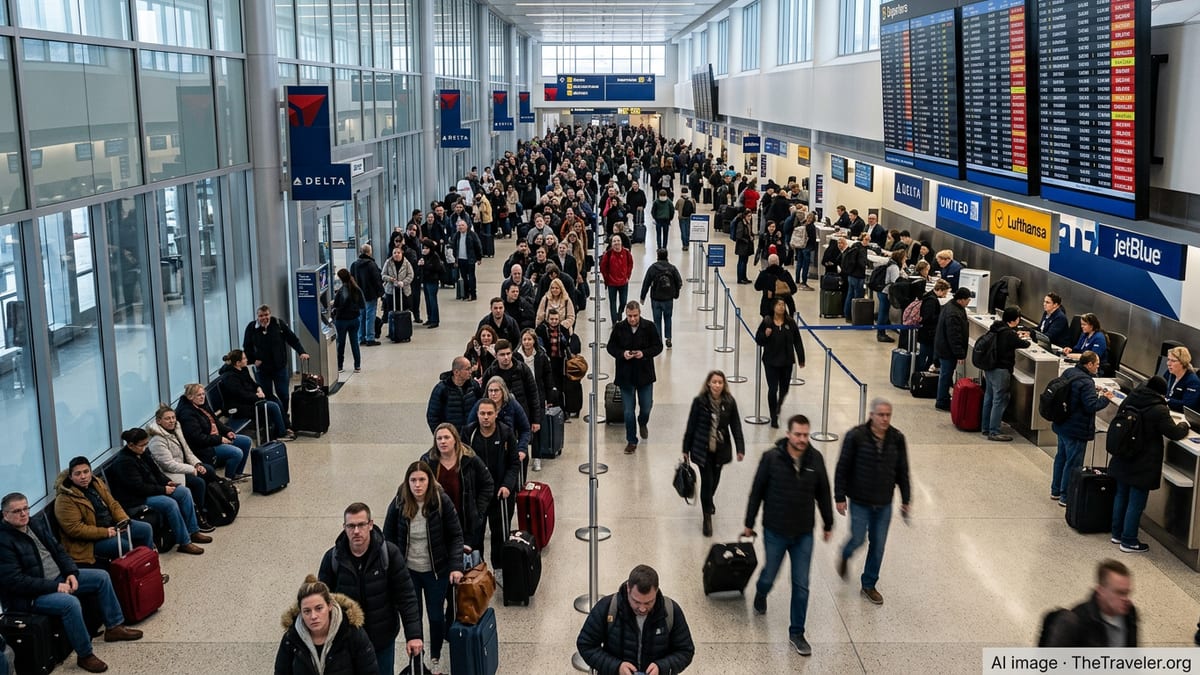
Coverage from local broadcasters focused on scenes inside Newark’s terminals, where passengers faced long lines at check-in counters, security checkpoints and customer service desks as airlines attempted to rebook travelers. Some flights that had already departed were rerouted mid-journey, creating additional logistical complexity as crews and aircraft ended the day far from their scheduled positions.
On Tuesday, September 22, airlines resumed regular operations at Newark but continued to warn of delays while they worked through displaced aircraft and crew schedules. Local news reports from New Jersey indicate that carriers were still contending with rolling delays into the afternoon, even though the original telecommunications issue had been resolved.
Newark’s role as a major hub for domestic and international connections amplified the impact. When hub operations are disrupted, missed connections can cascade throughout national and global networks, causing knock-on delays for flights that do not pass through the original point of failure.
What travelers can expect in the next 24 to 48 hours
According to airline advisories and publicly posted schedules, travelers using Newark Liberty over the next one to two days should be prepared for irregular operations while carriers realign aircraft and crews. Schedules may show flights as operating, but day-of delays remain possible, particularly during peak morning and late afternoon bank times when the airport typically runs close to its capacity limits.
Some airlines have announced flexible travel policies in response to the outage, allowing passengers booked to, from or through Newark and other affected Northeast airports to change dates without standard change fees or fare differences within specified windows. The exact terms vary by carrier, and travelers are being directed in public notices to check their airline’s website or app for the latest options.
Flight status tools on airline platforms and flight tracking services are likely to be the most up-to-date source of information on individual departures. Published guidance from travel and aviation analysts recommends that passengers confirm the status of their flights before leaving for the airport, and consider arriving earlier than usual in case check-in and security queues remain longer than normal while airlines handle rebookings.
For those with tight connections in Newark, several analysis pieces suggest evaluating whether same-day re-routing through other hubs is possible if delays mount. However, this can depend on available seats and on whether disruptions are still affecting neighboring airports in the New York and Philadelphia regions.
Why Newark is particularly vulnerable to disruptions
The latest outage comes on top of longstanding congestion challenges at Newark Liberty. Federal regulatory documents and prior coverage highlight that the airport has been subject to operating limitations intended to manage chronic delays, reflecting both high demand and constrained airspace near New York City. Even on routine days, Newark often records some of the nation’s longest average delay times during peak periods.
Because Newark serves as a major hub and gateway, schedules are densely packed, with narrow turnaround times between arrivals and departures. When a large-scale event removes several hours of arrivals and departures from the system, as occurred during the communications failure, there is limited slack to absorb the shock. Aircraft and crews become misaligned, and recovery can extend well beyond the moment technical systems are restored.
Recent congressional and regulatory attention to previous outages linked to the same Philadelphia-area facility has focused on the resilience of the telecommunications and radar infrastructure that supports Newark’s operations. Public reports reference earlier episodes in 2025 in which outages affected Newark-bound flights and prompted questions about redundancy and contingency planning for critical circuits.
The current incident is likely to renew discussion about the pace of modernization for the region’s air traffic control systems and the robustness of backup connections. Analysts cited in national coverage have pointed to the combination of aging infrastructure, intense traffic volumes and increasing weather volatility as a complex mix of challenges for major Northeast airports.
Practical tips for travelers using Newark after the outage
As operations stabilize, travelers passing through Newark Liberty in the coming days can reduce uncertainty by relying on multiple sources of real-time information. Airline mobile apps and text or email alerts provide the most direct updates on gate changes and delays, while the airport’s own departure boards reflect local adjustments as they occur.
Reports from the disruption suggest that rebooking lines at airport counters grew quickly during the height of Monday’s outage. For any residual knock-on delays, using digital self-service tools, such as airline apps and automated customer service channels, may offer faster rebooking options than waiting in person, especially for simple itinerary changes or same-day standby requests.
Passengers connecting through Newark to international destinations should pay particular attention to minimum connection times and immigration or security requirements on their itineraries. If a misconnection appears likely because of ongoing delays, some travel experts quoted in recent media coverage recommend proactively contacting the airline before arrival to explore alternative routings.
For travelers with flexible plans, publicly available guidance suggests considering off-peak departure times, such as midday or late evening, while the system recovers. These flights may face less congestion both on the ground and in the air, reducing the risk of extended waits as airlines continue to unwind the disruption caused by the telecommunications outage.