

More news on this day
Hundreds of US air passengers faced unexpected overnight stays and missed connections after Newark Liberty International Airport reported 179 delays and 62 cancelled flights in a single day, disrupting services on United, Republic, American and other carriers across key routes to London, Chicago, Boston and additional domestic and transatlantic destinations.
Get the latest news straight to your inbox!
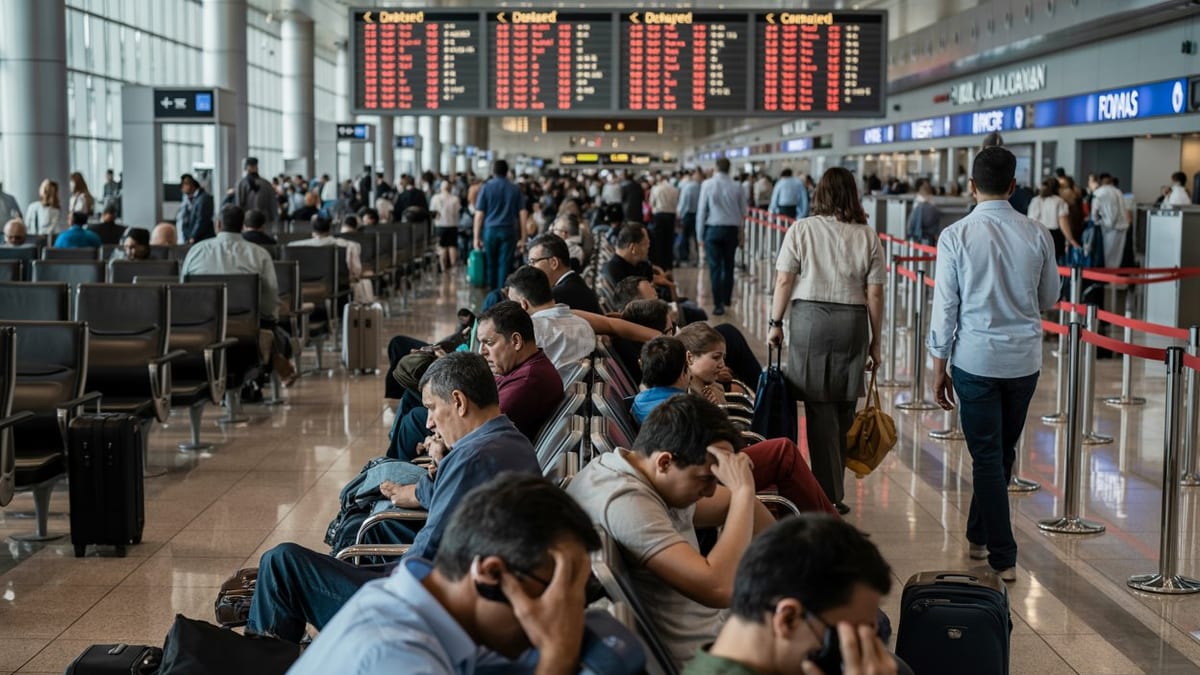
Heavy Disruptions Hit Newark Liberty Operations
Newark Liberty International Airport once again emerged as one of the most disrupted hubs in the United States, with 179 delayed services and 62 cancellations recorded in one travel day, according to aggregated flight-tracking data and consumer-rights analyses. The disruption affected departures and arrivals throughout the schedule, with peak problems concentrated in the afternoon and evening connection banks.
Publicly available information shows that the operational strain particularly affected United Airlines, the largest carrier at Newark, along with regional partner Republic Airways and rivals including American Airlines. Knock-on effects spread beyond the New York and New Jersey region into major hubs such as Chicago and Boston, as well as key long haul routes including London services.
Travel data providers indicate that more than 300 individual flights at Newark were touched by delays or cancellations over the wider disruption window, underscoring how quickly problems at a capacity constrained hub can cascade through the network. For many passengers, relatively short pushback delays evolved into multi hour waits, missed onward flights and, in some cases, complete trip rebookings.
Newark has long been identified by aviation analysts as one of the most delay prone large US airports during high volume periods. Its tightly scheduled runway system and busy airspace shared with John F. Kennedy International and LaGuardia mean that even modest operational shocks, from weather cells to staffing constraints, can translate into large numbers of delayed and cancelled services.
United, Republic And American Among Most Affected Carriers
Available schedules and disruption tallies point to United Airlines bearing the brunt of the latest wave of problems, reflecting its dominant presence at Newark. Regional feeders operated by Republic Airways on behalf of United were also heavily exposed, particularly on short haul routes linking Newark with cities such as Boston and Chicago.
Consumer compensation platforms and flight status services show that multiple United operated departures between Newark and London Heathrow, Chicago O’Hare and Boston Logan experienced extended delays or cancellations during the disruption period. Services operated by American Airlines and other competitors also saw schedule changes as congestion and ground holds slowed the flow of traffic in and out of the airport.
Because many of the affected flights connected through large hubs, the fallout extended nationwide. Passengers originating in smaller US cities but connecting via Newark to London or other transatlantic gateways found themselves stranded mid journey when their onward departures were scrubbed or significantly delayed. Some travelers reported being rebooked on alternative routings that added many hours to already long itineraries.
Publicly accessible booking data suggests that rebooking options were limited on some corridors, especially evening services to Europe that typically operate near full capacity. As a result, some customers were shifted to flights departing the following day, increasing pressure on hotels and ground transportation around the airport.
Ripple Effects Across London, Chicago, Boston And Beyond
The scale of the disruption at Newark translated into a web of delays across the North American and transatlantic network. Routes linking Newark to London were among the highest profile casualties, with at least one Newark to London Heathrow departure listed as cancelled in real time tracking systems and others experiencing schedule changes that pushed arrivals well past their planned times.
Chicago O’Hare and Boston Logan, both critical business and leisure markets from Newark, also saw a series of delayed and cancelled flights. Public disruption logs show regional jets and narrow body aircraft either departing substantially behind schedule or failing to operate at all, leaving passengers to queue for rebooking assistance and scramble for remaining seats on later services.
These operational snags did not only affect passengers bound for major hubs. Because many Newark departures continue onward to secondary US and international destinations, the delays rippled into flights serving mid size cities across the Midwest and East Coast. In several cases, missed inbound connections left aircraft underutilized and forced schedule adjustments further down the line.
Analysts note that when a hub like Newark experiences dozens of cancellations in quick succession, network resilience is quickly tested. Aircraft and crew end up out of position, and recovery can require multiple days of schedule adjustments, especially when high load factors limit the availability of spare seats on subsequent flights.
Why Newark Is Vulnerable To Large Scale Disruptions
Aviation specialists frequently highlight Newark’s structural vulnerabilities in explaining outsized disruption numbers. The airport operates in some of the most congested airspace in the United States and must coordinate closely with neighboring New York area airports that share approach and departure corridors. When the Federal Aviation Administration implements ground delay programs or spacing restrictions in this airspace, Newark often sees immediate slowdowns.
Past federal orders have placed caps on the number of hourly operations at Newark in an effort to ease chronic congestion. While these limits are intended to reduce extreme delays over the long term, they also leave the system with little slack. When weather, air traffic control staffing issues or technical constraints arise, schedules can quickly unravel because there are few open slots available to absorb disruption.
Industry observers also point to the complexity of Newark’s role as a major connecting hub. United and its partners feed a large volume of domestic flights into banks that connect onward to Europe, Latin America and other long haul markets. If local operations falter during one of these banks, the impact can strand large numbers of connecting passengers who rely on tight transfer windows.
The latest spike of 179 delays and 62 cancellations underlines how even a single difficult day can cascade across multiple airlines using the airport. With summer and holiday travel peaks approaching, consumer advocates suggest that travelers monitor conditions at Newark closely and consider allowing extra time or flexible routings when itineraries depend on connections through the airport.
What Stranded Passengers Can Do Next
For travelers affected by the wave of delays and cancellations, publicly available guidance emphasizes several immediate steps. Passengers are encouraged to check real time flight status tools and airline apps, which often display rebooking options and digital boarding passes faster than traditional customer service lines can process requests.
Where flights have been cancelled or severely delayed, some travelers may be eligible for refunds, vouchers or out of pocket expense support, depending on the cause of disruption and airline policies. Consumer rights organizations recommend that passengers retain receipts for hotels, meals and alternative transport, and review carrier specific service plans that outline what assistance is offered in the event of irregular operations.
Travel experts also note that travelers with time sensitive connections, such as cruises or long haul tours, may wish to plan greater buffers when using Newark during historically busy periods. Building in additional connection time or considering alternative routings through less congested hubs can reduce the risk of cascading disruptions when conditions at Newark deteriorate.
While airlines and regulators continue working on long term solutions to improve resilience at Newark Liberty, the latest episode of 179 delays and 62 cancellations illustrates that significant disruption remains a realistic scenario for US passengers. For now, close monitoring, flexible planning and a clear understanding of passenger rights remain the most practical tools for travelers navigating this critical but congestion prone gateway.