


Nice Côte d’Azur Airport is the main gateway to the French Riviera, and for many travelers it is also the starting line of a classic Mediterranean road trip. Whether you are planning a day in Monaco, a beach hop to Cannes, or a longer loop into the hilltop villages and lavender fields of Provence, renting a car at Nice Airport can be either wonderfully liberating or needlessly stressful. This guide walks you through the practical details so you can decide if a car is actually worth it for your itinerary and, if it is, pick up the keys with confidence.
Get the latest updates straight to your inbox!
How car rental works at Nice Côte d’Azur Airport
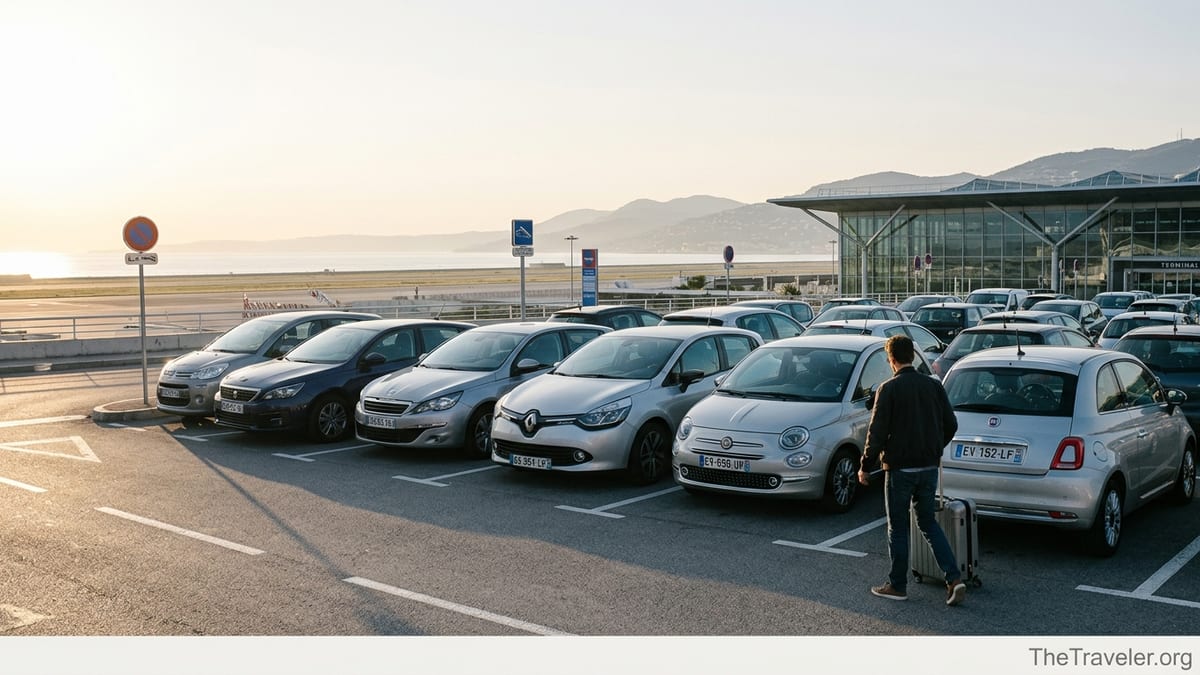
Nice Côte d’Azur Airport serves both Nice and the wider Riviera, including Monaco and much of Provence, and it has one of the busiest rental operations in France. Major international brands such as Avis, Budget, Hertz, Europcar, Sixt, Enterprise and Goldcar all maintain desks at the airport, alongside a few smaller local firms. Desks are signposted in both Terminal 1 and Terminal 2, but the actual vehicles are grouped in a dedicated Car Rental Center next to Terminal 2, behind the main parking areas. In practice, this means that even if you land at Terminal 1, you may collect and return your car in the same consolidated zone by following the “Car Rental” and “Location de voitures” signs or by using the free internal shuttle.
For many travelers, the most confusing part is that booking sites may list “Nice Airport” with slightly different wording, such as “Nice Airport T1,” “Nice Airport T2,” or simply “Nice Ville / Airport.” As long as the confirmation clearly mentions “Nice Airport” rather than downtown Nice, you will collect at the airport Car Rental Center. If you accidentally book a city branch to save a few euros, you will need to take the tram or taxi into Nice to pick up the vehicle, which can easily erase any savings and add an hour to your arrival day.
Opening hours are generally aligned with flight schedules, but not all companies operate 24 hours. A typical schedule for a mid-range company might be 7:00 to 23:00, with surcharges or restrictions for very late pickups. If you are arriving on a late evening flight from London or New York, check the opening times printed on your voucher and consider shifting your rental start to the following morning if your arrival is after closing. In that case, you could take the tram into Nice for the first night and collect your car from an in-town office the next day.
Queue times fluctuate dramatically by season. On a July or August Saturday around midday, when villas turn over and cruise passengers disembark, lines at the largest counters can stretch to 45 minutes or more. At 9:00 on a weekday in October, you might be served in under ten minutes. Booking with a loyalty profile, signing the contract in advance through a “fast lane” program, or choosing a slightly less popular brand can all reduce the time you spend in line before you can actually start your Riviera drive.
Choosing the right car and understanding costs
The Riviera’s narrow streets and tight parking garages mean that smaller often truly is better. A compact hatchback such as a Renault Clio, Peugeot 208 or similar segment is usually the sweet spot for two to four travelers with moderate luggage. These cars are much easier to thread through Nice’s one-way streets or into a tight space in a Cannes underground car park than a large SUV, and they generally use less fuel. If you are heading deep into Provence for a week and carrying larger luggage, a compact SUV like a Peugeot 2008 or Nissan Qashqai offers additional comfort without becoming unwieldy.
Pricing is highly seasonal. In shoulder months like April or October, a compact with manual transmission can often be found for the equivalent of a modest hotel night per day, sometimes less if you book several months in advance. In late July or during the Monaco Grand Prix period in May, the same category can easily cost two or three times more. Automatics, convertibles and larger SUVs carry noticeable premiums. An automatic compact may cost 20 to 40 percent more than a manual, while a small cabriolet like a Fiat 500C can be priced more as a lifestyle accessory than simple transport, especially in summer.
Fuel and tolls add to the equation, but usually not dramatically for common Riviera routes. The run from Nice Airport to Monaco via the A8 motorway is only about 30 minutes and uses a short tolled section, so the toll cost remains modest, while the parallel coastal road via Villefranche and Èze has no toll but takes longer and can be congested. A day loop from Nice through Cannes, Antibes and back on local roads may not require any motorway tolls at all if you are willing to stay on the coastal and departmental roads.
Manual transmission is still standard on many French rental fleets, and first-time visitors from North America are often surprised at how limited the automatic inventory can be in busy periods. If you are not fully comfortable with a manual, it is worth paying the automatic premium and reserving early rather than hoping to “be upgraded” at the counter, particularly around weekends and holidays. Rental companies will almost always honor a paid automatic reservation with an automatic, even if they have to move you to a higher category, while they are under no obligation to find you an automatic if you booked the cheapest manual option.
Driving from Nice Airport to Monaco, Cannes and Provence
Driving out of Nice Airport is relatively straightforward compared with exiting some big-city airports. As you leave the Car Rental Center you quickly merge onto the Promenade des Anglais towards Nice or pick up signs for the A8 motorway towards Cannes and Aix-en-Provence in one direction and Monaco and Italy in the other. Sat-nav units rented with the car usually recognize “Monaco” and “Cannes” without fuss, and smartphone apps work well, although data roaming costs should be checked in advance for non-European visitors.
The drive from the airport to Monaco splits into two broad choices: the fast A8 motorway or the scenic coastal “Basse Corniche” through Villefranche-sur-Mer, Beaulieu and Cap-d’Ail. The motorway is the practical option if you are arriving after a long flight or at night, since signage is clear and the route is well lit. The coastal road offers sweeping sea views but can be slow in peak hours, with locals commuting and tour buses navigating tight bends. A realistic door-to-door time from the airport to a Monaco hotel garage is around 35 to 50 minutes, depending on traffic and your chosen route.
Reaching Cannes from Nice Airport is simpler: the A8 runs west from the airport and brings you above Cannes in about 25 to 35 minutes in normal conditions. From there, signed exits lead down to La Croisette, the Palais des Festivals and the compact city center. Alternatively, you can follow the seafront road via Antibes and Juan-les-Pins, which is slower but feels much more like a holiday drive, especially in good weather when the Esterel hills appear in the distance.
For Provence proper, distances stretch but remain very manageable. Aix-en-Provence is around two hours away by motorway, and hilltop villages such as Moustiers-Sainte-Marie or Gordes can be day trips if you start early, although many travelers choose an overnight stay to avoid spending most of the day behind the wheel. The Riviera’s motorway network is modern and generally in good condition, but summer Saturdays can bring heavy slowdowns, particularly westbound in the morning and eastbound in late afternoon, as vacation rentals change guests. Planning long drives outside peak changeover hours can save a surprising amount of time and stress.
Parking realities in Monaco, Cannes and along the Riviera
Parking is often the biggest surprise for first-time visitors who have imagined carefree seaside motoring. In Monaco, almost all on-street parking is tightly regulated or reserved for residents, and visitors are expected to use the network of underground public garages. These garages are clearly signposted on approach roads and display real-time space numbers at the entrance. The upside is that they are generally clean, well lit and close to key sights such as the Casino, the old town on the Rock or the Port area. The downside is that costs accumulate over a full day, especially if you enter and exit multiple times.
In Cannes, the pattern is similar but slightly less intense. Underground car parks near La Croisette, the railway station and the Palais des Festivals are the default choice for visitors, and during major events such as the Cannes Film Festival or big trade fairs they can fill quickly. Residential streets on the hills above the center may offer some free or cheaper spaces, but they are scarce and often involve steep walks back down to the seafront. For many travelers staying in Cannes with a car, it is worth paying a bit more for accommodation that includes secure on-site parking, even if it is a mechanical stacker system common in some modern buildings.
Elsewhere along the Riviera, parking varies widely from town to town. In Antibes, garages near the old town help you avoid circling the ramparts; in Saint-Paul-de-Vence, visitors park in large hillside lots and walk up into the walled village. In smaller coastal towns, a single waterfront lot may serve the entire beach, filling by mid-morning in July. As a practical example, arriving at 10:30 in high season at a popular beach town like Juan-les-Pins can mean a 20-minute search for a space, while arriving before 9:00 usually offers multiple options in the same lot.
Many public garages and pay-and-display zones have height restrictions, often between 1.80 and 2.00 meters. This is important if you are tempted by a taller SUV or van. A compact SUV usually remains under common limits, but a larger people carrier with roof box may exceed them, forcing you to hunt for outdoor lots further from the center. When booking, check the vehicle height in the specification and think about where you will park, especially if Monaco or central Nice garages are part of your plan.
Insurance basics when renting a car in France
All rental cars in France must carry third-party liability insurance, which is bundled into the base rate. This covers damage or injury you may cause to others but not damage to the rental car itself or theft. To protect the vehicle, rental companies layer on products commonly labeled CDW (Collision Damage Waiver), LDW (Loss Damage Waiver) and Theft Protection. In France these are often already included to some extent in displayed prices, but with an excess: if the car is damaged, you can still be charged up to a set amount, sometimes in the low thousands of euros.
At the counter you are likely to be offered options to reduce or eliminate that excess. This might be called Super CDW, Super Cover or similar, and it typically raises the daily price but lowers your maximum liability to a few hundred euros or even zero. Separate add-ons may cover glass and tires, roadside assistance without extra call-out fees, or personal accident insurance for the driver and passengers. The exact mix varies by brand, and the names differ, so reading the inclusions line on your voucher before arrival is wise.
Many international travelers rely on a credit card’s rental car insurance to avoid paying for full coverage at the counter. These policies typically cover damage and theft to the rental vehicle when you decline the rental company’s own CDW, but they do not replace the legally required third-party liability that is already included by the French rental company. To use a card benefit confidently, you should confirm in advance that your specific card covers rentals in France and Monaco, check maximum rental lengths and vehicle categories, and be prepared to pay any damage charges on the card while the claim is processed later.
For cautious travelers, especially those unfamiliar with narrow village lanes or underground garages, paying for the rental company’s enhanced coverage can provide straightforward peace of mind. A realistic scenario might see a traveler scraping a rim or a pillar in an Antibes car park. With only basic coverage, that can result in a bill approaching a four-figure sum, later reclaimed from a card insurer. With the highest in-house cover, it may be reduced to a modest administrative fee or nothing at all. The right choice largely depends on your risk tolerance, your willingness to manage paperwork after the trip, and how close the rental company’s excess is to an amount you are comfortable having temporarily blocked on your card.
Local rules, low-emission zones and practical driving tips
Driving along the Riviera is not technically difficult, but local habits and rules differ from those in North America or the UK. Urban areas like Nice use a dense network of one-way streets and bus lanes, some of which are policed by cameras. Accidentally entering a bus-only corridor can lead to a fine that arrives weeks after you return home. Using updated navigation, watching for blue bus-lane signs and avoiding last-second lane changes into seemingly empty lanes will keep you out of trouble.
Speed limits are generally 50 km/h in built-up areas, 80 or 90 km/h on main local roads depending on signage, and up to 110 or 130 km/h on motorways, but limits can drop sharply around tunnels or junctions. Fixed speed cameras are common, especially along the A8 and approaches to major towns, and they are usually preceded by warning signs. A common real-world scenario involves a visiting driver following local traffic slightly above the limit and receiving a notice several months later at their home address via the rental company. Setting your cruise control near, not above, posted limits is a simple protective habit.
Environmental regulations are evolving across France, with more cities creating low-emission zones. In practice, major rental fleets based at Nice Airport operate relatively new vehicles that comply with current standards, and rental license plates are generally allowed in restricted zones where private older vehicles would face limits. Nonetheless, it is sensible to stick to signed through-routes in city centers and avoid ad hoc detours into residential side streets, both for emissions rules and for your own navigation sanity.
Fuel is straightforward: most cars use diesel or unleaded gasoline clearly labeled at service stations along the A8 and in major towns. You almost always pay at the pump or in the adjacent shop, and many unmanned stations accept foreign credit cards, though a small number may reject certain non-European cards. Returning the car with the agreed fuel level is important, as refueling charges from rental companies can be noticeably above pump prices. Allow an extra fifteen minutes at the end of your trip to stop at a fuel station near the airport before following signs back to the Car Rental Center.
Do you really need a car for the Côte d’Azur?
A key question for many travelers is whether a car is necessary at all. For itineraries focused on a single base like Nice or Cannes, with perhaps a side trip or two, the answer is often no. The coastal train line links Nice, Villefranche, Monaco, Antibes and Cannes in a string of half-hour hops, and trams and buses within Nice cover most urban sightseeing. In such cases, a car can feel more like a burden than a freedom, especially when factoring in hotel parking charges and the hassle of navigating tight streets after dinner.
On the other hand, a car becomes distinctly useful if your plans include hilltop villages, inland vineyards or remote coves poorly served by public transport. Destinations like Èze Village, Saint-Paul-de-Vence, Gourdon, the Gorges du Loup or certain stretchs of the Var and Luberon countryside are reachable by bus with patience, but a car turns them into a relaxed circuit instead of a logistics puzzle. Couples or families who enjoy exploring at their own pace, stopping wherever a roadside view tempts them, often find that a few days of car rental in the middle of a longer Riviera stay provide the ideal balance.
A practical approach many visitors adopt is to separate their trip into a car-free and a car-based segment. You might spend three nights in Nice without a car, walking, using trams and trains, then rent a car from the airport or a city branch for four days to explore inland Provence and smaller coastal towns, returning it before a final car-free night back in Nice. This strategy avoids paying for a car to sit unused in a garage during your urban days while still unlocking the rural and small-town side of the region.
Budget also plays a role. A couple staying in a mid-range hotel in Nice will often find that train tickets plus the occasional taxi or ride-hail cost significantly less than a week of car rental plus parking. A family of four staying in a villa outside a town center, on the other hand, may find a car essential both for grocery runs and for reaching beaches or attractions that are not on a direct bus route. Thinking about where you will sleep and how far you will be from the train line is as important as listing the names of the towns you want to see.
The Takeaway
Renting a car at Nice Côte d’Azur Airport can be the key to a memorable Riviera and Provence road trip, but it is not a one-size-fits-all solution. The airport’s Car Rental Center brings together all major brands, making collection and return relatively streamlined, yet seasonal crowds, narrow streets and structured parking mean the driving experience is very different from a wide-open North American highway.
If your travel style leans towards exploring hill villages, quiet vineyards and lesser-known coves, a compact car booked ahead of time and paired with sensible insurance coverage will likely feel like money well spent. If your plans revolve around Nice, Monaco, Cannes and other rail-connected towns, you may prefer to rely on trains and trams and either skip the car completely or rent one only for a short inland segment.
Ultimately, the best plan is the one that aligns with your comfort behind the wheel, your accommodation choices and your willingness to manage parking and local rules. With realistic expectations, a bit of advance research on coverage and routes, and a car sized to the Riviera’s streets rather than your luggage fantasies, your drive out of Nice Airport can mark the start of a relaxed, flexible journey along one of Europe’s most celebrated coastlines.
FAQ
Q1. Is it easy to find the car rental desks when I land at Nice Airport?
Yes. Both terminals have clear signs for car rental, and all major brands are grouped around the Car Rental Center by Terminal 2. Just follow the “Location de voitures” signs after baggage claim.
Q2. Do I need an International Driving Permit to rent a car in Nice?
Most EU and UK licenses are accepted as is. Travelers from North America and other regions can usually rent with their home license, but an International Driving Permit is recommended if your license is not in Roman script or if the rental company specifically requests it.
Q3. How long does it take to drive from Nice Airport to Monaco?
In normal traffic, expect around 35 to 50 minutes door to door, depending on whether you take the faster A8 motorway or the slower but more scenic coastal road via Villefranche and Èze.
Q4. Is parking in Monaco as difficult as people say?
Street parking is extremely limited and mostly reserved for residents, but visitors can rely on a well-organized network of underground public garages. Spaces are usually available outside of major events, but costs add up over a full day.
Q5. Should I book an automatic car or is a manual fine?
If you are fully comfortable driving a manual, it can save money and broaden your vehicle choices. If you are at all unsure, especially on hills or in tight garages, booking an automatic in advance is the safer and less stressful option.
Q6. What insurance do I really need for a Riviera road trip?
Third-party liability is included by law. Beyond that, you should decide whether to rely on your credit card’s collision coverage or pay the rental company to reduce your excess. Many travelers choose higher in-house coverage for peace of mind in tight parking garages and village streets.
Q7. Are toll roads unavoidable when driving from Nice to Cannes or Monaco?
No. The A8 motorway has toll sections, but you can use coastal and local roads to avoid them. This is slower but more scenic. Many drivers mix both, taking the motorway when in a hurry and the coast road for relaxed sightseeing.
Q8. Is it worth having a car if I am only visiting Nice and Cannes?
Often it is not. The train between Nice, Antibes and Cannes is frequent and inexpensive, and local public transport inside each city is good. A car may sit unused while you pay for parking, so many travelers skip it for a purely coastal city itinerary.
Q9. How early should I book a rental car for July or August?
For peak summer, booking several months ahead is wise, especially if you need an automatic, a child seat or a specific vehicle size. Last-minute availability can be limited and prices can climb sharply close to travel dates.
Q10. Can I drive my French rental car across the border into Italy or elsewhere?
Most airport rentals allow cross-border travel to neighboring countries such as Italy and Monaco, but restrictions vary by company and vehicle category. Always check your rental conditions in advance, and inform the company if you plan to cross any borders so insurance remains valid.