


Every winter, the French Riviera explodes back to life with two of Europe’s most distinctive festivals: Nice Carnival and the Menton Lemon Festival. Both turn the usually quiet low season into a blaze of color, confetti and night-time parades, yet they offer very different experiences. If you can only plan one Riviera escape, which event is more likely to stay with you long after the last float rolls away?
Get the latest updates straight to your inbox!
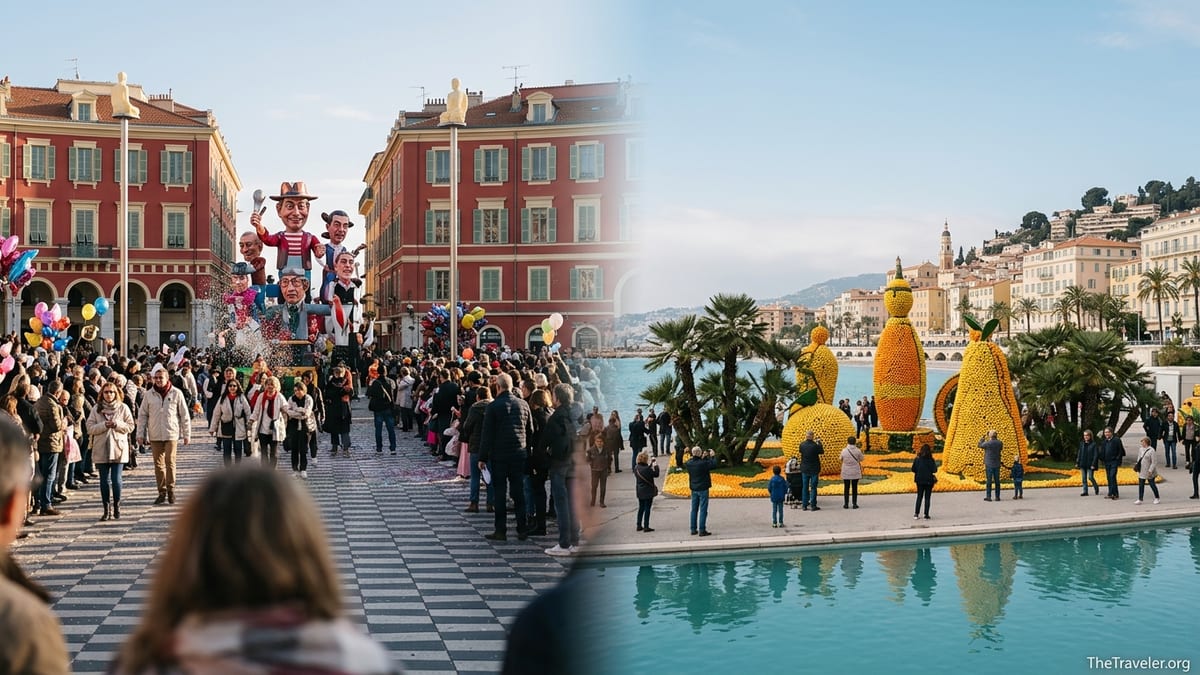
Two Riviera Icons With Very Different Personalities
Nice Carnival and the Menton Lemon Festival occupy the same late‑winter window, often running in February and early March, but they feel like cousins with contrasting personalities. Nice is a big city carnival with satirical giants, booming sound systems and crowds that can top a million visitors over the season, according to regional tourism figures. Menton, a much smaller town near the Italian border, hosts a festival that is part carnival, part open‑air art exhibition built from real citrus fruit.
Nice Carnival typically stretches across a little more than two weeks. Recent editions, such as the 2025 carnival, have run roughly from mid‑February to early March, filling the city center around Place Masséna and the Promenade des Anglais with day and night parades, flower battles and light shows. Standing tickets for key events often start at around 12 to 15 euros for adults, with grandstand seating costing more depending on the date and location.
Menton’s Lemon Festival, or Fête du Citron, follows a similar calendar, for example from around 15 February to 2 March in 2025, but its rhythm is gentler. The town builds monumental sculptures in the Biovès Gardens using up to several tonnes of lemons and oranges each, then supplements them with Sunday “Golden Fruit” parades and Thursday night corsos. The official tourism office notes that the festival attracts in the ballpark of 250,000 visitors each year, a fraction of Nice Carnival’s footfall, which has a direct impact on atmosphere and crowd levels.
The result is a clear personality split. Nice Carnival feels like a classic European mega‑carnival comparable in spirit to Viareggio or even a mini version of Rio, while Menton feels closer to a dreamy coastal fair dedicated to one very specific fruit and the slow pleasures of the Riviera winter sun.
Visual Spectacle: Satirical Giants vs Citrus Cathedrals
When travelers talk about the impression these events leave, they almost always start with visuals. Nice Carnival is famous for its towering floats, some several stories high, that lampoon global politics, pop culture and local life. Recent editions have featured oversized caricatures of world leaders, social media “monsters” and surreal mash‑ups marching through Place Masséna accompanied by dancers, brass bands and costumed performers. At night, the Parades of Lights transform these figures into glowing moving sculptures set against the illuminated facades of the square.
The Bataille de Fleurs, or Flower Parade, is one of Nice’s signature experiences. Floats covered in fresh blooms glide along the Promenade des Anglais while costumed performers throw armfuls of mimosa, roses and lilies into the crowd. You come away literally dusted in petals, with the salty sea air mixed with the scent of flowers. If you sit in a mid‑range grandstand, expect to pay somewhere from 30 to 50 euros per adult seat depending on the date and how early you book, though prices can vary slightly by year and reseller.
Menton leans into a very different aesthetic. Here, the artistic centerpiece sits still for much of the day in the Biovès Gardens. Designers and builders spend months preparing metal frameworks that are later hand‑covered with individually tied lemons and oranges. Official festival material notes that the biggest structures can require up to around 15 tonnes of fruit. In a recent edition, visitors wandered among citrus dinosaurs, rockets and mythological scenes, all glowing in warm golden hues.
On Golden Fruit Corso days, the citrus theme goes mobile. Floats covered in lemons, oranges and greenery roll along Menton’s seafront Promenade du Soleil, accompanied by marching bands, folk groups and performers in Mediterranean‑inspired costumes. Night parades build on this, with spotlights and fireworks reflecting on the sea. Rather than satire, the focus is on whimsy and wonder, often tied to a yearly theme such as space travel, the Olympic Games or the natural world.
Atmosphere & Crowd Experience: Big‑City Buzz or Seaside Charm
Nice’s size is both its strength and its main drawback. On peak carnival Saturdays and for popular Parades of Lights, streets around Place Masséna are fenced and controlled by ticket checks. Local accounts from recent years highlight that seated tribune tickets can sell out weeks in advance, leaving late‑planners reliant on standing “promenoir” areas. The atmosphere can be electric, with tens of thousands of people cheering as confetti storms rain down, but it is undeniably intense.
If you stand along the route, you may find yourself shoulder‑to‑shoulder with other visitors, pressed against temporary barriers. Families with small children and travelers who dislike crowds might find the noise, strobe lighting and loud music overwhelming during the busiest evenings. On the other hand, many visitors describe it as one of the rare moments when Nice feels united: locals in elaborate costumes mingle with tourists from across Europe, and bars around the old town stay lively long after the final float passes.
Menton offers an almost opposite ambiance. Even during festival days, you can usually step away from the main promenade into quiet backstreets in minutes. The town itself is compact, with a pastel‑colored old quarter, baroque churches and a seafront dotted with palm trees. During the Lemon Festival, you might watch a Golden Fruit parade in the afternoon, then retreat to a café on Place aux Herbes for a citron pressé or a Menton lemon tart without feeling like you are part of a massive street party.
Night corsos in Menton still draw crowds and involve music, performers and fireworks, but the overall scale is smaller. Many visitors report being able to arrive 30 to 45 minutes before the parade and still find a decent standing spot, particularly outside peak Sundays. This more manageable atmosphere appeals to couples looking for a romantic break, older travelers and anyone who prefers a festival they can dip in and out of without planning their whole day around security cordons and ticketed entry zones.
Practicalities: Tickets, Costs and Getting Around
From a practical standpoint, both events are very accessible by public transport from other Riviera bases. Nice Carnival takes place in a city served by one of France’s busiest airports and by regional trains running along the coast. If you stay in central Nice, you can usually walk or take a short tram ride to Place Masséna and the Promenade des Anglais. Hotels in February and early March can still be significantly cheaper than in July and August, but carnival weekends do push prices up, so it is wise to book months in advance if you want mid‑range properties near the sea.
Ticketing for Nice Carnival is structured around major event types: Corso Carnavalesque (day and night parades) and Bataille de Fleurs. In recent years, adult standing tickets have often started around the low‑teens in euros, while seated grandstand places range from the mid‑20s to over 50 euros in prime locations. Children’s discounts and family packages are typically available. Travelers on a strict budget sometimes base themselves in nearby Antibes or Cannes and take a regional train into Nice for a single key parade, minimizing accommodation costs while still capturing the carnival energy.
Menton is smaller and slightly trickier to reach by air, since the nearest airport is still Nice, about 40 to 50 minutes away by regional TER train. During the Lemon Festival, many visitors stay either in Menton itself or in nearby towns such as Roquebrune‑Cap‑Martin, Beaulieu‑sur‑Mer or Monte‑Carlo and commute in by train. Ticket types mirror Nice in concept but are usually a little cheaper on average: you pay separately for access to the Biovès Gardens citrus displays and for seats or standing places along the parade route.
Prices vary by year, but as a rough guide, garden entry might cost under 15 euros per adult, with parade seats and night‑parade tickets rising above that. One practical advantage is flexibility: you can visit the gardens during the day, then choose whether to spend extra on a single Golden Fruit Corso or a night corso. Artisan and food markets, many showcasing Menton’s protected geographical indication lemon products, are generally free to browse, meaning you can experience a portion of the festival atmosphere without a full ticketed program.
Culture, History and Sense of Place
Nice Carnival has deep historical roots, with written references dating back to the Middle Ages. By the 19th century, it had evolved into a major social event for wintering aristocrats and wealthy visitors, who came to the Riviera to enjoy mild weather while the rest of Europe shivered. Over time, the carnival adopted giant satirical floats and themes that change annually, often riffing on current affairs. That gives it a strong sense of continuity with other European carnival traditions that mix celebration with pointed social commentary.
Today, Nice uses the event to showcase local creativity and to mark the official start of spring on the Riviera. The presence of flower battles, in particular, roots the carnival in the region’s agricultural past, when flower farming in the surrounding hills was a significant industry. Costume workshops, float‑building teams and local music groups work year‑round to prepare. Travelers who enjoy understanding the social fabric of a place will find that the carnival reveals a playful, sometimes irreverent side of Nice that can be harder to spot the rest of the year.
Menton’s Lemon Festival is equally tied to place, but in a more focused way. The town has long been known for its distinctive lemons, grown in a sheltered microclimate along the terraced hillsides around Menton, Castellar and Sainte‑Agnès. These lemons now benefit from protected geographical indication status, recognizing their particular flavor and growing conditions. The festival began in the early 20th century as a way to celebrate this citrus wealth and attract winter visitors, eventually evolving into a full‑scale carnival from the 1930s onward.
Walking through the Biovès Gardens during the festival, it is hard not to feel the precision and care that goes into the displays. Every lemon and orange is wired into place, and after the festival, much of the fruit is repurposed for compost or non‑food uses due to the amount of handling. Alongside the main installations, side events such as orchid shows, local craft markets and guided tours of lemon groves connect visitors directly to Menton’s agricultural identity. The effect is to anchor the spectacle in a very tangible local story.
Who Will Love Which Festival?
Deciding which event leaves a bigger impression depends heavily on travel style and expectations. If you thrive on large crowds, loud music and high‑energy nighttime experiences, Nice Carnival almost certainly packs a stronger punch. A traveler staying near Place Masséna might spend a long weekend attending a night parade, a flower battle and at least one daytime Corso Carnavalesque, interspersed with lunches in the old town and walks along the Promenade des Anglais. For some, the moment that lingers longest is standing in a shower of petals while a samba band erupts nearby and illuminated floats loom overhead.
On the other hand, if you are drawn to craftsmanship, visual detail and slower wandering, the Menton Lemon Festival can be unexpectedly moving. Many visitors describe arriving in the Biovès Gardens expecting a quaint citrus display and instead finding towering lemon pagodas, dragons or space stations that feel like temporary cathedrals made of fruit. The combination of sea air, citrus scent and pastel Belle Époque architecture around the gardens gives Menton a slightly dreamlike quality, especially at dusk when the installations are lit.
Families with younger children often find Menton easier to manage. Strollers can navigate the promenade more easily, and you can retreat to the beach or a quiet square within minutes if kids become overstimulated. Nice can still be family‑friendly, but planning matters: daytime parades and flower battles are more suitable for younger audiences than the loudest night events, and seated grandstand tickets help avoid long periods standing in crowds.
For photographers and creative travelers, both festivals are rich, but in distinct ways. Nice offers dynamic street scenes, movement and human expression: masked revelers in narrow alleys, confetti swirling in artificial light, reflections of floats in wet pavement after a passing shower. Menton provides more controlled compositions: citrus structures framed against blue winter skies, details of lemons wired into patterns, and the contrast between bright fruit and the soft pastel facades of Menton’s seafront hotels and town hall.
The Takeaway
If your priority is scale, adrenaline and a sense of being in the heart of a major European carnival, Nice is hard to beat. It offers more events, bigger crowds and a city that embraces the party from late afternoon until late at night. You will likely remember the sound of drums echoing off the facades of Place Masséna, the sudden bursts of fireworks over the Promenade des Anglais and the sheer audacity of the satirical floats.
If instead you value a festival that feels intimately tied to a single place and product, Menton’s Lemon Festival often makes the deeper emotional mark. Its citrus sculptures are unlike anything else on the Riviera, and the mix of small‑town charm, seafront setting and lemon‑scented creativity leaves many visitors with the feeling of having discovered something unique, even if hundreds of thousands attend across the season.
For travelers with enough time, the ideal solution is not to choose. In many years, dates for the two events overlap or follow one another closely, allowing you to base yourself in Nice, enjoy one or two key carnival nights and then hop on a train east to Menton for a day among the citrus cathedrals. If your schedule or budget forces a choice, let your own travel personality guide you: extroverted night owl, choose Nice; contemplative stroller who loves craftsmanship and coastal charm, choose Menton.
Either way, visiting the Riviera in carnival season overturns the usual picture of a summer‑only destination. In February, with snow still falling across much of Europe, you can stand under a blue sky, feel the low winter sun on your face and decide for yourself which Riviera celebration leaves the bigger impression.
FAQ
Q1. When do Nice Carnival and the Menton Lemon Festival usually take place?
The two events generally run in February and sometimes into early March. Exact dates shift each year, but they often overlap or follow one another closely, making it feasible to experience both on a single Riviera trip.
Q2. Which event is better for travelers who dislike big crowds?
Menton’s Lemon Festival is typically calmer and more compact, with fewer overall visitors than Nice Carnival. While parade times can still be busy, it is easier to step away from the action and find quiet streets or seafront corners.
Q3. Is Nice Carnival suitable for young children?
Yes, with some planning. Daytime parades and the Flower Parade are generally more child‑friendly than late‑night events, and booking grandstand seats helps avoid long periods of standing in dense crowds. Ear protection can be useful for sensitive children.
Q4. Do I need to buy tickets in advance for both festivals?
It is strongly recommended. Popular Nice Carnival parades and good grandstand seats often sell out weeks ahead, especially on Saturdays. For Menton, advance tickets are important for Golden Fruit and night parades, as well as timed entry to the citrus gardens in busy periods.
Q5. How expensive are these festivals compared to summer on the Riviera?
Accommodation and dining in February and early March are usually cheaper than in peak summer, even during festival weeks. Parade and garden tickets add to costs, but many travelers find that a long weekend at either event still undercuts high‑season hotel prices in July and August.
Q6. Can I visit the Menton citrus sculptures without attending a parade?
Yes. The Biovès Gardens, where the main citrus installations stand, have separate entry tickets and can be visited during the day and some evenings independently of parade times, which is ideal if you prefer quieter viewing.
Q7. Is it realistic to see both festivals in one trip?
Often, yes. With Nice and Menton connected by frequent regional trains taking under an hour, many visitors base themselves in one place and make a day or overnight trip to the other, timing their visit around key parades or garden opening hours.
Q8. Which festival offers more in terms of food and local products?
Both have street food and market stalls, but Menton stands out for lemon‑based products such as jams, liqueurs and pâtisserie, many tied to the town’s protected lemon variety. Nice’s larger size means more restaurants and bars overall, but they are less focused on a single signature ingredient.
Q9. How should I dress for these winter festivals on the Riviera?
Expect cool but generally mild weather. A warm layer, comfortable shoes, and a windproof jacket for evenings are sensible. For Nice Carnival, many people add fun accessories or simple costumes, while Menton’s festival tends to see more casual, everyday attire.
Q10. If I have only one full day, which event will feel more complete?
For a single day, Menton can be slightly more self‑contained: you can tour the citrus gardens, browse markets and catch a Golden Fruit parade or night corso. Nice Carnival rewards a longer stay, but one well‑chosen parade or Flower Battle still offers a memorable snapshot of its larger‑than‑life atmosphere.