


For years I thought I knew the French Riviera: a string of sun‑struck beaches, glossy yachts and languid summer evenings on café terraces. Then I went back in February, timed my trip with the Nice Carnival, and discovered a completely different Côte d’Azur. Seeing Nice during Carnival did not just add a spectacular event to my itinerary. It rewired how I move around the Riviera, when I visit, what I spend money on and how I connect with the people who actually live there.
Get the latest updates straight to your inbox!
Discovering the Riviera in Winter Instead of Summer
Like most visitors, my first taste of the French Riviera was in high season. In July, the Promenade des Anglais is a parade of sun umbrellas and beach clubs charging premium rates for a front‑row lounger. Hotel prices soar, restaurant terraces are full by 7 p.m., and day trips to Antibes or Cannes mean sharing packed TER trains. Returning in February for Carnival flipped that script. Airfare from major European hubs was noticeably cheaper, and midrange hotels that command summer prices often reduce their winter rates, sometimes by a third or more, especially for weekday stays.
The weather was cooler but friendlier than I expected. Afternoons hovered in the low teens Celsius, often with bright sun and that clear Riviera light that painters chased here. Locals walked dogs along the seafront in light coats, and joggers still filled the Promenade. Instead of structuring my day around avoiding the midday heat, I found myself planning around parade times and using the late morning for market strolls at the Cours Saleya, where citrus, olives and socca stands were open as usual but with shorter queues.
Winter also changed how the city sounded. In August, the background noise is mostly foreign languages. In February, I heard Niçois accents, Italian from just across the border and Parisian French from weekenders down for the festivities. Cafés near Place Garibaldi felt more like neighborhood hangouts than tourist staging posts. Carnival did not chase away visitors; it attracted a different mix, with more French and Italian families and fewer large tour groups. That made the Riviera feel less like a postcard and more like a place people live.
Stepping out of the summer mindset, I stopped comparing every moment with a beach day. Instead, the city became a stage for processions and street performances, and the sea a glittering backdrop to floats and fireworks. It was still unmistakably the Riviera, but the focus shifted from sunbathing to street life.
Inside the Nice Carnival: Parades, Flowers and Firelight
The Nice Carnival is not a single event; it is a full season, typically spread over two weeks in February and sometimes nudging into early March, depending on the broader Carnival calendar. The city closes parts of its main square, Place Masséna, and the Promenade du Paillon gardens to build a dedicated arena of grandstands and bleachers. Buying a ticket gets you into this controlled zone, while those content with a glimpse from outside can still catch flashes of color along side streets and from certain balconies.
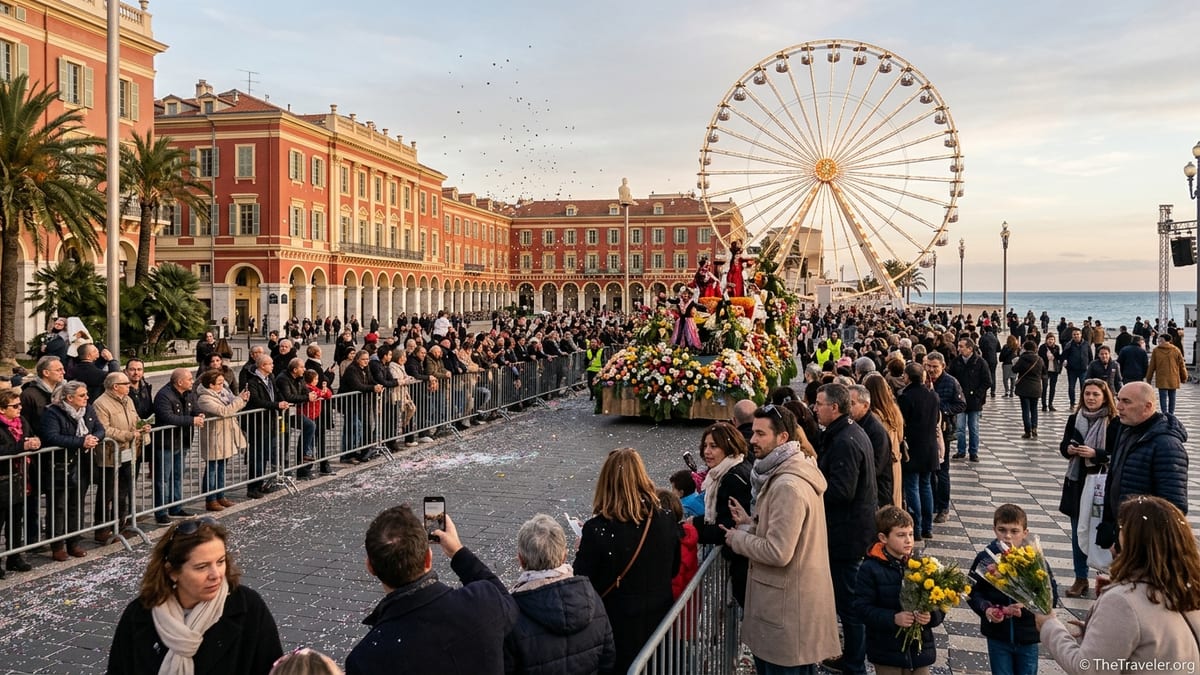
My first immersion was the evening “Corso carnavalesque illuminé,” the illuminated parade. As the sun dropped behind the Baie des Anges, towering floats rolled into Place Masséna, crowned by caricatured heads that bobbed as they moved: oversized politicians, mythic creatures, and a King of Carnival with a knowing grin. Brass bands from as far as Italy marched between troupes of dancers in sequined costumes, and confetti cannons periodically transformed the air into a snow globe of color. Under the floodlights, even the familiar red‑and‑white façades of the square took on a theatrical glow.
A very different energy infuses the daytime “Bataille de Fleurs,” the Battle of Flowers. Instead of satirical giants, the stars here are the blooms. Floats are built on flatbed trucks and dressed in mimosas, roses and gerberas, with costumed performers perched on top. As they pass, they toss long‑stemmed flowers into the stands. I watched a grandmother carefully gather her armful into a makeshift bouquet while children scrambled for fallen stems along the barriers. The scent of crushed petals mingled with sea air as the procession looped around the Jardins Albert‑Ier and along the Promenade des Anglais.
The finale recast Nice in yet another light. On the closing night, the effigy of the Carnival King is ceremonially burned near the sea, followed by a fireworks show that reflects off the bay. Locals explained that this symbolizes the end of winter excess and the return to everyday life, echoing Carnival traditions found across Europe and in Mardi Gras celebrations further afield. Watching the flames from the pebbled beach, with the Ferris wheel glowing in the background, I realized how deeply Carnival is woven into Nice’s identity; it is not a borrowed spectacle, but something rooted in centuries of celebration.
Practical Shifts: Costs, Tickets and Where to Stay
Experiencing the Riviera during Carnival also changed my sense of what “expensive” means here. February is technically low season for beach tourism, but Carnival pushes Nice into a kind of focused peak. Hotel prices in the city center often sit between high‑summer and off‑season rates. Booking early matters. When I searched three months out, central midrange hotels around Place Masséna and the Old Town were already showing limited availability for key parade weekends, while properties a 15‑minute tram ride away still had flexible rates.
Carnival tickets themselves are structured in tiers. Standing‑room “zone piétonne” places are the most affordable and put you right along the parade route, ideal if you enjoy being in the crush of energy and confetti. Reserved grandstand seats cost more but are worth considering if you want clear sightlines for photography or are traveling with children or older relatives. Many visitors choose one evening illuminated parade and one daytime Battle of Flowers rather than trying to attend every single event. That strategy kept my costs reasonable and left evenings open for dinners in the Port district or wine bars in the Old Town.
Choosing where to stay became less about beach proximity and more about access and noise tolerance. Seafront hotels along the Promenade des Anglais offer sweeping views and easy access to the arena, but they also sit under some of the busiest stretches during big parade nights. An alternative is to base yourself near the tram line T1 or T2 in neighborhoods like Libération or near the Nice Ville train station. In these areas I found family‑run hotels and apartment rentals at softer prices, plus markets and bakeries that operate to local rhythms, not tourist schedules.
Carnival timing also changed how I allocated my budget. In summer, I am tempted by day‑rate beach clubs and boat excursions. In February, I skipped those and put that money into event tickets, a couple of splurge meals and a guided walking tour that unpacked the history of Nice’s Italian past and how Carnival here influenced celebrations as far away as Rio. The result was a trip that felt indulgent without being dominated by the usual Riviera luxuries.
Day Trips Reimagined: Menton, Monaco and Beyond
Seeing Nice during Carnival reshaped how I approached day trips along the coast. Instead of structuring excursions around swimming and late sunsets, I planned around daytime light and parallel winter festivals. Menton, less than an hour by TER train from Nice, hosts the Fête du Citron, or Lemon Festival, typically in February at the same time as Carnival. The town transforms its Biovès Gardens into a citrus fantasyland, with towering sculptures built from oranges and lemons and Sunday parades where floats roll past pastel Belle Époque façades.
Arriving mid‑morning, I joined a steady flow of visitors walking from Menton station to the garden entrance. Inside, families posed by lemon sphinxes and astronauts in citrus “space suits,” echoing one recent theme celebrating space exploration. Street vendors sold candied peel and jars of local lemon marmalade, a sharp contrast to the ice cream and beach towels that dominate in July. The combination of Nice’s glittering night parades and Menton’s daytime citrus displays showed me that the Riviera’s winter identity is as event‑driven as its summer one is beach‑driven.
Monaco, too, feels different in February. Instead of throngs photographing the casino steps in Monte‑Carlo, I found a quieter hilltop old town with open views back toward Italy and over the port. The oceanographic museum, often crowded in high season, was busy but manageable, making it a practical rainy‑day option if the weather in Nice turned. Returning by train in late afternoon meant I was back in time for an illuminated corso in Nice that evening, something nearly impossible in summer when long, hot beach days drain your energy.
Even short hops to places like Villefranche‑sur‑Mer or Antibes took on a different weight. With the sea too cold for most swimmers, I lingered on coastal paths, exploring citadels and harbors rather than rushing to find sun loungers. Knowing I had Carnival events waiting back in Nice made these side trips feel like chapters in a larger story instead of stand‑alone beach days. The Riviera became a tapestry of winter rituals rather than a marathon of tanning sessions.
How Carnival Changes Your Relationship With Nice Itself
Before Carnival, Nice for me was defined by the Promenade des Anglais, the Old Town and a handful of well‑known museums. During Carnival, the same spaces became stages that locals and visitors shared in a more intimate way. Place Masséna, which in summer is a photogenic square people simply cross on their way to somewhere else, became the beating heart of the city. Light installations and giant glowing sculptures loomed over the checkerboard pavement, and music from the parades spilled into side streets long after the floats had passed.
Because so much of Carnival is outdoors, it forces you to engage with the city’s micro‑geography. You learn, for example, which alleyways through the Old Town let you slip from the Cours Saleya markets back to the arena without fighting the thickest crowds, or which steps up to Castle Hill give you a quick escape to a peaceful viewpoint between two events. After a few days, I realized I had internalized the layout of Nice far better than I ever did in summer, when slow beach days kept me orbiting the water’s edge.
Carnival also softened some of the Riviera’s intimidating glamour. In August, luxury boutiques along Avenue Jean‑Médecin and the Carré d’Or can make budget travelers feel like spectators in someone else’s playground. During Carnival, those same streets were filled with children in costumes, teenagers with face paint and retirees in silly hats decorated with streamers. The mood was playful rather than polished. Even high‑end hotels draped temporary decorations over their façades, as if acknowledging that for two weeks the city belonged to the confetti and brass bands as much as to their regular clientele.
Most importantly, Carnival made me more aware of Nice as a year‑round home for its residents. Talking with people who live there, I heard variations of the same sentiment: they avoid the hottest part of summer when the city feels saturated, but they look forward to Carnival as the moment winter cracks open. Experiencing that shift alongside them changed my mental image of the Riviera from a summer resort region to a place with its own calendar and rituals.
Planning Your Own French Riviera Trip Around Carnival
Traveling to the Riviera for Carnival requires a different sort of planning than a beach holiday, but the payoff is high. First, timing. Because Carnival follows the broader pre‑Lenten calendar, its dates move each year, usually landing across two weeks in February and occasionally stretching into early March. Checking the official program for specific days of the illuminated parades and Battles of Flowers is essential if you want to align your stay with the most iconic events or with the closing night bonfire and fireworks.
Second, book accommodation before you secure event tickets. Hotels with easy access to tram lines and to Place Masséna fill fastest, especially for the central Friday and Saturday nights. Once your base is set, you can buy your parade tickets online, choosing between standing and seated sections. If you prefer flexibility, consider attending midweek events, which are generally a bit less crowded and sometimes slightly cheaper, freeing up weekends for trips to Menton’s Lemon Festival or Monaco.
Third, think in layers when it comes to clothing and expectations. February on the Riviera can alternate between crisp, sunny days and damp, windy evenings by the sea. Having a warm layer and a scarf makes waiting for parades comfortable, and comfortable shoes are non‑negotiable; you will walk and stand far more than on a pool‑lounger holiday. The payoff is the ability to wander freely through a city in full celebration mode without worrying about overheating.
Finally, give yourself time outside the arena. Some of my favorite Carnival memories took place well away from the grandstands: stumbling on a small brass band rehearsing in a side street, watching a café owner tape colorful masks to his windows, and seeing residents on apartment balconies tossing confetti down on the crowds. Building in open hours for these unscripted moments will keep your trip from feeling like a sprint from one ticketed event to the next.
The Takeaway
Seeing Nice during Carnival shifted the French Riviera from a place I visited for its beaches to a region I return to for its rhythms. The February light, the unexpected warmth of the days, the overlapping celebrations from Nice to Menton and the sense of locals reclaiming their city all combined into an experience that felt both festive and oddly intimate. Instead of queuing for beach clubs and jostling for restaurant tables in peak season, I found myself sharing bleachers with Niçois families, catching flowers in the Battle of Flowers and watching the Carnival King burn against a winter sky.
If your idea of the Riviera is limited to high summer, consider recalibrating your compass. Plan a trip that traces the curve of the Baie des Anges not by sunscreen and sangria, but by parades, citrus sculptures and the glow of fireworks over the water. You may find, as I did, that the region’s true character reveals itself not only when the sun is strongest, but when the nights are cool, the streets are alive with music and the confetti settles slowly over the stones of an old Mediterranean city.
FAQ
Q1. When does the Nice Carnival usually take place?
The Nice Carnival is typically held over two weeks in February and occasionally extends into early March, following the wider pre‑Lenten Carnival calendar. Exact dates change each year, so it is important to check the current program when planning.
Q2. Is Nice in February too cold to enjoy?
Nice in February is cool but generally mild for winter, with daytime temperatures often in the low to mid‑teens Celsius. You will not be sunbathing for hours, but with layered clothing it is comfortable for walking, outdoor parades and café terraces, especially on sunny days.
Q3. How far in advance should I book accommodation for Carnival?
It is wise to secure your hotel three to six months ahead if you plan to be there over the main Carnival weekends. Central hotels and apartments near Place Masséna and the Old Town fill first, while properties slightly inland or along tram lines tend to have availability and better prices for longer.
Q4. Are Carnival tickets expensive?
Ticket prices vary by event and seating type. Standing‑room areas are the most affordable and put you close to the action, while reserved grandstand seats cost more but offer better visibility and comfort. Many travelers keep costs manageable by choosing one illuminated evening parade and one daytime Battle of Flowers.
Q5. Can I combine Nice Carnival with a visit to Menton’s Lemon Festival?
Yes. Menton’s Fête du Citron usually runs during a similar February window, and regular TER trains link Nice and Menton in under an hour. Many visitors base themselves in Nice, attend Carnival events in the evening and make a daytime trip to Menton to see the citrus sculptures and parades.
Q6. Is it easy to get around the Riviera without a car in winter?
Yes. The coastal TER train connects Nice with Menton, Monaco, Villefranche‑sur‑Mer, Antibes and Cannes, and it runs year‑round. Inside Nice, trams and buses operate on a regular schedule, and Carnival venues are designed to be walkable from central stops.
Q7. Does Carnival make the city feel overcrowded?
The central arena area around Place Masséna and the Promenade du Paillon can be very busy at parade times, but crowds are concentrated in those zones. Outside event hours, many neighborhoods feel calmer than in summer, and with a bit of planning you can step in and out of the busiest areas as you like.
Q8. What should I pack specifically for a Carnival trip?
Comfortable walking shoes, a warm layer, a windproof jacket or coat and a scarf are essential. Gloves and a hat are useful for evening parades by the sea. If you plan to join in the fun, pack something festive like a colorful mask, wig or simple costume accessory.
Q9. Are restaurants and museums open as normal during Carnival?
Yes. Most restaurants, cafés and museums in Nice operate as usual during Carnival, and some extend hours to accommodate increased visitors. Popular spots near the parade area may be busier around event times, so reservations are recommended for dinners on key parade nights.
Q10. Is Nice Carnival suitable for children?
Very much so. Many local families attend together, and the daytime Battle of Flowers in particular is popular with children, who enjoy catching the flowers and confetti. Choosing seated sections and daytime events, and bringing warm layers, makes the experience more comfortable for younger travelers.