


More news on this day
Chicago’s O’Hare International Airport is entering the Labor Day weekend with thousands of delayed flights, as thunderstorms, airspace constraints and already tight schedules converge at one of the country’s busiest hubs.
Get the latest news straight to your inbox!
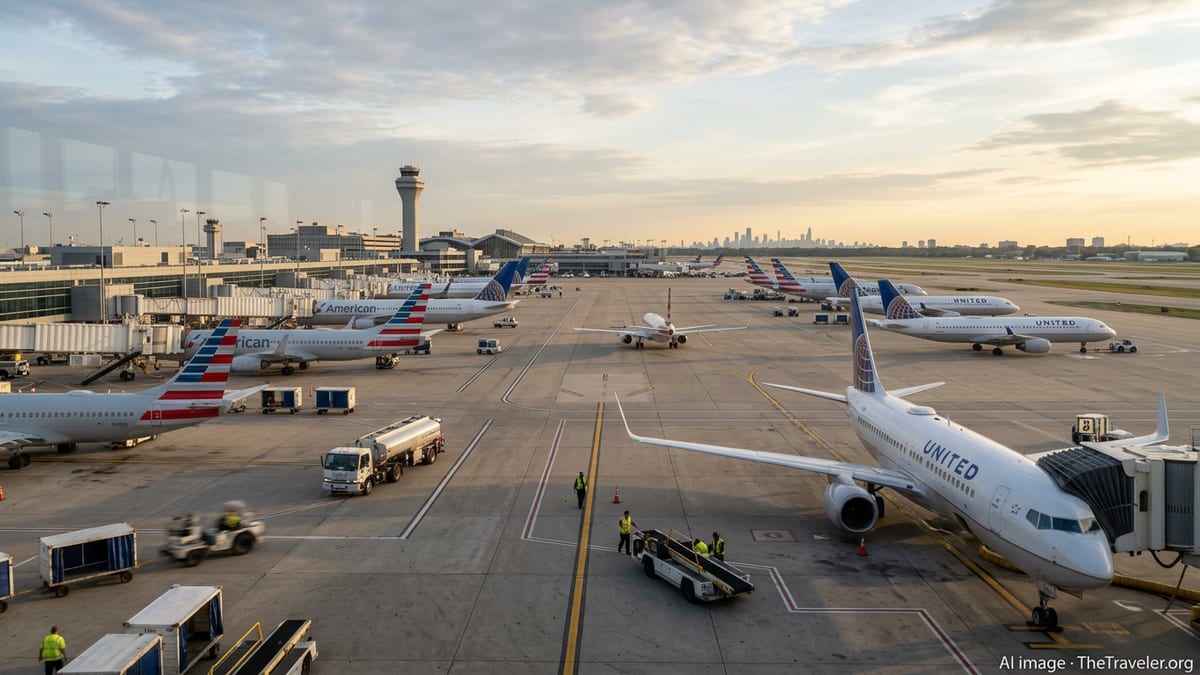
Storms and Congestion Create a Difficult Start to the Holiday
Industry tracking data and local reports indicate that rolling thunderstorms across the Midwest and East Coast have triggered widespread disruptions at O’Hare in the days leading into the Labor Day travel period. The airport has repeatedly appeared near the top of national delay tallies, with long stretches where average waits have hovered around an hour or more for arrivals and departures.
Ground delay programs and temporary ground stops have been used several times in recent weeks to meter traffic into the Chicago airspace when storms reduce the number of planes that can safely land each hour. One Federal Aviation Administration advisory in August cited more than 3,500 total delay minutes tied to an O’Hare ground stop, illustrating how quickly conditions can deteriorate once convective weather intersects with a full holiday schedule.
On the airport side, Chicago’s flight information portal has flagged periods of “average” delays that translate into significant waits at the gate and on the tarmac when traffic peaks. Publicly available accounts from travelers over the past 48 hours describe extended taxi times, aircraft holding for available gates and lines stretching through security checkpoints as airlines work through backed up operations.
Even when storms move on, congestion inside the complex airfield can slow recovery. Passengers report situations where aircraft have been delayed simply waiting to move between terminals, underscoring how heavy traffic magnifies every small disruption during a peak travel window.
Labor Day Surge Meets a Strained Summer Operation
The timing of the latest disruption adds pressure to an already strained summer at O’Hare. Chicago aviation authorities project that O’Hare and nearby Midway will handle more than 1.7 million passengers between Thursday and Tuesday of the Labor Day period, an increase over 2025 volumes. O’Hare accounts for the bulk of that traffic, functioning as a major connecting hub as well as a primary gateway for Chicago-area travelers.
The wider 2026 summer travel season has repeatedly tested the airport’s capacity. Flight performance data compiled by passenger rights platforms shows that in early July, severe weather contributed to more than 3,200 delays and hundreds of cancellations across major U.S. hubs, with O’Hare among the most affected. Another busy Friday in mid-July saw the airport again leading national disruption tables, as storms, smoke and staffing constraints combined to slow operations.
Those patterns matter as Labor Day begins, because delays in the weeks before have already stretched airline scheduling resilience. Crews and aircraft that operate at the edge of legal and practical limits during a long summer can leave less slack in the system when another major holiday approaches, making it harder for carriers to absorb fresh shocks from weather or congestion.
Travel demand also remains robust. Airlines have maintained aggressive summer schedules in Chicago, adding new routes and extra frequencies across domestic networks. That growth has helped push passenger totals higher than in 2025, but it has also increased exposure when conditions turn unfavorable.
Federal Scheduling Caps Aim to Contain Overscheduling
Regulators entered the 2026 summer season already concerned that O’Hare’s planned schedule exceeded what the airport and airspace could reliably support. An order published in the Federal Register in April established operating limitations that cap scheduled flights at 2,708 per day from mid May through late October, a reduction of roughly 12 percent from what carriers initially proposed.
That cap followed a formal determination that the previous level of operations was not sustainable if the goal was to stabilize performance at the airport. Analyses submitted with the order pointed to the risk of “significant” delays driven by ongoing construction work on runways and taxiways and by a national shortfall in fully certified air traffic controllers, particularly in the Chicago area’s en route airspace.
Federal aviation notices emphasize that disruptions at O’Hare tend to ripple across the National Airspace System. When demand outstrips capacity at the airport, command center managers often deploy traffic management tools such as ground delay programs and reroutes, measures that can quickly affect dozens of other airports as connections misalign and aircraft rotate out of position.
Even with scheduling limits in place for summer 2026, on time performance at O’Hare has remained under pressure, especially on weather affected days. Publicly accessible data shows that last summer less than 60 percent of flights at the airport operated on time, a benchmark that motivated regulators to tighten oversight this year.
Knock On Effects for Travelers Across the Network
For passengers, thousands of delays at a key hub translate into a cascade of missed connections, last minute rebookings and overnight stays. Academic and industry research on delay propagation has repeatedly identified O’Hare as a “key node” in the U.S. air travel network, meaning that disruptions there are more likely than at many other airports to spread through national schedules.
Reports from travelers in recent days describe long queues at customer service desks, reshuffled gate assignments and extended tarmac waits. Accounts posted publicly from Thursday into Friday mention aircraft being held on the ground for more than two hours, as well as flights forced to circle or divert while storms moved through and arrival rates were reduced.
Downline airports are feeling the impact as well. Flights leaving Chicago late arrive behind schedule in smaller markets, compressing turn times and sometimes triggering further delays even where local weather is clear. Carriers may then opt to cancel selected legs to reset their operations, a decision that can strand travelers far from the original disruption point.
The cumulative effect is that a thunderstorm over northern Illinois or an overwhelmed taxiway at O’Hare can end up affecting flight times in cities hundreds or thousands of miles away. For the Labor Day period, that dynamic is especially challenging, because many planes are already flying near capacity, giving airlines fewer easy options to accommodate displaced passengers.
What Holiday Travelers Can Expect in the Days Ahead
Near real time status information published by aviation authorities on Friday shows that O’Hare is still experiencing periods of delay, although the intensity varies by hour as weather cells move and traffic ebbs and flows. While some windows show no destination specific restrictions, others are accompanied by advisories warning of airborne holding and extended arrival spacing into the Chicago area.
Passenger volume projections suggest that the busiest days at O’Hare over the Labor Day stretch will be Friday and Monday, with high traffic continuing into Tuesday as travelers return home. Given the combination of demand, active construction on the airfield and ongoing staffing constraints, observers expect continued vulnerability to new rounds of delays if storms redevelop or if winds force changes to the airport’s runway configuration.
Travel industry guidance derived from recent summers continues to emphasize simple strategies for those passing through O’Hare this weekend. Early morning departures tend to be less affected by cascading disruptions, while longer connection windows provide a buffer when taxi times stretch or security lines grow. Monitoring airline apps and official airport resources for gate changes and evolving delay information remains critical on days when conditions are shifting hour by hour.
For now, publicly available indicators and eyewitness accounts align in portraying a challenging start to the holiday at Chicago’s primary airport. With millions of people set to pass through its terminals in the coming days, the question for travelers is less whether there will be delays, and more how prepared they are to navigate them.
O'Hare Sees Thousands of Flight Delays Before Labor Day Rush
Chicago airports expect 1.71 million passengers over the Labor Day weekend
Operating Limitations at Chicago O'Hare International Airport, Summer 2026