


More news on this day
A collision between two passenger trains near Bedford in eastern England has left one person dead and 89 injured, according to emerging casualty figures from the scene north of London.
Get the latest news straight to your inbox!
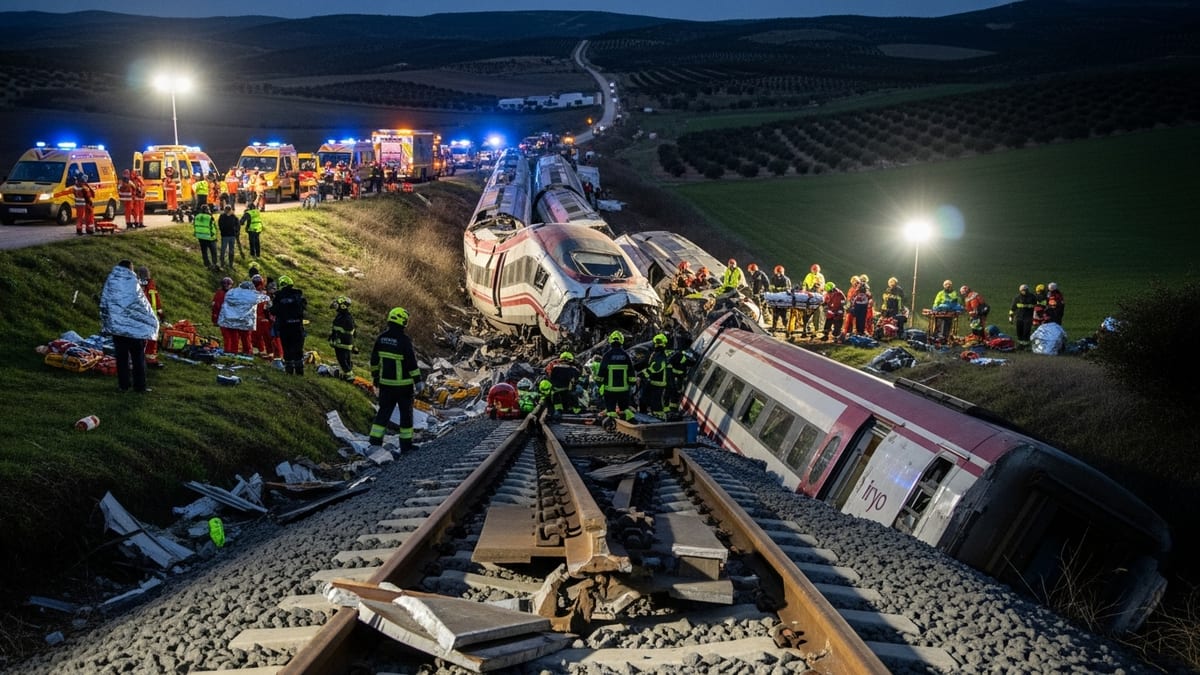
Major incident on busy route north of London
The crash occurred on Friday evening near Bedford, a major junction on the main line linking London St Pancras with communities across central and eastern England. Publicly available information indicates that two passenger services were involved, with at least one operating on a London-bound route when the collision took place.
Images and descriptions shared on social media and referenced in published coverage show crumpled carriages and significant damage at the front of one train, with debris scattered along the track. Early accounts suggest that one of the trains may have struck the rear of another service, although the precise sequence of events has not yet been established by investigators.
Rail services in and out of London on the affected corridor were halted following the impact, with operators warning travelers of severe disruption and advising them to seek alternative routes. Trains already en route were held at stations along the line while emergency responses unfolded.
The area around the crash site was designated a major incident, a classification that enables emergency planners to coordinate a large-scale, multi-agency response and to prioritize the movement of ambulances, fire crews, and specialist rescue teams.
Casualties and emergency response
Figures circulating through official channels and summarized in multiple news reports indicate that one person, believed to be a train driver, has died as a result of the collision. A further 89 people are reported injured, with sub-categories of very serious, serious, and minor injuries reflecting the differing impact on passengers and crew.
Accounts from the scene describe rapid deployment of paramedics, air ambulances, and fire and rescue units to reach carriages and assist those trapped or unable to move. Some passengers were treated trackside before being transferred to regional hospitals, while others were assessed on site and later escorted away from the area.
Local hospitals in Bedford and the wider East of England region were placed on heightened readiness, with staff advised to prepare for a significant inflow of trauma patients. Visual evidence and contemporary reporting refer to passengers with head and limb injuries, consistent with the abrupt deceleration and internal damage that often follow high-impact rail collisions.
Although the full medical picture is still developing, early indications are that the rapid arrival of emergency services and the design of modern rolling stock helped prevent a higher death toll, even as dozens of people sustained serious harm.
Impact on rail operations and passengers
The route affected by the crash is a key artery for both regional and intercity traffic, carrying commuter services into London as well as longer-distance trains serving the Midlands and further north. As a result, the collision prompted widespread cancellations and diversions across multiple operators’ networks.
Rail companies advised passengers not to attempt travel on the affected line while recovery efforts and investigations continue. Ticket acceptance arrangements were put in place on alternative routes where possible, but journey planners showed extended journey times and limited capacity on parallel corridors.
Stranded passengers reported crowded platforms and full replacement services, particularly at major hubs feeding into London. In some cases, travelers were encouraged to delay non-essential journeys until the following day or to consider road-based alternatives.
Infrastructure managers face a complex recovery operation, involving the careful removal of damaged rolling stock, inspection of tracks, signaling equipment, and overhead power systems, and the eventual restoration of normal line speeds once safety checks are complete.
Early focus on safety systems and investigation
Attention is already turning to the performance of safety systems on the route and to how two modern passenger trains came to collide on a busy, signaled main line. Commentators in specialist publications and online rail forums have noted that the United Kingdom’s railway network typically experiences very few train-to-train collisions, in part due to layered protections that include signaling, driver training, and, on some routes, automatic braking technology.
Published commentary has raised questions about whether the section of line involved was equipped with the most advanced train protection systems and whether any equipment failure, signal overrun, or communication breakdown played a role. At this stage, there is no definitive public account of the cause, and all suggestions remain speculative pending a formal inquiry.
Britain’s independent rail accident investigators are expected to examine data recorders, signaling logs, track layouts, and the condition of both trains in the coming days. The process typically includes detailed reconstruction of events leading up to the collision, as well as analysis of how rolling stock structures, seating layouts, and emergency procedures influenced the pattern of injuries.
Previous reports into serious rail incidents in the UK and abroad have often resulted in specific recommendations on technology upgrades, operational protocols, and staff training. Observers anticipate that the Bedford collision will prompt similar scrutiny, particularly given the high number of casualties and the prominence of the route.
Travelers urged to monitor updates as disruption continues
For travelers, the immediate priority remains understanding how long disruption will last and which services can safely operate around the damaged stretch of railway. Rail operators and national journey-planning tools are expected to update timetables as recovery work progresses and sections of the line are gradually reopened.
Passengers planning to use connections between London and eastern or central England are being advised, in widely shared service notices, to check their journeys close to departure time and to allow additional time for potential diversions. Those with flexible schedules are encouraged to adjust their plans to avoid peak periods while capacity is constrained.
Tourists and international visitors may feel particular effects, as the Bedford corridor links with airport services and popular destinations beyond the capital. Travel advisers are recommending that visitors keep digital tickets and identification easily accessible, remain alert to public address announcements, and consult station staff for the latest available alternatives.
As daylight reveals the full extent of the damage and investigators begin formal work at the scene, the collision near Bedford is emerging as one of the most serious rail incidents in the United Kingdom in recent years, reshaping travel plans for thousands and renewing debate over how best to safeguard one of Europe’s busiest passenger networks.