


More news on this day
A train driver has died and dozens of passengers have been injured after two London-bound East Midlands Railway services collided near Bedford, disrupting one of Britain’s busiest intercity corridors and prompting a large-scale emergency response.
Get the latest news straight to your inbox!
Collision on Busy St Pancras Corridor
According to initial reports from British and international outlets, the crash occurred on the afternoon of Friday 19 June 2026 on the Midland Main Line just south of Bedford, around 50 miles north of central London. Two southbound trains, both operating East Midlands Railway services to London St Pancras, were involved.
Publicly available information indicates that one train had departed Corby in Northamptonshire for the capital, while the second service originated in Nottingham. The collision took place on a four-track section of line that carries high-speed intercity and commuter traffic, amplifying the operational shock for the route.
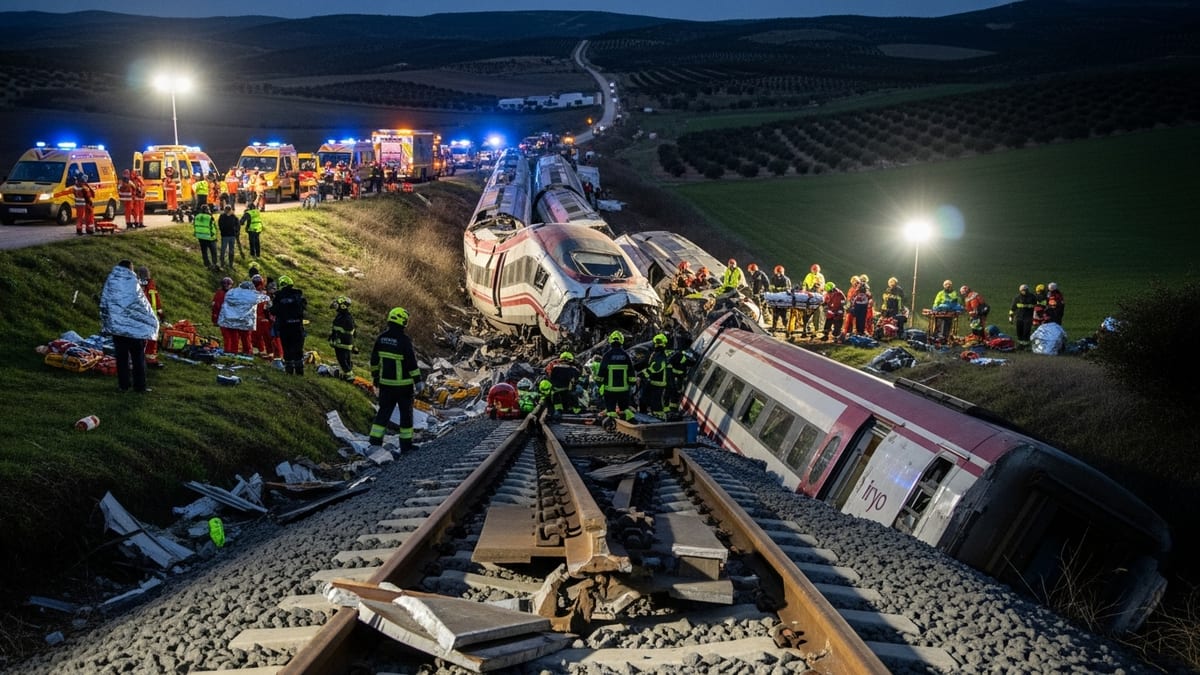
Rail tracking data and media coverage suggest the incident unfolded in the evening peak, when services are typically heavily loaded with commuters and long-distance travelers. Images from the scene show one train coming to rest behind another on the southbound track, with both formations remaining upright but visibly damaged.
The line between London St Pancras and the East Midlands was closed in both directions for many hours following the crash, with operators warning that disruption to rail traffic could extend into the weekend as investigators and engineers work at the site.
One Fatality and Dozens Injured
Figures published by regional ambulance services and relayed by major news organizations state that one person, believed to be the driver of the rear train, died at the scene. The death marks a rare fatality for a train crew member on Britain’s modern rail network.
Medical agencies reported a complex casualty picture. Public statements summarised in media coverage indicate that 11 people sustained very serious injuries, 22 were seriously injured and a further 56 suffered minor injuries. That brings the total number of reported casualties to 89, making the Bedford crash one of the most significant rail incidents in the United Kingdom in recent years.
Passengers described in news reports being thrown forward inside carriages, with some travelers suffering suspected fractures, head wounds and cuts from flying glass. Social media images verified and used by broadcasters show passengers with improvised bandages as they waited beside the track among a large deployment of emergency vehicles.
Local hospitals in the East of England region were placed on heightened alert to receive trauma patients, and neighboring ambulance services provided additional resources to help move the injured from the scene.
Major Emergency Response Near Bedford
Publicly available information from police and ambulance services indicates that the collision triggered a major incident declaration for the Bedford area. This led to a coordinated response involving local and regional agencies, including multiple ambulance units, specialist hazardous-area teams and at least several air ambulances.
Photographs carried by national and international outlets show long lines of emergency vehicles on roads running parallel to the railway, as well as field triage points established near the tracks. Passengers were seen being assisted from the trains, walking along the ballast and then boarding buses and other onward transport arranged at short notice.
Network Rail engineers and rail accident specialists arrived later to secure the site and begin preliminary assessments of the track, signaling equipment and train formations. Recovery operations are expected to take time, as damaged rolling stock must be examined before it can be moved and infrastructure inspected before passenger services can safely resume.
Rail operators issued messages urging travelers between London, the East Midlands and South Yorkshire to check for alternative routes, with long-distance services diverted or cancelled and local buses pressed into service to bridge gaps on the disrupted corridor.
Early Focus on Train Operations and Safety Systems
While it is too early for any formal conclusions, early reporting in British media has focused on how two trains traveling in the same direction came to occupy the same section of track. Commentators have noted that the Midland Main Line is equipped with multiple layers of signaling and train protection intended to prevent such occurrences.
Some coverage has highlighted unconfirmed accounts suggesting that one of the trains may have been stopped or moving slowly due to a technical issue when it was struck from behind by a following service. Other reports refer to modern on-board safety systems that intervene automatically if a train passes a signal at danger or if certain faults are detected.
The Rail Accident Investigation Branch is expected to conduct a detailed independent inquiry, examining data recorders, driver procedures, signaling logs and maintenance records. Previous RAIB investigations into collisions and near-misses have typically led to a series of recommendations covering equipment design, driver training, and network-wide safety protocols.
Railway specialists commenting in published analyses say the Bedford crash will be scrutinized not only for what went wrong on the day, but also for what it reveals about the resilience of Britain’s current safety systems under unusual or compound failure conditions.
Disruption for Travelers and Questions for the Network
The collision has caused significant disruption for passengers on one of the principal rail arteries linking London with Leicester, Nottingham, Derby and Sheffield. East Midlands Railway services to and from St Pancras were widely cancelled or severely curtailed on Friday evening, and the operator cautioned that further knock-on disruption was likely.
Travelers stranded on trains and at stations along the route described in media reports lengthy delays, busy replacement services and uncertainty about when normal timetables would resume. With many services terminating short of London or being rerouted, journey times for some passengers extended by several hours.
Transport commentators note that the crash comes at a time of intense scrutiny of UK rail performance, with passengers facing recurring timetable changes, infrastructure upgrades and industrial action in recent years. The Bedford incident is likely to renew debate over investment priorities for signaling technology, capacity upgrades and staff training.
For now, attention is focused on the condition of the injured and on restoring services through the affected stretch of line. As investigators begin their work, the Bedford collision will stand as a stark reminder that, despite strong safety records, rail operators and infrastructure managers must continually test and improve the systems designed to prevent a single operational failure from turning into a mass-casualty event.