


More news on this day
A rush hour collision between two London bound passenger trains near Bedford, north of the British capital, has left one person dead and dozens injured, according to updated figures released overnight, in one of the most serious rail incidents in England in recent years.
Get the latest news straight to your inbox!
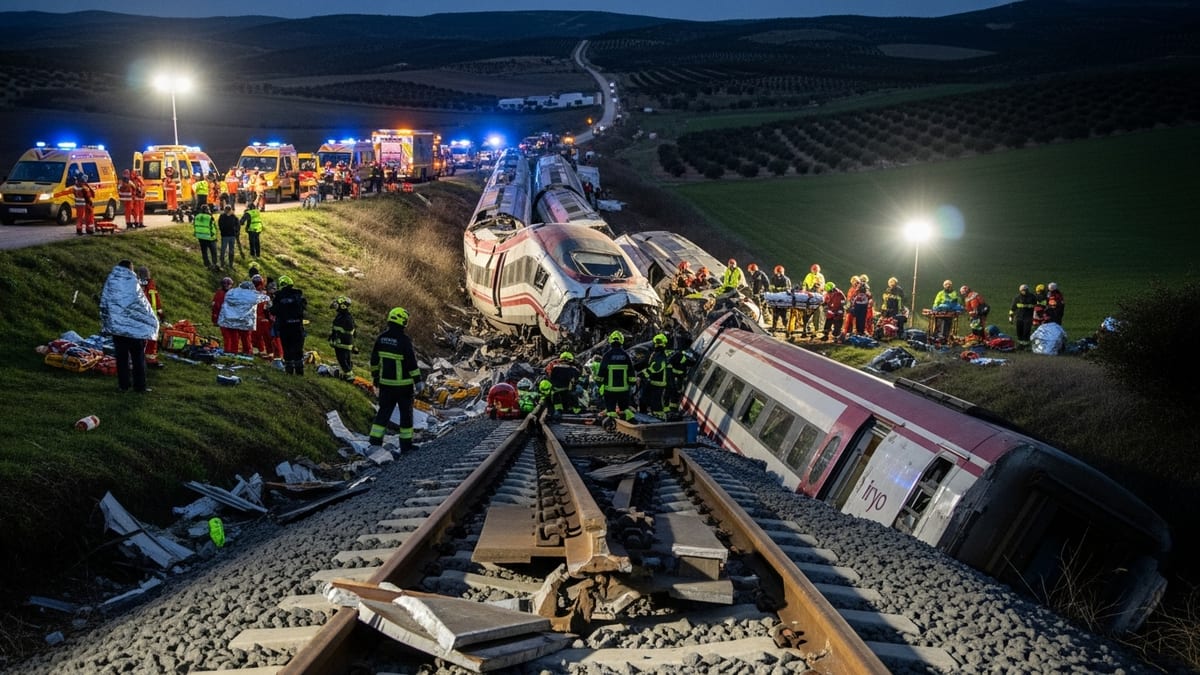
Rush hour crash on key London corridor
Publicly available information indicates the collision occurred late Friday afternoon near the town of Bedford, a busy junction on the main line linking the English Midlands with London St Pancras station. Both trains were reported to be traveling south toward the capital when the impact happened on a section of track bordered by fields and parallel local roads.
Coverage from multiple outlets describes a chaotic scene in the immediate aftermath, with injured passengers being treated beside the tracks and a large cordon established around the site. Photos and video shared on social media showed carriages still upright but visibly damaged, with windows blown out and debris scattered along the ballast.
Rail tracking data referenced in published reports suggests one service had departed Nottingham for London earlier in the afternoon, while another train began its journey in Corby, also bound for St Pancras. Both are operated on a route that typically carries thousands of commuters and long distance travelers during the evening peak.
At the time of the collision, the line was said to be busy with regular intercity and airport services, magnifying the wider impact on the network as operators halted trains and began diverting or canceling routes through the corridor.
One fatality and a complex injury picture
According to updated casualty figures cited across British and international coverage, one person has died as a result of the crash. Rail union statements and subsequent reporting indicate the victim was a train driver, highlighting the particular vulnerability of staff in the leading cabs during high speed impacts.
Health service updates compiled by news organizations describe a wide range of injuries among passengers and crew. Dozens of people were treated for minor wounds such as cuts, bruises and shock, while more than 30 were reported to have serious or very serious injuries, including fractures and head trauma. Several of the most severely injured were airlifted to regional trauma centers after helicopter units were scrambled to the scene.
Local hospitals in Bedfordshire and neighboring counties were placed on heightened alert as emergency departments prepared to receive a surge of patients. Field triage areas were established alongside the railway to stabilize those hurt before transport, a practice that has become standard in major transport incidents in the United Kingdom.
Passengers who shared their experiences with broadcasters and newspapers described a sudden jolt, smoke, and scenes of confusion as people struggled to understand what had happened. Some reported helping fellow travelers down from damaged carriages and across uneven ground to reach waiting ambulances.
Rail services halted as disruption spreads
East Midlands Railway, the operator of both services involved, announced the suspension of all trains to and from London St Pancras on the affected route for the remainder of Friday following the collision. Information posted on journey planners and rail alerts showed widespread cancellations on services linking London with Nottingham, Derby, Sheffield and Corby.
Publicly available statements from the company indicated that engineers and safety teams were deployed alongside emergency responders to secure the scene and begin initial assessments of damage to rolling stock and infrastructure, including tracks, overhead lines and signaling equipment. Recovery of the trains and repair work are expected to take considerable time, given the complexity of modern high speed rail systems.
Travel advice issued through national rail information channels urged passengers to avoid the St Pancras route and seek alternative services where possible, with some operators accepting tickets on parallel lines. Crowded platforms and lengthy delays were reported at several stations across the Midlands and in London as commuters attempted to replan journeys at short notice.
Timetables for the weekend remained uncertain as of early Saturday, with operators and infrastructure managers assessing how quickly partial services could be restored without compromising safety or interfering with ongoing investigations.
Early focus on safety systems and signaling
While the precise sequence of events remains under investigation, early technical discussion in specialist rail forums and preliminary media analysis has centered on the condition of one of the trains prior to the crash and the way the signaling system responded. Some commentary has suggested that a southbound train may have been brought to a standstill by an onboard fault and was subsequently struck from behind by the following service on the same track.
Rail safety analysts quoted in published coverage have noted that modern mainline routes are equipped with layered protections designed to prevent trains from entering occupied sections of track at speed. These include color light signals, automatic warning systems in the cab, and, on many routes, more advanced automatic braking or train protection technology.
The stretch of line north of London where the crash took place is widely regarded as one of the busiest and most technically sophisticated in the country, with centralized signaling controlling movements over long distances. Any questions about whether train protection systems were fully implemented, temporarily unavailable, or potentially overridden are expected to be a central part of the formal inquiry.
Investigators will also be examining factors such as train speed at the moment of impact, visibility of lineside signals, track conditions and any recent maintenance or upgrade work in the area, as well as the performance of couplers and crash energy management features designed to keep carriages upright and aligned.
Rail safety record under renewed scrutiny
The Bedford collision comes at a time when rail travel in the United Kingdom is frequently held up as one of the safest modes of mass transport, with serious passenger accidents relatively rare compared with earlier decades. Nonetheless, the scale of the casualties and the visibility of the incident on a major commuter artery have reignited public discussion around investment in signaling, staff training and rolling stock upgrades.
Commentary in national and international media has contrasted the outcome with recent high profile rail disasters elsewhere in Europe and Asia, noting that although the casualty numbers in Bedford are lower, the incident exposes vulnerabilities that can emerge when multiple layers of protection do not function as intended. Attention is also turning to the psychological impact on survivors and staff, with rail worker organizations emphasizing the need for long term support.
As the clean up continues and services gradually resume, the collision north of London is likely to shape debates over rail funding and modernization for months to come. For passengers who regularly rely on the affected route, the images of damaged trains in the Bedfordshire fields serve as a stark reminder that even heavily regulated and technologically advanced networks can experience sudden and devastating failures.