


Brightline has turned Orlando International Airport into a genuine rail hub, giving travelers a new way to connect MCO with Miami, Fort Lauderdale and West Palm Beach without getting behind the wheel. For many visitors, especially international arrivals and families heading to South Florida or cruises, the train can be a calmer, often time‑competitive alternative to driving or flying short haul. This guide walks you through how the Orlando airport station works, what routes are available, what to expect on board, how tickets are priced, and the real‑world situations where Brightline makes sense versus a rental car or quick flight.
Get the latest updates straight to your inbox!
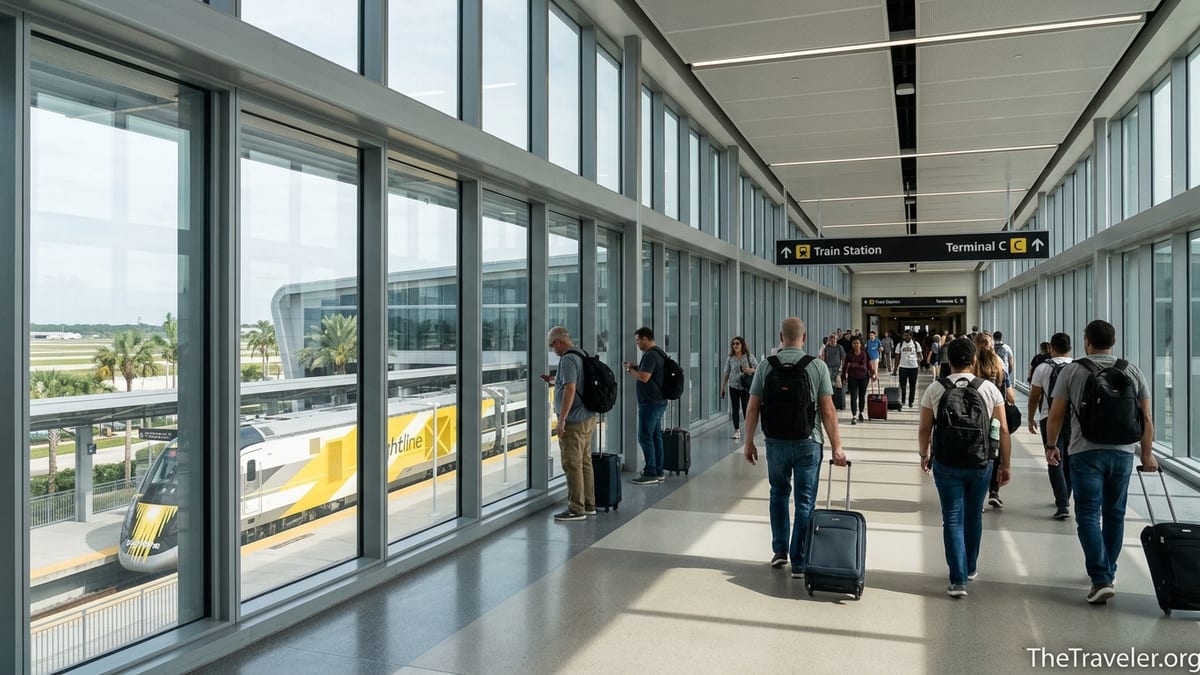
Brightline at Orlando International Airport: What to Expect
Brightline’s Orlando station is built directly into Orlando International Airport’s South Terminal complex, officially part of the intermodal terminal adjacent to Terminal C. In practical terms, that means you can land at MCO, collect your bags, and walk to the train without ever leaving airport property or getting into a car. The station is connected to Terminal C by a covered pedestrian bridge and linked to Terminals A and B by the airport’s automated people mover system, so you simply follow the overhead signs for “Train Station” or “Brightline” the same way you would follow signs for baggage claim.
The station itself feels more like a small airport terminal than a traditional train depot. Inside, you will find check‑in kiosks, ticket counters, security screening for luggage and passengers, and a large upstairs lounge area with floor‑to‑ceiling windows looking out over the tracks. Seating is divided into areas for Smart (standard) and Premium ticket holders, with Premium guests having access to a dedicated lounge where snacks and drinks are included. Digital boards display departures to Miami, Fort Lauderdale, Aventura, Boca Raton and West Palm Beach, making it easy to confirm you are boarding the correct train.
For Orlando locals who are not flying, the Brightline station is still accessed through the airport. When you arrive at MCO by car or rideshare, you follow signs to Terminal C and the train station. Drivers can drop you curbside right at the station entrance, and there is a large parking garage connected to the intermodal complex that caters both to air travelers and train passengers. This setup can feel unusual if you are used to downtown train stations, but it gives you the advantage of 24‑hour airport infrastructure, including rental cars, hotels and food options clustered in one place.
Inside the secure area of the station, the experience is closer to boarding a plane than hopping on a commuter train. You pass through a brief security check, then wait in the lounge area until boarding is called. Unlike at many airports, boarding is calm and orderly, with wide platforms, clear signage and staff on hand to direct you to the right car. For travelers fresh off a long‑haul flight, that smoother transition can make a big difference in how stressful your first hour in Florida feels.
Getting from MCO Terminals and Ground Transport to the Train
How you actually reach the Brightline station at MCO depends on where you start. If you land at Terminal C, the process is straightforward: after baggage claim and customs if applicable, you follow signs to the train station and cross a short pedestrian bridge that connects directly into the intermodal terminal. The walk is similar in length to walking from one end of a large airport terminal to the other, and is fully indoors and air‑conditioned, which is welcome in Florida’s heat and humidity.
From Terminals A or B, you use the airport’s automated people mover system to reach the South Terminal complex. After exiting your gate area and collecting luggage, look for signs to Terminal C or the train station. The people mover ride itself only takes a few minutes, after which you follow escalators and signage to the Brightline entrance. Travelers staying at the Hyatt Regency Orlando International Airport in the main terminal can do the same, riding the people mover from the hotel level to the South Terminal, then walking a short distance to the trains without ever stepping outside.
For those arriving by car, taxis and rideshares can drop off at the Brightline Orlando Station entrance near Terminal C. Entering “Brightline Orlando Station” as your destination in a rideshare app typically points drivers to the correct curb. Rental car returns at MCO are in the main terminal complex; from there you ride the people mover to the South Terminal and walk to Brightline. This is a common pattern for travelers who have driven around Central Florida and are turning in a car before taking the train south to begin a cruise or a Miami city stay.
If you are starting in Orlando proper rather than at the airport, keep in mind that you will still need to factor in travel time to MCO. For example, from the International Drive area or Universal Orlando hotels, a typical rideshare to the airport might take 20 to 30 minutes depending on traffic. From Walt Disney World, it can be 25 to 35 minutes. This “first leg” matters when you compare the total time and cost of Brightline to simply renting a car and driving straight to South Florida.
Routes from Orlando: Where Brightline Can Take You
From Orlando International Airport, Brightline operates multiple daily trains to five stations in South Florida: West Palm Beach, Boca Raton, Fort Lauderdale, Aventura and MiamiCentral in downtown Miami. Many travelers think of the route as “Orlando to Miami,” but in practice you can step off at whichever station lines up best with your hotel, cruise port, or onward transportation. For instance, someone cruising out of Port Everglades might choose Fort Lauderdale, while a family staying in Sunny Isles Beach might opt for Aventura, which is closer to their resort.
Typical scheduled travel time from Orlando to Miami is in the ballpark of three and a half hours, with a few minutes variance depending on the specific train. Orlando to Fort Lauderdale is usually around three hours, and Orlando to West Palm Beach is shorter again, generally in the low‑to‑mid two‑hour range. Trains are designed for intercity travel rather than local commuting, so you have assigned seats and luggage space at each end of the cars, plus overhead racks for smaller bags. Compared with a similar length of time driving on Interstate 95, the main difference is that all of those hours on the train are usable for working, reading, or relaxing instead of concentrating on traffic.
Where Brightline really shines is in connecting Central Florida with the three major South Florida cruise ports. For a traveler landing at MCO in the morning and sailing from PortMiami the next day, one of the easiest itineraries is to ride Brightline from the airport straight to downtown Miami, spend the night in a Brickell or downtown hotel, then take a short taxi or rideshare to the cruise terminals. For Port Everglades, you would typically ride to Fort Lauderdale station, then transfer to a short drive of 10 to 15 minutes to the port. West Palm Beach is a particularly convenient stop for those sailing on shorter Bahamas cruises from that region.
Brightline also functions as a link between Florida’s two major tourist regions for land‑based vacations. A family might spend five nights in Orlando visiting theme parks, return their rental car at MCO, then take the train to Miami for a three‑night beach break in South Beach or Brickell. Conversely, someone on a Miami business trip might take Brightline up to Orlando for a conference at the convention center near International Drive, then fly home from MCO. In both examples, the train replaces one direction of a drive or a short in‑state flight, often simplifying logistics.
Tickets, Classes and Typical Pricing
Brightline sells two main ticket types: Smart (standard class) and Premium. Smart is the more budget‑oriented option, with comfortable reserved seating, Wi‑Fi, power outlets at every seat and access to food and drinks for purchase on board. Premium includes wider seats in a dedicated coach, more inclusive food and alcoholic beverages, priority boarding and access to a private lounge at the station with complimentary snacks and drinks. Both classes share the same core onboard experience in terms of speed and schedule; the main differences are space and included amenities.
Pricing on Brightline is dynamic, similar to airlines. On many dates you will see promotional Smart fares between Orlando and Miami starting in the general range of several dozen dollars one way for advance bookings, with Premium typically priced higher. On peak travel days such as holiday weekends, events in Miami or Orlando, or school vacation periods, those fares can climb substantially. For example, a family looking at an Easter week Saturday morning Orlando to Miami departure might see Smart fares significantly higher than a midweek mid‑day train in a quieter season. It is always worth checking a few different departure times on your travel day if your schedule is flexible.
Brightline often runs promotions that matter in real‑world trip planning. Families should watch for discounted child fares or offers where kids ride for a reduced price on certain trains. Small groups may benefit from deals such as “buy three, get one free”‑style promotions that effectively bring down the per‑person cost. There are also package options that bundle the train with rideshare credits or airport connector shuttles in South Florida, useful if you know you will need a car either to reach your hotel or to connect on to Miami International Airport or Fort Lauderdale‑Hollywood International Airport.
When comparing the price of a Brightline ticket to renting a car, remember to factor in gas, tolls, and parking. A one‑way compact rental between Orlando and Miami might look cheap at first glance, but by the time you add fuel for a four‑hour drive, highway tolls, and overnight parking at a Miami hotel or cruise garage, the total can easily exceed the cost of two or three Smart tickets on certain dates. Conversely, for larger families of four or five traveling on off‑peak days, a single rental car can still work out cheaper than buying multiple train tickets, especially if they are willing to drive both directions.
Onboard Experience and Luggage: What It’s Really Like
Brightline’s trains are designed with air travelers in mind, so luggage handling feels familiar if you are used to flying. Each coach has large luggage racks at the ends where you can store full‑size suitcases, plus overhead racks suitable for carry‑on rollers and backpacks. In practice, most passengers bring the same bags they would on a flight: one checked‑sized suitcase and one carry‑on. If you are rolling off a transatlantic flight into MCO and heading directly to Brightline, you can take your bags straight from baggage claim to the train without needing a cart once you are in the station.
Seats in Smart class are similar in width to premium economy seats on an airline, with more generous legroom and a noticeably quieter environment than a typical domestic flight. Many travelers use the time to work, taking advantage of Wi‑Fi and individual power outlets, while others treat it as a chance to decompress after the airport. Windows are large, and the route alternates between inland Florida scenery and sections along the coast as you approach South Florida. Little touches, such as spacious restrooms compared to airplanes and the ability to get up and walk between cars at any time, make the journey feel less confined.
Premium class adds a layer of comfort that some travelers find worth the splurge, especially on the longer Orlando to Miami segment. Wider seats are arranged with more personal space, and attendants offer included snacks, soft drinks and alcoholic beverages. For a couple starting a honeymoon in Miami or a group of friends heading to a cruise, Premium can feel like a celebratory start to the trip without the price tag of business class air. On shorter segments like Orlando to West Palm Beach, many travelers opt to save the money and stick with Smart.
Food and drink on board are intentionally simple and familiar: think sandwiches, snack boxes, coffee, soft drinks, beer and wine, all available for purchase in Smart or included in Premium. There is no formal dining car, but you can easily grab something early in the trip and enjoy it at your seat. Compared with pulling over at fast‑food stops along the highway or dealing with airplane snack service, most passengers find the options more than adequate, especially given the relatively short total journey time.
When Brightline Makes Sense vs Driving or Flying
Whether Brightline is the right choice from Orlando airport depends on your specific trip. For many solo travelers and couples, especially those uncomfortable driving long distances or unfamiliar with U.S. roads, the train is appealing. If you land at MCO at midday and want to be in downtown Miami or Fort Lauderdale by evening, a direct Brightline ride avoids rental counters, highway traffic, and the fatigue of a four‑hour drive after a long flight. You can answer emails or watch a movie while covering the distance, and arrive in a downtown station that is often closer to hotels and cruise terminals than the airport would be.
Families and groups should weigh both cost and logistics. As an example, consider a family of four landing in Orlando, spending five nights at a Disney resort, and then sailing from PortMiami. Option one is to rent a car for the entire stay, drive to Miami on embarkation day, park at the cruise terminal for a week, and drive back at the end. Option two is to rent a car only for the Orlando days, return it at MCO, ride Brightline to Miami the afternoon before the cruise, spend a night at a hotel near the port, then take a short rideshare to the ship. The first option may seem simpler, but once you factor in a week of parking and the stress of the drive, many families conclude the rail‑plus‑hotel approach is more relaxing and sometimes similar in total cost.
Brightline can also be a smarter choice than flying for certain itineraries. A one‑hour flight between Orlando and Miami still requires arriving at the airport well ahead of departure, clearing security, boarding, taxiing, and then navigating from the destination airport into the city. In real terms, door‑to‑door, both flying and taking Brightline often fall into the three to four‑hour window. The main difference is what those hours feel like. On the train you have more personal space, fewer security formalities, and direct arrival into downtown Miami or central Fort Lauderdale rather than a separate airport miles away.
That said, there are situations where driving still wins. Large families or groups on tight budgets, travelers planning to explore widely across South Florida, and anyone whose plans involve frequent stops between Orlando and Miami may be better off with a rental car. If you are staying in a remote beach town far from any Brightline station, you might end up spending as much on rideshares as you saved on the train ticket. Similarly, if you already have a car in Orlando and your hotel in South Florida offers free parking, the marginal cost of simply driving may be lower, especially outside peak traffic hours.
Practical Planning Tips and Real‑World Use Cases
In practice, the travelers who get the most value from Brightline at Orlando airport are those who design their itineraries around the train instead of treating it as an afterthought. For example, a European couple might book an open‑jaw airfare flying into Orlando and out of Miami. They spend four nights at a resort on International Drive, turn in their rental car at MCO, ride Brightline to downtown Miami, enjoy three nights in a Brickell hotel within walking distance of restaurants and the Metromover, then taxi to Miami International Airport for their flight home. In this scenario, they only rent a car for the portion of the trip where they truly need it and avoid navigating Miami traffic at all.
Another common use case involves business travelers. Consider someone attending a three‑day conference near the Orange County Convention Center who then has meetings in downtown Fort Lauderdale. Instead of flying between cities, they might land at MCO, take a short rideshare to their hotel, attend the conference, then return the car and board Brightline to Fort Lauderdale. On the train south, they can prepare presentations, hold video calls using onboard Wi‑Fi, and arrive a short taxi ride from their downtown office. For this traveler, predictability and productive travel time are worth as much as the straightforward ticket price.
Cruise passengers can also use Brightline to simplify logistics on either end of a voyage. One realistic plan for a family sailing from Port Everglades is to fly into MCO a few days early for theme parks, then on the morning before the cruise, take a mid‑day train to Fort Lauderdale. They spend that night in a hotel near the port, then take a short taxi to the ship the next day. After the cruise, they might fly home from Fort Lauderdale‑Hollywood International Airport or Miami, never needing to return to Orlando. By using Brightline as the spine of the itinerary, they reduce the number of long highway drives and overnight parking arrangements they have to manage.
When planning, build in a cushion between flight times and train departures, especially on arrival. While Brightline is designed to be integrated with air travel, luggage delays and immigration lines can still cause you to miss a planned connection. Many travelers arriving from overseas choose a train that leaves at least two to three hours after their scheduled landing, or even stay overnight at the airport hotel and take a morning train south. On the return, if you are using Brightline to reach MCO for a flight, aim to arrive at the airport with the same buffer you would if you were coming by car, remembering to include the short walk or people mover ride between the station and your departure terminal.
The Takeaway
Brightline’s Orlando International Airport station has quietly reshaped how travelers can move between Central and South Florida. By placing a modern intercity rail hub directly inside MCO’s Terminal C complex, it offers a workable alternative to both highway driving and short‑haul flights. For solo travelers and couples who value comfort and the ability to work or relax en route, the train often feels like an upgrade even when total travel times are similar to driving. For cruise passengers and visitors combining Orlando’s theme parks with South Florida’s beaches, it can simplify logistics and turn a tiring transfer into a pleasant part of the holiday.
That does not mean Brightline is the automatic right choice for every itinerary. Larger families on tight budgets, road‑trip enthusiasts who want maximum flexibility, and travelers headed to destinations far from any Brightline station may still prefer the traditional rental car. The key is to compare the full door‑to‑door picture: not just ticket prices and scheduled times, but also parking costs, stress levels, and how you want to spend three or four hours of your vacation.
If you like the idea of walking off a plane at MCO and straight into a sleek train station, using the ride to decompress while someone else handles the driving, Brightline is worth serious consideration. With thoughtful planning, it can turn the stretch between Orlando and South Florida from something you endure into a memorable and genuinely pleasant part of your Florida journey.
FAQ
Q1. Where exactly is the Brightline station at Orlando International Airport?
The Brightline station is inside the South Terminal intermodal complex, directly adjacent to Terminal C at MCO, connected by indoor walkways and close to the Terminal C parking garage.
Q2. How long does the Brightline train take from Orlando to Miami?
Typical scheduled travel time between Orlando airport and MiamiCentral is roughly three and a half hours, with small variations depending on the specific train and stops.
Q3. Is Brightline faster than driving between Orlando and South Florida?
Door to door, the total time is often similar to driving, especially outside rush hours, but Brightline replaces hours of active driving with time you can relax, work or sleep.
Q4. Can I take Brightline directly from my arrival gate at MCO?
You cannot board at the gate, but after leaving your gate and collecting luggage you follow signs to Terminal C and the train station, using the people mover where needed.
Q5. Is Brightline a good option for cruise passengers?
Yes, many cruisers use it to reach Miami and Fort Lauderdale. You ride from MCO to the closest station, then take a short taxi or rideshare to the cruise port.
Q6. How much does a typical Brightline ticket from Orlando to Miami cost?
Fares are dynamic, but Smart class prices often start in the moderate range when booked early, rising on busy days or close to departure, with Premium costing more.
Q7. Do I need to reserve a seat in advance?
Yes, Brightline tickets are sold with reserved seats. Booking in advance secures your preferred departure time and often better pricing than last‑minute purchases.
Q8. How much time should I leave between my flight and a Brightline departure?
Plan at least a couple of hours between scheduled landing and train departure, more if you are arriving on an international flight or during peak travel periods.
Q9. Is there luggage storage on the train for large suitcases?
Each Brightline coach has large luggage racks at the ends for full‑size suitcases, plus overhead racks for smaller bags, so typical airline luggage fits comfortably.
Q10. When does Brightline make more sense than renting a car?
It makes the most sense for solo travelers or couples, nervous drivers, cruise passengers, and anyone who prefers a relaxed, car‑free journey between Orlando and South Florida.