


Driving to Orlando International Airport can be the easiest way to catch a flight, but figuring out where to park is another story. With three terminals, multiple garages, economy lots, two cell phone lots and a growing list of off-site options, it pays to have a plan before you reach the toll plaza. This guide walks you through how parking works at Orlando International Airport (MCO), what you can realistically expect to pay, and how to choose the best option for your trip and budget.
Get the latest updates straight to your inbox!
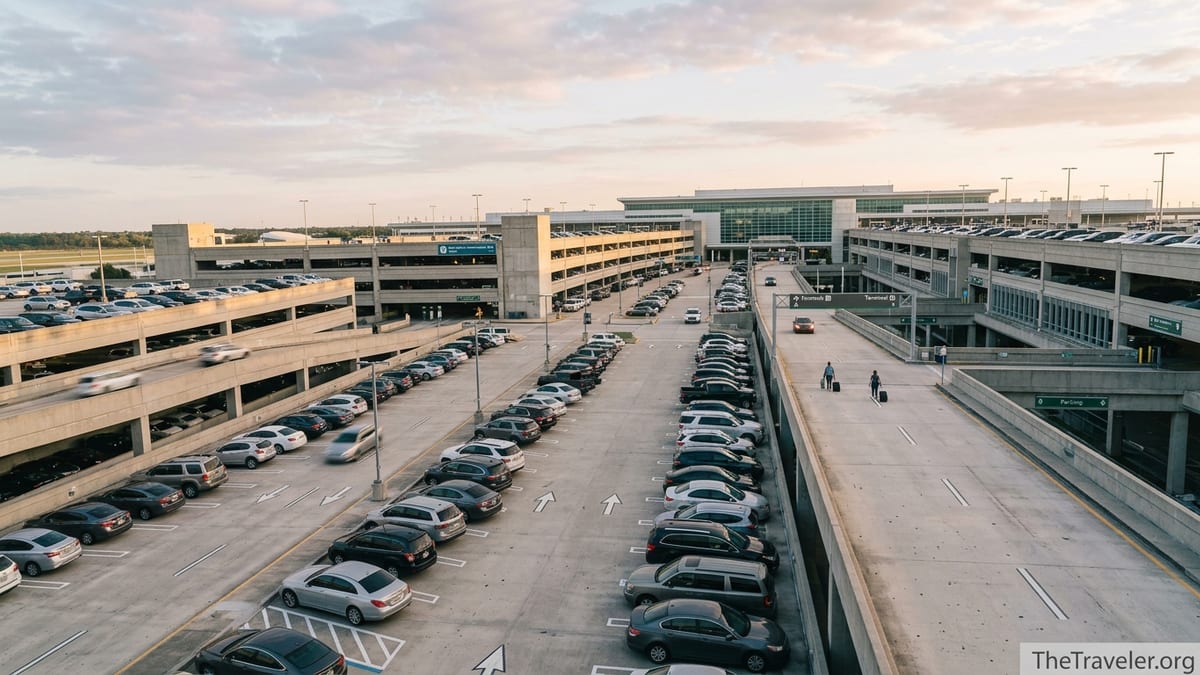
How Orlando International Airport Parking Is Laid Out
Orlando International Airport serves Terminals A, B and C, each with its own parking footprint. Terminals A and B share the original North Terminal complex and sit between two large parking structures known simply as Garage A and Garage B. Terminal C, the newer South Terminal, is connected to Garage C, which also sits next to the Brightline train station and the airport’s intermodal hub. For most travelers, these three garages are the closest and most convenient choices for parking right at the terminal.
Beyond the garages, MCO operates economy parking areas branded as North Park Place and South Park Place. These are surface lots set away from the terminal buildings that rely on 24/7 shuttle buses to move passengers to and from the main terminal curbs. In practical terms, this means you are trading walking distance for lower daily rates. A typical shuttle ride from North or South Park Place to the terminal usually takes around 10 to 15 minutes, depending on traffic and how many stops the bus makes along the way.
The airport also maintains two cell phone waiting lots, one north and one south of the airfield, positioned to serve both the original terminals and the newer Terminal C. These free lots are designed strictly for drivers waiting to pick up arriving passengers and help keep the terminal roadways from becoming clogged with circulating cars. Finally, a cluster of private off-site parking operators line nearby roads such as Semoran Boulevard and Narcoossee Road, offering their own long-term parking products with shuttle transfers back to MCO.
Because parking conditions at a busy hub like Orlando can change throughout the day, it is worth checking the official MCO app or roadside digital signs as you approach the airport. These tools provide live updates on whether Garages A, B, and C or the economy lots are open, near capacity or full, so you can adjust your plan before you find yourself stuck in a queue.
Terminal Garages: Closest Parking to the Gates
For travelers who prize convenience, the terminal garages at MCO are the premium option. Garages A and B flank the North Terminal complex that houses Terminals A and B. They are connected to the main terminal building by enclosed walkways and elevators, so you can park your car, grab your bags and be at airline check-in within a few minutes. Garage C serves the South Terminal and is joined to Terminal C and the intermodal train station by dedicated walkways and people movers, making it the natural choice if you are flying in or out of that newer facility.
On a typical weekday in 2026, daily drive-up rates for the terminal garages at Orlando International Airport sit in the upper end of the airport’s pricing ladder. Recent traveler reports and airport comparisons place Garages A and B around the high teens to low 30s per day, with Garage C often a few dollars less per day than A and B, reflecting its slightly longer walk to some gates and its role in accommodating rail passengers as well as air travelers. These prices can change as the airport adjusts its fees, but you can expect terminal garage parking to be notably more expensive than the economy lots for the convenience of being directly at your terminal.
A practical example illustrates the trade-off. A family leaving Orlando on a four-day long weekend to visit New York might choose Garage B because they are flying Delta from Terminal B and want to keep things simple with two young children and luggage. Even if they pay roughly double the daily rate compared with the economy lots, they may decide the cost is justified because they can park on an upper level near the elevator, roll their bags indoors and be at security in less than 10 minutes without waiting for a shuttle.
Keep in mind that the terminal garages can reach capacity during peak periods such as summer holidays, spring break, major conventions and Thanksgiving week. The airport posts availability on electronic signs along airport roads; if you see a “Full” indicator for Garage A or B, be prepared to divert to Garage C or straight to North or South Park Place. Because turning around at the terminal loops can be confusing when you are under time pressure, it is smart to decide in advance whether you are willing to pay terminal-garage prices or if you will default directly to economy parking.
Economy Parking: North and South Park Place
Economy parking at Orlando International Airport is centered on two off-terminal facilities: North Park Place and South Park Place. These large, open-air lots are intended for longer stays and for travelers who are more price-sensitive than time-sensitive. Shuttles from both lots run continuously to the main terminal area, dropping passengers at or near the arrivals level so they can access check-in counters and security. In most cases, the buses are wheelchair accessible and can accommodate both standard luggage and larger items like strollers.
Daily economy parking rates at MCO are typically significantly lower than at the terminal garages. As of mid-2026, local coverage and traveler forums commonly quote prices in the low to mid-teens per day for the official economy lots, compared with roughly double that amount for terminal garages. For instance, a week-long trip from Orlando to London might cost a traveler somewhere in the ballpark of 80 to 100 dollars for seven nights in North or South Park Place, vs well over 150 dollars if they opted for garage parking near the terminal. While exact figures can shift as the airport updates its fees, the pattern of economy parking being the value option remains consistent.
Shuttle timing is the biggest factor to consider with economy parking. If you arrive at North or South Park Place in the early morning rush around 6 to 8 a.m., you may find buses filling quickly and running every few minutes. On a slow mid-afternoon or late evening arrival, however, you might wait closer to 10 or even 15 minutes for the next coach. Most travelers find that planning to arrive at the lot at least 45 minutes earlier than they would for terminal garage parking gives enough cushion for shuttle waits and the ride to the terminal.
Economy lots also make sense for Orlando-area residents who travel frequently and are comfortable navigating the airport. A business traveler from downtown heading out on a Monday through Friday trip to Chicago, for example, might routinely use South Park Place, budgeting an extra 20 minutes for the shuttle in exchange for savings that add up over multiple trips each year. The trade-off is less attractive if you have heavy bags, a large family group or mobility concerns, in which case paying more for a closer garage may be worth the expense.
Cell Phone Lots, Pickup and Drop-off
Orlando International Airport’s roadways can get crowded, particularly during evening arrival banks when several domestic and international flights land in quick succession. To ease congestion, the airport operates two free cell phone waiting lots, one on the north side of the complex closer to Terminals A and B and another on the south side near Terminal C and the train station. These lots allow drivers to wait in their vehicles until the arriving passenger collects baggage and steps to the curb, at which point a quick text or call prompts the driver to head to the terminal.
The cell phone lots are well marked with roadside signs, and each has basic amenities like lighting, restrooms or portable toilets, and in many cases vending machines. There is no official time limit, but vehicles must be attended at all times, and you are not allowed to leave your car and walk to the terminal. For example, if you are picking up a friend arriving on a late JetBlue international flight into Terminal C at 11 p.m., you might park in the south cell phone lot, track the flight’s progress on your phone, and drive to the curb only after you receive a message that your friend is standing outside the arrivals doors.
For quick drop-offs, each terminal at MCO has a designated departures-level curb where private vehicles can pull up briefly to unload passengers and luggage. There is no fee for using this area, but stopping is intended to be short; security officers and curbside staff often encourage drivers to keep moving if they stay longer than a couple of minutes. If you need more time to assist someone with special needs, it can be more practical to park in a terminal garage, accompany them inside using an airport-provided wheelchair, and then return to your car without the pressure of circling the loop road.
Arrivals pick-up follows a similar pattern. Vehicles can pull up on the arrivals level for an active pickup once the passenger is curbside and ready. However, waiting at the curb for an extended period is discouraged and can result in being asked to move along. This is why coordinating via text from the baggage claim area and using the cell phone lot until your traveler is ready can make the experience less stressful for both parties.
Reserved Parking, E-PASS and Off-site Alternatives
To help manage demand and give planners some certainty, Orlando International Airport offers an official reserved parking program focused on Garage C. Travelers can pre-book a space online or through the airport’s mobile app by entering their license plate details, choosing dates and times, and prepaying for their stay. On arrival, they use a QR code or their plate number at the dedicated entrance lane for Garage C and proceed directly to the reserved level, typically Level 4. For someone flying out on a busy holiday weekend, this can be an attractive way to guarantee a spot without circling full garages.
MCO also supports electronic tolling accounts such as E-PASS for payment in its on-airport garages and economy lots. This allows drivers who already have a transponder for Central Florida toll roads to enter and exit parking facilities without pulling a paper ticket or inserting a credit card. The parking system reads the transponder or license plate and charges the toll account for the corresponding daily rate. For example, a commuter who regularly flies out Monday morning and returns Thursday night could park in Garage A, breeze through the entry gate using E-PASS, and see the parking charge appear automatically alongside their toll transactions.
Off-site parking operators around the airport provide another layer of choice, often at lower daily prices than the official airport lots. Facilities along Semoran Boulevard and Narcoossee Road, as well as branded companies like Drive & Park or WallyPark, typically advertise uncovered self-parking from the high single digits to the low teens per day, sometimes including free valet-style service where staff park your car for you and retrieve it upon return. These lots run their own shuttles to MCO, generally on 10 to 20 minute intervals, and many allow online reservations to lock in a rate ahead of time.
However, off-site parking does require extra due diligence. Recent traveler accounts in local forums show that quality and security standards can vary markedly between operators. Before booking, it is wise to read current reviews, confirm shuttle frequency, and understand whether the service is true valet or simply key drop-off with your car parked in an unsecured area. For example, one traveler might happily use a well-reviewed off-site lot with fenced parking, cameras and a predictable shuttle schedule to save 50 dollars on a week-long trip, while another may decide that on-airport economy parking is worth the additional cost for the added predictability and direct airport oversight.
Realistic Costs and Money-Saving Strategies
While exact numbers can fluctuate as the Greater Orlando Aviation Authority updates its parking tariffs, some practical ranges can help set expectations. In mid-2026, travelers commonly encounter daily on-airport prices in roughly this pattern: economy lots such as North and South Park Place in the low to mid-teens per day; Garage C in the mid- to high-teens per day; and Garages A and B at or above that level, often edging into the high teens or low thirties depending on stay length and any promotional or peak pricing. Valet-style options or hotel-park-and-fly packages can push the daily effective rate even higher once service fees are factored in.
Knowing these tiers, you can tailor your strategy. For instance, if you are taking a two-night weekend trip and value speed over savings, paying for Garage A or B might add only a modest amount to your total travel cost, while significantly reducing the stress of early-morning departure logistics. On the other hand, if you are heading out on a 10-day vacation, the difference between terminal garage and economy lot pricing can easily add up to the cost of a theme park ticket or an extra hotel night, making economy or a reputable off-site provider more appealing.
Another cost-saving technique is pairing an airport hotel stay with long-term parking. Some hotels around MCO offer “park, sleep and fly” packages where you pay a slightly higher room rate for one night but can leave your car in the hotel lot for 7 to 14 days while using their shuttle to reach the terminal. This can be especially attractive if you have an early morning flight. A family driving from Tampa, for example, might stay near MCO the night before their 7 a.m. departure, enjoy free or discounted long-term parking at the hotel, and eliminate a pre-dawn drive on Interstate 4.
Small habits also reduce costs. Carpooling with family members or colleagues can cut the per-person cost of parking dramatically compared with taking separate vehicles. Being disciplined about your entry and exit times helps avoid rolling into an additional day’s charge by just a few minutes. For travelers who fly frequently, keeping a simple log of where you parked and how much you paid at different facilities can quickly reveal a pattern that guides your future choices, such as consistently favoring South Park Place for trips longer than three days.
The Takeaway
Parking at Orlando International Airport does not have to be stressful or confusing, but it does reward a bit of advance planning. Understanding the basic layout of Garages A, B and C, the role of North and South Park Place as lower-cost economy options, and how the cell phone lots and pickup areas work will help you avoid last-minute surprises at the curb. Whether you choose a premium terminal garage, a budget-friendly economy lot, or a reputable off-site operator, aligning your parking choice with your priorities for time, convenience and budget is key.
Before your next trip, sketch out a simple parking plan that includes a first choice and a backup. Make a note of which terminal your airline uses, check the current parking rates and availability via the airport’s official channels, and consider whether a reservation in Garage C or a hotel park-and-fly package might fit your needs. By treating parking as part of your overall travel strategy rather than an afterthought, you can turn what is often a source of stress into a predictable and manageable start to your journey from Orlando.
FAQ
Q1. What is the cheapest on-site parking option at Orlando International Airport?
The cheapest on-site options are usually the official economy lots at North and South Park Place, which typically charge noticeably less per day than the terminal garages.
Q2. How early should I arrive if I plan to park in an economy lot at MCO?
Plan to arrive at least 30 to 45 minutes earlier than you would if parking in a terminal garage to allow time for shuttle waits and the ride to the terminal.
Q3. Can I reserve a parking space in advance at Orlando International Airport?
Yes. MCO offers advance reservations primarily for Garage C through its official online system and mobile app, allowing you to prepay and secure a space on a designated level.
Q4. Are the cell phone lots at MCO free to use?
Yes. Both the north and south cell phone lots are free, but you must remain with your vehicle and only proceed to the terminal once your passenger is ready for pickup.
Q5. Is there a difference between Garages A, B and C at Orlando International Airport?
Garages A and B serve Terminals A and B at the North Terminal complex, while Garage C is linked to Terminal C and the train station. Rates and walking distances can differ slightly between them.
Q6. Does Orlando International Airport accept E-PASS or similar toll transponders for parking payment?
Yes. MCO accepts certain electronic toll transponders, including E-PASS, at its on-airport garages and economy lots, allowing for ticketless entry and automatic payment.
Q7. How do off-site parking lots near MCO compare to airport-operated lots?
Off-site lots often charge lower daily rates and include shuttle service, but service quality and security vary, so it is important to read recent reviews and confirm shuttle frequency before booking.
Q8. Is overnight parking allowed in the cell phone lots at Orlando International Airport?
No. Cell phone lots are intended only for short-term waiting while picking up arriving passengers, and vehicles cannot be left unattended or parked overnight.
Q9. What should I do if the terminal garages are full when I arrive?
If Garages A or B are full, follow airport signs to Garage C or to North or South Park Place. Availability is posted on digital signs and within the airport’s mobile app.
Q10. Are there special parking options for travelers with reduced mobility at MCO?
Yes. Accessible parking spaces are available in all official garages and economy lots, and airport shuttles are designed to accommodate passengers who use wheelchairs or have mobility challenges.